Excision theorem
Anchor (Master): Hatcher §2.1 (full barycentric subdivision proof); Eilenberg-Steenrod 1952 *Foundations of Algebraic Topology* §I (axiomatic perspective); May *A Concise Course in Algebraic Topology* Ch. 13
Intuition [Beginner]
Excision is the rule that says small things you remove from the inside of a region do not change the relative homology of that region. Imagine you have a big space and inside it a smaller subspace . The relative homology measures shapes in that have their boundary contained in . Now suppose you take a piece that sits well inside , with a thick collar of around it on every side. Excision says that cutting out of both and leaves the relative homology unchanged.
Why should this be believable? The relative homology only sees pieces of that hang off the part not in . A piece buried strictly inside contributes nothing to that count. Cutting away from just makes the inside of a little smaller, but the boundary between and the rest of stays put. Anything you could detect by looking outside before, you can still detect after.
The reason this matters: excision is the tool that lets you compute the homology of a complicated space by chopping it into simpler pieces. Glue two spaces along a common piece, excise the overlap, and the two halves become independent at the level of homology. Mayer-Vietoris, the long exact sequence for an open cover, and every standard computation of the homology of a sphere or a projective space depend on excision.
Visual [Beginner]
A schematic showing a region , a sub-region shaded inside it, a smaller piece buried strictly inside with a collar of pure around it, and an arrow indicating that the inclusion of into induces an isomorphism on relative homology.
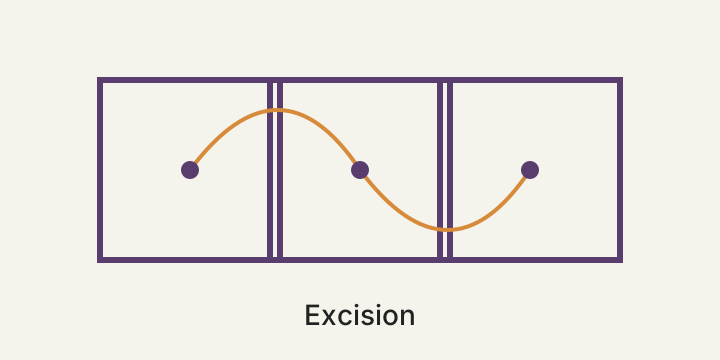
The picture captures the essential geometry: sits in the interior of , with room on every side; the boundary of inside is the only thing that matters for relative homology, and removing leaves that boundary alone.
Worked example [Beginner]
Compute the relative homology of the disk modulo its boundary circle, then use excision to relate it to the homology of the sphere.
Step 1. Take , the closed disk in the plane, and , its boundary circle. The relative homology measures chains in the disk whose boundary lies on the circle, modulo chains that already live on the circle.
Step 2. Apply excision. Let be a small open disk centred at the origin, well inside the interior of the larger disk. The closure of sits in the interior of , so we may excise from both and from any neighbourhood of that contains the closure of as a piece in its interior.
Step 3. After excision, the pair becomes — an annulus together with its outer boundary circle. The annulus deformation retracts onto its outer boundary , so the pair is homotopy-equivalent to , which has zero relative homology in every dimension.
Step 4. To get a non-zero answer, instead apply excision to identify with for a point . Crush the boundary of the disk to a point: the quotient is the sphere . The collapse map sends to , and excision combined with homotopy invariance gives an isomorphism on relative homology.
Step 5. Using the long exact sequence of the pair together with in dimension zero and elsewhere, the relative homology equals for and zero otherwise.
What this tells us: excision converts a hard relative-homology question on a complicated pair into a simpler one. The disk-modulo-boundary problem became the sphere-relative-to-a-point problem, and the latter was already understood.
Check your understanding [Beginner]
Formal definition [Intermediate+]
Let be a topological space and let be subspaces. The inclusion of pairs is the map of topological pairs given by the set-theoretic inclusion in each coordinate. It induces a chain map on relative singular chain complexes $$ j_\sharp : C_\bullet(X \setminus Z) / C_\bullet(A \setminus Z) \to C_\bullet(X) / C_\bullet(A), $$ and hence a homomorphism on relative homology $$ j_* : H_n(X \setminus Z, A \setminus Z) \to H_n(X, A) $$ for every .
The excision condition is the requirement $$ \overline{Z} \subseteq \mathrm{int}(A), $$ where is the closure of in and is the topological interior. Geometrically, must sit deep inside with a buffer of -interior around it.
An equivalent formulation uses an open cover of . Suppose for subspaces . The inclusion corresponds, under the substitution , to the original excision setup: and , and the closure-interior condition becomes the open-cover condition.
The subdivision operator is defined inductively on singular simplices by barycentric subdivision of the standard simplex. For , define as the signed sum of the simplices obtained by composing with the affine maps from onto the -simplices of the barycentric subdivision of . The operator is a chain map: .
For an open cover of , the subordinate subcomplex is generated by singular simplices whose image lies entirely inside some .
Counterexamples to common slips
- The closure-interior condition is genuinely needed: if touches the boundary of — say , with closed but not open — the conclusion can fail. A standard example is , , : excising all of leaves and the empty set, and the induced map on relative homology is no longer an isomorphism.
- Excision does not hold for arbitrary functors . A homotopy-invariant functor can fail to satisfy excision; the higher homotopy groups are the canonical example. This is what distinguishes a generalised homology theory from an arbitrary functor.
- The open-cover and closure-interior formulations are equivalent but not identical: one is most useful for Mayer-Vietoris, the other for relating CW pairs to their attached cells. The same theorem powers both.
Key theorem with proof [Intermediate+]
Theorem (Excision; Hatcher Theorem 2.20). Let be a topological space and let satisfy . Then the inclusion induces an isomorphism $$ j_* : H_n(X \setminus Z, A \setminus Z) \xrightarrow{\cong} H_n(X, A) $$ for every .
Proof. Set . The hypothesis rephrases as , and combined with this gives . The pair is an open cover of .
The proof has two parts. First, prove that the subordinate subcomplex inclusion is a chain-homotopy equivalence, hence induces an isomorphism on homology. Second, deduce excision from this comparison by an algebraic argument.
Part 1: small simplices. Define the subdivision operator by barycentric subdivision of each singular simplex. There is a chain homotopy satisfying $$ \partial T + T \partial = \mathrm{id} - \mathcal{S}. $$ The construction of is standard: for the identity simplex , define as the cone on from the barycentre of , then extend naturally to all singular simplices by composition. The chain-homotopy identity is verified by direct computation on the cone.
Iterate. The operator is also chain-homotopic to the identity: from , define $$ D_k = \sum_{i=0}^{k-1} T \circ \mathcal{S}^i, $$ which gives .
Now the Lebesgue-number argument. Fix a singular simplex . The pullback cover is an open cover of the compact metric space . By the Lebesgue number lemma there is such that every subset of of diameter lies in some element of the pullback cover. Iterated barycentric subdivision shrinks the diameter of geometrically: after subdivisions the maximal diameter is at most . Choose large enough that this is below . Then every simplex of has image in or in ; that is, .
For a finite chain , take to push the entire chain into . The chain-homotopy identity then gives, for , $$ c - \mathcal{S}^k c = \partial D_k(c) + D_k(\partial c), $$ exhibiting as homologous to its -th subdivision, which lies in . The inclusion is therefore a chain-homotopy equivalence; both complexes have the same homology, namely .
Part 2: from small simplices to excision. The relative chain complex is computed by the same comparison restricted to chains modulo . The subordinate subcomplex modulo , , is generated by singular simplices in or in modulo those in . Simplices in vanish in the quotient by . The generators that survive are exactly those whose image lies in — equivalently, in . The quotient is therefore identified with .
Combining the chain-homotopy equivalence of Part 1 with this identification, the inclusion of pairs induces an isomorphism on relative homology. Translating back via , , this is exactly the assertion of the theorem.
Bridge. The excision theorem builds toward the entire computational machinery of singular homology. The foundational reason it holds is exactly the Lebesgue-number argument applied to barycentric subdivision: every chain in can be replaced, up to chain-homotopy, by a chain whose simplices fit inside an arbitrary open cover. This is exactly the same small-chains principle that appears again in 03.12.13 (cellular homology), where the inclusions are analysed via excision applied to the characteristic maps of cells, and it generalises directly to any localising chain-level functor. The central insight is that excision is not a property of the space but of the homology functor itself: putting these together, excision, homotopy invariance, and the long exact sequence of a pair are the three properties that turn singular chains into a useful invariant. The bridge is the recognition that excision identifies with the homology of the part of not buried inside — a localisation principle that appears again in 03.12.05 (Eilenberg-MacLane spaces) when proving representability of cohomology, and the bridge is that representability needs a genuinely homological functor, which means excision.
Exercises [Intermediate+]
Lean formalization [Intermediate+]
Mathlib has Algebra.Homology.HomologicalComplex for chain-complex homology and AlgebraicTopology.SingularSet for the simplicial-set side, but no named excision theorem. The intended formalisation would read schematically:
The proof gap is substantive. Mathlib needs the subdivision operator as a chain map, the chain-homotopy with the identity, the Lebesgue-number argument relating iterated subdivision to a given open cover, and the comparison theorem identifying the subordinate subcomplex's homology with the full singular homology. Each piece is formalisable from existing infrastructure but has not been packaged. The relative-homology version requires the long exact sequence of a pair as a separate prerequisite.
Advanced results [Master]
Theorem (open-cover form). Let be a topological space and let satisfy . Then the inclusion induces an isomorphism $$ H_n(B, A \cap B) \xrightarrow{\cong} H_n(X, A) $$ for every .
This is the formulation most directly powering the Mayer-Vietoris derivation. Setting , the closure-interior condition is equivalent to the open-cover condition, and the two statements of excision become substitutions of one another.
Theorem (Mayer-Vietoris from excision). Let with open. There is a long exact sequence $$ \cdots \to H_n(U \cap V) \to H_n(U) \oplus H_n(V) \to H_n(X) \to H_{n-1}(U \cap V) \to \cdots $$ natural in , and the connecting morphism is the composite of the long-exact-sequence connecting map of the pair with the inverse of the excision isomorphism .
The derivation: excision identifies . The long exact sequences of the pairs and share this common middle term, and splicing them yields Mayer-Vietoris.
Theorem (relative spheres). For there is an isomorphism $$ H_n(D^k, S^{k-1}) \cong \tilde H_{n-1}(S^{k-1}) $$ for every . In particular, for and zero otherwise.
The proof uses excision twice: once to identify with via the cone decomposition , then the long exact sequence of the pair to peel off the basepoint.
Theorem (cellular boundary formula; Hatcher §2.2). Let be a CW complex with cellular chain complex given by . The cellular boundary on a generator is $$ d_n^{\mathrm{cell}}(e^n_\alpha) = \sum_\beta \deg(\varphi_{\alpha\beta}) , e^{n-1}\beta, $$ *where $\varphi{\alpha\beta}: S^{n-1} \to S^{n-1}\betae^n\alphaX^{(n-1)} \to X^{(n-1)}/X^{(n-2)} \to S^{n-1}_\beta(n-1)\beta$-th.*
This formula is the engine of every CW homology computation. Its derivation uses excision to decompose as a direct sum of one per -cell, and then to track the connecting map cell-by-cell into the corresponding decomposition for .
Theorem (Eilenberg-Steenrod axiomatic excision). Excision is one of the seven Eilenberg-Steenrod axioms characterising ordinary homology theories on the category of CW pairs. The axioms are: homotopy invariance, exactness of the long sequence of a pair, excision, additivity (for disjoint unions), the dimension axiom for , and naturality. Any functor satisfying all of these on CW pairs is naturally isomorphic to singular homology with coefficients .
Excision is the axiom that distinguishes homology theories from arbitrary homotopy-invariant functors . Dropping the dimension axiom but keeping excision gives the framework of generalised homology theories — -theory, bordism, stable homotopy. Dropping excision but keeping the others gives a much wider class of functors of which homology theories are a tiny subspecies.
Synthesis. Excision is the foundational reason singular homology behaves locally: a chain in can always be replaced, up to chain-homotopy, by a chain whose simplices fit inside any prescribed open cover, and this small-chains principle is what makes relative homology compute by ignoring whatever sits buried strictly inside the subspace. The central insight is that excision is dual to the long exact sequence of a pair in a precise sense: the long exact sequence relates absolute homology of and to relative homology of the pair, and excision identifies the relative homology with absolute homology of the complementary half of an open cover. Putting these together, the long exact sequence and excision together produce Mayer-Vietoris, which is the technical workhorse of every standard homology computation.
This is exactly the same localisation principle that appears again in 03.12.05 (Eilenberg-MacLane spaces) when proving representability — a homotopy-invariant functor satisfying excision and the wedge axiom is automatically representable as — and the bridge is that representability cannot work for precisely because fails excision, with the Blakers-Massey theorem identifying the range in which excision does hold for homotopy groups. The bridge is therefore the recognition that excision is what separates homological functors from homotopical ones: homology generalises to spectra and to generalised homology theories like -theory via the Eilenberg-Steenrod axiomatisation, in which excision is one of the seven axioms any such theory must satisfy. The barycentric-subdivision argument identifies the subordinate subcomplex with the full singular complex at the level of homology, and this identifies the local-to-global behaviour of chains with the open-cover behaviour of the space.
Full proof set [Master]
Theorem (open-cover form), proof. Set . Then and , and the closure-interior condition becomes , which together with the tautological inclusion produces . The relative-homology isomorphism asserted by Hatcher Theorem 2.20 is then the open-cover isomorphism. Conversely, given , defining recovers the closure-interior hypothesis. The two formulations are substitutions of one another.
Theorem (Mayer-Vietoris from excision), proof. Let with open, so tautologically. Apply the open-cover form of excision with and : the inclusion induces an isomorphism . The long exact sequence of the pair reads $$ \cdots \to H_n(U) \to H_n(X) \to H_n(X, U) \to H_{n-1}(U) \to \cdots $$ Substituting via excision and using the long exact sequence of the pair to express in terms of and , and then splicing the two sequences via the common term, yields the Mayer-Vietoris sequence $$ \cdots \to H_n(U \cap V) \xrightarrow{(i_*, j_*)} H_n(U) \oplus H_n(V) \xrightarrow{k_* - l_*} H_n(X) \xrightarrow{\partial} H_{n-1}(U \cap V) \to \cdots, $$ where are the four inclusion maps of the Mayer-Vietoris square. The connecting morphism is the composite of the long-exact-sequence connecting map for with the inverse of the excision isomorphism. Naturality of all constructions in the triple propagates to naturality of the Mayer-Vietoris sequence.
Theorem (relative spheres), proof. The pair has long exact sequence $$ \cdots \to H_n(S^{k-1}) \to H_n(D^k) \to H_n(D^k, S^{k-1}) \to H_{n-1}(S^{k-1}) \to \cdots $$ is contractible, so for and zero for . For the map is sandwiched between zero groups and is an isomorphism. For , the augmentation reduces the absolute groups to reduced ones, giving . Combining, for all . Substituting the standard sphere homology gives the explicit answer.
Theorem (cellular boundary formula), proof sketch. Let be a CW complex. The -skeleton inclusion has the cofibre (one -sphere per -cell). By excision applied to the open cover with a neighbourhood of deformation-retracting onto it and the union of the open -cells, $$ H_n(X^{(n)}, X^{(n-1)}) \cong H_n(V, V \cap U) \cong H_n\Big(\bigsqcup_\alpha D^n_\alpha, \bigsqcup_\alpha S^{n-1}\alpha\Big) \cong \bigoplus\alpha \mathbb{Z}. $$ The cellular boundary , where the projection identifies , sends the generator of the -th -summand to the image in of the homology class of the attaching sphere . Decomposing by the same excision argument applied to , the -th component of this image is computed by collapsing all -cells except the -th: the resulting map has degree , and the cellular boundary formula follows. The full argument is in Hatcher §2.2; the only non-formal step is the excision identification, which is the input from this unit.
Theorem (Eilenberg-Steenrod axiomatic excision), stated without proof — see Eilenberg-Steenrod 1952 §I [pending]. The uniqueness theorem stating that any functor on the category of CW pairs satisfying the seven axioms (homotopy, exactness, excision, additivity, dimension, naturality, plus the axiom on the long exact sequence's connecting morphism) is naturally isomorphic to singular homology with coefficients given by the value on a point. The argument uses cellular approximation to reduce to CW pairs, then induction on dimension using excision plus the dimension axiom to identify the value on each cell.
Connections [Master]
Singular homology
03.12.11. The singular chain complex is the input to which excision applies; excision is what makes singular homology a homology theory rather than a generic functor. The barycentric-subdivision argument used to prove excision works at the chain level on , and the relative version is computed from the relative chain complex that excision shows is chain-homotopy-equivalent to .Cellular homology
03.12.13. Excision is the technical input that powers the cellular chain complex: it identifies and yields the explicit cellular boundary formula . Without excision, the cellular chain complex would be a definition; with excision, it is a theorem agreeing with singular homology.Eilenberg-MacLane spaces
03.12.05. The representability theorem rests on the Eilenberg-Steenrod axioms, of which excision is the load-bearing one. A homotopy-invariant functor satisfying excision and the wedge axiom is automatically representable on CW complexes; this is exactly the gateway from chain-complex homology to the spectrum-level point of view.Mayer-Vietoris / open covers [03.12.11 §M]. The Mayer-Vietoris sequence for is derived directly from excision applied to the pair with . Every standard homology computation that uses Mayer-Vietoris is implicitly using excision; the spheres , the projective spaces and , lens spaces, and surfaces of genus are all computed this way.
CW complex
03.12.10. The CW pair is the canonical setting in which excision is applied, and the homotopy-extension property of CW pairs is what guarantees the closure-interior condition holds for the open neighbourhoods used in the cellular argument. The CW framework and excision together are what make algebraic topology computable.
Historical & philosophical context [Master]
Excision in singular homology was elevated to an axiomatic principle by Samuel Eilenberg and Norman Steenrod in their 1952 monograph Foundations of Algebraic Topology (Princeton) [pending]. The book consolidated decades of homology constructions — Vietoris cycles (1927), Lefschetz combinatorial chains (1930, 1942), Eilenberg singular chains (1944) — into a single axiomatic framework with seven properties characterising ordinary homology theory uniquely on CW pairs. Excision, in their formulation as Axiom 6, was identified as the property distinguishing homological functors from arbitrary homotopy-invariant ones.
The technical content of excision had appeared earlier in ad-hoc form. Eilenberg's 1944 paper Singular homology theory (Ann. Math. 45, 407-447) [pending] used a barycentric-subdivision argument implicitly to prove the agreement of singular homology with the simplicial homology of a triangulable space, and this argument is the same one that, abstracted, gives the small-chains theorem and excision. Earlier still, Lefschetz's Topology (1930) and Algebraic Topology (1942) used local-cycle arguments equivalent to excision in the simplicial setting, but framed them as combinatorial subdivision lemmas rather than as a general property of the homology functor. Eilenberg's contribution was to recognise that the same argument applies to singular chains on an arbitrary topological space, with no triangulability required.
The abstract perspective opened by Eilenberg-Steenrod proved consequential. The seven axioms minus the dimension axiom characterise generalised homology theories: -theory (Atiyah-Hirzebruch 1959), bordism homology (Thom 1954, Atiyah 1961), and stable homotopy (Adams 1960s) are all examples in which excision still holds but the dimension axiom fails. The Eilenberg-Steenrod framework, originally a uniqueness theorem for ordinary homology, became the entry point to the theory of spectra in the hands of Adams, Boardman, and Vogt in the 1960s and 1970s. Excision survives in this generalisation as the property that any spectrum-valued homology theory must satisfy, and barycentric subdivision survives in the form of the small-objects argument and the localisation theorems of the Bousfield-Kan tower.