Poincaré recurrence theorem
Anchor (Master): Poincaré 1890 (originator); Carathéodory 1919 (abstract measure-theoretic version); Walters Ch. 1; Halmos *Lectures on Ergodic Theory* Ch. 2
Intuition [Beginner]
Imagine all the air molecules in a sealed room squeezed into a single corner. Release them. They spread out and fill the room — that is what gases do. Poincaré's recurrence theorem says something startling: if you wait long enough, the molecules will arrange themselves back in the corner, and they will do so infinitely often. Not approximately. Arbitrarily close to the original configuration.
The hypothesis is mild. The system has to evolve in a bounded region of phase space, and the dynamics has to preserve volume. Hamiltonian mechanics on a compact phase space satisfies both: energy conservation bounds the trajectory, and Liouville's theorem guarantees the volume is preserved by the flow. Under these conditions, almost every starting state returns arbitrarily close to itself, infinitely often.
The "paradox" with the Second Law of Thermodynamics is a question about timescales. The recurrence theorem says recurrence happens. It does not say it happens soon. For a gas of molecules in a litre-sized room, the recurrence time exceeds the age of the universe by an absurd margin. So the Second Law and Poincaré recurrence coexist: the universe ends long before any macroscopic gas recurs.
Visual [Beginner]
A bounded region of phase space is drawn as a finite-area patch. A trajectory enters a small neighbourhood of its starting point, leaves, and returns — repeatedly, at irregular intervals. The picture is a finite-area pigeon-hole: the trajectory has nowhere unbounded to go, so it must come back.
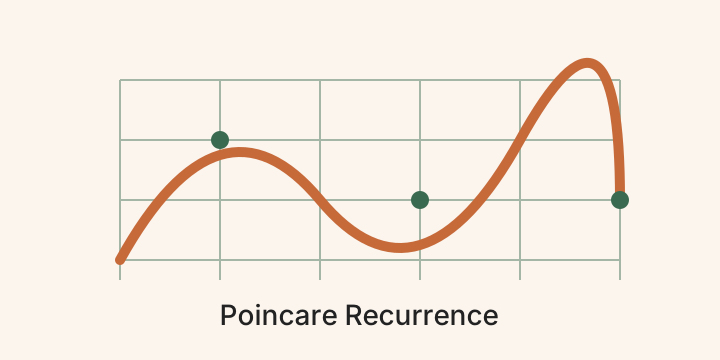
The key visual is the return: once the system is trapped in a finite region and conserves a measure, geometry forces almost every orbit back to its starting neighbourhood.
Worked example [Beginner]
Take a two-dimensional torus (a square with opposite edges identified). Consider the rotation map that shifts every point by with and . After 6 iterations the shift accumulates to on the torus, so every point returns exactly to itself. Recurrence is dramatic and easy to see: the period is 6.
Now perturb to and . The orbit no longer closes (irrational shifts never close), but Poincaré recurrence still applies because the torus has finite area and the rotation preserves it. Pick a small disk of radius 0.01 around your starting point. The orbit re-enters that disk infinitely often, at unpredictable times. You can compute by hand: the first few re-entries happen at iteration counts roughly , but the gap pattern never repeats.
The takeaway: in both cases the orbit comes back. The first case has a finite period; the second has irregular but guaranteed recurrence. The hypothesis the theorem needs is finite measure plus measure preservation, not periodicity.
Check your understanding [Beginner]
Formal definition [Intermediate+]
Let be a finite measure space (so ). A measure-preserving transformation is a measurable map such that for every . The map need not be invertible. When invertible with measurable inverse, both and preserve .
A point is recurrent (with respect to ) if the orbit enters — equivalently, if there exists with . The point is infinitely recurrent if for infinitely many .
For a continuous-time Hamiltonian flow on a symplectic manifold with , the Liouville measure is preserved by for every . When is compact, . The recurrence statement specialises: a point is recurrent if for every neighbourhood of and every there exists with .
Counter-example to drop any hypothesis. Translation by 1 on preserves Lebesgue measure but the measure is infinite — no point recurs. Multiplication by 2 on the circle preserves the Lebesgue probability measure (after the right normalisation) but is not invertible — almost every point still recurs, showing invertibility is not required.
Key theorem with proof [Intermediate+]
Theorem (Poincaré recurrence). Let be a finite measure space and a measure-preserving transformation. For every measurable set with , the set of points of that fail to return to infinitely often has -measure zero.
Proof. Define $$ E = {x \in A : T^n x \notin A \text{ for all } n \geq 1}, $$ the set of points in that never return. The claim splits in two: (i) , then (ii) almost every recurrent point recurs infinitely often.
Step (i): . If , then all lie outside , hence in particular outside . Equivalently, for any . So for every .
The same argument applied to in place of shows for every and . The sets are therefore pairwise disjoint.
By measure-preservation, for every . So $$ \sum_{n=0}^{\infty} \mu(E) = \sum_{n=0}^{\infty} \mu(T^{-n} E) = \mu!\left(\bigsqcup_{n=0}^\infty T^{-n} E\right) \leq \mu(X) < \infty. $$ A constant infinite sum is finite only if the constant is zero, so .
Step (ii): almost every recurrent point recurs infinitely often. Apply step (i) to the iterate for each fixed : the set of points in with for all has measure zero. The set of points that return only finitely often is contained in , and each set in the union is contained in some , which has measure zero. A countable union of null sets is null, so the set of points returning only finitely often is null.
Bridge. This recurrence calculation builds toward 05.09.01 (KAM theorem), where the same finite-measure pigeonhole appears again in a perturbative setting: the invariant tori produced by KAM have positive Liouville measure, so almost every initial condition on a torus recurs to its starting neighbourhood under the perturbed flow. The setup is exactly the smooth-structure consequence of 05.02.07 (Liouville volume preservation): Liouville produces the invariant measure, recurrence consumes it. Putting these together, the foundational reason every bounded Hamiltonian system exhibits return behaviour is exactly that the Liouville measure on the energy surface is finite and preserved — the cohomology hypothesis behind 05.02.07 is dual to the dynamical conclusion here.
Exercises [Intermediate+]
Advanced results [Master]
The recurrence theorem is the foundational example of measure-preserving dynamics. The bare statement — almost every point returns infinitely often — extends in many directions, each consuming the same finite-measure-plus-pigeonhole structure with sharper inputs.
Kac's lemma and recurrence-time statistics. Kac (1947) refined recurrence by computing the expected first-return time. For an ergodic measure-preserving on a probability space and a measurable with , the mean first-return time on is . The proof partitions into towers over indexed by first-return time and uses measure-preservation to identify the tower volumes. For a finite (non-probability) measure space the formula reads . Higher moments require stronger hypotheses: variance is finite under exponential-mixing assumptions, infinite for heavy-tailed return-time distributions (Exercise 5). Quantitative recurrence — how fast the orbit enters small neighbourhoods of itself — is the subject of dimensional and Diophantine refinements (Boshernitzan, Barreira-Saussol).
Hierarchy of ergodic-theoretic strengthenings.
- Recurrence (Poincaré): almost every point returns to its starting neighbourhood infinitely often.
- Ergodicity: every measurable invariant set has measure zero or full measure. Equivalent to: almost every orbit visits every positive-measure set with positive frequency. Birkhoff's ergodic theorem upgrades the recurrence almost-surely-positive-lim-sup to an almost-sure limit.
- Mixing: as for all measurable . The orbit forgets initial conditions.
- K-system: the tail -algebra is -essentially the two-element -algebra (mod null sets). The strongest of the standard hierarchy below Bernoulli.
- Bernoulli: measure-theoretically isomorphic to a shift on a product space. The classification up to measure-isomorphism is by Kolmogorov-Sinai entropy (Ornstein 1970).
Each strengthening uses the recurrence theorem as input and adds analytic content. Recurrence alone is the floor.
Failure modes — when recurrence does not hold.
- Non-compact phase space. A free particle in has Hamiltonian ; the energy-surface measure is infinite, and orbits escape to infinity without recurring. The hypothesis the recurrence theorem requires is finite measure, not just measure preservation.
- Hamiltonian systems with unbounded energy surfaces. The Kepler problem in has bounded orbits below threshold energy and unbounded orbits above; the unbounded ones do not recur. The recurrence statement applies only to the bounded-orbit subsystem.
- Infinite-dimensional quantum systems. A state in an infinite-dimensional Hilbert space whose spectral measure has continuous part can decay irreversibly; recurrence in the strict sense fails. The mathematical content here is that absolutely continuous spectrum supports scattering, not recurrence (the RAGE theorem makes this precise).
Quantum analogue. For a self-adjoint Hamiltonian on a finite-dimensional Hilbert space , the state is a Bohr-almost-periodic function on . Almost-periodicity gives quantum recurrence: for every , there exist arbitrarily large with . The recurrence time grows exponentially in the number of frequencies, hence super-exponentially in the size of the system. In infinite dimension, almost-periodicity may fail and the state can scatter; the failure of recurrence is the analytic signature of irreversibility from infinitely many degrees of freedom.
Connection to the Second Law of Thermodynamics. The Boltzmann H-theorem asserts monotone decrease of an entropy functional under the kinetic-theory dynamics. Poincaré recurrence appears to contradict this: a recurrent system returns to its initial low-entropy state infinitely often. Boltzmann's reply (1896, Wiedemann's Annalen) made the timescale precise: the recurrence time for particles in a litre at standard temperature scales as to a positive power. For , the recurrence time is incomprehensibly large compared to the age of the universe. The two statements are compatible because they describe disjoint timescales: the H-theorem governs the observable approach to equilibrium, and Poincaré recurrence governs a timescale that no physical process realises.
Synthesis. The recurrence theorem is the simplest non-vacuous statement in measure-theoretic dynamics, and it is the bridge between volume-preserving geometry and ergodic theory: Liouville's theorem provides the invariant measure, compactness provides finiteness, and pigeonhole provides recurrence. Read the other direction, the recurrence statement is the test case for every refinement: ergodicity strengthens the lim-sup to a lim, mixing rewrites the lim as a product, K-systems and Bernoulli extend to entropy-graded equivalence classes. Putting these together, one sees that the moduli of measure-preserving transformations on a fixed probability space up to measure-isomorphism is graded by ergodic-theoretic invariants of which recurrence is the floor. The central insight is that the bridge between the geometric hypothesis (finite invariant volume) and the dynamical conclusion (almost-sure return) is exactly the pigeonhole identity — the foundational reason every bounded volume-preserving system exhibits return behaviour and the template every stronger ergodic-theoretic statement specialises.
Full proof set [Master]
Lemma (pigeonhole for measure-preserving transformations). Let be a finite measure space and measure-preserving. If are pairwise disjoint measurable sets with for all , then .
Proof. The disjoint union has measure . Disjointness within the finite measure space forces this sum to be at most . A constant infinite sum is finite only if the constant is zero.
Theorem (Poincaré recurrence, full statement). Let be a finite measure space and measure-preserving. For every measurable with , the set $$ F = {x \in A : #{n \geq 1 : T^n x \in A} < \infty} $$ is -null.
Proof. Let as in the §I proof. Step (i) showed . For the full statement, observe $$ F = \bigcup_{N \geq 1} {x \in A : T^n x \notin A \text{ for all } n \geq N}. $$ The set is contained in , where . The set has measure zero by the same pigeonhole argument applied to the iterates , which are pairwise disjoint. By measure preservation, . So is a countable union of null sets, hence null.
Theorem (Kac, ergodic case). Let be an ergodic measure-preserving transformation of a probability space and let be measurable with . Define the first-return time by (defined -a.e. on by recurrence). Then , equivalently .
Proof. Set . The Rokhlin tower is a measurable partition of up to a null set: ergodicity ensures the orbit of has full measure, and the tower structure follows from the definition of first-return time. By measure preservation, . Hence $$ 1 = \mu(X) = \sum_k \sum_{j=0}^{k-1} \mu(T^j A_k) = \sum_k k \mu(A_k) = \int_A n_A , d\mu. $$ Dividing by gives .
Corollary (Hamiltonian recurrence). Let be a compact symplectic manifold and a smooth Hamiltonian with flow . For almost every (with respect to Liouville measure ), and for every neighbourhood , there exist arbitrarily large with .
Proof. The Liouville measure is finite by compactness. Liouville's theorem (the volume theorem for Hamiltonian flows) states that preserves the Liouville measure for every . Apply discrete Poincaré recurrence to the time-1 map and a countable basis of neighbourhoods to conclude continuous-time recurrence (Exercise 2).
Connections [Master]
Liouville volume preservation
05.02.07. The recurrence theorem requires a measure preserved by the dynamics. Liouville's theorem provides exactly this for Hamiltonian flows: is invariant under . The two units form a pair — Liouville is the geometric input, recurrence is the dynamical output — and on a compact phase space their conjunction yields the Hamiltonian recurrence corollary.Hamiltonian vector field
05.02.01. Recurrence applies to the flow of a Hamiltonian vector field on a compact symplectic manifold. The structural fact that preserves (and hence ) is the bridge: without measure preservation no recurrence statement is available.KAM theorem
05.09.01. KAM produces invariant tori of positive measure for nearly-integrable Hamiltonians. Each invariant torus carries a flow conjugate to a quasi-periodic translation; on the torus the translation is measure-preserving with finite measure and recurrence applies. The recurrence theorem is therefore the floor on which KAM-stability guarantees rest, and the failure of recurrence on the chaotic complement of the KAM tori is the dynamical content of Arnold diffusion.Action-angle coordinates
05.02.04. On the regular fibres of a Liouville-Arnold integrable system, the flow is quasi-periodic on a torus. Recurrence is automatic from the torus geometry; the recurrence theorem is the abstract version that survives perturbation outside the integrable case.Symplectic reduction
05.04.02. Reduced phase spaces of compact symmetric Hamiltonian systems remain compact symplectic, so recurrence transfers from the original to the reduced dynamics. Together with the Marsden-Weinstein structure this gives recurrence statements for guiding-centre and rigid-body reductions.
Historical & philosophical context [Master]
Henri Poincaré proved the recurrence theorem in 1890 in his prize memoir Sur le problème des trois corps et les équations de la dynamique (Acta Math. 13, 1–270) [Poincaré 1890]. The memoir was submitted for the King Oscar II Prize on the stability of the solar system, and the recurrence theorem appeared in §8 as the key ingredient in Poincaré's argument that the three-body problem cannot be solved in closed form: bounded orbits return to their initial conditions, ruling out simple algebraic representations of the trajectory. The 1890 proof used phase-volume preservation explicitly, anticipating the abstract measure-theoretic version by three decades.
Constantin Carathéodory in 1919 Über den Wiederkehrsatz von Poincaré (Berl. Sitzungsber., 580–584) [Carathéodory 1919] reformulated the theorem in the abstract setting of an arbitrary finite measure space and a measurable measure-preserving transformation, dropping all reference to differential equations or symplectic geometry. The Carathéodory proof is the one in §I above; it is the version that opens every modern textbook treatment.
Ludwig Boltzmann's 1896 reply to Zermelo's recurrence objection (Wiedemann's Annalen 57, 773–784, "Entgegnung auf die wärmetheoretischen Betrachtungen des Hrn. E. Zermelo") established the timescale-separation argument: recurrence times for -particle gases scale exponentially in , rendering recurrence physically irrelevant for . The exchange between Zermelo and Boltzmann is one of the foundational debates in the philosophy of statistical mechanics.
George Birkhoff's 1931 ergodic theorem (Proc. Natl. Acad. Sci. USA 17, 656–660) sharpened recurrence to almost-sure convergence of time averages. Mark Kac's 1947 On the notion of recurrence in discrete stochastic processes (Bull. Amer. Math. Soc. 53, 1002–1010) computed the mean recurrence time. Eberhard Hopf, Andrei Kolmogorov, Yakov Sinai, and Donald Ornstein extended the theory through ergodicity, mixing, K-systems, and Bernoulli classification, with each layer using the Poincaré recurrence statement as the structural floor.
Peter Walters' An Introduction to Ergodic Theory (Springer GTM 79, 1982) [Walters] and Paul Halmos's Lectures on Ergodic Theory (Math. Soc. Japan, 1956) [Halmos] are the canonical pedagogical sources. Halmos in particular gives the recurrence theorem the treatment it deserves as the foundational measure-theoretic dynamical statement.