Duistermaat-Heckman theorem
Anchor (Master): Duistermaat-Heckman 1982 (originator); Atiyah-Bott 1984; Cannas da Silva §31; Audin §IV.4; Guillemin-Sternberg *Supersymmetry and Equivariant de Rham Theory*
Intuition [Beginner]
When a torus acts on a closed symplectic manifold in a way that respects the symplectic form, the manifold carries a canonical volume form — the Liouville volume — and the moment map projects this volume down onto the moment-polytope side. The result is a measure on the polytope, and the question Duistermaat and Heckman answered in 1982 is: how does this measure look?
Their answer is remarkably tidy. The measure has a density , and that density is a piecewise polynomial in . The polynomial pieces are separated by the images of fixed-point components, which carve into walls. Inside each open wall-free chamber, the density is a single polynomial in of degree at most ; cross a wall, and the polynomial changes.
For toric manifolds — where the torus has half the dimension of the manifold — the polynomial piece has degree zero, so the measure is just (a multiple of) the standard Lebesgue measure on the polytope. This is why the Liouville volume of a symplectic toric manifold equals times the volume of its Delzant polytope.
Visual [Beginner]
For a rotation of about its vertical axis, the moment map is the height function . The Liouville volume is just the round area . Push it forward to : the answer is the constant measure . A constant is a degree-zero polynomial — exactly the predicted by the theorem.
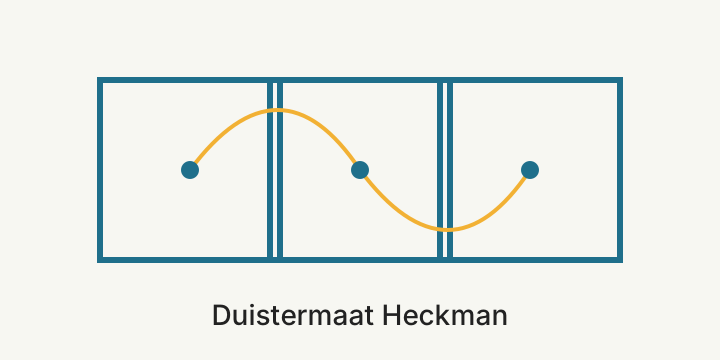
The picture you should keep is a manifold above a polytope, with the Liouville volume sliding down through the moment map and arriving as a piecewise-polynomial density that you can compute directly from the polytope's shape.
Worked example [Beginner]
Take the rotation of the unit sphere about its vertical axis, with the round area form, so that the total area of the sphere is . The moment map is the height , with image the interval . The pushforward measure on is what you get by sliding the area form down to the -axis; write it as .
Compute at : the level set is the equator, the slice of at . A thin slab on the sphere has area equal to its lateral surface — by Archimedes' hat-box theorem, this lateral area is , independent of . So for every between and .
Now check the prediction. Total mass: times the length of the interval gives , matching the sphere's area. Polynomial degree: is constant, degree . Walls: the only fixed-point images are the two poles at , which sit at the endpoints of the polytope and don't cross the open interval — so a single polynomial piece covers the whole open polytope.
What this tells us: the Duistermaat-Heckman density encodes the rate at which manifold volume accumulates as you sweep the moment-map level. For a rotating sphere, that rate is constant, which is the Archimedean fact you may already know from elementary geometry. The theorem says this kind of polynomial behaviour is general.
Check your understanding [Beginner]
Formal definition [Intermediate+]
Let be a closed connected symplectic manifold of dimension , and let be a torus acting on in a Hamiltonian fashion with moment map , where and is the dual. The Liouville volume is the smooth measure on associated to the top form , equivalently the Riemannian volume of any compatible -induced metric times (the pairing is intrinsic, not metric-dependent).
Definition (Duistermaat-Heckman measure). The Duistermaat-Heckman measure is the pushforward
on , where is Lebesgue measure on relative to a chosen integer-lattice basis and is the density.
Wall set. A point is a regular value of when is surjective at every point of and the -action on has finite stabilisers. The complement of the regular values is the wall set ; equivalently, , the union of moment-map images of fixed-point components of every proper subtorus (including the full ). Connected components of are called chambers.
Reduced symplectic form. When is a regular value of and acts freely on , the reduced space is a closed connected symplectic manifold of dimension via Marsden-Weinstein-Meyer reduction 05.04.02, with a reduced symplectic form uniquely characterised by where and .
Sign convention. Throughout this unit, with the fundamental vector field of , matching the convention of 05.02.01 and 05.04.01.
Key theorem with proof [Intermediate+]
Theorem (Duistermaat-Heckman 1982). Let be a closed connected symplectic manifold of dimension with a Hamiltonian -action and moment map . Then on each chamber , the Duistermaat-Heckman density is a polynomial in of degree at most . On ,
where $\Lambda^\mathfrak{t}^\mathrm{vol}tt \mapsto \mathrm{vol}(M_t, \omega_t)n - k$ on each chamber.
The theorem has three equivalent formulations: (1) the pushforward statement above; (2) the equivariant integration formula
where ranges over connected components of the -fixed-point set, is the normal bundle of in , and is the equivariant Euler class of ; and (3) the polynomial-volume statement that is piecewise polynomial. The three are equivalent by Fourier transform and standard equivariant cohomology.
Proof. The argument proceeds in four stages, the central one being a reduction to a local calculation near the level set.
Stage 1 (variation of the reduced form). Fix a chamber and a basepoint . For near , choose a -invariant connection one-form on the principal -bundle , and identify a tubular neighbourhood of in with , a neighbourhood of , via the moment-map fibration. On this neighbourhood, the level set is identified with for small. The reduced form on varies linearly with in cohomology:
where is the Chern class of the principal -bundle , viewed as an element of valued in . The argument: in the tubular identification, and represents the Chern class.
Stage 2 (volume is polynomial in ). The reduced symplectic volume is
Substituting the cohomological linear variation of Stage 1,
Expanding by the binomial theorem in produces a polynomial of degree in , with coefficients given by integrals of mixed cup products over .
Stage 3 (relation between and reduced volume). By the coarea formula applied to the moment map (writing the Liouville volume as the product of -fibre measure and a Jacobian on the polytope), and using that on the -action gives a principal-bundle structure with fibre volume once the integer lattice is normalised,
Combining Stages 2 and 3 establishes that is a polynomial of degree on each chamber .
Stage 4 (walls and polynomial change). Across a wall , the topology of changes: a fixed-point component of some subtorus contributes either a vanishing or a creating reduced-space component, and the principal-bundle Chern class jumps by an amount controlled by the local model at the fixed-point component. The polynomial pieces on adjacent chambers therefore differ; their difference is itself polynomial and supported by the local-normal-form contribution of the wall-defining fixed-point set. The walls are exactly the moment-map images of fixed components of proper subtori (including all of ), as claimed.
Bridge. The Duistermaat-Heckman theorem builds toward 05.04.04 (Delzant), where it appears again in the role of computing volumes: in the toric case the polynomial degree bound is , so the density is constant on the (single) open polytope chamber, and the Liouville volume of a symplectic toric manifold equals times the Lebesgue volume of its Delzant polytope. The theorem also builds toward equivariant cohomology and the Atiyah-Bott / Berline-Vergne localisation theorem, which the equivariant integration formulation realises as the prototype example of equivariant localisation. Putting these together, the foundational reason the density is piecewise polynomial is exactly that the reduced symplectic class varies linearly with in cohomology — the Stage 1 cohomological identity is the bridge between the analytic moment-map fibration and the algebraic polynomial in . The variation-of-cohomology framing identifies the symplectic-reduction structure on with a piece of polynomial data on , mirroring how AGS 05.04.03 identified the Hamiltonian-action structure with a piece of convex-polyhedral data and Delzant 05.04.04 then upgraded that polyhedral data to a complete invariant in the half-dimensional case.
Exercises [Intermediate+]
Lean formalization [Intermediate+]
Mathlib does not currently have the equivariant differential geometry, the Marsden-Weinstein-Meyer regular reduction, or the Cartan model of equivariant cohomology that Duistermaat-Heckman requires. The skeleton below sketches the statement at the type level; the proof would require the full apparatus described in lean_mathlib_gap.
Advanced results [Master]
The Duistermaat-Heckman theorem is the prototype of equivariant localisation, and it sits at the head of a family of results that became foundational for equivariant cohomology, geometric quantisation, and modern mathematical physics.
Atiyah-Bott / Berline-Vergne localisation (1982-1984). Atiyah and Bott in The moment map and equivariant cohomology (Topology 23, 1984) reformulated Duistermaat-Heckman as a special case of a general theorem in equivariant cohomology: for any equivariantly closed form on a compact manifold with a torus action, the integral localises to a sum over the fixed-point set, . Berline and Vergne proved a closely related statement independently in 1982 in the Cartan model. Duistermaat-Heckman follows by taking where is the equivariantly closed extension of .
Witten's non-Abelian generalisation (1992). Edward Witten in Two-dimensional gauge theories revisited (J. Geom. Phys. 9) extended equivariant localisation to non-Abelian gauge theories, deriving the Migdal-Witten formula for partition functions of two-dimensional Yang-Mills theory. The non-Abelian analogue of Duistermaat-Heckman applies to Hamiltonian -manifolds for compact non-Abelian and yields integrations over moduli spaces of flat connections.
Heckman polynomials and Kostant partition function. When is a regular coadjoint orbit of a compact connected semisimple Lie group and the Hamiltonian action is by a maximal torus , the Duistermaat-Heckman measure has a polynomial density given by Heckman's formula in terms of the Kostant partition function. The asymptotic of this density as is the leading-order term of the Weyl character formula; this is the modern version of the Kirillov character formula relating coadjoint orbits to representations.
Local Duistermaat-Heckman. Near a fixed-point component , the local moment-map image is the cone on the polytope of the linearised -representation on , and the local Duistermaat-Heckman density is computable purely from the equivariant Euler class of . This local statement is the seed of the wall-crossing formula: the difference of polynomial pieces across a wall is determined by the local model at the wall-defining fixed component.
Symplectic implosion and DH on the implosion. Guillemin-Jeffrey-Sjamaar 2002 introduced the symplectic implosion construction, which sends a Hamiltonian -manifold to a Hamiltonian -manifold; the Duistermaat-Heckman measure of the implosion recovers the Harish-Chandra orbital integral and the Heckman formula in a unified framework.
Relation to Hilbert series and Ehrhart polynomials. For symplectic toric manifolds, the Duistermaat-Heckman measure on the Delzant polytope is constant Lebesgue measure (after lattice normalisation), and the corresponding Hilbert series of the polytope's Ehrhart polynomial counts lattice points for . The asymptotic is the lattice-point counterpart of the Liouville volume statement. This is the bridge between equivariant symplectic geometry and combinatorial commutative algebra.
Connection to Liouville-Arnold integrability. When is half-dimensional, every reduced space is a point and is constant on the open polytope. The constancy is the variational shadow of the Liouville-Arnold theorem: for an integrable system in action-angle coordinates the symplectic form is , and the Liouville volume in action coordinates is constant.
Equivariant index theorems. Atiyah-Singer's equivariant index theorem and its specialisations (Atiyah-Bott Lefschetz fixed-point formula; the equivariant Riemann-Roch for compact Kähler manifolds with -action) all follow the same localisation pattern: the global topological invariant equals a sum of local fixed-point contributions weighted by equivariant Euler classes. Duistermaat-Heckman is the de Rham / symplectic version of this circle of theorems.
Synthesis. The Duistermaat-Heckman theorem identifies a piece of symplectic-geometric data (the Liouville volume on together with the moment map) with a piece of polynomial data (the piecewise polynomial density on the polytope), and the bridge is a single cohomological identity: the reduced symplectic class varies linearly with the moment-map level. Read as a structural statement, the theorem generalises the elementary fact that volumes of slices of a convex body are piecewise polynomial — index parity in AGS 05.04.03 is what allowed the polytope to be convex, and linearity-in-cohomology of the reduced form is what allows the density to be polynomial. Read in the opposite direction, the equivariant integration formula is the prototype of equivariant localisation, and the Atiyah-Bott / Berline-Vergne abstract version subsumes Duistermaat-Heckman as the special case of integrating the equivariantly closed form .
The foundational reason the density is piecewise polynomial is exactly that the Marsden-Weinstein-Meyer reduction at a regular value produces a smooth symplectic manifold whose cohomology class depends linearly on — the Stage 1 cohomological identity. This is the bridge between the analytic moment-map fibration and the algebraic polynomial dependence. Putting these together one sees that the entire theorem reduces to the existence of a -invariant connection on the principal -bundle , plus the binomial-theorem expansion of the perturbed cohomology class, plus the standard reduction theory. The theorem identifies the equivariant-symplectic structure on with a piece of polynomial data that can be computed entirely from the fixed-point set, in the precise sense that the polynomial pieces and walls are determined by the equivariant Euler classes of the fixed-component normal bundles. The central insight is that all the relevant geometry of the moment-map pushforward localises onto the fixed-point set, because that is where the equivariant cohomology lives.
Full proof set [Master]
Lemma (linear variation of reduced cohomology). Let be a closed symplectic manifold with a Hamiltonian -action and moment map , let be a chamber of , and fix . There exists a neighbourhood in and a smooth family of diffeomorphisms () with such that
where $c_T \in H^2(M_{t_0}) \otimes \mathfrak{t}^T\mu^{-1}(t_0) \to M_{t_0}$.*
Proof. Pick a -invariant connection one-form on the principal -bundle . By the equivariant tubular neighbourhood theorem applied to with -action transverse to a chosen complementary slice, there is an equivariant diffeomorphism
with (inclusion) and . On the image, the symplectic form pulls back to
where the remainder vanishes to second order at on each fixed level set, and is exact in of each level set by the Cartan formula applied to -invariant forms. Restricting to level and projecting to via for an appropriately chosen , we get . In cohomology, where is the principal-bundle curvature class (Chern-Weil). Hence the cohomological linear variation.
Lemma (reduced volume is polynomial in ). On a chamber , the reduced symplectic volume
is a polynomial in of degree at most .
Proof. By the previous lemma, in , identified with via . Hence , expanded by the binomial theorem,
Integrating over (which is closed and oriented) gives a polynomial in of degree at most , with coefficients
Hence in , polynomial of degree .
Lemma (density-volume relation). On a chamber , the Duistermaat-Heckman density satisfies
for a normalisation constant $c_T = (2\pi)^k / |\Lambda^|\mathfrak{t}^$.
Proof. Write the Liouville volume as a fibre integral using the moment-map fibration. On a tubular neighbourhood of , the symplectic form decomposes as , where is the reduced form pulled back from and encodes the principal--bundle direction. The top form then factors as . Integrate first along the -fibre at level : the fibre is with giving Haar measure scaled to total fibre volume , and then over gives . The product, integrated against on , gives with .
Theorem (Duistermaat-Heckman, full statement and proof). On every chamber , the Duistermaat-Heckman density is a polynomial of degree at most . Across walls, the polynomial pieces change by amounts governed by the equivariant Euler classes of the wall-defining fixed-point components.
Proof. Combining the three lemmas: the linear-variation lemma identifies the reduced cohomology class as linear in ; the polynomial-volume lemma applies the binomial theorem to extract a polynomial of degree ; the density-volume lemma transfers this polynomial structure to on . The wall-crossing claim follows from the local Duistermaat-Heckman computation near a fixed-point component : the local moment-image is the cone on the polytope of the linearised -action on , and the local density is computable as evaluated formally; the difference of the polynomial pieces on two adjacent chambers is the residue of the local contribution. The Atiyah-Bott / Berline-Vergne localisation theorem applied to the equivariantly closed form (with ) gives the equivariant integration formula
and Fourier inversion of this identity recovers as a sum of fixed-point contributions, manifestly piecewise polynomial.
Corollary (toric volume formula). For a symplectic toric manifold with Delzant polytope ,
Proof. In the toric case , so the polynomial degree bound is and is constant on the (single) open chamber . By the density-volume lemma the constant is , and since is a point. The total Liouville volume is therefore .
Connections [Master]
Moment map
05.04.01. Duistermaat-Heckman is a statement about the pushforward of the Liouville volume under the moment map; the unit's three-condition definition is what makes the moment-map fibration well-behaved enough to admit the fibre-integration argument. The Hamiltonian sign convention used here matches that unit.Symplectic reduction
05.04.02. The proof's central object is the reduced space at a regular value, whose existence as a smooth symplectic manifold is exactly the Marsden-Weinstein-Meyer regular-reduction theorem. The reduced symplectic class varies linearly with — the Stage 1 cohomological identity that drives the entire argument.AGS convexity
05.04.03. The polytope on which the Duistermaat-Heckman measure lives is the convex polytope established by Atiyah-Guillemin-Sternberg. The walls of the piecewise-polynomial density are sub-polytopes (images of fixed-point components of proper subtori), each itself a convex polytope by the same AGS argument applied to the subtorus action.Delzant theorem
05.04.04. In the toric case (), Duistermaat-Heckman gives the volume formula , used in the uniqueness step of Delzant's classification (the cohomology class on a symplectic toric manifold is determined by via this volume formula plus integration against equivariant cohomology classes). The Moser-deformation step in Delzant's proof relies on the two reduced forms having the same Duistermaat-Heckman cohomology class.Hamiltonian vector field
05.02.01. The components are Hamiltonians whose flow generates the one-parameter subgroup ; the proof's analytic backbone is the unit's identity , which makes the moment-map fibration a -equivariant submersion at regular values.Action-angle coordinates
05.02.04. When is half-dimensional, the reduced spaces are points and is constant on the open polytope. The constancy is the variational shadow of action-angle coordinates: in variables the symplectic form is and the Liouville volume in -coordinates is constant.Coadjoint orbit
05.03.01. For a regular coadjoint orbit of with the maximal-torus action, Duistermaat-Heckman recovers the Harish-Chandra-Itzykson-Zuber integral; the equivariant integration formula at the Weyl-image fixed points gives the closed-form determinantal expression that underlies a substantial part of random-matrix theory.
Historical & philosophical context [Master]
Hans Duistermaat and Gerrit Heckman's 1982 paper On the variation in the cohomology of the symplectic form of the reduced phase space (Invent. Math. 69, 259-268) [Duistermaat-Heckman 1982] established both the polynomial-density form and the equivariant integration form of the theorem, in a single short paper of remarkable density. Duistermaat had been working on stationary-phase asymptotics and Heckman had been studying coadjoint-orbit measures; the joint paper unified the two perspectives.
Almost simultaneously in 1982, Nicole Berline and Michèle Vergne in Classes caractéristiques équivariantes; formule de localisation en cohomologie équivariante (C. R. Acad. Sci. Paris 295) [Berline-Vergne 1982] proved an abstract equivariant localisation theorem in the Cartan model of equivariant cohomology, of which Duistermaat-Heckman is a special case for Hamiltonian torus actions. Michael Atiyah and Raoul Bott in their 1984 paper The moment map and equivariant cohomology (Topology 23, 1-28) [Atiyah-Bott 1984] gave the topologist's reformulation of localisation, deriving Duistermaat-Heckman as a corollary and integrating the result into the broader Atiyah-Bott / Atiyah-Singer framework.
Johannes Heckman's 1980s work on coadjoint-orbit measures, building on Bertram Kostant's Quantization and unitary representations (1970), connected the theorem to representation theory: the asymptotic of the Duistermaat-Heckman polynomial on a regular coadjoint orbit recovers the Weyl character formula and provides the modern formulation of the Kirillov character formula. Edward Witten's 1992 paper Two-dimensional gauge theories revisited (J. Geom. Phys. 9, 303-368) [Witten 1992] extended the localisation principle to non-Abelian gauge theories, deriving the Migdal-Witten partition function for two-dimensional Yang-Mills and connecting the result to the moduli of flat connections.
Ana Cannas da Silva's Lectures on Symplectic Geometry (2001) [CannasDaSilvaSymplectic] devotes its closing lecture (§31) to Duistermaat-Heckman, presenting it as the climax of the Hamiltonian-actions strand. Victor Guillemin and Shlomo Sternberg's Supersymmetry and Equivariant de Rham Theory (1999) [GuilleminSternberg1999] is the canonical modern reference for the Cartan-model derivation of equivariant localisation. Michèle Audin's Topology of Torus Actions on Symplectic Manifolds (1991) [Audin1991Topology] gives the canonical textbook treatment of the polynomial-density form and its applications to toric volume formulas and symplectic implosion.