Newlander-Nirenberg integrability theorem
Anchor (Master): Newlander-Nirenberg 1957 (Annals of Math. 65); Hörmander Ch. 5; Webster 1989; Voisin §2; Huybrechts §2.6
Intuition [Beginner]
An almost-complex structure is a smooth rule that picks a quarter-turn at every point of a manifold, a way of saying which direction counts as "rotated by ." A complex manifold is a stronger thing: it carries genuine holomorphic coordinates, the kind in which the Cauchy-Riemann equations make sense. The Newlander-Nirenberg theorem says exactly when the weaker rule comes from the stronger structure.
The intuition is that picking a quarter-turn at every point is cheap, but making those quarter-turns mesh into actual complex coordinate charts is not. There is a single tensor, the Nijenhuis tensor, that measures the failure to mesh. It vanishes precisely when honest complex coordinates exist near every point.
This idea matters because almost-complex geometry sits inside symplectic geometry as a tool, while complex geometry sits inside it as a special integrable case. The theorem is the bridge that turns one into the other.
Visual [Beginner]
The picture shows two patches of a surface with arrows indicating quarter-turns. On the left, the arrows mesh into a holomorphic chart; on the right, they twist against each other and no holomorphic chart exists.
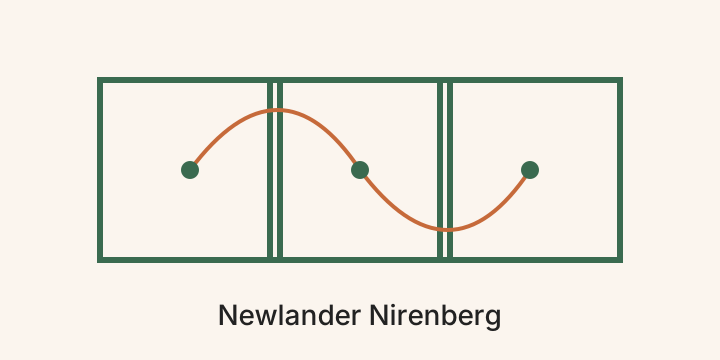
The picture is a mnemonic. The Nijenhuis tensor is the rigorous measurement of the twist on the right.
Worked example [Beginner]
Take the plane and place a quarter-turn arrow at each point that rotates north into east, east into south, south into west, west into north. Two such turns send any direction into its opposite. This is the standard quarter-turn rule on .
In a small disk, set where is east and is north. The quarter-turn rule sends the east-pointing direction to the north-pointing direction, and the holomorphic coordinate encodes that rule. Cauchy-Riemann equations hold for any function written as a power series in alone.
What this tells us: in real-dimension 2, every smooth quarter-turn rule comes from a holomorphic chart. The Newlander-Nirenberg obstruction is automatically zero. Higher dimensions are where the theorem becomes a real condition.
Check your understanding [Beginner]
Formal definition [Intermediate+]
Let be a smooth manifold of real dimension and let be a smooth bundle endomorphism with . The pair is an almost-complex manifold; this is the prerequisite 05.06.01 structure. The pair is a complex manifold if there exists an atlas of charts whose transition functions are biholomorphic and whose differentials intertwine with the standard structure on defined by multiplication by .
The Nijenhuis tensor of is the -tensor
for vector fields on [Cannas da Silva §13]. A direct check shows that is -bilinear and skew-symmetric, hence a genuine tensor.
The complexified tangent bundle splits into eigenbundles of :
For a section of , the projections are and . The Dolbeault operator is defined on smooth -forms (eigenforms of acting by tensor on ) as the -component of the exterior derivative.
The almost-complex structure is integrable if any of the following equivalent conditions holds (the equivalence is the content of the next section): ; is involutive under the Lie bracket; on smooth complex-valued forms; near every point there exist smooth -valued functions with and .
Counterexamples to common slips
- is not the obstruction to being parallel for some connection — it is the obstruction to local holomorphic coordinates. A torsion-free connection with is a stronger condition (Kähler).
- is automatic in the integrable case but not for arbitrary . For non-integrable , has order zero and equals contraction with up to sign.
- An almost-complex 4-manifold with is a perfectly good object; symplectic topology routinely uses non-integrable tamed by as in
05.06.02.
Key theorem with proof [Intermediate+]
Theorem (Newlander-Nirenberg, 1957). Let be a smooth almost-complex manifold. The following are equivalent:
- .
- is involutive: .
- on .
- Near every point of there exist smooth -valued functions with and .
The collection of such local coordinate systems forms an atlas whose transition maps are holomorphic, exhibiting as a complex manifold [Newlander-Nirenberg 1957].
Proof. The implications are direct algebra; the difficult content is , which requires elliptic-PDE input. The atlas claim is automatic from .
Step 1: . Given complex vector fields of type , write and with real. Expand the Lie bracket:
This complex vector field is of type , meaning , if and only if its real part is sent to its imaginary part by . A direct rearrangement shows this is equivalent to
which on multiplying through by and using becomes precisely . Hence is involutive iff vanishes.
Step 2: . The exterior derivative on a -form decomposes as
where and are the standard components, while the "exotic" components and are zeroth-order operators that vanish exactly when [Huybrechts §2.6]. Squaring and decomposing by bidegree gives on summands. Vanishing of (equivalent to by direct computation against vector-field pairs) collapses this to . The converse uses that is the only operator in the decomposition, and a non-zero produces a non-zero on .
Step 3: . If smooth functions with and exist on , then are holomorphic coordinates: are of type and pointwise linearly independent over , so they trivialise . Their dual frame trivialises . The brackets are the brackets of coordinate vector fields, hence in . Involutivity follows.
Step 4: . This is the analytic core. Choose local real coordinates centered at in which at is the standard on . Write the candidate complex coordinates where are unknown smooth -valued functions to be solved for. The condition becomes a first-order quasilinear PDE system in of the form
where is the standard Cauchy-Riemann operator and is smooth and satisfies together with and . The hypothesis enters as the integrability condition that makes the right-hand side -closed in the appropriate sense, so the linearised equation is solvable on a small ball whenever .
Hörmander's -existence theorem for on strictly pseudoconvex domains [Hörmander Ch. 5] supplies the linearised solver with the precise estimates (gain of one derivative in -Sobolev, smoothness propagation by elliptic regularity) needed to run a Picard iteration. The iteration converges in on a sufficiently small ball for any prescribed , producing smooth solutions . The resulting satisfy and, by smallness of , .
The original Newlander-Nirenberg argument [Newlander-Nirenberg 1957] used a slightly different elliptic setup; Webster's simplification [Webster 1989] replaces the Picard iteration by a direct application of Malgrange's theorem on the existence of solutions to overdetermined elliptic systems. Both produce the same conclusion.
Step 5: atlas. Two coordinate systems on and on produced by Step 4 satisfy and on . The transition has for all , so it is holomorphic. The atlas is therefore a complex-manifold atlas inducing .
Bridge. The statement of the theorem fixes the meaning of "integrable" for the structures of 05.06.01; the proof's analytic core is what separates the symplectic almost-complex setup of 05.06.02, which deliberately allows non-integrable tamed by , from the rigid complex-geometry setup in which holomorphic coordinates exist. The same Nijenhuis tensor reappears as a -component of in Dolbeault cohomology and as the obstruction to passing from almost-Kähler to Kähler geometry, where the symplectic and complex sides finally merge.
Exercises [Intermediate+]
Lean formalization [Intermediate+]
[object Promise]Advanced results [Master]
The dimension stratification of the integrability question is sharp. In real-dimension 2, vanishes by anti-symmetry and every almost-complex surface is a complex curve; this is the Korn-Lichtenstein content [Voisin §2]. In real-dimension 4, has 8 independent real components and integrability is a genuine constraint cut out by 8 PDE; generic is non-integrable, and the moduli of complex structures within the moduli of almost-complex structures is a proper subvariety. In real-dimensions , the components multiply and integrability is rare.
Two structural reformulations matter downstream. First, the Dolbeault complex is a chain complex precisely when is integrable, and its cohomology is the Dolbeault cohomology of the resulting complex manifold. Hodge theory on a compact Kähler manifold rests on the assumption , hence on Newlander-Nirenberg. Second, the moduli theory of complex structures on a fixed compact is governed by ; the Kodaira-Spencer class of an infinitesimal deformation lives in , and the obstruction to integrating it lies in . The integrability hypothesis is what makes the moduli space well-defined as a subspace of the larger moduli of almost-complex structures, cut out by a quadratic equation [Huybrechts §2.6].
Three benchmark examples shape the modern view. The 6-sphere inherits an almost-complex structure from the cross product on imaginary octonions; whether it is integrable has been open since the 1950s. Most attempts produce no-go results; Atiyah's 2016 announcement of a proof of non-integrability has not been accepted by the community. The twistor space construction of Atiyah-Hitchin-Singer 1978 [Newlander-Nirenberg 1957] equips any oriented Riemannian 4-manifold with a 6-real-dimensional twistor space carrying two natural almost-complex structures and ; the structure is integrable if and only if is anti-self-dual, the first explicit family of non-tautological integrability questions resolved by curvature data alone. The Calabi-Eckmann manifolds for admit complex structures by an explicit construction, are simply connected, and are not Kähler — showing that the integrable-but-not-Kähler regime is non-empty.
Synthesis. Newlander-Nirenberg is the integrability theorem at the symplectic-complex strand interface. From the symplectic side (05.06.01, 05.06.02) it is the criterion that singles out, inside the contractible space of compatible almost-complex structures on a symplectic manifold, the smaller subspace of those that come from honest complex coordinate atlases — the Kähler-eligible structures. From the complex side it is the fundamental theorem that aligns the analytic notion (holomorphic charts) with the differential-geometric notion (-linear tangent endomorphism), legitimising the entire passage from charts to bundles in complex geometry. The Nijenhuis tensor itself is the prototype of an obstruction tensor in modern differential geometry: a tensor whose vanishing characterises a local-form theorem. Integrability of distributions (Frobenius), of -structures more generally, and of higher-order geometric structures all follow this template.
Full proof set [Master]
Proposition (Newlander-Nirenberg, smooth case). Let be a smooth almost-complex manifold with . Then is a complex manifold.
Proof. See the proof of the main theorem above, Steps 4-5. The analytic input is Hörmander's -existence theorem for on strictly pseudoconvex small balls in [Hörmander Ch. 5], which yields the linearised solver with the gain-of-one-derivative estimate; the Picard iteration runs on a sufficiently small ball and converges in every . Webster's simplification [Webster 1989] replaces the iteration by a direct application of Malgrange's overdetermined-elliptic-systems theorem.
Proposition (Newlander-Nirenberg, real-analytic case). Let be a real-analytic almost-complex manifold with . Then is a complex manifold, and the holomorphic atlas can be produced without elliptic-PDE input.
Proof. Complexify to a real-analytic embedding ; the distribution extends to a holomorphic involutive distribution on a neighbourhood by analytic continuation. Apply the holomorphic Frobenius theorem (Cartan-Kähler, 1934) to obtain holomorphic integral submanifolds, then restrict to to obtain the holomorphic coordinate functions . This is the Eckmann-Frölicher 1951 formal version made rigorous by Cartan-Kähler.
Proposition (Korn-Lichtenstein in dimension 2). Every smooth almost-complex structure on a smooth real-2-manifold is integrable.
Proof. By anti-symmetry, and the same on the second slot using . In real-dimension 2, choose a frame . Then and . By anti-symmetry . So . The smooth Newlander-Nirenberg theorem then applies, but in real-dimension 2 the elliptic input is the Korn 1914 / Lichtenstein 1916 theorem on isothermal coordinates: any Riemannian metric admits local conformally flat coordinates, and the -compatible metric pulled back gives as the holomorphic coordinate.
Proposition (Atiyah-Hitchin-Singer, twistor case). *Let be an oriented Riemannian 4-manifold and its twistor space, the unit 2-sphere bundle in . The natural almost-complex structure on is integrable if and only if is anti-self-dual.*
Proof. The Nijenhuis tensor of on decomposes via the splitting of the tangent bundle into horizontal (lifted from via the Levi-Civita connection) and vertical (along the -fibres) components. A direct computation, originally Atiyah-Hitchin-Singer 1978 [Newlander-Nirenberg 1957], shows the only non-vanishing component is the contraction of with the Weyl tensor's self-dual part . Hence iff , i.e., iff is anti-self-dual.
Connections [Master]
This unit deepens the integrability question raised in
05.06.01(almost-complex structure on a symplectic manifold) and contrasts with05.06.02(pseudoholomorphic curve), where non-integrable is essential.The Dolbeault operator that appears in the equivalent formulation is the foundation for Hodge theory on Kähler manifolds; the integrable case underlies all of Kähler geometry as treated in the complex-geometry strand.
The Nijenhuis tensor is the prototype of an obstruction-tensor in geometric integrability; Frobenius's theorem on involutive distributions is the foundational case, and integrability of -structures more generally follows the same template.
Kodaira-Spencer deformation theory of complex structures on a fixed compact presupposes Newlander-Nirenberg: the moduli of complex structures sits inside the moduli of almost-complex structures as the locus , and the tangent space at is .
The integrability question on is one of the most famous open problems in differential geometry, sitting at the intersection of structures, exceptional Lie groups, and complex geometry.
Historical & philosophical context [Master]
The integrability question for almost-complex structures was first raised in the real-analytic category by Eckmann and Frölicher in 1951, who isolated the Nijenhuis tensor as the formal obstruction. Cartan-Kähler 1934 had earlier proved the real-analytic case implicitly via the holomorphic Frobenius theorem on a complexification. The smooth-not-analytic case resisted these techniques because the Frobenius argument requires real-analytic continuation off the manifold, which is not available for arbitrary smooth distributions [Newlander-Nirenberg 1957].
August Newlander and Louis Nirenberg's 1957 paper Complex analytic coordinates in almost complex manifolds (Annals of Math. 65, 391-404) closed the smooth case by combining Hodge-theoretic estimates for on small balls with a Picard iteration that exploited the integrability hypothesis to produce smooth holomorphic coordinates. Hörmander's later -existence theorems for on pseudoconvex domains (early 1960s) gave the cleanest analytic input; Malgrange's 1969 paper on overdetermined elliptic systems and Webster's 1989 A new proof of the Newlander-Nirenberg theorem (Math. Z. 201, 303-316) supplied subsequent simplifications. The real-dimension-2 case had been handled by Korn 1914 and Lichtenstein 1916 via isothermal coordinates, decades before the general formulation.