Harmonic functions on the plane
Anchor (Master): Laplace 1782 *Théorie des attractions*; Lagrange 1781 *Mémoire sur la théorie du mouvement des fluides*; Poisson 1820 *Mémoire sur la manière d'exprimer les fonctions par des séries de quantités périodiques*; Riemann 1851 *Grundlagen* (Dirichlet principle); Hilbert 1900 *Über das Dirichletsche Prinzip*; Wiener 1924 *The Dirichlet problem*; Perron 1923; Ahlfors *Complex Analysis* Ch. 4 §6; Axler-Bourdon-Ramey *Harmonic Function Theory*
Intuition [Beginner]
A harmonic function on the plane is a smooth real-valued function whose two second partial derivatives cancel out:
This single condition is Laplace's equation. The combination on the left is called the Laplacian of . Concretely it asks that the rate at which curves up-or-down in the -direction be exactly balanced by the rate it curves in the -direction.
The picture to keep in mind is a stretched soap film with no weight pulling on it and no extra forces inside. The film settles into a shape whose height at every interior point is the average of nearby heights. That averaging behaviour is the geometric content of Laplace's equation.
Harmonic functions show up in physics whenever something settles to a steady state. A flat plate with its edges held at fixed temperatures: once the heat stops moving, the temperature distribution across the plate is harmonic. A perfect fluid flowing around an obstacle with no swirl: the velocity has a potential whose dependence on position is harmonic. Electric potential in a region empty of charges: harmonic. The plane Laplace equation is the simplest two-variable partial differential equation with this physical importance, and it is also the equation that the real and imaginary parts of a holomorphic function automatically satisfy, which is the bridge to complex analysis built in 06.01.10.
Visual [Beginner]
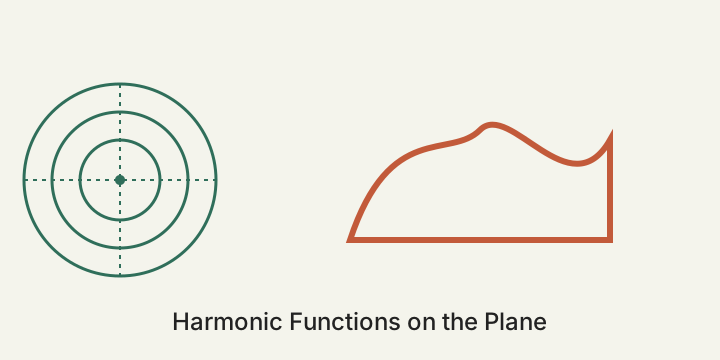
A harmonic function on the plane looks locally like a saddle — curving up in one direction and exactly as much down in the other. The contour lines of a harmonic function form an orthogonal grid against the contour lines of its harmonic conjugate, with the pair of grids meeting at right angles everywhere both are defined.
Worked example [Beginner]
Take . Compute the two second partial derivatives in turn.
The first partial in is . The second partial in is .
The first partial in is . The second partial in is .
Add the two second partials: . The Laplacian vanishes everywhere, so is harmonic on the whole plane. This is exactly the real part of , matching the rule from 06.01.10 that real parts of holomorphic functions are harmonic.
For contrast, take . The same kind of computation gives and , so . The Laplacian is positive everywhere, not zero, so is not harmonic. In the soap-film picture, looks like a bowl, curving up in both directions — the two contributions reinforce instead of cancelling.
What this tells us: harmonic is a balanced condition. The two second derivatives have to be equal-and-opposite for to qualify. The polynomial passes; the polynomial fails because both directions curve the same way.
Check your understanding [Beginner]
Formal definition [Intermediate+]
Let be open. A function of class is harmonic on if it satisfies Laplace's equation
at every point of . The differential operator is the (two-dimensional) Laplacian. The space of real-valued harmonic functions on is denoted ; it is a real vector space, since is linear.
Connection to holomorphic functions. Let be holomorphic with . The Cauchy-Riemann equations and from 06.01.10, differentiated once more and combined using equality of mixed partials, yield
and the same argument gives . So real and imaginary parts of holomorphic functions are harmonic. Smoothness of to (in fact and real-analytic) is automatic from holomorphicity.
Conversely, on simply-connected , every harmonic admits a harmonic conjugate — a harmonic such that is holomorphic — unique up to an additive real constant. The construction proceeds by line-integration of the closed -form , whose closedness is exactly (see 06.01.10 Exercise 6). On non-simply-connected the conjugate exists locally but may fail to glue globally; on is the canonical obstruction, with its candidate conjugate the multivalued from 06.01.10. [Ahlfors Ch. 4 §6]
Higher-dimensional analogue. On open , the same definition defines harmonic functions in variables. The mean-value property, the maximum principle, and many of the structural theorems below survive to all dimensions; the harmonic-conjugate / holomorphic-function linkage is special to .
Counterexamples to common slips
- The Laplacian must vanish, not just be small. The function has everywhere. It is subharmonic (the condition characterising functions dominated by their disc averages), not harmonic. Subharmonic and superharmonic () functions are systematically studied in Perron's method for the Dirichlet problem on general domains.
- Harmonicity is a local condition; the domain matters. A function can be harmonic on and fail to extend to a larger — for instance, is harmonic on but undefined at the origin; the function is not harmonic anywhere except where it is also defined and the Laplacian computation gives zero, which a direct computation shows happens nowhere.
- Mean-value need not be over circles only; over the full closed disc gives an equivalent statement. The two integrals — average over the circle of radius around and average over the closed disc of radius — agree for harmonic , with the disc-average version following from the circle-average version via integration in . Both versions characterise harmonicity for continuous functions (Koebe's theorem), without an a priori smoothness assumption.
Key theorem with proof [Intermediate+]
Theorem (mean-value property). Let be open and let be harmonic. For every and every with ,
That is, the value at the centre equals the average over every circle around the centre that fits inside the domain. [Ahlfors Ch. 4 §6]
Proof. Fix and with . Choose a simply-connected open with — for instance an open disc of radius slightly larger than around . The harmonic-conjugate existence theorem (06.01.10 Exercise 6) gives a real-valued such that is holomorphic on .
The Cauchy integral formula on the disc — applied with the boundary parametrisation , , — reads
The left-hand side equals and the integrand on the right equals . Taking real parts of both sides gives
which is the mean-value identity.
The harmonic-conjugate construction depends on the choice of , but the conclusion — an identity involving only — does not, so the auxiliary disappears from the final statement.
An equivalent route using only the divergence theorem and the harmonicity of avoids the harmonic-conjugate construction. Apply the divergence theorem to the gradient field on the closed disc :
where is the outward unit normal. Since the left side is zero, so . Now consider the function giving the circle-averaged value as a function of radius. Differentiating in and using the chain rule,
so is constant in . Taking gives , so for every with . This is again the mean-value identity.
Bridge. The mean-value property is the structural pivot from which the rest of harmonic-function theory unfolds, and the synthesis runs in five directions. First, it builds toward the maximum principle: a non-constant harmonic function on a connected open attains neither an interior maximum nor an interior minimum, since an interior maximum value would equal the local circle-average and force constancy on every disc inside , iterated and propagated by connectedness. This appears again in 06.01.12 (maximum modulus and Schwarz lemma), where its complex-valued analogue for holomorphic is the gate to the Schwarz lemma and Schwarz-Pick hyperbolic-metric chain.
Second, it builds toward the Poisson integral formula, which recovers at every interior point of a disc from its values on the boundary circle via the Poisson kernel — a constructive solution of the Dirichlet problem on . Third, it builds toward the Liouville theorem: a bounded harmonic function on all of is constant, since for any two points the difference of their values is bounded by an integral over large circles whose area-normalised contribution shrinks to zero. The Liouville theorem reappears in 02.11.* for elliptic regularity on more general elliptic operators. Fourth, it builds toward Harnack's inequality — a quantitative two-sided ratio bound between values at two points of a compactly contained subdomain — which sharpens the maximum principle into a uniform-comparison estimate. Fifth, it builds toward the elliptic-regularity philosophy: the mean-value property is a global integral identity that forces to be real-analytic, the cleanest instance of the slogan that solutions of elliptic equations inherit regularity beyond the regularity of the equation. Putting these together, the planar Laplacian's elliptic-regularity is the foundational reason 2D harmonic problems are uniformly solvable across the categories of domain in which they appear.
Exercises [Intermediate+]
Lean formalization [Intermediate+]
lean_status: none. Mathlib has the scaffolding for a planar Laplacian via iteratedFDeriv and the real-Fréchet derivative API, but does not package the curriculum-facing planar harmonic theory (Laplace's equation on , mean-value identity, maximum principle, Poisson kernel, Liouville theorem, real-part-of-holomorphic-is-harmonic). The lean_mathlib_gap field in this unit's frontmatter records the precise contribution roadmap. The unit ships without a lean_module while the upstream Mathlib gaps remain open; the human-reviewer gate covers correctness in the interim.
Advanced results [Master]
Maximum principle. A non-constant harmonic function on a connected open attains no interior maximum or minimum. The argument extracts directly from the mean-value identity: if at some interior , then for every with the circle-average equals , forcing on the circle, then on the disc, then by an open-and-closed connectedness argument on all of . The minimum case is the symmetric statement for . A corollary: a harmonic function on a bounded open , continuous on , attains its extrema on .
Dirichlet problem on the disc. Given continuous , the Poisson integral $$ u(re^{i\theta}) := \frac{1}{2\pi} \int_0^{2\pi} \frac{1 - r^2}{1 - 2r\cos(\theta - \phi) + r^2}, g(\phi), d\phi $$ is the unique harmonic function on the open unit disc with continuous extension to taking boundary values . Existence is Exercise 7 above; uniqueness follows from the maximum principle applied to the difference of two solutions, whose boundary values vanish.
Dirichlet problem on general domains; Perron's method. For a bounded open and continuous boundary data , the Dirichlet problem asks for a harmonic on with continuous extension to matching on . Perron (1923) constructed the candidate , the Perron solution. The Perron solution is always harmonic on . Continuity-on-the-closure with the prescribed boundary values, however, holds iff the boundary is sufficiently regular — Wiener's 1924 criterion characterises regular boundary points in terms of a capacity-density condition on the complement at the point. On smoothly-bounded or convex , every boundary point is regular. The exterior-cone condition (a Lipschitz boundary suffices) is a clean sufficient criterion.
Hardy spaces on the disc. For , the Hardy space consists of harmonic with bounded radial averages $$ |u|{h^p}^p := \sup{0 \leq r < 1} \frac{1}{2\pi} \int_0^{2\pi} |u(r e^{i\theta})|^p , d\theta < \infty. $$ The corresponding holomorphic Hardy space is the subspace of holomorphic . The Fatou theorem (Fatou 1906) shows that every has nontangential boundary values almost everywhere, and the Poisson integral of recovers . Hardy-space theory is the function-theoretic foundation of operator theory on the disc, Beurling-Lax invariant subspaces of , and the modern theory of bounded harmonic extension problems.
Harnack's inequality. For every compactly contained there is a constant such that every positive harmonic function on satisfies . On the disc the explicit constant from the Poisson kernel is for and , derived from the upper and lower bounds on the Poisson kernel on circles of radius . Harnack's inequality is the quantitative form of the maximum-principle slogan that positive harmonic functions are uniformly comparable on compact subsets.
Higher dimensions. A function on open is harmonic if . The mean-value property generalises: (with the surface area of ) for . The maximum principle, Harnack's inequality, Liouville's theorem (with the boundedness hypothesis allowing polynomial growth of degree ), and the elliptic-regularity bootstrap all hold. The fundamental solution of on is for and for . The harmonic-conjugate / holomorphic-function linkage, however, is special to — in higher dimensions one works with the larger Cauchy-Riemann-Fueter system for quaternion-valued functions, or with the Dirac operator on Clifford-valued sections.
Elliptic regularity. The Laplacian is the simplest elliptic operator on : its principal symbol is non-zero for every non-zero . Weyl's lemma (Weyl 1940) gives the cleanest statement of the elliptic-regularity slogan for the Laplacian: a distribution on with in the distributional sense is automatically , and in fact real-analytic — the regularity of the solution is independent of the regularity at which the equation is posed. This bootstrap from -in-distributions to convergent Taylor expansion is the prototype for the Petrovskii / Morrey theorem on analytic-coefficient elliptic systems and underlies the Mathlib-coverable proof that harmonic functions are real-analytic. [Axler-Bourdon-Ramey Chs. 1–3]
Synthesis. The planar harmonic theory is the foundational hub from which five different lines of mathematics radiate, and the synthesis runs as follows. First, the synthesis with complex analysis through Cauchy-Riemann (06.01.10): real parts of holomorphic functions are harmonic, every harmonic function on a simply-connected domain is the real part of a holomorphic one, and the Poisson kernel produces both the Dirichlet solution and the harmonic conjugate constructively. The bridge collapses the two-dimensional Laplace equation into a one-complex-dimensional holomorphic problem and is the structural reason complex analysis has disproportionate power in two real dimensions.
Second, the synthesis with partial-differential-equation theory through the elliptic-regularity paradigm: the planar Laplacian is the simplest scalar elliptic operator, and the techniques developed for it — mean-value identities, maximum principles, Poisson integrals, Perron's method, Wiener regular-point criteria, Harnack inequalities — generalise to higher-dimensional Laplacians, to variable-coefficient elliptic operators , and to general second-order elliptic operators on Riemannian manifolds. Every theorem of De Giorgi-Nash-Moser regularity, every Hopf maximum principle, every Krylov-Safonov Harnack estimate has its planar harmonic ancestor.
Third, the synthesis with potential theory and probability: harmonic functions are the bounded solutions of for Brownian motion and the exit time from any compactly contained subdomain — the mean-value property is exactly the Brownian-motion martingale identity. The Perron solution coincides with the boundary-hitting expectation , and regular boundary points in Wiener's sense are exactly the points at which Brownian motion almost-surely exits immediately if started at .
Fourth, the synthesis with conformal geometry and Riemann surfaces: a orientation-preserving map is conformal iff is holomorphic with non-vanishing derivative (the Cauchy-Riemann conditions from 06.01.10), and conformal maps pull harmonic functions back to harmonic functions. So the Dirichlet problem on a simply-connected proper subdomain reduces — via the Riemann mapping theorem 06.01.06 — to the Dirichlet problem on the unit disc, which is the Poisson integral. Harmonic-function theory on Riemann surfaces (Forster, Donaldson) generalises this picture, with the harmonic-conjugate / period-integral / Hodge-theory chain occupying the central role.
Fifth, the synthesis with operator theory and Hardy-space analysis: and are the function-theoretic settings for Toeplitz operators, Hankel operators, Beurling-Lax invariant subspaces, and the modern theory of model spaces. The Poisson integral is the bridge from boundary functions to interior harmonic / holomorphic functions and is the integral kernel underlying the Cauchy transform on the circle. Together these five lines of synthesis position the planar harmonic theory as the foundational stratum on which a substantial portion of twentieth-century analysis was built.
Full proof set [Master]
The advanced results assembled above follow from the proofs given in earlier sections together with classical results recorded in Ahlfors Complex Analysis Ch. 4 §6, Axler-Bourdon-Ramey Harmonic Function Theory Chs. 1–3, and the original sources. Six reference points complete the proof set.
(a) The maximum principle is Exercise 4 above; the symmetric minimum case applies the same argument to . The corollary that bounded harmonic functions on attain extrema on uses the compactness of to extract a maximising point, which by the principle lies on the boundary.
(b) The Poisson-integral existence half of the Dirichlet problem on the disc is Exercise 7 above. Uniqueness: if are two solutions with the same continuous boundary data , the difference is harmonic on , continuous on , and vanishes on . The maximum principle applied to and forces on .
(c) The Perron-method existence theorem proceeds in two stages. Stage 1: the Perron candidate over the class of subharmonic with is harmonic on . This uses the Harnack principle (a monotone increasing sequence of harmonic functions either diverges to everywhere on a compactly contained or converges locally uniformly to a harmonic function) together with the Poisson modification construction (replace any subharmonic on a disc by its harmonic Poisson extension on , producing a larger subharmonic candidate). Stage 2: continuity-on-the-closure requires a barrier at every — a subharmonic with on and . The boundary point is regular iff a barrier exists, and Wiener's 1924 capacity-density criterion characterises regular points. [Wiener 1924]
(d) The Liouville theorem is Exercise 6 above. The argument extends to the polynomial-growth statement: a harmonic function on with is a harmonic polynomial of degree , proved by applying the gradient estimates from the Poisson integral on growing balls and observing that derivatives of order vanish.
(e) Harnack's inequality on the disc with the explicit constant uses the bounds on the Poisson kernel for , . Integrating against a positive harmonic via the Poisson formula and comparing the resulting upper and lower bounds at two points of yields the displayed constant. The general statement on follows from a covering argument by discs together with chaining.
(f) Weyl's lemma and elliptic regularity for the Laplacian. The proof convolves the distribution with a smooth radial approximate-identity supported in , obtaining . The Laplacian commutes with convolution, so , hence is classically harmonic on the interior of . The mean-value identity for and the radial symmetry of imply at every point of where the convolution is defined, since both sides give the disc-average. Letting shows is itself smooth (in fact real-analytic) on . [Axler-Bourdon-Ramey Chs. 1–3]
Connections [Master]
Cauchy-Riemann equations and harmonic conjugate
06.01.10— The bridge between holomorphic and harmonic is the structural ground for this unit: real and imaginary parts of holomorphic functions are harmonic, and on simply-connected domains every harmonic has a harmonic conjugate making holomorphic. The harmonic-conjugate construction supplies the holomorphic auxiliary used in the mean-value-property proof, and the Cauchy integral formula applied to produces the mean-value identity for on every closed disc inside the domain.Cauchy integral formula
06.01.02— The harmonic mean-value property is the real part of the Cauchy integral formula applied to the holomorphic completion on a disc. Conversely, the Poisson kernel — and hence the disc Dirichlet solution — arises from a Cauchy-formula manipulation that adds a vanishing integral over the reflection point outside the disc (Exercise 5), and the Poisson integral can be read as a hybrid Cauchy-Pompeiu identity for the half-Laplacian . The two formulas are the integral-representation faces of the same closed-form story.Maximum modulus and Schwarz lemma [06.01.12, pending] — The maximum principle for harmonic functions specialises to for holomorphic — itself the modulus of a holomorphic function and so satisfying a subharmonic inequality — and the resulting maximum modulus principle is the gateway to the Schwarz lemma and the Schwarz-Pick contraction theorem on the disc. The hyperbolic-metric arithmetic underlying Picard's theorems chains downstream from the maximum modulus, which chains in turn from the harmonic maximum principle proved here.
Riemann mapping theorem
06.01.06— Conformal maps pull harmonic functions back to harmonic functions, so the Dirichlet problem on any simply-connected proper subdomain reduces via the Riemann mapping theorem to the Dirichlet problem on the disc, which is the Poisson integral. The composition "Riemann mapping + Poisson integral" produces an explicit solution operator for the Dirichlet problem on the entire class of simply-connected planar domains, and the existence half of the Riemann mapping theorem itself rests on a normal-families argument applied to a family of harmonic-conjugate-related extremal holomorphic maps.Riemann surfaces and Hodge theory [06.03.01, pending] — On a compact Riemann surface , the harmonic functions are the locally constant functions (by the maximum principle applied to the connected compact ), but the theory of harmonic forms — closed coclosed -forms — supplies the Hodge decomposition with finite-dimensional. The planar harmonic theory is the local model for this global theory: in a coordinate chart, harmonic -forms are pairs with planar harmonic, and the global Hodge theorem is patched together from the local Poisson-integral existence theory.
Historical & philosophical context [Master]
Pierre-Simon Laplace introduced the operator in his Théorie des attractions des sphéroïdes et de la figure des planètes (1782), as the operator annihilating gravitational and electrostatic potentials in vacuum — the field equation for celestial mechanics. Joseph-Louis Lagrange had used a closely related construction one year earlier in his 1781 Mémoire sur la théorie du mouvement des fluides, applied to the incompressible-irrotational case in hydrodynamics. Siméon Denis Poisson in 1813 extended the picture to the source-included case (the Poisson equation), and in his 1820 Mémoire sur la manière d'exprimer les fonctions par des séries de quantités périodiques introduced the integral kernel on the disc, recognising it as the integral representation that reproduces the boundary values of a harmonic function from circle data. [Poisson 1820]
Bernhard Riemann, in his 1851 Inaugural Dissertation Grundlagen für eine allgemeine Theorie der Functionen einer veränderlichen complexen Grösse under Gauss at Göttingen, made the harmonic-function existence problem central to complex function theory. Riemann argued that for a domain with prescribed boundary data , a harmonic function with those boundary values exists as the minimiser of the Dirichlet energy over functions extending — the Dirichlet principle. Riemann used this to prove existence theorems for conformal maps and meromorphic functions on Riemann surfaces. The argument's logical gap — Riemann took for granted that the infimum of the Dirichlet energy is attained — was exposed by Weierstrass in 1870 with explicit counterexamples to the analogous one-dimensional principle, and the Riemann mapping theorem and most of Riemann's complex-function-theoretic edifice lost their existence proofs. The gap was definitively closed by David Hilbert in Über das Dirichletsche Prinzip (1900), who rehabilitated the variational argument using the (then-new) compactness machinery of the calculus of variations. [Riemann 1851; Hilbert 1900]
Henri Poincaré (1890) and Oskar Perron (1923) developed the modern alternatives to the Dirichlet principle: Poincaré's sweeping out method and Perron's supremum-over-subharmonic-functions construction. Norbert Wiener (1924) gave the capacity-density characterisation of regular boundary points, completing the existence-and-continuity-up-to-the-boundary theory for the Dirichlet problem on general domains. The same period saw the rise of Hardy-space theory: Pierre Fatou (1906) proved that bounded harmonic functions on have radial boundary values almost everywhere, and Frigyes Riesz and Marcel Riesz (1916–1924) developed the theory of holomorphic boundary behaviour. Hermann Weyl (1940) supplied the cleanest modern statement of elliptic regularity for the Laplacian in The method of orthogonal projection in potential theory (Duke Math. J. 7): every distributional solution of is smooth, and the bootstrap from -in-distributions to real-analyticity is the prototype of the general elliptic-regularity theorem. The pedagogical synthesis of this two-century arc as the prequel to one-complex-variable function theory is Lars Ahlfors's Complex Analysis Ch. 4 §6 (1979). [Wiener 1924; Ahlfors Ch. 4 §6]
Bibliography [Master]
Lagrange, J.-L., Mémoire sur la théorie du mouvement des fluides, Nouv. Mém. Acad. Roy. Sci. Berlin (1781).
Laplace, P.-S., Théorie des attractions des sphéroïdes et de la figure des planètes, Mém. Acad. Roy. Sci. (1782).
Poisson, S. D., Mémoire sur la manière d'exprimer les fonctions par des séries de quantités périodiques, Mém. Acad. Roy. Sci. Inst. France (1820).
Riemann, B., Grundlagen für eine allgemeine Theorie der Functionen einer veränderlichen complexen Grösse (Inaugural Diss.), Göttingen (1851).
Schwarz, H. A., Über einige Abbildungsaufgaben, J. Reine Angew. Math. 70 (1869), 105–120.
Poincaré, H., Sur les équations aux dérivées partielles de la physique mathématique, Amer. J. Math. 12 (1890), 211–294.
Hilbert, D., Über das Dirichletsche Prinzip, Jahresber. Deutsch. Math.-Verein. 8 (1900), 184–188.
Fatou, P., Séries trigonométriques et séries de Taylor, Acta Math. 30 (1906), 335–400.
Perron, O., Eine neue Behandlung der ersten Randwertaufgabe für , Math. Z. 18 (1923), 42–54.
Wiener, N., The Dirichlet problem, J. Math. Phys. 3 (1924), 127–146.
Weyl, H., The method of orthogonal projection in potential theory, Duke Math. J. 7 (1940), 411–444.
Ahlfors, L. V., Complex Analysis, 3rd ed., McGraw-Hill (1979). Ch. 4 §6.
Axler, S., Bourdon, P., and Ramey, W., Harmonic Function Theory, 2nd ed., GTM 137, Springer (2001).
Stein, E. M. and Shakarchi, R., Complex Analysis, Princeton (2003). §3.2.
Conway, J. B., Functions of One Complex Variable I, 2nd ed., GTM 11, Springer (1978). §X.
Needham, T., Visual Complex Analysis, Oxford University Press (1997). Ch. 12.