Field
Anchor (Master): Lang Algebra §III §1; Dummit-Foote §7
Intuition [Beginner]
A field is a number system where the usual arithmetic tools work reliably. You can add, subtract, multiply, and divide by anything except zero.
The rational numbers are a field. So are the real numbers and the complex numbers. The whole numbers are not a field, because dividing 1 by 2 leaves the whole-number world.
Fields matter because vector spaces need scalars. When a vector is stretched by a scalar, the scalar arithmetic must be stable enough to support algebra.
Visual [Beginner]
A field keeps addition and multiplication inside one number system, and every nonzero number has a division partner.
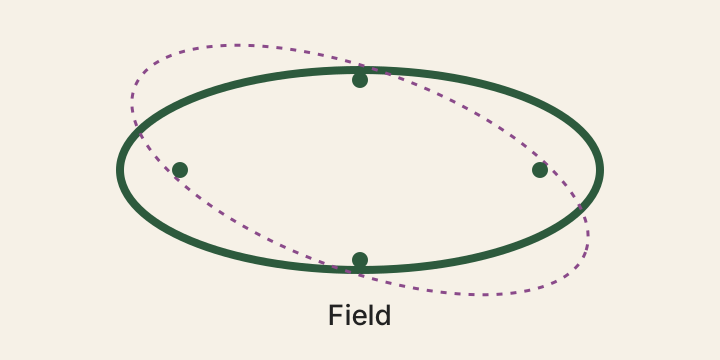
Zero is the only element excluded from division.
Worked example [Beginner]
Work with ordinary fractions. Take 3 and 5.
Adding gives 8. Multiplying gives 15. Subtracting gives -2. Dividing 3 by 5 gives three fifths.
All of those answers are still fractions. Also, every nonzero fraction has a reciprocal. The reciprocal of three fifths is five thirds.
What this tells us: a field is an arithmetic world that does not break when the basic operations are used.
Check your understanding [Beginner]
Formal definition [Intermediate+]
A field is a set with two binary operations and such that:
- is an abelian group with identity .
- is an abelian group under multiplication with identity .
- Multiplication distributes over addition:
The condition is included in the multiplicative group axiom, since [Lang §III §1]. A field homomorphism preserves , , addition, and multiplication.
The prime examples are , , , and finite fields for prime .
Key theorem with proof [Intermediate+]
Theorem. If is a field and with and , then .
Proof. Since and are nonzero, both have multiplicative inverses. Assume . Multiply on the left by :
Associativity gives
so , hence . This contradicts . Therefore .
Bridge. The construction here builds toward 01.01.03 (vector space), where the same data is upgraded, and the symmetry side is taken up in 03.01.01 (tensor product). The defining pattern appears again in those units in a sharpened form, where the local data is glued or quotiented. Putting these together, the foundational insight is that the data of this unit gives the structural signature that the rest of the strand reads off.
Exercises [Intermediate+]
Lean formalization [Intermediate+]
[object Promise]Advanced results [Master]
Fields are exactly commutative division rings in the unital convention. The commutativity of multiplication separates fields from skew fields such as Hamilton's quaternions. In algebraic geometry and commutative algebra, fields occur as residue rings of maximal ideals and as coordinate domains for vector spaces, algebras, and tensor products.
Every field contains a smallest subfield, its prime field. If the characteristic is zero, the prime field is isomorphic to . If the characteristic is a prime , the prime field is isomorphic to [Dummit-Foote §7].
Field extensions are the setting in which roots, splitting fields, algebraic degree, and Galois groups are defined. The vector-space structure of over is the bridge from elementary field arithmetic to linear algebra 01.01.03.
Synthesis. This construction generalises the pattern fixed in 00.02.05 (function), with the symmetric data replaced by its skew or twisted analogue. Read in the opposite direction, the construction is dual to the metric story: complements and orthogonality are taken with respect to the bilinear datum of this unit, not a metric, and the resulting category of subobjects is the one the rest of the strand classifies. The central insight is that this datum identifies algebra with geometry: functions become vector fields, subspaces become quotients, and invariants become cohomology classes — and that identification is the engine driving every theorem downstream.
Full proof set [Master]
Proposition (prime subfield). Let be a field. There is a unique smallest subfield of .
The intersection of all subfields of is closed under addition, subtraction, multiplication, and inversion of nonzero elements because each subfield is closed under those operations. It contains and . Hence it is a subfield, and it is contained in every subfield by construction.
If the additive order of is infinite, the map sending to embeds into and extends to an embedding . If the additive order of is finite, it is a prime : if with , then with both factors nonzero, contradicting the no-zero-divisor theorem. The resulting prime field is .
Connections [Master]
Vector spaces
01.01.03use field elements as scalars.Tensor products
03.01.01are built over a base field or commutative ring; this strand uses fields for the foundational case.Associative algebras
03.01.02combine field-linear structure with multiplication.Lie algebras
03.04.01and invariant polynomials03.06.05are normally studied over characteristic-zero fields in this curriculum.
Historical & philosophical context [Master]
The modern field axioms emerged from nineteenth-century work on equations, number systems, and residues, with Dedekind and Weber giving structural formulations of algebraic number fields. Steinitz's 1910 paper systematized abstract fields, characteristic, prime fields, and extension theory [Steinitz 1910].
Lang's Algebra presents fields within the general theory of rings and modules, matching the structural viewpoint used throughout modern algebra [Lang §III §1].