Tensor product
Anchor (Master): Lang Algebra §XVI §1-§2; Bourbaki Algebra I Ch. III
Intuition [Beginner]
A tensor product is a way to combine two independent vector inputs into one new kind of vector.
Think of choosing a color and a direction. "Red pointing east" is not just a color and not just a direction. It is a paired object that remembers both choices. If colors can be blended and directions can be added, the paired objects should respect both kinds of linear mixing.
Tensor products matter because geometry often carries several linear ingredients at once: directions, forms, spinors, matrices, and bundle fibers.
Visual [Beginner]
The tensor product stores paired vector data in a single combined space.
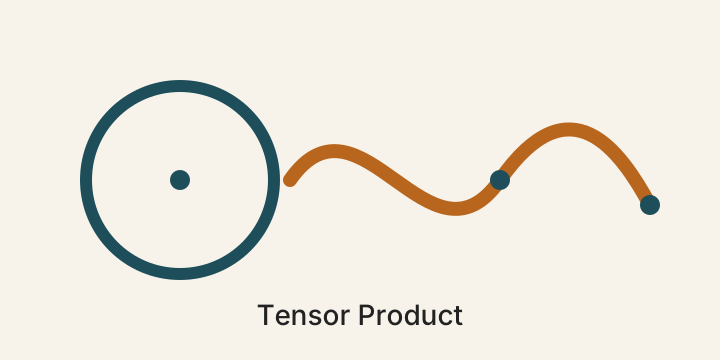
The combined space is built so pairing behaves linearly in each input.
Worked example [Beginner]
Take one space with basis vectors red and blue. Take another space with basis vectors left and right.
The combined space has four basic pairs:
red-left, red-right, blue-left, blue-right.
If a color is half red plus half blue, pairing it with right gives half of red-right plus half of blue-right.
What this tells us: tensor product turns paired linear choices into ordinary vectors in a larger space.
Check your understanding [Beginner]
Formal definition [Intermediate+]
Let and be vector spaces over a field 01.01.01, 01.01.03. A tensor product of and is a vector space together with a bilinear map
such that every bilinear map into a vector space factors uniquely through a linear map :
The element is written and is called a pure tensor. The defining relations are
and
Key theorem with proof [Intermediate+]
Theorem (basis of a tensor product). Let have basis and let have basis . Then the elements form a basis of .
Proof. First show spanning. Write
Bilinearity gives
Since pure tensors generate the tensor product, the displayed tensors span.
For linear independence, define for each pair a bilinear map by
By the universal property, induces a linear map . If
applying gives . This holds for every pair , so all coefficients vanish.
Bridge. The construction here builds toward 03.01.04 (tensor algebra), where the same data is upgraded, and the symmetry side is taken up in 03.05.02 (vector bundle). The defining pattern appears again in those units in a sharpened form, where the local data is glued or quotiented. Putting these together, the foundational insight is that the data of this unit gives the structural signature that the rest of the strand reads off.
Exercises [Intermediate+]
Lean formalization [Intermediate+]
[object Promise]Advanced results [Master]
The tensor product is characterized up to unique isomorphism by its universal property. If and both represent bilinear maps out of , the universal property gives unique linear maps and carrying one universal bilinear map to the other. The two composites preserve the universal maps and therefore equal the identity maps.
The construction is functorial: linear maps and induce a linear map
with . Associativity and symmetry constraints make tensor product the monoidal structure on vector spaces [Lang §XVI §1-§2].
For modules over a commutative ring, the same universal property defines . Exactness properties become subtler: tensoring is right exact in general and exact when the module is flat. The present unit uses vector spaces, where all modules are free and tensoring is exact.
Synthesis. This construction generalises the pattern fixed in 01.01.01 (field), with the symmetric data replaced by its skew or twisted analogue. Read in the opposite direction, the construction is dual to the metric story: complements and orthogonality are taken with respect to the bilinear datum of this unit, not a metric, and the resulting category of subobjects is the one the rest of the strand classifies. The central insight is that this datum identifies algebra with geometry: functions become vector fields, subspaces become quotients, and invariants become cohomology classes — and that identification is the engine driving every theorem downstream.
Full proof set [Master]
Proposition (uniqueness). Tensor products satisfying the universal property are uniquely isomorphic.
Let and be two tensor products of and . Since is bilinear, the universal property of gives a unique linear map with . Since is bilinear, the universal property of gives a unique linear map with .
Then . The identity map on also has this property, so uniqueness gives . Similarly, . Thus is an isomorphism.
Connections [Master]
Tensor algebra
03.01.04is the direct sum of all tensor powers of a vector space.Quotient algebra
03.01.05uses tensor algebras and ideals to impose relations.Vector bundles
03.05.02have tensor products fiberwise, producing new bundles from old ones.Clifford algebra
03.09.02starts from tensor algebra and then quotients by quadratic relations.
Historical & philosophical context [Master]
Tensor products grew out of multilinear algebra and invariant theory, where one needed a linear object representing bilinear and multilinear operations. Bourbaki and Cartan-Eilenberg helped fix the universal-property formulation in modern algebraic language [Bourbaki Algebra I Ch. III].
Lang's treatment emphasizes tensor products as representing objects for bilinear maps, the formulation used in algebra, geometry, and topology [Lang §XVI §1-§2].