Determinant: axiomatic + expansion + properties
Anchor (Master): Apostol Calculus Vol. 2 Ch. 3; Axler — Linear Algebra Done Right Ch. 10; Bourbaki — Algèbre Ch. III (multilinear algebra)
Intuition [Beginner]
A determinant assigns one number to a square block of numbers. The number measures how much the block stretches or shrinks area when the columns are read as arrows in the plane, or volume when the columns are read as arrows in space. Stretch by a factor of two and the area doubles, fold the block flat and the area drops to zero.
The sign of the number records orientation. Two columns drawn anticlockwise give a positive answer; swap them and the columns now run clockwise, so the answer flips sign. Three columns in space follow the right-hand rule the same way: a positive determinant says the three column-arrows form a right-handed frame, a negative determinant says left-handed.
A determinant of zero is the test for dependence among the columns. If one column is built out of the others, the block has no area or volume to measure, and the answer drops to zero.
Visual [Beginner]
The left panel shows two column-arrows in the plane, the vectors and . Together they outline a parallelogram. The signed area of that parallelogram, with the orientation set by sweeping from the first column to the second anticlockwise, is the determinant of the two-by-two block with those columns. The number works out to .
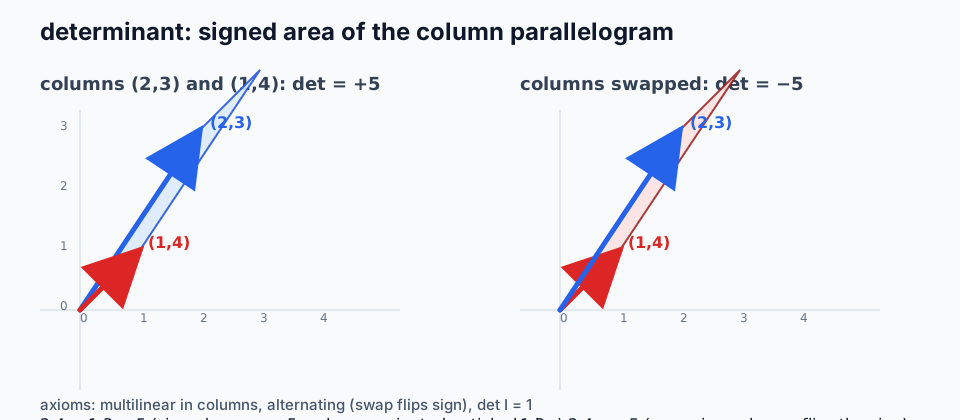
The right panel shows the same two columns with their order swapped. The parallelogram is the same shape, but the orientation now sweeps the other way around: the signed area is . Swapping two columns flips the sign of the determinant.
Worked example [Beginner]
Compute the determinant of the two-by-two block
The rule for a two-by-two block is , where and are the entries on the main diagonal and and the entries on the other diagonal. Multiply the diagonal entries: . Multiply the off-diagonal entries: . Subtract: .
Read the same number geometrically. The first column is the arrow , the second column is the arrow . The two arrows are not parallel, so they outline a parallelogram in the plane. The signed area of that parallelogram, oriented by sweeping from the first column to the second anticlockwise, is .
Now swap the two columns to get the block with columns and . The rule gives . The parallelogram is the same shape, but the sweep is reversed, so the signed area picks up a minus sign.
What this tells us: the determinant of a two-by-two block is a single number that measures both how much area the columns enclose and which way the columns sweep. Multiply the diagonals, subtract the off-diagonals, and read the signed area.
Check your understanding [Beginner]
Formal definition [Intermediate+]
Let be a field and let denote the set of matrices with entries in . The standard data of this unit is a function that admits three equivalent definitions; each is taken as a starting point in some standard treatment, and the equivalence of the three is the first theorem of the subject.
Axiomatic characterisation. The function is the unique function that satisfies
(D1) multilinearity in the rows: for each row index , and for any matrices that differ only in row , the assignment is -linear;
(D2) alternation: if two distinct rows of coincide, then (equivalently in characteristic different from , swapping two rows flips the sign of );
(D3) normalisation: , where is the identity matrix.
The same axioms with "row" replaced by "column" yield the same function. This is the modern axiomatic presentation; see [textbooks-extra Calculus Vol.2 - Multi-Variable Calculus and Linear Algebra with Applications (Tom Apostol).pdf] Ch. 3 §3.1–§3.5 and [Artin, E. — Galois Theory].
Leibniz permutation-sum formula. Writing for the symmetric group on symbols and for the sign of a permutation,
The sum contains terms, each a signed product of entries chosen one per row and one per column.
Cofactor / Laplace expansion. Fix a row index . Write for the minor of , the determinant of the matrix obtained by deleting row and column from . The Laplace expansion along row is
The same formula with and exchanged gives the expansion along column . The factor is the cofactor of , written .
For , the determinant is the single entry: . For , all three definitions reduce to for . For , the Leibniz formula yields the standard six-term Sarrus expansion. See [quantum-well md/Mathematical foundations/Algebra/Linear Algebra and Matrix Theory/Determinants.md] for the matrix-group framing.
Notation. The determinant of is variously written , , or . The terms minor, cofactor, and adjugate (the transpose of the cofactor matrix) belong to the same family of derived data; the adjugate satisfies .
Counterexamples to common slips
- in general: multilinearity is in each row separately, holding the others fixed, not in the matrix as a whole. The two-by-two example gives while .
- , not : multilinearity in each of rows contributes a factor of .
- A determinant of does not say the matrix is the zero matrix; it says the columns (equivalently rows) are linearly dependent. The two-by-two matrix has determinant with no zero entries.
- The cofactor expansion uses the sign attached to the minor; the unsigned minor alone does not give the determinant.
Key theorem with proof [Intermediate+]
Theorem (multiplicativity). Let . Then
[textbooks-extra Calculus Vol.2 - Multi-Variable Calculus and Linear Algebra with Applications (Tom Apostol).pdf]
Proof. Fix the matrix and define the function by . The plan is to show that satisfies axioms (D1) and (D2) of the axiomatic characterisation, conclude that for some scalar depending only on , and pin down by evaluating at .
Multilinearity of in the rows of . The -th row of is the linear combination . Hence the assignment is -linear with the other rows of held fixed. Composing with the determinant, which is multilinear in the rows of by axiom (D1) applied to , gives that is -linear with the other rows of held fixed. The same holds for every row index , so satisfies (D1).
Alternation of in the rows of . If two rows of coincide, say row and row , then the corresponding rows of also coincide, since each is the same linear combination of the rows of . Hence by axiom (D2) applied to , and so . The function satisfies (D2).
Pin down the scalar. Multilinearity (D1) and alternation (D2) together imply that any function satisfying both is determined by its value on the identity; concretely, expansion of in the standard basis of rows reduces the value to a sum of values of on row-permutation matrices, each of which equals by alternation. Apply this to : there exists a scalar such that for every . Evaluate at :
So , and . Substituting back,
Corollary (invertibility). A square matrix is invertible if and only if . When invertible, .
Proof. Suppose is invertible with inverse . Apply multiplicativity to the identity :
The product of two field elements equals , so neither factor can be ; in particular and .
Conversely, suppose . The columns of , viewed as vectors in , are then linearly independent: if a linear dependence held with not all zero, then one column could be written in terms of the others, the matrix would have a column equal to a linear combination of the rest, and multilinearity together with alternation would force . Linear independence of vectors in is equivalent (by 01.01.05) to the linear map defined by left-multiplication by being injective; in finite-dimensional spaces, injectivity is equivalent to surjectivity, hence to bijectivity, hence to invertibility of .
Bridge. Multiplicativity is the load-bearing identity from which essentially every property of the determinant flows, and the axiomatic proof above is the canonical route to it. First synthesis: the determinant is a group homomorphism from the general linear group to the multiplicative group of the field; the kernel is the special linear group , and the short exact sequence is the structural identity that organises the linear-group strand. Second synthesis: combined with the corollary, multiplicativity reduces solving the linear system to inverting a single scalar — Cramer's rule expresses , where is with column replaced by , recovering the explicit-formula content of invertibility. Third synthesis: the same multiplicativity yields the change-of-variables Jacobian in multivariable integration; the geometric content is that a diffeomorphism scales infinitesimal volume by , and the multiplicativity identity becomes the chain rule for that scaling under composition of diffeomorphisms. Fourth synthesis: passing to characteristic-polynomial language, packages the eigenvalue spectrum of as the roots of a degree- polynomial, with the determinant recording the constant term and the trace recording the next-to-leading coefficient; the determinant-and-trace pair generates all symmetric polynomials in the eigenvalues by the Newton identities, so every coordinate-free invariant of a linear operator is a polynomial in and of its iterates.
Exercises [Intermediate+]
Lean formalization [Intermediate+]
Mathlib packages the determinant as Matrix.det, the Leibniz formula as Matrix.det_apply, multilinearity and alternation in the rows as Matrix.det_updateRow_* together with Matrix.det_smul_row and Matrix.det_swap_rows, multiplicativity as Matrix.det_mul, and the invertibility-iff-non-vanishing characterisation as Matrix.isUnit_iff_isUnit_det. The companion file Codex.Foundations.LinearAlgebra.Determinant records the statements used above and packages the multiplicativity identity in the Codex namespace.
This unit is marked lean_status: partial because Mathlib supplies every named ingredient — Matrix.det, the Leibniz formula Matrix.det_apply, the multilinearity / alternation lemmas, multiplicativity Matrix.det_mul, and the invertibility characterisation Matrix.isUnit_iff_isUnit_det — but the unified axiomatic uniqueness theorem, together with the determinant-line-bundle generalisation beyond Matrix.det, is not packaged as a single named module; the corresponding statement in the companion module is left as a sorry-gated alias.
Advanced results [Master]
Exterior-power realisation. Let be an -dimensional -vector space. The -th exterior power is one-dimensional; fixing an isomorphism is equivalent to choosing an orientation. A linear endomorphism induces a linear endomorphism , which under the chosen isomorphism is multiplication by a scalar. That scalar is . Multilinearity and alternation of in the rows are the statement that is a multilinear alternating functor of the rows of ; normalisation is the statement that . The axiomatic characterisation of the determinant is therefore the universal property of the top exterior power. See [Bourbaki, N. — Algèbre, Ch. III: Algèbre tensorielle, algèbre symétrique, algèbre extérieure].
Determinant line bundle. For a finite-rank vector bundle over a base (the geometric framing reached in 03.05.02), the assignment is a line bundle , the determinant line bundle. Vector bundle morphisms over induce line bundle morphisms . The first Chern class equals ; the top scalar invariant of is recorded entirely by its determinant line. Orientation of corresponds to a global nowhere-vanishing section of ; a determinant line bundle without such a section is the obstruction to orientability.
Characteristic polynomial and eigenvalue spectrum. The polynomial is monic of degree , and its roots in an algebraic closure are the eigenvalues of with algebraic multiplicity. Two scalar invariants are immediate from the coefficients: , so is the sum of eigenvalues with multiplicity and is the product. The Newton identities express every symmetric polynomial in the eigenvalues as a polynomial in the traces , which by the Cayley-Hamilton identity are polynomials in and alone (for ) or more generally in the elementary symmetric polynomials of the eigenvalues.
Computational complexity. Three algorithms compute for over a field in which arithmetic is constant-time:
- Naïve Leibniz: field operations from the permutations, each contributing multiplications and one addition.
- Cofactor recursion: , hence , no improvement asymptotically.
- LU decomposition / Gaussian elimination: field operations, using for unit-lower-triangular and upper-triangular . The decomposition exists when no pivot vanishes, and partial pivoting handles the remaining case.
Strassen-style fast matrix multiplication gives matrix multiplication with (currently via Coppersmith-Winograd-Le Gall-Vassilevska Williams refinements). Bunch-Hopcroft (1974) showed that LU decomposition reduces to matrix multiplication in the same complexity, so is computable in field operations. Over , bit-complexity bounds are sharper via modular reduction.
Special-form determinants.
- Vandermonde determinant. . The right-hand side vanishes iff two of the coincide, recovering the geometric statement that the vectors in are linearly dependent iff a coincidence occurs.
- Cauchy determinant. , when all .
- Pfaffian and skew-symmetric matrices. For an antisymmetric matrix of even size (so ), there is a polynomial , the Pfaffian, of degree , satisfying and . Antisymmetric matrices of odd size have determinant .
- Circulant matrix. A circulant matrix with first row has determinant , where is a primitive -th root of unity. The eigenvalues are the discrete Fourier transform of the first row.
Smith normal form over a PID. Over a principal ideal domain , every matrix admits a Smith normal form , with , , and diagonal with diagonal entries , the elementary divisors of . When is square and invertible over the fraction field, equals the product up to a unit of . Smith normal form recovers the structure theorem for finitely generated modules over a PID, and the determinant records the product of elementary divisors.
Synthesis. Several threads weave together. First synthesis — the determinant as the universal alternating multilinear functional: axioms (D1)–(D3) characterise as the unique such object, and this characterisation is the reason every coordinate-free identity it satisfies is structurally inevitable rather than computationally lucky. Second synthesis — the determinant as group homomorphism: is a surjective group homomorphism with kernel , giving the structural decomposition of the general linear group and the algebraic-K-theoretic identification in the lowest dimension. Third synthesis — the determinant as local volume scale: under a change of variables , infinitesimal volume scales by , the chain rule becomes the multiplicativity identity , and the change-of-variables formula in multivariable integration is the integrated form of that pointwise identity. Fourth synthesis — the determinant as top characteristic class: for a finite-rank vector bundle, the determinant line bundle is the universal target of the first Chern class, and the determinant of a bundle map is the section of the determinant line bundle that records the obstruction to invertibility. Fifth synthesis — the determinant as Pfaffian-squared: for antisymmetric matrices the determinant is a perfect square in the entries, and the square-root Pfaffian is the more refined invariant; this is the prototype for square-root-of-determinant phenomena in spin geometry and in the index theorem for Dirac operators.
Full proof set [Master]
Axiomatic uniqueness theorem. Let satisfy (D1) multilinearity in rows, (D2) alternation, and (D3) . Then . The proof has two parts: first, that is determined by its values on permutation matrices; second, that those values are the signatures of the corresponding permutations.
Write a matrix row by row, with . Expand each in the standard basis of : . Multilinearity (D1) in each row separately expands
a sum over all index sequences. Alternation (D2) implies whenever two of the coincide, leaving only the sequences that form a permutation; write with :
It remains to compute on the permutation matrix . Alternation implies that swapping two rows of any matrix flips the sign of : if rows and are swapped, write for the swapped matrix and apply multilinearity to the matrix with both rows equal to , which has -value by alternation; expanding gives , so . Hence by (D3). Substituting, , the Leibniz formula, so on every .
Equivalence of Leibniz and Laplace. Fix a row index . Group the terms in the Leibniz sum by the value :
The inner sum runs over permutations with ; restricting to gives a bijection to on the index set . The sign of relates to the sign of its restriction by an extra , the number of inversions introduced by moving to its proper position. The inner sum is therefore , where is the minor of obtained by deleting row and column . Substituting, , the Laplace expansion along row .
Adjugate identity. Define the adjugate by (note the transpose). Then .
Compute the entry of :
For , this is the Laplace expansion of along row , giving . For , this is the Laplace expansion along row of the matrix obtained from by replacing row with row ; since has two equal rows (row and row ), alternation gives . Hence the matrix product is . When , dividing yields , the closed-form inverse.
Cayley-Hamilton via the adjugate. The characteristic polynomial is a polynomial of degree in with matrix-valued coefficients in the adjugate computation. Working in the polynomial ring , the adjugate of has entries that are polynomials of degree at most in , and the adjugate identity gives
Write with . Substituting and equating coefficients of like powers of on both sides gives the system
where . Multiply the -th identity by and sum:
and the telescoping on the left yields , so as a matrix identity.
Vandermonde determinant by row reduction. Let . Subtract from each column (starting at the rightmost) times the column to its left. Each resulting entry in row , column , for , becomes . Row becomes . Expand along the first row: only the entry contributes, yielding
Factor from row for each :
The remaining matrix is the Vandermonde of size on parameters . Induction on gives . The base case is .
Block-triangular determinant. Recorded in Exercise 6; the proof is the Leibniz-formula factorisation given there. The same argument extends by induction to blocks.
Pfaffian-squared identity. Stated without proof; one route uses the exterior-algebra realisation of an antisymmetric form on of dimension . The top exterior power is a scalar multiple of the orientation, and that scalar is when is the matrix of in an orientation-compatible basis; squaring gives . The full proof is the content of the multilinear-algebra strand and is reached in 01.01.10 pending / 03.01.04. See [Bourbaki, N. — Algèbre, Ch. III: Algèbre tensorielle, algèbre symétrique, algèbre extérieure].
Connections [Master]
Linear transformation, kernel, image, rank-nullity
01.01.05— provides the equivalence between invertibility of a square matrix and full rank of the associated linear map. The determinant test records the same condition via the axiomatic alternating property: a dependence among columns forces the determinant to zero, and conversely a non-zero determinant rules out dependence and so forces the kernel to consist of the zero vector alone. The corollary " invertible iff " is therefore the determinant-side dual of the rank-nullity criterion for invertibility.Eigenvalue, eigenvector, characteristic polynomial
01.01.08— the characteristic polynomial is the determinant of a -shifted matrix whose roots are the eigenvalues of . Determinant multiplicativity gives the similarity-invariance , so the eigenvalue spectrum is an intrinsic invariant of the operator class. The two extreme coefficients are the trace and the determinant , the sum and product of the eigenvalues respectively.Differential forms
03.04.02— the determinant is the coordinate expression of the action of a linear endomorphism on the top exterior power. A top differential form on an -dimensional manifold pulls back along a smooth map to in local coordinates, where is the Jacobian matrix; this is the differential-forms incarnation of the determinant as local volume scale.Integration on manifolds
03.04.03— the change-of-variables formula for a diffeomorphism rests on the determinant as the scaling factor of -dimensional Lebesgue measure under a linear transformation. Multiplicativity of corresponds to the chain rule for Jacobians, and the change-of-variables formula is the integrated pointwise identity.Vector bundle
03.05.02— the determinant line bundle assembles the fibrewise top exterior power into a globally defined line bundle. The first Chern class is the topological invariant carried by the determinant line; the existence of a global trivialisation of is equivalent to orientability of , and a smooth nowhere-vanishing section of is an orientation.Lie group
03.03.01— the determinant is the structural homomorphism presenting as its kernel. At the Lie-algebra level this is the trace with kernel , and the linearised relation tracks the determinant of one-parameter subgroups of via the trace of the generator.
Historical & philosophical context [Master]
The determinant predates the matrix. Seki Takakazu in Japan (manuscript circulated 1683, Kai Fukudai no Ho) and Gottfried Wilhelm Leibniz in Hanover (letter to L'Hôpital, 28 April 1693) independently developed the determinant as a tool for the elimination of variables from systems of linear equations a century before the matrix entered the literature. Gabriel Cramer's Introduction à l'analyse des lignes courbes algébriques (Geneva, 1750) gave the determinant-quotient formula now bearing his name without using the word determinant. Alexandre-Théophile Vandermonde, in Mémoire sur l'élimination (Histoire de l'Académie Royale des Sciences, 1771), introduced the determinant treated as a function in its own right and computed the special-form determinant that bears his name [Cauchy, A.-L. — Mémoire sur les fonctions qui ne peuvent obtenir que deux valeurs égales et de signes contraires par suite des transpositions opérées entre les variables qu'elles renferment].
Augustin-Louis Cauchy's 1815 memoir in the Journal de l'École Polytechnique unified the existing fragments — Vandermonde, Laplace's 1772 expansion in the Recherches sur le calcul intégral, Bézout's resultant — into a single theory of "fonctions symétriques alternées", the alternating multilinear functions of which the determinant is the canonical case. Cauchy proved multiplicativity, gave the Laplace expansion in modern form, and computed many special determinants including the resultant of two polynomials. The vocabulary "determinant" entered the literature with Carl Friedrich Gauss in Disquisitiones Arithmeticae (Leipzig, 1801, §171) in the binary-quadratic-form sense; the modern matrix-determinant sense crystallised through Cauchy and Carl Gustav Jacob Jacobi in the 1820s and 1830s. Arthur Cayley's A memoir on the theory of matrices (Philosophical Transactions of the Royal Society 148, 1858, 17–37) introduced matrix notation and matrix multiplication, retroactively turning the determinant into a function of a single matrix rather than a function of an array of arguments [Cayley, A. — A memoir on the theory of matrices].
Karl Weierstrass and Leopold Kronecker, lecturing in Berlin in the 1870s, gave the first axiomatic presentation: the determinant as the unique multilinear alternating normalised function. The presentation was perfected and disseminated by Emil Artin in his Notre Dame lectures of 1942, published as Galois Theory in 1944, where the determinant is developed in an appendix from exactly the three axioms (D1)–(D3) used in this unit [Artin, E. — Galois Theory]. The Bourbaki Algèbre, Chapter III (Hermann, Paris, 1948), recast the determinant as a special case of the universal property of the top exterior power, embedding it permanently in multilinear algebra [Bourbaki, N. — Algèbre, Ch. III: Algèbre tensorielle, algèbre symétrique, algèbre extérieure]. The exterior-algebra framing is the modern presentation and the one that generalises cleanly to vector bundles, super-vector-spaces, and the various flavours of non-commutative determinant (Dieudonné determinant, quantum determinant, Berezinian) that arose in the second half of the twentieth century.
Bibliography [Master]
Seki, T., Kai Fukudai no Ho (manuscript circulated 1683, published posthumously in collected works); reproduced in Hayashi, T. (ed.), Takakazu Seki's Collected Works, Osaka, 1974.
Leibniz, G. W., Letter to L'Hôpital, 28 April 1693, in Mathematische Schriften, ed. C. I. Gerhardt, Berlin, 1850–1863, Vol. II, 229.
Cramer, G., Introduction à l'analyse des lignes courbes algébriques, Frères Cramer & Cl. Philibert, Geneva, 1750.
Vandermonde, A.-T., "Mémoire sur l'élimination", Histoire de l'Académie Royale des Sciences, Paris, 1771 (published 1774), 516–532.
Laplace, P.-S., "Recherches sur le calcul intégral et sur le système du monde", Histoire de l'Académie Royale des Sciences, Paris, 1772, 267–376 (cofactor expansion).
Gauss, C. F., Disquisitiones Arithmeticae, Gerh. Fleischer Jun., Leipzig, 1801.
Cauchy, A.-L., "Mémoire sur les fonctions qui ne peuvent obtenir que deux valeurs égales et de signes contraires par suite des transpositions opérées entre les variables qu'elles renferment", Journal de l'École Polytechnique 10 (1815), 29–112.
Jacobi, C. G. J., "De formatione et proprietatibus determinantium", Journal für die reine und angewandte Mathematik 22 (1841), 285–318.
Cayley, A., "A memoir on the theory of matrices", Philosophical Transactions of the Royal Society of London 148 (1858), 17–37.
Bunch, J. R. & Hopcroft, J. E., "Triangular factorization and inversion by fast matrix multiplication", Mathematics of Computation 28 (1974), 231–236.
Artin, E., Galois Theory, Notre Dame Mathematical Lectures No. 2, University of Notre Dame Press, 1942; 2nd ed. 1944.
Bourbaki, N., Algèbre, Chapter III: Algèbre tensorielle, algèbre symétrique, algèbre extérieure, Hermann, Paris, 1948; 2nd ed. 1970.
Apostol, T. M., Calculus, Vol. 2: Multi-Variable Calculus and Linear Algebra with Applications, 2nd ed., John Wiley & Sons, 1969, Ch. 3.
Hoffman, K. & Kunze, R., Linear Algebra, 2nd ed., Prentice-Hall, 1971, Ch. 5.
Axler, S., Linear Algebra Done Right, 3rd ed., Springer, 2015, Ch. 10.
Autonomous production unit. Successor to linear-transformation / rank-nullity; load-bearing for eigenvalues and the characteristic polynomial, for the change-of-variables Jacobian in multivariable calculus, for the top differential form on , and for the determinant line bundle in geometry.