Differential forms
Anchor (Master): Bott-Tu — Differential Forms in Algebraic Topology; Lee Ch. 11–14; Spivak Vol. I
Intuition [Beginner]
A differential form is something you can integrate over a region of a manifold of the right dimension. A 1-form integrates over curves. A 2-form integrates over surfaces. A -form integrates over -dimensional regions.
The basic idea: a differential form is a measurement device that takes tangent directions at a point and returns a number, in a way that flips sign when you swap two of the directions (antisymmetry). Antisymmetry is what makes integration well-defined and orientation-sensitive.
In ordinary multivariable calculus, you've seen 1-forms in disguise as for line integrals, and 2-forms as for area integrals. Differential forms package these into a single algebraic-geometric object that works on any smooth manifold of any dimension.
The exterior derivative takes a -form to a -form. Stokes's theorem then says: integrating a form over a boundary equals integrating its derivative over the interior — generalising the fundamental theorem of calculus, the divergence theorem, and Green's theorem all at once.
Visual [Beginner]
A small region of a curved surface. A 2-form assigns a signed area to each parallelogram of tangent vectors. The orientation comes built in: swapping the two tangent vectors negates the value.
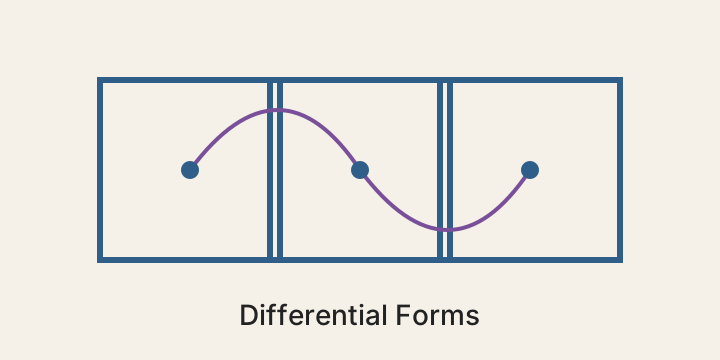
Integration over a region adds these local signed areas, weighted by the form. Smooth deformations of the form change the integral predictably; that predictability is what makes Stokes's theorem possible.
Worked example [Beginner]
In 2-dimensional flat space with coordinates , the 1-form is the angular form: it measures change in angle.
Integrate around the unit circle, parametrised as for . At each point on the circle, and . Substitute:
Integrate from to : total .
So this 1-form integrates to around any loop encircling the origin once — and it integrates to around any loop not enclosing the origin (because is closed away from the origin: there). The records the topological winding number of the loop.
Check your understanding [Beginner]
Formal definition [Intermediate+]
Let be a smooth -manifold 03.02.01. The cotangent space at is the dual of the tangent space — the space of linear functionals . The cotangent bundle is a smooth -manifold (the rigorous construction uses the smooth structure on dualised fibrewise).
A differential -form on is a smooth section of the -th exterior power . Equivalently, is a smooth field of alternating multilinear maps ( inputs, antisymmetric under permutation of any two), varying smoothly with .
In a local chart with coordinates , a -form has the local expression
where the are smooth functions and is the wedge product (the alternating tensor product).
The wedge product is bilinear, associative, and graded-commutative: for , .
The exterior derivative is the unique linear operator satisfying:
- On 0-forms (smooth functions) , is the differential: .
- Graded Leibniz rule: for .
- : for every form .
These three properties uniquely determine . Locally, is given by
A form is closed if and exact if for some . By , every exact form is closed; the converse fails in general, and the failure is captured by de Rham cohomology 03.04.06.
Key theorem with proof [Intermediate+]
Theorem (). For every differential form on a smooth manifold , .
Proof. It suffices to verify in a single chart, by the patching property of forms. In local coordinates , take (a single-summand form; the general case follows by linearity).
Apply once:
Apply again:
Now use two facts:
- Symmetry of mixed partials: (Schwarz / Clairaut; valid for functions).
- Antisymmetry of wedge: .
For each unordered pair with , the contributions from and are
using both facts. The diagonal contributions () vanish because . So in this chart, and by patching, on all of .
The identity is the structural foundation of de Rham cohomology. It says that exact forms are automatically closed, so the inclusion is well-defined; the quotient is the -th de Rham cohomology group.
Bridge. The construction here builds toward 03.04.03 (integration on manifolds), where the same data is upgraded, and the symmetry side is taken up in 03.04.06 (de rham cohomology). The defining pattern appears again in those units in a sharpened form, where the local data is glued or quotiented. Putting these together, the foundational insight is that the data of this unit gives the structural signature that the rest of the strand reads off.
Exercises [Intermediate+]
Lean formalization [Intermediate+]
lean_status: partial — Mathlib has DifferentialForm, ExteriorAlgebra, and the de Rham complex via Mathlib.Geometry.Manifold.MFDeriv and related files. The Codex companion module records the conventions.
Mathlib's coverage of full -form theory is partial; basic differential calculus on manifolds is in place, full exterior calculus and Stokes's theorem are works in progress.
Advanced results [Master]
Stokes's theorem. For an oriented smooth -manifold with boundary and a compactly supported -form ,
This is the geometric structural theorem of differential calculus on manifolds, generalising the fundamental theorem of calculus, Green's theorem, the divergence theorem, and the classical Stokes's theorem (curl form) all at once.
Poincaré lemma. On a star-shaped open set , every closed form is exact: if on , then for some on . The proof uses the cone construction (homotopy operator). The Poincaré lemma is the local triviality of the de Rham complex; non-triviality is global, captured by de Rham cohomology 03.04.06.
Cartan magic formula. , where is the Lie derivative along a vector field and is the interior product (contraction with ). This relates the three fundamental operations on forms: , , .
Hodge theory. On a closed oriented Riemannian manifold , there is a -operator (Hodge star) and an inner product on each . The codifferential gives a Laplacian , and Hodge's theorem decomposes as harmonic + exact + co-exact. Each de Rham cohomology class has a unique harmonic representative.
Connection to characteristic classes. Curvature 2-forms of connections 03.05.09 are 2-forms valued in adjoint bundles. Invariant polynomials 03.06.05 of curvature give scalar 2k-forms representing characteristic classes 03.06.04.
Synthesis. This construction generalises the pattern fixed in 03.02.01 (smooth manifold), with the symmetric data replaced by its skew or twisted analogue. Read in the opposite direction, the construction is dual to the metric story: complements and orthogonality are taken with respect to the bilinear datum of this unit, not a metric, and the resulting category of subobjects is the one the rest of the strand classifies. The central insight is that this datum identifies algebra with geometry: functions become vector fields, subspaces become quotients, and invariants become cohomology classes — and that identification is the engine driving every theorem downstream.
Full proof set [Master]
. Proved in §"Key theorem".
Existence and uniqueness of . Existence: define in coordinates by and verify on overlaps that the definitions agree (the chain rule plus antisymmetry of wedge). Uniqueness: shown in Exercise 6.
Pullback compatibility. Proved in Exercise 5.
Stokes's theorem (sketch). Use a partition of unity to reduce to forms supported in a single chart; in a chart, reduce to the case where is a half-space ; in that case, both sides reduce to integrals of partial derivatives via the fundamental theorem of calculus. The boundary contribution survives at the boundary face .
Poincaré lemma. On a star-shaped around the origin, define the homotopy operator by
Verify that on positive-degree forms. So if , then , exhibiting as exact.
Cartan magic formula. Compute on coordinate basis forms; both sides agree on (giving ) and on (giving and via Lie derivative on functions); the formula extends to all forms by linearity, the graded Leibniz rule, and induction on form degree.
Connections [Master]
Smooth manifold
03.02.01— the underlying geometric setting.Vector space
01.01.03— fibres of the cotangent and exterior bundles.De Rham cohomology
03.04.06— closed forms modulo exact forms.Integration on manifolds
03.04.03— what differential forms are designed for.Variational calculus on manifolds
03.04.08— Lagrangians as differential forms.Connections and curvature
03.05.04,03.05.07,03.05.09— connection 1-forms and curvature 2-forms.Chern-Weil homomorphism
03.06.06— invariant polynomials evaluated on curvature 2-forms produce closed scalar forms.Yang-Mills action
03.07.05— squared norm of a curvature 2-form.
Historical & philosophical context [Master]
Differential forms in their modern abstract form are due to Élie Cartan (1899–1908), who introduced the exterior calculus to clarify the integrability conditions for systems of partial differential equations. The connection to topology was made by Georges de Rham (1931), whose theorem identifying real cohomology with closed-modulo-exact forms made the analytic computation of cohomology possible.
In the mid-twentieth century, Cartan's calculus became the standard language for differential geometry, gauge theory, and mathematical physics. Hodge theory (1941) refined the theory on Riemannian manifolds. Bott-Tu's monograph (1982) systematised the relationship to algebraic topology, and the Stolz-Teichner programme on elliptic cohomology (2000s) extended differential-form thinking into the highest reaches of algebraic topology.
Exterior calculus is also the working language of modern theoretical physics: gauge fields are connection 1-forms, field strengths are curvatures (2-forms), action functionals are -forms integrated over spacetime, and conservation laws are statements about closed forms.
Bibliography [Master]
- Bott, R. & Tu, L. W., Differential Forms in Algebraic Topology, Springer GTM 82, 1982.
- Madsen, I. & Tornehave, J., From Calculus to Cohomology, Cambridge University Press, 1997.
- Spivak, M., A Comprehensive Introduction to Differential Geometry, Vol. I, Publish or Perish, 1979.
- Lee, J. M., Introduction to Smooth Manifolds, 2nd ed., Springer GTM 218, 2013.
- Cartan, H., Differential Forms, Hermann, 1970.
Wave 3 Phase 3.1 unit #2. Differential forms — the essential geometric calculus on smooth manifolds; foundation for de Rham cohomology, integration, characteristic classes, and gauge theory.