Ideal in an algebra
Anchor (Master): Lang Algebra §III §6; Atiyah-Macdonald §1
Intuition [Beginner]
An ideal is a special kind of subspace inside an algebra. It is closed under addition, and it absorbs multiplication by algebra elements.
Think of a sponge inside a bucket. If an element is in the ideal, multiplying it by anything from the surrounding algebra still keeps the result inside the ideal. The ideal is built to be collapsed safely.
Ideals matter because quotient algebras use them to impose equations. If the ideal is declared to be zero, multiplication still makes sense.
Visual [Beginner]
The smaller region is the ideal. Multiplication from the larger algebra points back into it.
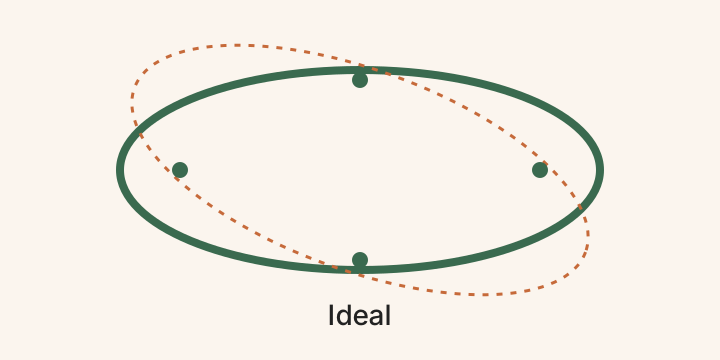
Absorption is what makes ideals stronger than ordinary subspaces.
Worked example [Beginner]
Look at all ordinary polynomials, and focus on the polynomials that have a factor of .
The polynomial is in this collection. So is . Adding them gives , still with a factor of .
Multiplying by any other polynomial still leaves a factor of .
What this tells us: an ideal is a collection stable under addition and under multiplication by outside algebra elements.
Check your understanding [Beginner]
Formal definition [Intermediate+]
Let be an associative -algebra 03.01.02. A left ideal is a vector subspace such that for every . A right ideal satisfies for every .
A two-sided ideal is both a left ideal and a right ideal. Equivalently, is a vector subspace such that
for all and [Lang §III §6].
If is commutative, left, right, and two-sided ideals coincide. In noncommutative algebras, the distinction is essential.
Key theorem with proof [Intermediate+]
Theorem (kernel ideal). Let be a homomorphism of associative -algebras. Then is a two-sided ideal of .
Proof. Since is linear, is a vector subspace. Let and . Then . Multiplicativity gives
so . Similarly,
so . Hence is a two-sided ideal.
Bridge. The construction here builds toward 03.01.05 (quotient algebra), where the same data is upgraded, and the symmetry side is taken up in 03.09.02 (clifford algebra). The defining pattern appears again in those units in a sharpened form, where the local data is glued or quotiented. Putting these together, the foundational insight is that the data of this unit gives the structural signature that the rest of the strand reads off.
Exercises [Intermediate+]
Lean formalization [Intermediate+]
[object Promise]Advanced results [Master]
Two-sided ideals in an associative algebra are the congruence data for quotient algebras. If , the vector-space quotient carries multiplication
because the two-sided ideal condition absorbs all representative changes [Atiyah-Macdonald §1].
Ideals also organize representation theory. If is a representation, then is a two-sided ideal. Faithful representations are precisely those with zero kernel.
For commutative algebras, ideals encode geometry: maximal ideals behave like points, prime ideals behave like irreducible loci, and quotient algebras impose equations. This viewpoint later supports characteristic-class examples through polynomial and invariant algebras.
Synthesis. This construction generalises the pattern fixed in 03.01.02 (associative algebra), with the symmetric data replaced by its skew or twisted analogue. Read in the opposite direction, the construction is dual to the metric story: complements and orthogonality are taken with respect to the bilinear datum of this unit, not a metric, and the resulting category of subobjects is the one the rest of the strand classifies. The central insight is that this datum identifies algebra with geometry: functions become vector fields, subspaces become quotients, and invariants become cohomology classes — and that identification is the engine driving every theorem downstream.
Full proof set [Master]
Proposition (well-defined quotient multiplication). Let be a two-sided ideal in . The rule is independent of representatives.
If and with , then
Since is a right ideal, . Since is a left ideal, . Since and is a right ideal, . Hence , so .
Proposition. The preimage of a two-sided ideal under an algebra homomorphism is a two-sided ideal.
Let and let . The preimage is a subspace by linearity. If and , then and because is two-sided. Thus .
Connections [Master]
Quotient algebra
03.01.05is built by collapsing a two-sided ideal.Associative algebra
03.01.02supplies the multiplication that ideals must absorb.Tensor algebra
03.01.04produces free algebras whose ideals impose relations.Clifford algebra
03.09.02is a quotient of tensor algebra by the ideal generated by quadratic relations.
Historical & philosophical context [Master]
Ideals entered algebra through Kummer's ideal numbers and Dedekind's reconstruction of divisibility in algebraic number theory. The term later became part of the general language of rings and algebras, where ideals replace normal subgroups as the correct quotient data [Atiyah-Macdonald §1].
Lang treats ideals as the kernel-like subobjects for rings and algebras, the form needed for quotient constructions and homomorphism theorems [Lang §III §6].