Clifford algebra
Anchor (Master): Lawson & Michelsohn — Spin Geometry §I.1
Intuition [Beginner]
You've already met multiplication that knows about geometry. Multiply two complex numbers — say — and the result encodes both how their lengths multiply and how their angles add. The whole trick is one rule: . From that single relation, all of 2D rotation falls out.
Now ask: is there a 3D version? In 1843, William Rowan Hamilton walked across a Dublin bridge wrestling with this question, and the answer hit him hard enough that he carved it into the stone of the bridge:
These are the quaternions — three "imaginary units" with anticommuting multiplication, and they handle 3D rotations the way complex numbers handle 2D rotations. Game engines and aerospace controllers use them every day.
A pattern is emerging. In each case, vectors aren't just things you add — they also multiply, and the rule is forced by the geometry of the space they live in.
The Clifford algebra is the systematic answer to "what's that rule, in general?"
The one-line definition: given any vector space with a notion of length, the Clifford algebra is the smallest associative algebra in which vectors multiply, with one rule —
A unit vector squares to . Two perpendicular unit vectors anticommute (because implies ).
Everything else — quaternions, the Pauli matrices in quantum mechanics, the gamma matrices for Dirac spinors, the way rotations factor into reflections — is a special case of this one rule. When you see a Clifford algebra, you're seeing the natural multiplication on a space that knows how to measure things.
Visual [Beginner]
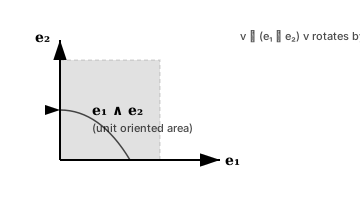
Picture two perpendicular unit arrows in the plane: pointing east, pointing north. In ordinary linear algebra they're just basis vectors and there's nothing more to say.
In a Clifford algebra, you can multiply them. The product is something new — not a number, not a vector, but an oriented unit area, a "bivector." Read it as "the unit square swept from toward ."
Now the punchline: , and using plus this simplifies to . The bivector squares to — the same rule as in the complex numbers.
That's not a coincidence. Multiplying by the unit bivector rotates a vector by 90 degrees in the – plane. Two such multiplications take you 180 degrees, which sends a vector to its negative — so .
The Clifford algebra has a built-in geometry for "rotation as multiplication" that scales to any number of dimensions.
Worked example [Beginner]
Compute in the smallest interesting Clifford algebra: take the plane with its usual length, and write for the standard basis vectors. The Clifford algebra rule says
The third equation rearranges to — the two basis vectors anticommute.
What lives in this algebra? Take — these are linearly independent (you can check), and any product of 's and 's reduces to one of these four. So our Clifford algebra has dimension 4 over the reals, with basis .
Now compute :
So the bivector squares to — it behaves exactly like the imaginary unit. Let . Then the subalgebra spanned by inside our Clifford algebra is the field of complex numbers .
This is the punchline made concrete: the complex numbers live inside the 2D Clifford algebra as the "even part."
Multiplying any vector by from the left gives
which is exactly the same rotation by 90° you'd get from multiplying by in the complex numbers. The Clifford algebra recovers complex multiplication, and exposes that the "imaginary unit" is geometrically the unit oriented area.
In three dimensions, the same construction gives the quaternions, with , , , and , . Hamilton's relations are forced by the Clifford algebra.
Check your understanding [Beginner]
Formal definition [Intermediate+]
Let be a finite-dimensional vector space over a field with . We work over or throughout. Equip with a symmetric bilinear form , with associated quadratic form . In characteristic different from two the two are interchangeable through the polarisation identity
and we will use whichever is more natural at each step.
We adopt the Lawson-Michelsohn sign convention throughout: a vector acts on the Clifford algebra by . The opposite sign convention is standard in physics and exchanges with in the classification table below; no essential algebraic structure depends on the choice. As always with sign conventions: state it before computing.
The Clifford algebra is then defined as the quotient
where is the tensor algebra of [Sternberg §1.8.3] and is the two-sided ideal generated by the elements for . The defining ideal lives in degrees , which is what permits the deformation interpretation below. The universal property characterising up to unique isomorphism is then proved, not assumed — see the next section.
Polarising the defining relation in gives the equivalent fundamental relation
with denoting Clifford multiplication. When vanishes, collapses to the ideal generated by pure squares and the quotient is the exterior algebra . The Clifford algebra is therefore a flat deformation of the exterior algebra controlled by the quadratic form — a perspective that becomes precise when we examine the associated graded below.
The tensor-degree -grading of does not descend, since identifies a degree-2 element with a scalar; what survives is the -grading by parity (treated below). The fundamental relation makes the anticommutator of two vectors a scalar, but the commutator does not vanish in general; it is this noncommutativity that lets encode rotations rather than shears.
We adopt the sign convention of Lawson-Michelsohn and Atiyah-Bott-Shapiro; Tong's lectures and most of the physics literature use [tong §4.1], under which . The construction is valid in any characteristic; in characteristic two the polarisation identity fails, but the dimension and the PBW basis below remain in force. The foundational reason deserves universal-property treatment is exactly that any algebra in which vectors square to is an instance of a quotient of by — putting these together gives the universal property.
Key theorem with proof [Intermediate+]
Theorem (Universal property of ). Let denote the composition . Then for any unital associative -algebra and any -linear map satisfying for all , there exists a unique -algebra homomorphism such that .
Proof. Existence of . The inclusion followed by the quotient map gives the linear map . Inside the quotient,
since . So itself satisfies .
By the universal property of the tensor algebra, the linear map extends uniquely to a -algebra map . Compute, for any generator of :
using the hypothesis . Hence , and descends to a unique -algebra map . Verifying : for , .
Uniqueness of . Any algebra map with must agree with on , hence on the subalgebra generated by , which is all of . ∎
Corollary (uniqueness of up to unique isomorphism). Suppose is another pair, with a -linear map satisfying , also satisfying the universal property. Apply the universal property of to to obtain with , and symmetrically with . The compositions and are both algebra maps satisfying , and uniqueness in the universal property forces them to coincide. The same argument on the other side gives . ∎
We invoke the universal property whenever a homomorphism out of is required: it suffices to define the map on in a way that respects the squaring relation. The presentation enters only to establish existence.
Bridge. Products of unit-norm vectors inside build toward 03.09.03 (spin group): the adjoint action recovers the orthogonal group, this is exactly the double cover , and globalising the lift across an oriented Riemannian manifold gives the spin structure 03.09.04. The same Clifford action turns into the Dirac operator 03.09.08 via ; the relation fixed here appears again in every theorem downstream. Putting these together, the foundational reason an order-one operator can square to a Laplacian is exactly this universal-property identity.
Structure: -grading, filtration, and basis [Intermediate+]
The map , , satisfies (using , automatic from quadratic-form-ness) and so extends by the universal property to a -algebra homomorphism . To check : on generators ; since is an algebra map agreeing with on the generating set , and generates as an algebra, .
Since , the involution has eigenspaces giving the -grading
where is the -eigenspace, with . The even part is itself a unital associative algebra; the odd part is a -bimodule.
Although the -grading of does not survive the quotient, the filtration does:
The associated graded algebra is canonically (this argument is characteristic-independent). This identifies with as a vector space, though not as an algebra. Concretely, if is a basis for , lifting the standard basis of along the filtration yields the -basis
for , of cardinality . So where , over any field .
Exercises [Intermediate+]
A graded set of exercises covering the universal property, structure, and elementary classification.
Real Clifford algebras and the ABS classification [Master]
Specialise to with quadratic form . Write for the resulting algebra. Under the LM convention , generators corresponding to positive coordinates square to and generators corresponding to negative coordinates square to :
The Atiyah-Bott-Shapiro classification [ABS §3], systematised in [Lawson-Michelsohn Table I.4.3], identifies each as a matrix algebra over , , or (or a direct sum of two such). The full LM chessboard, taking to and to :
| 0 | 1 | 2 | 3 | 4 | 5 | 6 | 7 | |
|---|---|---|---|---|---|---|---|---|
| 0 | ||||||||
| 1 | ||||||||
| 2 | ||||||||
| 3 | ||||||||
| 4 | ||||||||
| 5 | ||||||||
| 6 | ||||||||
| 7 |
For , the generator satisfies , so , in agreement with the table. The full derivation of every cell — and the chessboard's structural rules — lives in the dedicated unit 03.09.11 Clifford chessboard classification.
The pattern is governed by the bridging identity [Lawson-Michelsohn Proposition I.4.1]
together with the eight-fold periodicity [Lawson-Michelsohn Proposition I.4.2]
the algebraic shadow of real Bott periodicity. The bridging identity is an algebraic computation; we sketch it here.
Derivation of the bridging identity. Let be the standard generators of (, ), and let be the generators of (, ). Set . A direct computation gives and the anticommutators , . Define a linear map by
Each matches (computation: ), the anticommutators all hold, and the universal property of extends to an algebra homomorphism . A dimension count plus a check that the image generates establish that is an isomorphism. Full proof in 03.09.11.
Eight-fold periodicity. The same volume-element technique applied to the volume element — which is central, satisfies , and induces — combined with the substitution produces . Detailed argument in 03.09.11.
Atiyah, Bott, and Shapiro identify with the cokernel of the restriction map on Grothendieck groups of -graded Clifford modules; see [ABS §11.5] or [Lawson-Michelsohn Theorem I.9.27]. This Grothendieck-group quotient is the ABS module quotient, written in Lawson-Michelsohn — the bridge between the chessboard's algebraic periodicity and the topological periodicity of -theory.
Reversion and conjugation [Master]
Beyond the involution studied above, admits two further structural maps that distinguish it from a generic associative algebra: reversion and conjugation.
Reversion. The opposite-multiplication structure on the tensor algebra descends to as an antiautomorphism
Equivalently, is the unique -algebra antiautomorphism extending the identity on . Existence: define on as the antiautomorphism extending on generators, observe , hence descends. Idempotence: on generators, hence on the algebra they generate.
On a Clifford monomial of length , reversion just reverses the order:
where the sign comes from sorting the reversed monomial back into ascending order using for . The sign is the parity of the reversal permutation.
Conjugation. The composition — the two compositions agree because and commute — defines the Clifford conjugation, an antiautomorphism with and . On a Clifford monomial,
The Clifford conjugation is the operation that recovers the Clifford-algebraic norm of an element : define , which on a vector gives . So the Clifford-algebraic norm extends the quadratic form on to all of . The Pin group is recovered as .
The pair generates a finite group of involutions on : , isomorphic to . The fixed-point subalgebras of these involutions stratify in a way that becomes load-bearing for the spinor inner-product theory of 03.09.05.
Complex Clifford algebras [Master]
Over , the signature distinction collapses since every non-degenerate quadratic form is equivalent to . Write in Codex notation [notation crosswalk #4: Lawson-Michelsohn write the same algebra as in script font; we use the subscript-superscript form throughout for plain-text searchability, with both notations cited interchangeably]. The classification simplifies to a two-fold periodicity:
This is the algebraic shadow of complex Bott periodicity. The unique irreducible representation of on is the (complex) spinor representation; for odd , there are two irreducible representations of equal dimension, distinguished by the action of the volume element.
Complex Clifford algebras [Master]
Over , the signature distinction collapses since every non-degenerate quadratic form is equivalent to . Write . The classification simplifies to a two-fold periodicity:
This is the algebraic shadow of complex Bott periodicity. The unique irreducible representation of on is the (complex) spinor representation; for odd , there are two irreducible representations of equal dimension, distinguished by the action of the volume element.
The Pin and Spin groups [Master]
The Pin group is the subgroup of the unit group generated by all with . Concretely, it is the set of all products of unit-norm vectors. This set is closed under products (a product of products is a product) and under inverses (since , the inverse of a unit vector is , again a unit vector); hence it is a subgroup.
The Spin group is the index-2 subgroup of consisting of products of an even number of unit vectors, equivalently the intersection .
For with positive-definite , write and . The twisted adjoint action of on is
(The twist by is necessary; the untwisted adjoint does not preserve when is odd.) For a unit vector with , a direct computation gives, for any ,
i.e., reflection of in the hyperplane . Hence for is a product of reflections, which is precisely an element of . Restricting to (even products) lands in , giving the celebrated short exact sequence
[Lawson-Michelsohn §I.2.9]. The kernel is the centre. The sequence is exact for all ; is connected for and simply connected for , in which case the sequence is the universal cover of . Spin structures on a Riemannian manifold lift this cover globally — the subject of unit 03.09.04.
Connection to physics: gamma matrices and Dirac spinors [Master]
The physics literature works in Lorentzian signature with the opposite sign convention from LM, so and the gamma matrices satisfy
where [tong §4.2; ref: quantum-well md/Quantum Mechanics/Quantum Field Theory/Relativistic Quantum Mechanics/gamma matrices.md]. The translation to LM convention is which swaps ; physics's corresponds to LM's .
The complexification is independent of signature (over all non-degenerate quadratic forms of the same dimension are equivalent), and as an abstract complex algebra — that is, the smallest faithful complex representation acts on , the Dirac representation. A standard explicit choice is the Weyl (chiral) representation [tong §4.2]:
where are the Pauli matrices. The double cover of the proper orthochronous Lorentz group is , realised inside the even part of the real algebra (the complexification has no notion of "proper orthochronous" because complex orthogonal groups are connected). The Dirac operator promotes Clifford multiplication to a differential operator, and is the subject of unit 03.09.08.
Lean formalization [Intermediate+]
The companion module Codex.SpinGeometry.CliffordAlgebra (at lean/Codex/SpinGeometry/CliffordAlgebra.lean) builds on Mathlib's existing CliffordAlgebra, which captures the universal property for an arbitrary quadratic form via CliffordAlgebra.ι_sq_scalar. The module:
- Re-exports the fundamental relation
ι(v) * ι(v) = algebraMap R _ (Q v)(Mathlib's sign convention is the negative of LM's; the universal property carries through unchanged). - Re-exports the polarised relation via
CliffordAlgebra.ι_mul_ι_add_swap(note Mathlib'sQuadraticForm.polaris , without the ). - Establishes
CliffordAlgebra.involuteis involutive and exposes the even partCliffordAlgebra.even Qas a subalgebra. - Declares (with
sorry) the -dimension result for finite-rank free , usingModule.finrank(natural-number rank); this is partially in Mathlib for special cases, the general statement is a contribution candidate. - Comments out the ABS classification and Bott periodicity statements pending the relevant Mathlib infrastructure (see
lean_mathlib_gapin frontmatter).
lean_status: partial reflects that the universal-property foundation compiles cleanly while the classification-table results are stubs.
Connections [Master]
The Clifford algebra is not a self-contained construction; it is the algebraic substrate on which a long sequence of geometric and analytic structures rest. Each of the following downstream units depends on the constructions above, and each adds back a layer of geometry that the bare algebra does not see. We will see in
03.09.11the chessboard classification of , builds toward the spin-geometric machinery of03.09.05, and we will later use the bridging identity to derive Bott periodicity in the next two units after the chessboard. The foundational reason the Clifford algebra organises spin geometry is exactly its universal property — putting this together with gives the bridge between rotations and half-integer spin. The Clifford algebra is an instance of the broader pattern that quadratic forms generate associative algebras; the spin double cover is precisely the resulting structure on the unit-vector products.Spin group
03.09.03and spin structure03.09.04sit inside the even part as the closure of products of unit-norm vectors. A spin structure on an oriented Riemannian manifold globalises the cover across the orthonormal frame bundle; the obstruction is the second Stiefel-Whitney class . Without the algebraic preliminaries above, "spin structure" has no domain to lift along.Dirac operator
03.09.08. The Clifford action of on the spinor module promotes — via a chosen connection on the spinor bundle — to a first-order elliptic differential operator whose square recovers the Laplace-Beltrami operator (modulo curvature corrections). Atkinson's theorem makes a Fredholm operator on the appropriate Sobolev spaces (unit03.09.06).Atiyah-Singer index theorem
03.09.10. The Â-genus on the topological side of the index formula for is built from Pontryagin classes via the splitting principle; the analytic side is a symbol calculation in which the principal symbol is Clifford multiplication. The index theorem itself routes through the Clifford-algebraic universal property of this unit.Bott periodicity
03.08.07. The eight-fold real / two-fold complex Clifford periodicities ( and ) are not coincidences but the algebraic shadow of Bott periodicity in - and -theory. ABS make the correspondence precise: the Grothendieck group of -graded Clifford modules modulo restriction is the relevant -theory of a point.
Historical & philosophical context [Master]
William Kingdon Clifford introduced what we now call Clifford algebras in 1878 [Clifford, "Applications of Grassmann's Extensive Algebra", *Amer. J. Math.* 1 (1878), 350–358], explicitly aiming to unify Hamilton's quaternions (1843) with Grassmann's exterior algebra (1844). The construction lay relatively dormant in mathematics for half a century. Its serious use as a geometric tool waited for physics: Pauli's two-component spin formalism (1927), recognising in retrospect , and Dirac's relativistic electron equation (1928), recognising in retrospect . Both were derived in matrix language, with the Clifford-algebraic interpretation arriving only after — a recurring pattern in the history of structure-revealing mathematics.
The systematic theory crystallised in the early 1960s. Atiyah, Bott, and Shapiro's 1964 paper [ABS *Topology* 3 (1964), 3–38] connected the eight-fold periodicity of to the eight-fold periodicity of real -theory, opening the bridge between operator-algebraic and topological invariants that the Atiyah-Singer index theorem would later traverse. Karoubi's monograph (1968) extended the picture into a full -theoretic framework; Lawson and Michelsohn (1989) packaged the resulting body of theory into the canonical reference for spin geometry.
The algebraic input alone — vectors squaring to — recovers the structure governing rotations, half-integer spin, and the homotopy of the orthogonal group. This explanatory economy is the principal reason the Clifford algebra has come to organise the subject.
Bibliography [Master]
Primary literature (cite when used; not all currently in reference/):
- Lawson, H. B. & Michelsohn, M.-L., Spin Geometry, Princeton University Press, 1989. [Need to source — pending in docs/catalogs/NEED_TO_SOURCE.md #75. Canonical anchor.]
- Atiyah, M. F., Bott, R. & Shapiro, A., "Clifford Modules", Topology 3 Suppl. 1 (1964), 3–38. [Need to source.]
- Clifford, W. K., "Applications of Grassmann's Extensive Algebra", Amer. J. Math. 1 (1878), 350–358.
- Tong, D., Quantum Field Theory, DAMTP Cambridge lecture notes, §4. [Have.]
- Sternberg, S., Lie Algebras, §1.8 (tensor algebra prerequisite). [Have.]
Pilot unit produced manually 2026-04-27 (Phase 2a). No agent assistance, no RAG (RAG layer pending Phase 1.5 completion). Citations marked TODO_REF indicate sources expected in reference/ but not yet acquired; replace with [ref: …] when sources arrive.