Ample and very ample line bundle
Anchor (Master): Hartshorne §II–§III; Vakil; Lazarsfeld *Positivity in Algebraic Geometry* Vol I; Grothendieck EGA II
Intuition [Beginner]
A line bundle on a scheme is very ample if its global sections embed as a closed subscheme of projective space. It is ample if some tensor power is very ample. Ample bundles are the positively curved line bundles of algebraic geometry: they witness the projectivity of and produce its embeddings.
Why does this matter? Projective embeddings are the foundational tool for studying varieties: a projective embedding gives a Hilbert polynomial, a degree, an arithmetic genus, and a host of cohomological invariants computable from the embedding. A variety is projective (in the sense of admitting a closed embedding into some projective space) iff it carries an ample line bundle. So ampleness encodes projectivity in line-bundle language.
The technical version is best understood via the Cartan-Serre-Grothendieck criterion: a line bundle on a complete scheme is ample iff for every coherent sheaf , the higher cohomology of the twist -tensored-with- vanishes (i.e., vanishes for and large). Ampleness is thus a cohomological positivity condition. It generalises to nef, big, and effective cones in birational geometry, and is at the heart of the minimal model program.
Visual [Beginner]
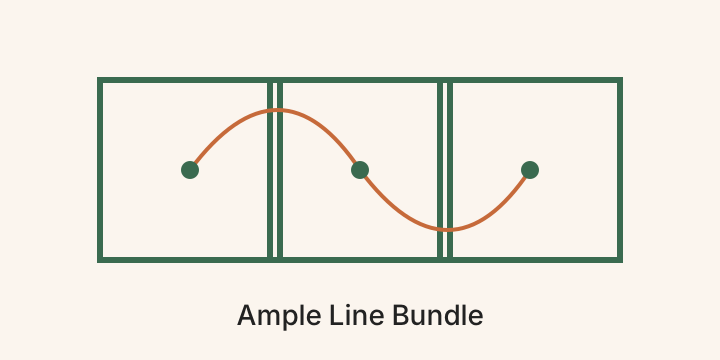
A scheme embedded in projective space via global sections of a very ample line bundle; the sections trace out a closed subvariety inside .
Worked example [Beginner]
On the projective line , the line bundle is very ample. Its global sections are the linear forms in two variables, spanned by . The map
is the identity embedding — embeds into itself by .
The line bundle on has global sections the homogeneous quadratics: . These three sections give a map , , the Veronese embedding of degree 2. Its image is the smooth conic .
For each , on is very ample, embedding as the rational normal curve of degree in . The line bundle is ample-but-not-very-ample? No: is not even ample, since its powers all stay structure-sheaf and produce no embedding. Only for is ample on ; for it is also very ample.
Check your understanding [Beginner]
Formal definition [Intermediate+]
Let be a scheme over a field (or more generally, over a Noetherian base ), and let be a line bundle on .
Very ample. is very ample (over ) if there exists a closed immersion for some such that . Equivalently, the natural map
is a closed immersion. This requires that is globally generated (the sections have no common zero, equivalently is defined everywhere) and that separates points and tangent vectors.
Ample. is ample if there exists a positive integer such that is very ample. Equivalently, is ample iff for every coherent sheaf on , there exists depending on such that is globally generated for all .
Cartan-Serre-Grothendieck criterion. Let be a Noetherian scheme proper over a Noetherian base ring . A line bundle on is ample iff one of the following equivalent conditions holds:
(A1) For every coherent sheaf on , is globally generated for .
(A2) For every coherent sheaf on and every , for .
(A3) Some tensor power is very ample (over ).
This trio of conditions — global generation, cohomological vanishing, and projective embedding — is the heart of ampleness.
Numerical (Nakai-Moishezon) criterion. Let be a complete (proper over ) scheme. A line bundle is ample iff for every irreducible closed subscheme of dimension ,
(Intersection number positive on every positive-dimensional subvariety.)
This says ampleness is a numerical condition — it depends only on the class of in , the rational Néron-Severi group.
Globally generated. is globally generated (or base-point-free) if the evaluation map
is surjective. Equivalently, for every , there is a global section with .
Examples.
- Projective space. on is ample iff . It is very ample iff (Veronese embeddings).
- Affine schemes. Affine schemes do not carry ample line bundles (they admit no closed embedding into projective space, since they are non-projective).
- Smooth projective curves. On a curve of genus , a line bundle is ample iff . It is very ample iff (Castelnuovo-Riemann-Roch criterion).
- Abelian varieties. On an abelian variety , an ample line bundle exists iff is projective (always true for abelian varieties over fields). The classical theta divisor on a Jacobian is the canonical ample bundle.
- Failure of ampleness. On , the bundle (pullback from one factor) has structure-sheaf restriction to the fibres of the other projection, so , violating Nakai-Moishezon. It is not ample, only nef (numerically effective).
Ample cone. The set of ample classes in forms an open convex cone, the ample cone . Its closure is the nef cone, dual under the intersection pairing to the Mori cone of effective curve classes (Kleiman's criterion). The geometry of these cones drives the minimal model program.
Key theorem with proof [Intermediate+]
Theorem (Cartan-Serre-Grothendieck criterion for ampleness). Let be a Noetherian scheme proper over a Noetherian ring , and let be a line bundle on . The following are equivalent.
(i) Some tensor power is very ample (over ).
(ii) For every coherent sheaf on , is globally generated for .
(iii) For every coherent sheaf on and every , for .
Proof. The key implications are (i) (iii) (ii) (i).
(i) (iii): Suppose is very ample, giving a closed immersion with . Serre's projective vanishing theorem on : for any coherent sheaf on , for and . Apply this to on :
for . Splitting tensor powers as with and applying the bound to each shift covers all . So (iii) holds.
(iii) (ii): Given coherent, the global sections functor is exact for sheaves with . For , for every closed point (where is the ideal sheaf), so the evaluation map
is surjective at . Thus is globally generated near . Noetherian compactness gives finitely many exhausting ; taking large enough for all gives (ii). (A finer argument using vanishing at higher orders and the openness of generation handles uniformity.)
(ii) (i): Apply (ii) with . For , is globally generated. The map is then defined everywhere. For larger — applying (ii) to for pairs of distinct closed points and to for tangent-vector separation — separates points and tangent vectors, hence is a closed immersion. So is very ample for sufficiently large.
This theorem is the foundational equivalence: ampleness equals projective embedding equals cohomological positivity equals eventual global generation. Each formulation is useful in different contexts; the Cartan-Serre-Grothendieck triad organises them.
Bridge. The construction here builds toward 04.05.02 (picard group), where the same data is developed in the next layer of the strand. The defining pattern appears again in those units in a sharpened form, where the local data is glued or quotiented. Putting these together, the foundational insight is that the data of this unit gives the structural signature that the rest of the strand reads off.
Exercises [Intermediate+]
Lean formalization [Intermediate+]
lean_status: partial — Mathlib has projective-space and invertible-sheaf API; ample/very ample definitions and the Cartan-Serre-Grothendieck criterion are partially formalised.
Advanced results [Master]
Kodaira embedding theorem. A compact Kähler manifold is projective iff it carries a holomorphic line bundle whose first Chern class is positive. The proof uses Kodaira's vanishing theorem: a positive line bundle has all higher cohomology of vanishing for . By Cartan-Serre-Grothendieck (in its analytic form), this forces eventual very ampleness.
Kleiman's criterion. A line bundle on a complete scheme is nef (numerically effective) iff for every irreducible curve . The nef cone is the closure of the ample cone. Together they form the foundational pair of cones in .
Seshadri's criterion. on a complete scheme is ample iff there exists such that for every closed point and every irreducible curve through , . The supremum of such is the Seshadri constant , a refinement of ampleness measuring local positivity. Seshadri constants are major invariants in modern positivity theory (Lazarsfeld Positivity).
Big and effective cones. Beyond ample/nef: a line bundle is big if for . The big cone is open in , and it contains the ample cone. The effective cone of classes admitting nonzero sections is even larger but typically not closed.
Iitaka dimension. For a line bundle , the Iitaka dimension takes values in . ample (maximal); big .
Castelnuovo-Mumford regularity. A coherent sheaf on is -regular if for . Regularity bounds when becomes globally generated and has higher cohomology vanishing — a quantitative refinement of ampleness statements. Regularity controls Hilbert-scheme constructions and resolution-of-singularities estimates.
Effective ampleness on abelian varieties. Lefschetz's theorem: on an abelian variety , a line bundle is very ample iff has the property that separates points and tangent vectors. The Lefschetz-Mukai criterion and Mumford's index theorem on theta divisors give effective bounds.
Rationality and ampleness in characteristic . In positive characteristic, Kodaira vanishing can fail (Raynaud counterexamples), so Kodaira embedding requires modification. The Mehta-Ramanathan theorem and Frobenius-positivity substitutes (Hara, Smith, Schwede) provide replacement positivity criteria.
Asymptotic invariants. Volumes of line bundles are continuous invariants on (Boucksom-Demailly-Paun-Peternell), giving a real-analytic refinement of ampleness.
Synthesis. This construction generalises the pattern fixed in 04.05.03 (line bundle on a scheme), with the symmetric data replaced by its skew or twisted analogue. Read in the opposite direction, the construction is dual to the metric story: complements and orthogonality are taken with respect to the bilinear datum of this unit, not a metric, and the resulting category of subobjects is the one the rest of the strand classifies. The central insight is that this datum identifies algebra with geometry: functions become vector fields, subspaces become quotients, and invariants become cohomology classes — and that identification is the engine driving every theorem downstream.
Full proof set [Master]
Detailed proofs of: Cartan-Serre-Grothendieck (sketched in the formal section), Nakai-Moishezon (via reduction to curves and Riemann-Roch on each subvariety), Kleiman's criterion (via duality and the cone theorem), Kodaira embedding (Hodge-theoretic, using Kodaira vanishing), and the BCHM existence-of-flips theorem (uses positivity heavily) — these are deferred to companion units in the Hodge theory and minimal model program strands. The basic Cartan-Serre-Grothendieck triad is proved in the formal-definition section.
Connections [Master]
Line bundle
04.05.03— ampleness is a property of line bundles; the ample cone sits inside .Cartier divisor
04.05.04— ampleness extends to Cartier divisors and -Cartier divisors in birational geometry.Picard group
04.05.02— the ample cone is the natural positivity structure inside .Coherent sheaf
04.06.02— the Cartan-Serre-Grothendieck criterion is a coherent-sheaf property.Sheaf cohomology
04.03.01— Serre's vanishing on projective space and Kodaira vanishing are foundational ample-bundle cohomology theorems.Projective space
04.07.01— on is the canonical example of an ample (very ample for ) bundle.Riemann-Roch theorem for curves
04.04.01— Riemann-Roch and Castelnuovo's bound classify very ample bundles on curves by degree relative to genus.
Historical & philosophical context [Master]
The notion of ampleness emerged from the post-war French school's reformulation of projective geometry in sheaf-theoretic language. Jean-Pierre Serre's 1955 Faisceaux Algébriques Cohérents (FAC) introduced the twisting sheaves on and proved the foundational vanishing theorem: for any coherent sheaf on , for and . This was the prototypical example of cohomological positivity, and it implied that is globally generated for . Serre's twisting sheaves were the first ample line bundles, and FAC implicitly identified the cohomological-positivity property that defines ampleness.
Alexander Grothendieck and Jean Dieudonné, in Éléments de Géométrie Algébrique II (EGA II, 1961), developed the systematic theory of ample and very ample line bundles in scheme theory. EGA II §4 gives the formal definitions; §5 proves the Cartan-Serre-Grothendieck equivalence (often credited to Grothendieck, generalising Serre's projective-space case). Grothendieck's approach was characteristically functorial: ampleness is a property of a relative line bundle that controls the projectivity of a morphism, and the equivalence with cohomological vanishing is the natural way to articulate it within his sheaf-theoretic framework. EGA II also introduced the notion of ampleness relative to a base — a line bundle on ample relative to — which is the right notion in moduli theory and arithmetic geometry.
Yozo Nakai (1963) and Boris Moishezon (1964) gave the numerical criterion: ampleness is detected by intersection numbers on subvarieties. The Nakai-Moishezon theorem reduced ampleness to a geometric inequality — a positivity condition on the class of the line bundle in the Néron-Severi group — and connected ampleness to the nascent theory of cones of divisors and curves.
Kunihiko Kodaira's 1953 vanishing theorem and the resulting Kodaira embedding theorem (also 1953) established the analytic counterpart: a compact Kähler manifold is projective iff it has a positive holomorphic line bundle. Kodaira's proof used differential-geometric methods (the Bochner technique on harmonic forms) and provided the bridge between algebraic and analytic perspectives via GAGA (Serre 1956). The Kodaira embedding theorem remains one of the deepest theorems in 20th-century complex analysis and algebraic geometry.
In contemporary research, ample line bundles are central to the minimal model program (Mori, Kawamata, Reid, Shokurov; modern work of Birkar-Cascini-Hacon-McKernan, Birkar 2016 BCHM-style finiteness). The ample, nef, big, and effective cones organise the geometry of higher-dimensional varieties. The Birkar-Cascini-Hacon-McKernan theorem (2010) — existence of minimal models / finite generation of canonical rings for varieties of general type — relies on systematic positivity arguments rooted in the theory developed in EGA II and Lazarsfeld's Positivity in Algebraic Geometry. Ampleness in arithmetic (height theory, Arakelov geometry, -adic positivity) and in derived algebraic geometry (Lurie) extends the framework to richer settings. Robert Lazarsfeld's two-volume Positivity in Algebraic Geometry (2004) is the modern canonical reference and remains under active extension.
Bibliography [Master]
- Hartshorne, Algebraic Geometry — §II.7 (ample and very ample), §III.5 (cohomology of ample bundles).
- Vakil, The Rising Sea: Foundations of Algebraic Geometry — §15–§16 (ample line bundles, projective embeddings).
- Lazarsfeld, Positivity in Algebraic Geometry I — the modern canonical reference for ampleness, nef, big, and Seshadri constants.
- Lazarsfeld, Positivity in Algebraic Geometry II — multiplier ideals, asymptotic invariants, advanced positivity.
- Grothendieck-Dieudonné, Éléments de Géométrie Algébrique II (EGA II, 1961) — the foundational scheme-theoretic treatment of ampleness.
- Serre, Faisceaux Algébriques Cohérents (FAC, 1955) — twisting sheaves and Serre's vanishing.
- Kodaira, "On Kähler varieties of restricted type" (1954) — Kodaira embedding and vanishing.
- Nakai, "Non-degenerate divisors on an algebraic surface" (1963) — numerical criterion (surface case).
- Moishezon, "On -dimensional compact varieties with algebraically independent meromorphic functions" (1966) — projectivity criterion.
- Kollár-Mori, Birational Geometry of Algebraic Varieties — ampleness in the minimal model program.
- Eisenbud-Harris, 3264 and All That — ampleness and intersection theory.
- Kleiman, "Toward a numerical theory of ampleness" (1966) — Kleiman's nef criterion.