Coherent sheaf
Anchor (Master): Hartshorne §II; Vakil; Cartan-Serre coherence theorems 1953; Serre FAC 1955
Intuition [Beginner]
A coherent sheaf on a Noetherian scheme is a quasi-coherent sheaf with a finiteness property — locally, it is described by a finitely-generated module rather than an arbitrary one. Coherent sheaves are the algebraic-geometric analogue of "finite-dimensional vector spaces" or "finitely-generated modules": well-behaved enough to admit a clean cohomological theory.
Why coherent? The key reason is cohomology. On a projective scheme over a Noetherian base, coherent sheaves have finite-dimensional cohomology groups — is a finitely-generated module over the base. This is the foundational input to Riemann-Roch, the Hilbert polynomial, and most computational tools in algebraic geometry. Quasi-coherent sheaves, in contrast, can have infinite-dimensional cohomology.
Examples of coherent sheaves: line bundles, vector bundles, ideal sheaves of closed subschemes, structure sheaves of closed subschemes , the canonical sheaf , the sheaf of differentials . Almost every "algebraic-geometrically natural" sheaf is coherent.
Visual [Beginner]
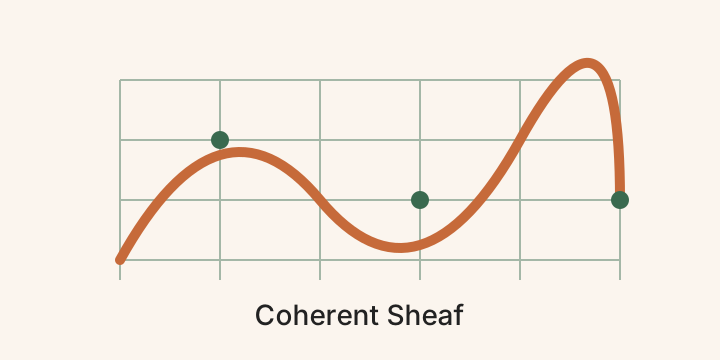
A coherent sheaf is locally finitely generated: on each affine chart, a small generating set determines the sheaf.
Worked example [Beginner]
The structure sheaf of any Noetherian scheme is coherent: it is locally generated by a single element (). Line bundles are coherent: they are locally free of rank 1 over .
For a closed subscheme defined by a finitely-generated ideal (which Noetherian guarantees), the ideal sheaf is coherent. The quotient is also coherent. This is how subschemes give rise to coherent sheaves systematically.
Non-example: the sheaf on corresponding to a countably infinite direct sum is quasi-coherent but not coherent — the underlying -module is not finitely generated.
Check your understanding [Beginner]
Formal definition [Intermediate+]
Let be a Noetherian scheme. A coherent sheaf on is a quasi-coherent sheaf on such that on every affine open , where is a finitely-generated -module.
Equivalently (over Noetherian schemes): is coherent iff:
(C1) is locally finitely generated: every point has a neighbourhood with a finite generating set.
(C2) For every open and every finite collection of sections , the kernel of the induced map , , is finitely generated.
The second condition (C2) is the key technical content: kernels of finite-rank maps from should themselves be finitely generated. This is automatic over Noetherian schemes (where the structure sheaf is itself coherent). Over non-Noetherian schemes, coherent sheaves are a more restrictive notion than just "locally finitely generated."
Equivalence on affine schemes (Noetherian). For with Noetherian:
an equivalence of abelian categories between finitely-generated -modules and coherent sheaves on .
Properties.
- Closure under standard operations: kernel, cokernel, image (via Noetherianness), tensor product, (between coherent sheaves, on Noetherian schemes).
- Pullback: for a morphism of locally Noetherian schemes, of a coherent is coherent on .
- Pushforward: requires proper hypotheses (Grothendieck's coherence-of-pushforward theorem). For a proper morphism of locally Noetherian schemes and a coherent sheaf on , is coherent on . The right derived are also coherent.
- Cohomology: for a coherent sheaf on a projective scheme over a Noetherian base, is a finitely-generated module over the base.
Examples.
- Structure sheaf : locally generated by 1, coherent.
- Ideal sheaf : coherent for closed subscheme defined by a finitely-generated ideal.
- Quotient sheaf of a closed subscheme: coherent.
- Line bundles : locally free of rank 1, coherent.
- Vector bundles : locally free of finite rank, coherent.
- Twisting sheaves on projective space: line bundles, coherent.
- Sheaf of differentials : coherent for a finite-type -scheme.
- Skyscraper sheaves at closed points: coherent (finite-dimensional fibre, zero elsewhere).
Non-examples.
- Constant sheaf on a positive-dimensional scheme: not even quasi-coherent.
- Stalks $i_{x,} \mathcal{O}_{X, x}\mathcal{O}_X$-module).
- Direct sums : quasi-coherent but not coherent.
Key theorem with proof [Intermediate+]
Theorem (finiteness of coherent cohomology on projective schemes). Let be a projective scheme over a Noetherian ring , and a coherent sheaf on . Then for every , is a finitely-generated -module.
Proof sketch. Reduce to and a coherent sheaf on (any projective scheme embeds as a closed subscheme of , and pushforward of coherent is coherent under closed embeddings, with cohomology preserved).
For on coherent: by Serre's theorem, there exists such that is generated by global sections for . So we get a surjection for some finite . Twisting back: surjects, so is a quotient of a coherent sheaf with known cohomology.
The cohomology of on is computed explicitly: for (a free -module of finite rank), is the dual for , all other cohomology zero. Each cohomology group is a finitely-generated -module.
By induction on the resolution length (using Hilbert's syzygy theorem for finitely-generated modules over a Noetherian ring), the long exact sequences in cohomology preserve finite generation, so is finitely generated.
This is the finiteness theorem for coherent cohomology on projective schemes — the foundational result powering Riemann-Roch, Hilbert polynomials, and computational algebraic geometry.
Bridge. The construction here builds toward 04.05.03 (line bundle on a scheme), where the same data is upgraded, and the symmetry side is taken up in 04.04.01 (riemann-roch theorem for curves). The defining pattern appears again in those units in a sharpened form, where the local data is glued or quotiented. Putting these together, the foundational insight is that the data of this unit gives the structural signature that the rest of the strand reads off.
Exercises [Intermediate+]
Lean formalization [Intermediate+]
lean_status: partial — Mathlib has a stub for coherent sheaves and the closely-related finitely-generated module theory.
Advanced results [Master]
Grothendieck's coherence-of-pushforward theorem (EGA III). For a proper morphism between locally Noetherian schemes and a coherent sheaf on , the right derived images are coherent for all .
Generic flatness. A coherent sheaf on a Noetherian integral scheme is generically flat: there is a dense open over which the sheaf is flat (locally free over a torsion-free base).
Resolution by locally-free sheaves. Over regular Noetherian schemes, every coherent sheaf has a finite resolution by locally-free coherent sheaves (Hilbert's syzygy theorem). This is the foundation of algebraic K-theory (Quillen) and Chow rings.
Hilbert polynomial. For a coherent sheaf on a closed subscheme , the Hilbert polynomial is a polynomial of degree . Its leading coefficient gives the degree, the constant term encodes the Euler characteristic of (related to genus), and intermediate coefficients capture intersection numbers.
Castelnuovo-Mumford regularity. A coherent sheaf on is -regular if for all . The regularity is the minimal such . Mumford's theory provides effective bounds.
Six-functor formalism. Coherent sheaves form the right setting for Grothendieck's six-functor formalism: . The functors interact via duality (Serre, Grothendieck) and base-change theorems, providing a complete framework for cohomological algebra.
Bondal-Orlov reconstruction. A smooth projective variety over an algebraically closed field is determined up to isomorphism by its derived category (when has ample (anti-)canonical class). This is one of the deepest "reconstruction" results in algebraic geometry.
Bridgeland stability. Stability conditions on form a complex manifold — a moduli space of "stability conditions" with deep connections to symplectic geometry (Donaldson-Thomas theory) and string theory (Calabi-Yau varieties).
Synthesis. This construction generalises the pattern fixed in 04.06.01 (quasi-coherent sheaf), with the symmetric data replaced by its skew or twisted analogue. Read in the opposite direction, the construction is dual to the metric story: complements and orthogonality are taken with respect to the bilinear datum of this unit, not a metric, and the resulting category of subobjects is the one the rest of the strand classifies. The central insight is that this datum identifies algebra with geometry: functions become vector fields, subspaces become quotients, and invariants become cohomology classes — and that identification is the engine driving every theorem downstream.
Full proof set [Master]
Detailed proofs of: Grothendieck's coherence-of-pushforward (EGA III §3), Serre's twist-and-vanish theorem (Hartshorne III §5), the Hilbert syzygy theorem, finiteness of coherent cohomology on projective schemes — these are deferred to companion units. The core finiteness theorem is sketched in the formal-definition section.
Connections [Master]
Quasi-coherent sheaf
04.06.01— coherent is quasi-coherent + finite-generation.Sheaf
04.01.01— coherent sheaves are the algebraic-geometric refinement.Scheme
04.02.01and Affine scheme04.02.02— the natural setting.Sheaf cohomology
04.03.01— coherent cohomology on projective schemes is finite-dimensional.Riemann-Roch theorem for curves
04.04.01— Riemann-Roch is a calculation of coherent Euler characteristics.Line bundle
04.05.03— line bundles are coherent locally free sheaves of rank 1.Ample line bundle
04.05.05— ampleness is defined relative to coherent cohomology vanishing.Topological K-theory
03.08.01— algebraic K-theory of coherent sheaves parallels topological K-theory.
Historical & philosophical context [Master]
The notion of coherent sheaf originates in the Cartan seminars of the early 1950s, in the context of complex analytic geometry. Henri Cartan's 1953 paper Faisceaux analytiques cohérents established the Cartan-Oka coherence theorems: the structure sheaf of a complex manifold is coherent, and proper holomorphic images of coherent sheaves are coherent. These were foundational achievements at the boundary of complex analysis and algebraic geometry.
Jean-Pierre Serre's Faisceaux Algébriques Cohérents (FAC, 1955) introduced the algebraic version: coherent sheaves on algebraic varieties (in the Zariski topology), with their finite-dimensional cohomology, twisting sheaves , and the foundational vanishing-and-formula theorem for . FAC was a watershed: it moved algebraic geometry from the pre-war classical perspective into the modern sheaf-theoretic framework.
Alexander Grothendieck's Éléments de Géométrie Algébrique (EGA, 1960–67) extended coherent sheaf theory to schemes:
- EGA I §1: quasi-coherent and coherent modules on locally ringed spaces.
- EGA III: cohomology of coherent sheaves, including the coherence-of-pushforward theorem for proper morphisms.
- EGA IV: coherent sheaves and morphisms of schemes, including flatness, smoothness, and étale properties.
The conceptual revolution: coherent sheaves are the right notion of "finite-dimensional algebraic-geometric object." Just as finite-dimensional vector spaces have a clean theory (rank, eigenvalues, characteristic polynomial), coherent sheaves have a clean theory (Hilbert polynomial, Chern classes, Euler characteristic). Most of modern algebraic geometry is fundamentally about coherent sheaves on schemes: classification (via Hilbert schemes, moduli problems), invariants (via cohomology, K-theory), and structure (via derived categories, Bondal-Orlov reconstruction).
Today coherent sheaves continue to be central:
- Derived categories of coherent sheaves encode the geometry of in a triangulated framework (Bondal, Orlov, Kontsevich).
- Geometric Langlands studies -modules (a derived enhancement of coherent sheaves) on moduli spaces.
- Donaldson-Thomas theory studies coherent sheaves on Calabi-Yau threefolds, with deep connections to string theory and enumerative geometry.
- Perfectoid spaces (Scholze) extend coherent-sheaf-theoretic methods to -adic geometry.
The deep insight of the Cartan-Serre-Grothendieck era — that coherent sheaves are the right finiteness class — has shaped algebraic geometry for 70 years and continues to drive its most exciting modern developments.
Bibliography [Master]
- Hartshorne, Algebraic Geometry — §II.5 is the standard introduction.
- Vakil, The Rising Sea: Foundations of Algebraic Geometry — §13.6, modern treatment.
- Cartan, "Faisceaux analytiques cohérents" (1953) — the original analytic coherence theorems.
- Serre, Faisceaux Algébriques Cohérents (FAC, 1955) — the foundational algebraic paper.
- Grothendieck-Dieudonné, Éléments de Géométrie Algébrique I, III — the systematic scheme-theoretic treatment.
- Eisenbud-Harris, The Geometry of Schemes — Ch. III, geometric perspective.
- Mumford, Abelian Varieties — Ch. II uses coherent-sheaf machinery extensively.
- Huybrechts, Fourier-Mukai Transforms in Algebraic Geometry — modern derived-categorical perspective.