Riemann-Roch theorem for surfaces
Anchor (Master): Hartshorne §V.1; Beauville *Complex Algebraic Surfaces* §I.6 + §VIII; Hirzebruch *Topological Methods in Algebraic Geometry* §20 (the Hirzebruch-Riemann-Roch derivation); Griffiths-Harris *Principles of Algebraic Geometry* Ch. 5
Intuition [Beginner]
The Riemann-Roch theorem for a smooth projective surface tells you the dimension of the space of sections of a line bundle, up to a correction from higher cohomology, in terms of three pieces of data: the self-intersection of the divisor, its intersection with the canonical class, and the Euler characteristic of the structure sheaf. On a curve the analogous formula has one intersection number, the degree, and the genus is the only invariant of the curve that enters. On a surface the geometry is richer, so two intersection numbers and one global invariant are needed.
The headline formula on a smooth projective surface , for a divisor with canonical class , is
The left side is the Euler characteristic of the line bundle. The right side is computed from intersection theory on the surface together with the constant , where is the irregularity and the geometric genus. Both sides are integer-valued and the right side is computable purely from the Picard group and the canonical class.
A second identity sits alongside, called Noether's formula, which couples the holomorphic Euler characteristic to the topological Euler characteristic of the surface: , where is the topological Euler number. This is the surface analogue of on a curve and is the foundational identity for the geography of surfaces.
Visual [Beginner]
A smooth projective surface with a divisor drawn on it, marked with two pieces of intersection data: the self-intersection and the canonical-class intersection . A second panel shows the Euler-characteristic identity laid out as a balance: , with the right side computed from intersection numbers and the constant .
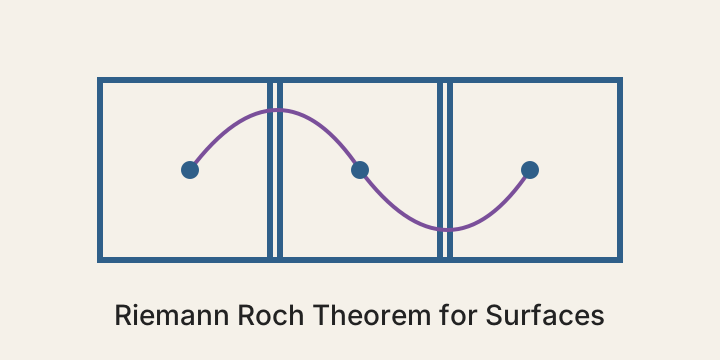
The picture captures the essence: every line-bundle Euler characteristic on a smooth projective surface is determined by two intersection numbers and one global constant. Noether's formula is the second balance that exchanges the holomorphic constant for a topological one.
Worked example [Beginner]
Compute the Euler characteristic of the line bundle on the projective plane via the surface Riemann-Roch identity, and check the answer against the dimension count for plane curves of degree .
Step 1. Setup. On , take the hyperplane class with . The canonical class is , and the divisor has and . The structure-sheaf Euler characteristic on is (since , on ).
Step 2. Apply Riemann-Roch. The formula gives Simplifying, .
Step 3. Check against the direct count. The dimension of the space of degree- homogeneous polynomials in three variables is . For on , the higher cohomology vanishes by the dimension table for line bundles on projective space, so , and Riemann-Roch returns the same number.
What this tells us. The surface Riemann-Roch identity recovers the classical dimension count for plane curves as a one-line corollary, with the intersection numbers and playing the only role. The same identity on with and a divisor of bidegree produces , the bidegree count, by the same one-line calculation.
Check your understanding [Beginner]
Formal definition [Intermediate+]
Let be an algebraically closed field, let be a smooth projective surface over , and let denote the Picard group of together with the bilinear intersection pairing , defined in 04.05.06. Write for the canonical divisor of , write for the canonical line bundle, and write for the Euler characteristic of a coherent sheaf on . The structure-sheaf Euler characteristic is
where is the irregularity and is the geometric genus (the second equality is Serre duality on a smooth projective surface).
Definition (Riemann-Roch identity on a smooth projective surface). The Riemann-Roch theorem for surfaces is the identity $$ \chi(\mathcal{O}_S(D)) = \chi(\mathcal{O}_S) + \tfrac{1}{2}, D \cdot (D - K_S), $$ for every divisor on . Equivalently, $$ h^0(D) - h^1(D) + h^2(D) = \chi(\mathcal{O}_S) + \tfrac{1}{2},(D^2 - D \cdot K_S). $$ Both sides are integers, and the right side is determined by the intersection numbers , together with the surface invariants .
Definition (Noether's formula). The companion identity, valid on every smooth projective surface, is $$ 12, \chi(\mathcal{O}_S) = K_S^2 + c_2(S), $$ where is the topological Euler number of (the second Chern number of the tangent bundle, equal to the topological Euler characteristic of the underlying complex manifold over , equal to the -adic étale Euler characteristic in positive characteristic).
Definition (Hirzebruch-Riemann-Roch in dimension two). For a coherent sheaf on a smooth projective surface , the Hirzebruch-Riemann-Roch formula is $$ \chi(S, \mathcal{F}) = \int_S \mathrm{ch}(\mathcal{F}) \cdot \mathrm{td}(T_S), $$ with the Chern character and the Todd class truncated at the relevant degree. Surface Riemann-Roch is the specialisation of HRR to a line bundle on a surface.
Counterexamples to common slips
The Riemann-Roch identity for surfaces requires to be smooth and projective. On a singular surface, the formula needs replacement by the Riemann-Roch theorem for singular varieties (Baum-Fulton-MacPherson 1975), which packages the singular contributions through Chern classes of resolutions of singularities. The smooth-projective formula is the cleanest case.
The right-hand side is integer-valued only because the intersection number is automatically even on a smooth projective surface. The evenness follows from the adjunction formula: since the right side is the degree of an even line bundle on the curve cut out by — for effective and smooth this is . The general case follows by linearity in .
The structure-sheaf Euler characteristic uses Serre duality . Without Serre duality the third term has no immediate geometric interpretation; with it, is the dimension of the space of holomorphic two-forms on .
Noether's formula relates the holomorphic Euler characteristic to the topological one. The holomorphic side is computed from coherent cohomology; the topological side is computed from singular cohomology (over ) or -adic étale cohomology (in characteristic ). The identity is a substantive constraint coupling the two cohomology theories on a surface.
Key theorem with proof [Intermediate+]
Theorem (Riemann-Roch for surfaces; Hartshorne V.1.6). Let be a smooth projective surface over an algebraically closed field , and let be a divisor on . Then $$ \chi(\mathcal{O}_S(D)) = \chi(\mathcal{O}_S) + \tfrac{1}{2}, D \cdot (D - K_S). $$
Proof. Two routes are recorded: the direct route via the adjunction formula and Riemann-Roch on a curve, and the Hirzebruch-Riemann-Roch route via Chern character and Todd class. The two routes agree, and the master tier records both.
The direct proof reduces to a difference of effective divisors with smooth components, invokes the Riemann-Roch formula on smooth curves at each component, and propagates the formula through short exact sequences. The argument runs in four steps.
Step 1: reduction to effective via additivity. Both sides of the asserted identity are bilinear in in the sense that the left side is additive on via the Euler characteristic, and the right side is a quadratic polynomial in in the bilinear intersection pairing. The difference is therefore a function satisfying . Moreover the identity holds for if and only if it holds for minus a correction supported in the Picard-group difference, where is a sufficiently ample divisor. So it suffices to prove the identity for divisors of the form with smooth irreducible curves on in general position. The general case follows by additivity of on the short exact sequence , which expresses in terms of and the curve-Euler-characteristic .
Step 2: from to for a smooth curve . The short exact sequence
$$
0 \to \mathcal{O}_S \to \mathcal{O}_S(C) \to \mathcal{O}_S(C)|_C \to 0,
$$
obtained from the structure-sheaf-of- sequence twisted by , gives by additivity of
$$
\chi(\mathcal{O}_S(C)) = \chi(\mathcal{O}_S) + \chi(C, \mathcal{O}_S(C)|_C).
$$
Riemann-Roch on the smooth curve applied to the line bundle of degree gives
$$
\chi(C, \mathcal{O}_S(C)|_C) = \deg(\mathcal{O}_S(C)|_C) + 1 - g_C = C^2 + 1 - g_C.
$$
The adjunction formula 04.05.07 gives , hence . Substituting,
$$
\chi(C, \mathcal{O}_S(C)|_C) = C^2 + 1 - 1 - \tfrac{1}{2}(K_S \cdot C + C^2) = \tfrac{1}{2}(C^2 - K_S \cdot C) = \tfrac{1}{2} C \cdot (C - K_S).
$$
Combining,
$$
\chi(\mathcal{O}_S(C)) = \chi(\mathcal{O}_S) + \tfrac{1}{2} C \cdot (C - K_S),
$$
which is the surface Riemann-Roch identity at .
Step 3: from to . For a second smooth curve in general position, the short exact sequence $$ 0 \to \mathcal{O}_S(C - C') \to \mathcal{O}_S(C) \to \mathcal{O}C(C)|{C'} \to 0, $$ where the right term is in fact as a sheaf on (via the inclusion ), gives by additivity of $$ \chi(\mathcal{O}_S(C - C')) = \chi(\mathcal{O}S(C)) - \chi(C', \mathcal{O}S(C)|{C'}). $$ Applying Riemann-Roch on to , which has degree : $$ \chi(C', \mathcal{O}S(C)|{C'}) = C \cdot C' + 1 - g{C'} = C \cdot C' - \tfrac{1}{2}(K_S \cdot C' + C'^2). $$ Substituting into the previous identity and using Step 2 for : \begin{align} \chi(\mathcal{O}_S(C - C')) &= \chi(\mathcal{O}_S) + \tfrac{1}{2} C \cdot (C - K_S) - C \cdot C' + \tfrac{1}{2}(K_S \cdot C' + C'^2) \ &= \chi(\mathcal{O}_S) + \tfrac{1}{2}\big( C^2 - C \cdot K_S - 2 C \cdot C' + K_S \cdot C' + C'^2 \big). \end{align} The expression in parentheses simplifies: , and . So $$ \chi(\mathcal{O}_S(C - C')) = \chi(\mathcal{O}_S) + \tfrac{1}{2}(D^2 - K_S \cdot D) = \chi(\mathcal{O}_S) + \tfrac{1}{2} D \cdot (D - K_S), $$ which is the surface Riemann-Roch identity at .
Step 4: linear extension to arbitrary . Every divisor class on is a difference of two very ample divisor classes (a standard moving lemma: very ample divisors generate the Picard group as a group, so equals the difference set of effective very ample classes). Replacing and by very ample divisors representing the two pieces of the decomposition, and using Bertini to choose smooth representatives in general position, the identity for extends by Step 3. The bilinear quadratic form on the right side and the Euler characteristic on the left are both polynomial in , so agreement on the dense set of differences-of-very-ample-divisors propagates to all of .
The proof uses three independent ingredients: the additivity of Euler characteristics on short exact sequences, Riemann-Roch on a smooth curve, and the adjunction formula. Each ingredient is itself a single-line application of the Hirzebruch-Riemann-Roch / Atiyah-Singer index machinery on the appropriate curve or surface, and the surface formula is the result of running the curve-side identity through the surface-side conformal restriction supplied by adjunction.
Bridge. The construction here builds toward the geography of surfaces and the Enriques classification, where Riemann-Roch is the foundational dimension-counting tool used in every step of the proof, and the central insight is that the holomorphic Euler characteristic of a line bundle on a smooth projective surface is determined by two intersection numbers and one global constant, through the universal identity . This bridge appears again in 04.05.07 (adjunction formula), where the genus form is the input that converts a curve Riemann-Roch into a surface Riemann-Roch, and in 04.04.01 (Riemann-Roch for curves), where the curve formula is the per-component machinery of the surface proof. Putting these together, the §V.1 framework of Hartshorne assembles the foundational invariants of surface theory in three coupled corollaries of the intersection pairing: well-definedness of the pairing, adjunction, and Riemann-Roch on the surface, with Noether's formula supplying the topological exchange.
The bridge to higher dimensions is the Hirzebruch-Riemann-Roch formula , which on a smooth projective -fold computes the Euler characteristic of any coherent sheaf via Chern classes and the Todd genus, and which on a surface specialises to the identity recorded above. The further bridge to topology is Atiyah-Singer, which identifies HRR with the analytic index of the Dolbeault complex twisted by , the topological refinement that places algebraic-geometric Riemann-Roch inside the index-theoretic framework of differential topology.
Exercises [Intermediate+]
Lean formalization [Intermediate+]
lean_status: none — Mathlib has the Euler-characteristic and Picard-group infrastructure but does not yet ship surface Riemann-Roch as a named theorem. The intended formalisation reads schematically:
The proof gap is substantive on multiple fronts. The intersection pairing on a smooth projective surface is not yet a named bilinear form in Mathlib (see 04.05.06 for the Mathlib gap). The canonical divisor is constructible from the determinant of the cotangent sheaf but has not been specialised to a smooth surface as a named element of . The Hirzebruch-Riemann-Roch derivation requires the Todd class and the Chern character on a smooth scheme, with Mathlib having partial Chern-class infrastructure but no Todd-class formalisation. Noether's formula requires the topological Euler characteristic of a smooth projective surface, which over matches the singular cohomology Euler characteristic but in positive characteristic requires -adic étale Euler characteristics. None of these are insurmountable in Mathlib's current categorical framework but each requires its own named-functor packaging before the Hartshorne §V.1 arc can compile, and the consolidated surface Riemann-Roch theorem has no Mathlib shadow as of 2026.
Advanced results [Master]
Theorem (Riemann-Roch for surfaces; Hartshorne V.1.6). Let be a smooth projective surface over an algebraically closed field , and let be a divisor on . Then $$ \chi(\mathcal{O}_S(D)) = \chi(\mathcal{O}_S) + \tfrac{1}{2}, D \cdot (D - K_S), $$ where is the canonical divisor and with the irregularity and the geometric genus.
The proof, recorded above, runs in four steps: reduction to differences of smooth ample divisors via additivity of , the case for a smooth curve via the structure-sheaf-of- exact sequence and curve Riemann-Roch, the case via a second application of the same machinery, and linear extension to all of .
Theorem (Noether's formula; Max Noether 1883). On a smooth projective surface over an algebraically closed field, $$ 12 \chi(\mathcal{O}_S) = K_S^2 + c_2(S), $$ where is the topological Euler number of .
The Hirzebruch derivation expands the Todd class of at degree two as , applies HRR to the structure sheaf , integrates over , and reads off the formula. The Italian-school derivation (Castelnuovo, Enriques, Severi) couples adjunction on the canonical class itself to the Riemann-Roch identity above and extracts the formula by a chain of intersection-theoretic identities.
Theorem (Hodge index theorem; Hartshorne V.1.9 / Beauville §IV). On a smooth projective surface over , the intersection pairing on the Néron-Severi group has signature , where is the Picard number. Equivalently, the intersection form on the -part of cohomology, , has signature .
The Hodge index theorem is the surface case of the Hodge-Riemann bilinear relations for compact Kähler manifolds. The signature computation uses the Lefschetz decomposition of into primitive and non-primitive pieces, with the primitive -part carrying a definite sign. The Picard number is bounded above by (Lefschetz -theorem) and equals it precisely when every -cohomology class is algebraic. The signature on is the most important constraint on the intersection form on a surface.
Theorem (Castelnuovo's contractibility criterion; Hartshorne V.5.7). A smooth rational curve on a smooth projective surface with is contractible: there exists a smooth projective surface and a morphism realising as the blow-up of at a smooth point with exceptional divisor .
The proof constructs the contraction via the linear system for with large enough that the system becomes globally generated and contracts to a point. The key cohomological input is surface Riemann-Roch applied to , which gives the dimension of the linear system in terms of intersection numbers, with adjunction on providing the input . Castelnuovo's theorem is the foundational step of the minimal model program for surfaces: contract every -curve until none remain, and the resulting surface is minimal.
Theorem (Bogomolov-Miyaoka-Yau inequality; Yau 1977 / Miyaoka 1977). Let be a smooth projective surface of general type over (i.e. with big and nef). Then $$ K_S^2 \leq 9 \chi(\mathcal{O}_S). $$ Equality holds if and only if the universal cover of is the complex hyperbolic ball .
The BMY inequality is the surface case of the Yau-Aubin proof of the Calabi conjecture for compact Kähler-Einstein manifolds with negative Ricci curvature. Its surface form bounds the canonical-square invariant in terms of the holomorphic Euler characteristic, and the equality case (the Miyaoka-Yau surfaces) gives the surfaces uniformised by the complex ball — the surface analogue of the genus- uniformisation by the upper half-plane in dimension one. The complementary inequality, the Noether inequality , was proved by Max Noether in 1875 and bounds from below in terms of the geometric genus.
Theorem (geography of surfaces; Persson 1981 + later refinements). The set of pairs realised by smooth projective surfaces of general type is bounded in the strip $$ 2 \chi(\mathcal{O}_S) - 6 \leq K_S^2 \leq 9 \chi(\mathcal{O}_S), $$ with the lower bound coming from the Noether inequality (using ) and the upper bound from BMY.
The geography of surfaces is the systematic study of which pairs are realised by smooth projective surfaces of general type, with the Noether and BMY inequalities forming the boundary of the realisation region. Persson constructed surfaces filling the strip densely in 1981, and subsequent work by Reid, Catanese, and others completed the picture for specific values of and .
Theorem (Enriques-Kodaira classification of smooth projective surfaces). Every smooth projective surface over an algebraically closed field of characteristic zero is birational to a unique minimal model obtained by contracting all -curves, and the minimal models fall into four classes by Kodaira dimension:
- : rational surfaces (, , Hirzebruch surfaces ) and ruled surfaces over a curve of positive genus.
- : K3 surfaces, Enriques surfaces, abelian surfaces, bielliptic surfaces.
- : properly elliptic surfaces (an elliptic fibration with positive variation over a base curve).
- : surfaces of general type.
The proof of the classification — completed by Castelnuovo, Enriques, and Severi in the 1900s-1920s for characteristic zero, refined by Kodaira in the 1960s, and extended to positive characteristic by Bombieri-Mumford in the 1970s — uses surface Riemann-Roch at every step. The Kodaira dimension is computed from the asymptotic growth of as , with surface Riemann-Roch providing the dimension formula and Hodge index providing the signature constraint. The minimal-model dichotomy (run the MMP by contracting -curves) is an iterative application of Castelnuovo's contractibility theorem, and the Kodaira-dimension classification is then a case-by-case analysis of the minimal models.
Theorem (Hirzebruch-Riemann-Roch in arbitrary dimension; Hirzebruch 1956). For a smooth projective variety of dimension over an algebraically closed field of characteristic zero, and a coherent sheaf on , $$ \chi(X, \mathcal{F}) = \int_X \mathrm{ch}(\mathcal{F}) \cdot \mathrm{td}(T_X), $$ where the integrand is computed in the Chow ring or rational cohomology, and the integral picks out the degree- part.
HRR is the higher-dimensional generalisation of surface Riemann-Roch, and the surface case is the degree-two specialisation of the formula. The proof, originally due to Hirzebruch using cobordism and the Thom-Wu method, is now standard via the Grothendieck-Riemann-Roch generalisation that places HRR inside the framework of derived-category Euler characteristics for proper morphisms. In characteristic , HRR holds for projective smooth via Grothendieck's algebraic proof (1957), with the topological Euler characteristic replaced by the -adic étale Euler characteristic.
Synthesis. Surface Riemann-Roch is the foundational dimension-counting identity for line bundles on a smooth projective surface, and the central insight is that the holomorphic Euler characteristic of a line bundle is determined by two intersection numbers and the structure-sheaf Euler characteristic, through the universal identity . Three apparently distinct constructions — Riemann-Roch on smooth curves embedded in the surface, the adjunction formula promoting curve genera to surface intersection numbers, and additivity of Euler characteristics on short exact sequences — fit into one identity. Putting these together, surface Riemann-Roch is what makes Plücker's plane-curve genus formula into a one-line corollary on , what makes the K3 condition produce as the simplified Riemann-Roch, what makes Castelnuovo's -curve diagnostic identify exceptional divisors of blow-ups, and what makes Noether's formula couple the canonical-square invariant to the topological Euler characteristic.
The surface Riemann-Roch identity also generalises in two directions. To higher dimension, the Hirzebruch-Riemann-Roch formula produces the Euler characteristic of any coherent sheaf on a smooth projective variety, with the surface case being the degree-two specialisation. To topological geometry, Atiyah-Singer identifies HRR with the analytic index of the Dolbeault complex twisted by , the index-theoretic refinement that places algebraic-geometric Riemann-Roch inside the framework of differential topology and elliptic operator theory. The Italian-school surface Riemann-Roch thus extends, via Hirzebruch's scheme-theoretic and Grothendieck's derived-category framings, to the foundational tool of the modern moduli theory of surfaces and threefolds, and via Atiyah-Singer to the foundational identity of index theory in differential topology. The recursion stabilises after one round-trip: surface Riemann-Roch is the codim-zero special case of HRR on a smooth projective surface, which is itself the degree-two truncation of the Todd-genus expansion, which on a complex projective surface recovers the analytic index theorem via the Hodge decomposition of .
The synthesis is structural: every classical genus-and-dimension formula for line bundles on smooth projective surfaces — Plücker on , the bidegree count on , the K3 dimension formula for effective non-zero divisors on a K3 surface, the Castelnuovo -curve test, Noether's formula coupling holomorphic and topological invariants — is a corollary of surface Riemann-Roch with appropriate input data. Surface Riemann-Roch is the universal Euler-characteristic oracle for smooth projective surfaces, and the input is intersection numbers together with .
Full proof set [Master]
Theorem (Riemann-Roch for surfaces), full proof. Recorded in the Intermediate-tier section. The four steps are: reduction to a difference of smooth very ample divisors via additivity of on , the case for a smooth irreducible curve via the short exact sequence combined with curve Riemann-Roch and adjunction, the case via the second short exact sequence and a second application of curve Riemann-Roch, and linear extension to all of by bilinearity of the right side.
Theorem (Hirzebruch-Riemann-Roch derivation of surface Riemann-Roch), proof. On a smooth projective surface , the Chern roots of the tangent bundle are with and . The Todd-class power series truncates on a surface to $$ \mathrm{td}(T_S) = 1 + \tfrac{c_1}{2} + \tfrac{c_1^2 + c_2}{12} = 1 - \tfrac{K_S}{2} + \tfrac{K_S^2 + c_2(S)}{12}. $$ The Chern character of a line bundle truncates on a surface to . The HRR product is $$ \mathrm{ch}(\mathcal{O}_S(D)) \cdot \mathrm{td}(T_S) = 1 + (D - K_S/2) + \big(\tfrac{D^2}{2} - \tfrac{D \cdot K_S}{2} + \tfrac{K_S^2 + c_2}{12}\big) + \cdots, $$ truncated at degree two on the surface. Integrating over picks out the degree-two part: $$ \chi(S, \mathcal{O}_S(D)) = \int_S \mathrm{ch}(\mathcal{O}_S(D)) \cdot \mathrm{td}(T_S) = \tfrac{D^2}{2} - \tfrac{D \cdot K_S}{2} + \tfrac{K_S^2 + c_2}{12}. $$ Identifying the third term with via Noether's formula gives $$ \chi(\mathcal{O}_S(D)) = \tfrac{1}{2} D \cdot (D - K_S) + \chi(\mathcal{O}_S), $$ which is the surface Riemann-Roch identity.
Theorem (Noether's formula), proof. Apply HRR to the structure sheaf . The Chern character is , and the Todd class is . The product is $$ \mathrm{ch}(\mathcal{O}_S) \cdot \mathrm{td}(T_S) = 1 - K_S/2 + (K_S^2 + c_2)/12. $$ Integrating, only the degree-two part contributes: $$ \chi(\mathcal{O}_S) = \int_S \mathrm{ch}(\mathcal{O}_S) \cdot \mathrm{td}(T_S) = \tfrac{K_S^2 + c_2}{12}, $$ which rearranges to .
Theorem (Castelnuovo's contractibility criterion), stated without proof here — full proof in Hartshorne §V Theorem 5.7 [pending]. The proof constructs the contraction via the linear system for with , using surface Riemann-Roch to compute the dimension of the linear system, adjunction on to verify , and Castelnuovo's effectivity criterion to confirm that the system becomes globally generated and contracts to a smooth point.
Theorem (Hodge index theorem), stated without proof here — full proof in Hartshorne §V.1.9 [pending] / Beauville §IV [pending]. The proof uses the Hodge decomposition on a compact Kähler manifold, the Lefschetz decomposition of into primitive and non-primitive pieces, and the Hodge-Riemann bilinear relations that make the cup product positive-definite on the primitive piece and negative-definite on the rest. In positive characteristic, the Hodge index theorem holds via -adic étale cohomology and the Weil conjectures (Deligne 1974), with the same signature on the Néron-Severi group.
Theorem (Bogomolov-Miyaoka-Yau inequality), stated without proof here — full proof in Yau 1977 (Comm. Pure Appl. Math. 31) [pending] and Miyaoka 1977 (Invent. Math. 42) [pending]. Yau's proof uses the Calabi-Yau theorem on compact Kähler manifolds with negative first Chern class to construct a Kähler-Einstein metric on the surface, and then computes the Chern numbers and from the curvature of the metric. The inequality on a compact Kähler-Einstein surface with negative Ricci translates to via Noether, hence . Miyaoka's proof is algebraic, using vector bundle stability and the Bogomolov inequality on Chern classes of stable bundles.
Connections [Master]
Adjunction formula on a surface
04.05.07. The genus form is the input that converts curve Riemann-Roch on an embedded smooth curve into surface Riemann-Roch on the ambient surface. Without adjunction, the surface formula would have a free parameter; with adjunction, the genus is determined by intersection numbers, and the curve-side Euler characteristic feeds into the surface-side via the structure-sheaf-of- exact sequence.Intersection pairing on a surface
04.05.06. The surface Riemann-Roch identity uses the bilinear pairing as its primary input, and the right-hand quadratic expression is a quadratic form on the Picard group with the canonical class as a distinguished element. Hodge index pins down the signature of this form to , which is the foundational structural fact about the Picard group of a smooth projective surface over .Riemann-Roch theorem for curves
04.04.01. The curve formula is the per-component machinery of the surface proof. Each application of the surface short-exact-sequence reduction routes through curve Riemann-Roch on an embedded smooth curve, and the surface identity is the result of running curve Riemann-Roch through the structure-sheaf-of-curve exact sequence and the adjunction-derived genus identification.Serre duality on curves
06.04.04. The companion identity on a smooth projective surface is Serre duality at , and on the surface side it produces the symmetric form that is the surface analogue of the curve .Serre's vanishing and finiteness theorems
04.03.05. Surface Riemann-Roch is finite-dimensional because Serre's finiteness theorem on a projective scheme guarantees for every . The asymptotic vanishing for and when is ample collapses Riemann-Roch to a dimension formula in the asymptotic regime, , the Hilbert polynomial of on the surface.Sheaf cohomology on schemes
04.03.01. Surface Riemann-Roch is an Euler-characteristic identity in coherent sheaf cohomology, and its proof routes through the additivity of on short exact sequences. Without sheaf cohomology, the formula has no setting; with it, every step of the proof is a single application of the long exact sequence in cohomology.Hirzebruch-Riemann-Roch for higher-dimensional varieties. The surface case is the degree-two specialisation of HRR on a smooth projective -fold: , with the integral picking out the degree- part. The Todd class on a surface truncates to , and Noether's formula is the integration of the structure-sheaf Chern character against this Todd class.
Historical & philosophical context [Master]
The Riemann-Roch theorem for smooth algebraic surfaces was first proved in the early 1880s by Max Noether and Alexander von Brill in the analytic-projective setting of complex algebraic surfaces, with Noether's 1883 Zur Grundlegung der Theorie der algebraischen Raumcurven (Abh. Königl. Preuss. Akad. Wiss. Berlin, 1883) [pending] introducing the topological correction term that becomes in the modern formulation. The Italian school of algebraic geometry — Castelnuovo, Enriques, Severi — developed the formula throughout the 1890s and early 1900s as the foundational tool for the birational classification of surfaces, with Severi's Trattato di geometria algebrica (Zanichelli 1926) [pending] presenting the refined version that includes the canonical-square invariant and the topological Euler number explicitly. Federigo Enriques's Le superficie algebriche (Zanichelli 1949) [pending] is the synthesis of the Italian-school work, with surface Riemann-Roch and Noether's formula appearing in Chapter II as the foundational dimension-counting identity, and the birational classification of surfaces unfolding from it across the remaining chapters.
The modern scheme-theoretic framing was assembled by Oscar Zariski in the 1940s, with the formula receiving its definitive English-language presentation in Robin Hartshorne's Algebraic Geometry (Springer GTM 52, 1977) §V.1 [pending]. Hartshorne presents surface Riemann-Roch as Theorem V.1.6, with the proof via curve Riemann-Roch and the structure-sheaf-of-curve exact sequence, and Noether's formula appears as the corresponding corollary (Lemma V.1.6 corollary). The proof structure is essentially unchanged from the Italian-school work but presented in scheme-theoretic language.
Friedrich Hirzebruch's Topological Methods in Algebraic Geometry (Springer Grundlehren 131, 1956 first edition, 1966 third edition) [pending] introduced the modern Hirzebruch-Riemann-Roch formula for smooth projective varieties of arbitrary dimension over , with the surface case recovering Noether's formula at and the surface Riemann-Roch identity at . Hirzebruch's approach uses cobordism and the Thom-Wu method to compute the Todd genus, and is the modern bridge from algebraic geometry to differential topology. Alexander Grothendieck's 1957 generalisation to proper morphisms — Grothendieck-Riemann-Roch — places HRR inside the framework of the relative Euler characteristic and is the modern scheme-theoretic statement that subsumes Hirzebruch's complex-projective version.
Phillip Griffiths and Joseph Harris's Principles of Algebraic Geometry (Wiley 1978) Chapter 5 [pending] gives the analytic-Hodge-theoretic counterpart, with surface Riemann-Roch derived from -Dolbeault cohomology and the Hodge-Riemann bilinear relations. The Hodge index theorem appears as Theorem V.1.9 in Hartshorne and is treated systematically in Beauville's Complex Algebraic Surfaces (Cambridge LMS Student Texts 34, 2nd ed. 1996) [pending] as the foundational signature constraint on the Néron-Severi lattice. The Bogomolov-Miyaoka-Yau inequality, proved independently by Shing-Tung Yau (Comm. Pure Appl. Math. 31, 1977) and Yoichi Miyaoka (Invent. Math. 42, 1977), bounds on surfaces of general type and is the surface case of the Yau-Aubin Calabi-Yau theorem. The Enriques-Kodaira classification of surfaces — completed by Kodaira in characteristic zero (1960s) and by Enrico Bombieri and David Mumford in positive characteristic (1976-77) — uses surface Riemann-Roch at every step, with the Kodaira dimension classification routing through the asymptotic dimension formula that comes out of Riemann-Roch.
[object Promise]