Adjunction formula on a surface
Anchor (Master): Hartshorne §V.1.5; Beauville *Complex Algebraic Surfaces* Ch. I and Ch. III; Griffiths-Harris §1.4 (conormal sequence) and §4.5 (analytic adjunction)
Intuition [Beginner]
The adjunction formula is the rule that lets you compute the genus of a smooth curve sitting inside a smooth surface from two pieces of intersection data on the surface: the self-intersection of the curve, and the intersection of the curve with the canonical class of the surface. A smooth plane curve of degree has genus — a line has genus , a conic has genus , a smooth cubic has genus , a smooth quartic has genus . The formula that produces this list is the adjunction formula, applied to the projective plane .
Why bother? Because the genus of a curve is the single most important invariant of the curve, and the adjunction formula computes it without ever touching the curve directly — only its embedding into the surface. The same formula works on any smooth projective surface: K3 surfaces, ruled surfaces, blow-ups, surfaces of general type. The genus of a curve drawn on the surface is read off the surface's intersection theory together with the curve's intersection numbers, all of which are computable.
The formula has a second face, equivalent to the genus form: the canonical bundle of the curve is the canonical bundle of the surface, restricted to the curve, twisted by the curve's own line bundle. This is the canonical-restriction identity, and it says that the curve's canonical structure is inherited from the surface's canonical structure, with a controlled twist coming from the way the curve sits inside the surface. The restriction-twist correction is exactly the conormal bundle of the curve in the surface — the geometric record of how the curve is embedded.
Visual [Beginner]
A schematic of a smooth projective surface with a curve drawn on it, marked with two pieces of intersection data: the self-intersection number and the intersection number with the canonical class. A second panel shows the same curve with its canonical bundle identified as a restriction-with-twist from the surface — the canonical-restriction picture that the formal sections make precise.
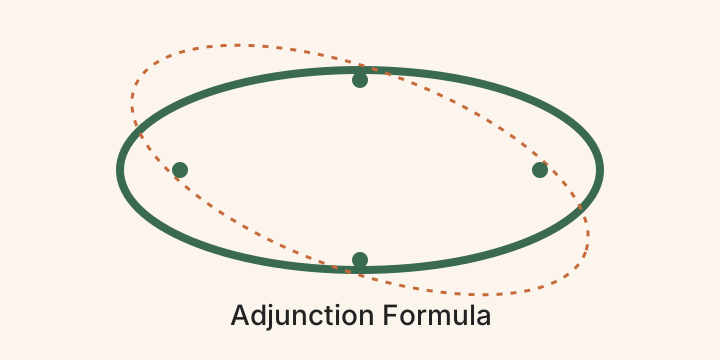
The picture captures the essential geometry: the genus of an embedded curve is determined by two intersection numbers on the ambient surface. The same picture in higher codimension replaces the curve with a smooth subvariety and the conormal bundle with the determinant of the higher-rank conormal bundle.
Worked example [Beginner]
Compute the genus of three smooth curves drawn on the projective plane , then on a K3 surface, using the adjunction formula and check the answers against classical genus computations.
Step 1. Smooth line . The hyperplane class on has (two distinct lines meet in one point). The canonical class is (from the Euler sequence on , or from the formula for the hyperplane class ). So . The adjunction formula gives . A line is a copy of , which has genus , matching.
Step 2. Smooth conic . The conic has class , so and . Adjunction: , hence . Every smooth conic in the plane is a rational curve (parameterisable by a single variable), so genus is expected, and adjunction confirms it.
Step 3. Smooth cubic . The cubic has class , so and . Adjunction: , hence . Smooth plane cubics are elliptic curves, genus , matching the classical result.
Step 4. Smooth plane curve of degree . With , the self-intersection is and the canonical intersection is . Adjunction: , hence . This is Plücker's classical genus formula for smooth plane curves, recovered as a one-line corollary of adjunction. The first three lines of the table — giving — match Steps 1, 2, 3.
Step 5. Smooth curve on a quartic surface in . A smooth quartic surface is a K3 surface, characterised by (the canonical class vanishes). For any smooth curve on , adjunction reduces to . So the genus of any smooth curve on a K3 surface is , and the inequality forces . Equality corresponds to , the rational curves on the K3 — exactly the famous "-curves" of K3 geometry.
What this tells us: the same one-line adjunction formula, applied to four different surfaces (the projective plane and a K3), recovers the classical Plücker genus formula and the foundational inequality on K3 surfaces. The adjunction formula is the universal genus-computing tool for embedded curves: feed it the intersection numbers, get out the genus.
Check your understanding [Beginner]
Formal definition [Intermediate+]
Let be an algebraically closed field, let be a smooth projective surface over , and let be a smooth projective curve, viewed as a smooth divisor. Write for the canonical divisor of (a divisor whose associated line bundle is the canonical sheaf ), write for the canonical divisor of , and write for the intersection pairing on (see 04.05.06).
Definition (adjunction formula, genus form). The adjunction formula for the smooth curve on the smooth projective surface is the identity $$ 2 g_C - 2 = (K_X + C) \cdot C = K_X \cdot C + C^2, $$ where is the genus of . Equivalently, $$ g_C = 1 + \tfrac{1}{2},(K_X \cdot C + C^2). $$
Definition (adjunction formula, canonical-restriction form). The canonical-restriction identity is the isomorphism of line bundles on , $$ \omega_C \cong \big(\omega_X \otimes \mathcal{O}_X(C)\big)\big|_C. $$ Equivalently, as divisor classes on . The genus form is recovered from the canonical-restriction form by taking degrees on and using together with for any divisor on .
Definition (conormal sheaf). For a smooth divisor on a smooth surface , the conormal sheaf of in is $$ \mathcal{N}_{C/X}^\vee = \mathcal{I}_C / \mathcal{I}_C^2 \cong \mathcal{O}_X(-C)\big|_C, $$ where is the ideal sheaf of . The normal sheaf is the dual, . Both are line bundles on since is a smooth divisor on a smooth surface.
Definition (conormal exact sequence). For a smooth curve on a smooth surface , the conormal exact sequence is the short exact sequence of sheaves on , $$ 0 \to \mathcal{N}_{C/X}^\vee \to \Omega^1_X\big|_C \to \Omega^1_C \to 0, $$ obtained by restricting the cotangent sheaf of along and exhibiting the conormal sheaf as the kernel of the restriction map.
Counterexamples to common slips
- The adjunction formula requires to be smooth. For a singular curve , the genus of the normalisation is given by an adjusted adjunction formula with a correction term counting the local delta-invariants of the singularities — the classical computation for plane curves, where the sum is over singular points.
- The canonical-restriction identity is an isomorphism of line bundles on , not an isomorphism on . The line bundle on has well-defined degree along , but its restriction to is what equals ; the un-restricted bundle on has more global structure.
- The intersection number is integer-valued, even when is not effective. On the canonical class is anti-effective, but is a perfectly good integer, and the adjunction formula handles the sign correctly.
- The formula extends to higher codimension only after replacing with the determinant of the normal bundle, , for a smooth subvariety of codimension . The codimension- formula is a special case of the general adjunction , and using the codim- statement at higher codim is wrong.
Key theorem with proof [Intermediate+]
Theorem (adjunction formula; Hartshorne V Proposition 1.5). Let be a smooth projective surface over an algebraically closed field and let be a smooth projective curve on with canonical divisor and genus . Then there is an isomorphism of line bundles on , $$ \omega_C \cong \big(\omega_X \otimes \mathcal{O}_X(C)\big)\big|_C, $$ equivalently as divisor classes, and equivalently the genus formula $$ 2 g_C - 2 = K_X \cdot C + C^2. $$
Proof. The argument has four steps. First, set up the conormal exact sequence. Second, take determinants to extract a line-bundle identity. Third, identify the conormal sheaf as . Fourth, take degrees to recover the genus form.
Step 1: conormal exact sequence. Let be the ideal sheaf of . Since is a smooth divisor on the smooth surface , the closed immersion is regular of codimension , and the standard conormal sequence (Hartshorne II.8.17 applied to the regular embedding ) is the short exact sequence of sheaves on , $$ 0 \to \mathcal{I}_C / \mathcal{I}_C^2 \to \Omega^1_X|C \to \Omega^1_C \to 0. $$ The exactness on the left uses smoothness of : for a non-smooth the conormal map could fail to be injective at singular points. The first term, the conormal sheaf $\mathcal{N}{C/X}^\vee = \mathcal{I}_C / \mathcal{I}_C^2CC\Omega^1_X|_C = i^* \Omega^1_X2C\Omega^1_CCC1$.
Step 2: determinant. A short exact sequence of locally free sheaves on a scheme satisfies (the determinant is multiplicative on short exact sequences of locally free sheaves). Applying this to the conormal sequence with (rank ), (rank , determinant is canonical sheaf), and (rank ), $$ \omega_X|C \cong \mathcal{N}{C/X}^\vee \otimes \omega_C, $$ hence $$ \omega_C \cong \omega_X|C \otimes \mathcal{N}{C/X} = \omega_X|C \otimes (\mathcal{N}{C/X}^\vee)^{-1}. $$
Step 3: conormal-bundle identification. The conormal sheaf of a smooth Cartier divisor on a scheme is canonically identified with the restriction of the line bundle , $$ \mathcal{N}_{C/X}^\vee = \mathcal{I}_C / \mathcal{I}_C^2 \cong \mathcal{O}_X(-C)|_C. $$ The isomorphism is the standard one: as -modules (a defining property of the line bundle of a Cartier divisor), and the quotient . So , and the displayed isomorphism in Step 2 becomes $$ \omega_C \cong \omega_X|_C \otimes \mathcal{O}_X(C)|_C \cong (\omega_X \otimes \mathcal{O}_X(C))|_C. $$ This is the canonical-restriction form of the adjunction formula.
Step 4: genus form via degrees. Take the degree on of the line-bundle isomorphism . The left side: by the curve-genus formula on a smooth projective curve (a corollary of Riemann-Roch on , see 04.04.01). The right side: , where the equality for any divisor on is the surface-curve case of the projection formula for the intersection pairing (the intersection pairing on a surface specialises to the degree of a line bundle on a curve when one of the factors is a curve). Equating,
$$
2 g_C - 2 = K_X \cdot C + C^2. \qquad \square
$$
Bridge. The adjunction formula builds toward the surface-classification theorems of Castelnuovo, Beauville, Bombieri, and Kodaira, and the central insight is that the genus of every smooth curve on a smooth projective surface is determined by two intersection numbers on the ambient surface — the self-intersection of the curve and its intersection with the canonical class — through the single identity . This bridge appears again in 04.05.08 (Riemann-Roch for surfaces), where the adjunction formula together with Riemann-Roch on smooth curves embedded in the surface produces the surface-Riemann-Roch identity , and in 04.05.09 pending (Hodge index theorem), where the signature of the intersection pairing on the Néron-Severi group is constrained by adjunction-derived identities like (Noether's formula). Putting these together, the §V.1 framework of Hartshorne assembles the foundational invariants of surface theory in three corollaries of the intersection pairing: well-definedness of the pairing itself, adjunction, and Riemann-Roch on a surface, with Hodge index supplying the lattice signature. The bridge to higher codimension is the determinantal generalisation , which makes adjunction compute the canonical bundle of any smooth complete intersection in projective space.
Exercises [Intermediate+]
Lean formalization [Intermediate+]
Mathlib has the canonical-sheaf and conormal-bundle infrastructure for smooth schemes but no named adjunction formula for a smooth curve on a smooth projective surface. The intended formalisation reads schematically:
[object Promise]The proof gap is substantive but the path is clean. Mathlib needs four pieces wired together: the regular-embedding conormal sequence for a smooth Cartier divisor on a smooth surface (the conormal sequence is in Mathlib for smooth morphisms but not yet specialised to the divisor case as a named exact sequence), the conormal-bundle identification for a Cartier divisor, multiplicativity of determinants on short exact sequences of locally free sheaves of finite rank (a general locally-free-sheaf lemma), and the projection-formula identity that connects the surface intersection pairing to line-bundle degrees on embedded curves. Each piece is formalisable from existing Mathlib infrastructure but has not been packaged. The canonical-restriction identity (adjunction_canonical) is the natural first formalisation target, and the genus form (adjunction_genus) follows by a degree calculation that uses the curve-genus formula from the formalised Riemann-Roch on curves.
Advanced results [Master]
Theorem (general adjunction formula for higher codimension; Hartshorne II.8.20 + Griffiths-Harris §1.4). Let be a smooth closed subvariety of codimension in a smooth variety over an algebraically closed field. The canonical sheaves are related by $$ \omega_Y \cong \big(\omega_X \otimes \det \mathcal{N}_{Y/X}\big)\big|Y, $$ *where $\mathcal{N}{Y/X}YXcY1c = 1Y = C\omega_C \cong (\omega_X \otimes \mathcal{O}_X(C))|C\mathcal{N}{C/X} = \mathcal{O}_X(C)|_C$ has determinant equal to itself.*
The general statement is the determinant calculation applied to the rank- conormal sequence , using and . The codim- formulation becomes the surface adjunction; the higher-codim formulation produces the canonical bundle of any smooth complete intersection in projective space, and through this the K3, Calabi-Yau, and general-type complete-intersection examples that anchor classical algebraic geometry.
Theorem (canonical bundle of a smooth complete intersection). Let be a smooth complete intersection of hypersurfaces of degrees . Then .
The numerical condition for to be Fano (anti-canonically positive) is ; for Calabi-Yau (canonically zero, ) it is ; for general type (canonically positive) it is . The classical examples: a smooth quartic in () is Calabi-Yau (a K3 surface); a smooth quintic threefold in () is Calabi-Yau; the smooth -complete intersection in () is also a Calabi-Yau threefold. Mirror symmetry as constructed by Batyrev and by Greene-Plesser starts from precisely this list of complete-intersection Calabi-Yau examples.
Theorem (Plücker's genus formula for plane curves; classical). A smooth plane curve of degree has genus .
This is the corollary of adjunction at , , , : , hence . The first values give genera — the classical "plane-curve genus list", recovered as a one-line consequence of the surface adjunction. For singular plane curves, the genus of the normalisation is reduced by the sum of local delta-invariants of the singularities, and the modified formula is the basis for the classical Italian-school enumerative geometry of plane curves.
Theorem (canonical bundle of a blow-up; Hartshorne V.3.3). Let be the blow-up of a smooth surface at a smooth point , with exceptional divisor . Then $$ K_{\widetilde{X}} = \pi^* K_X + E, $$ and adjunction on recovers with — the Castelnuovo "-curve" diagnostic.
The proof of comes from the explicit local model of the blow-up: in local coordinates near , the blow-up replaces with the total space of , and the canonical bundle picks up a factor of from the change of coordinates. Adjunction on : , hence . Since has , this forces .
Theorem (Castelnuovo's contractibility criterion; Hartshorne V.5.7). A smooth rational curve on a smooth projective surface with is contractible: there exists a smooth projective surface and a morphism realising as the blow-up of at a smooth point with exceptional divisor .
Castelnuovo's theorem is the converse to the blow-up calculation. The forward direction (blow-up produces an with , ) is the previous theorem. The converse is constructive: given the smooth rational with , one produces the contraction explicitly via the linear system of divisors on that vanish along to high order, and adjunction is the input that makes the linear system globally generated. The combination "smooth rational, " — a "-curve" — is the diagnostic for an exceptional divisor of a blow-up. This is the input to the minimal model program for surfaces: contract every -curve until none remain, and the resulting surface is minimal.
Theorem (Noether's formula; Hartshorne V.1.6 corollary). On a smooth projective surface over an algebraically closed field, $$ 12 \chi(\mathcal{O}_X) = K_X^2 + e(X), $$ where is the topological Euler characteristic of (with -adic étale Euler characteristic in positive characteristic).
Noether's formula couples adjunction to Riemann-Roch on a surface and to the Euler-characteristic identity for smooth projective varieties. The classical Italian-school derivation uses adjunction on the canonical class itself: feeds into a chain of identities concluded by the Hirzebruch-Riemann-Roch formula for the canonical line bundle. The modern proof is Hirzebruch's: Noether's formula is the surface case of Hirzebruch-Riemann-Roch, with appearing as the top Chern number and as , related by the Todd genus.
Theorem (adjunction on a smooth ample divisor; Lefschetz hyperplane + adjunction). Let be a smooth ample divisor on a smooth projective variety of dimension . The Lefschetz hyperplane theorem identifies the lower-degree cohomology of with that of , and adjunction identifies the canonical bundle of with the restriction-twist from . Together they give recursive control over the geometry of smooth hyperplane sections, which is the input to the inductive proof of the Kodaira vanishing theorem.
The Lefschetz-adjunction recursion is the central tool of the cohomological theory of smooth ample divisors, and is what makes induction on dimension work in the proof of Kodaira vanishing and in the classification of Fano varieties.
Synthesis. The adjunction formula is the foundational genus-computing identity for embedded curves, and the central insight is that the canonical bundle of a smooth subvariety is determined by the canonical bundle of the ambient together with the determinant of the normal bundle, through the universal isomorphism . Three apparently distinct constructions — the conormal exact sequence on a smooth Cartier divisor, the Euler-class / first-Chern-class identification of the normal bundle, and the determinantal calculation extracting line bundles from short exact sequences — fit into one identity. Putting these together, the adjunction formula is what makes Plücker's genus formula a one-line corollary on , what makes the K3 condition for a smooth quartic in a numerical accident at , what makes the Castelnuovo -curve diagnostic identify exceptional divisors, and what makes Noether's formula couple the canonical-square invariant to the topological Euler characteristic. This bridge appears again in 04.05.08 (Riemann-Roch for surfaces), where the surface-Riemann-Roch formula uses adjunction together with Riemann-Roch on smooth curves embedded in the surface, and in 04.05.09 pending (Hodge index theorem), where Noether's formula couples the adjunction-derived canonical-square invariant to the topological signature of the surface.
The adjunction formula also generalises in two directions. To higher codimension, the determinantal generalisation produces the canonical bundle of any smooth complete intersection in projective space, and through this the classical examples that anchor the geometry of K3, Calabi-Yau, and general-type complete intersections. To toric and mirror geometry, adjunction governs the canonical class of a complete intersection in a toric variety, with the combinatorial reflexive-polytope condition of Batyrev encoding the Calabi-Yau property as an integral-polytope identity equivalent to in the projective case. The Italian-school adjunction calculus thus extends, via Hartshorne's scheme-theoretic framing and Griffiths-Harris's analytic framing, to the foundational tool of the modern moduli theory of surfaces and threefolds. The recursion stabilises after one round-trip: adjunction on a curve in a surface is the codim- special case of adjunction on a subvariety in a higher-dimensional variety, which is itself the determinantal calculation extracted from the conormal exact sequence, which on a complex projective variety recovers the analytic adjunction formula via Poincaré duality for the canonical class.
The synthesis is structural: every classical genus formula in algebraic geometry — Plücker, the genus of curves on a quadric, the genus of complete intersections, the genus of curves on K3 surfaces — is a corollary of adjunction with appropriate input data. Adjunction is the universal genus oracle, and the input is intersection numbers.
Full proof set [Master]
Theorem (adjunction formula), proof. Given in the Intermediate-tier section: the conormal exact sequence is short exact for a smooth divisor on a smooth surface (smoothness of provides injectivity on the left, smoothness of provides the rank- locally free middle); taking determinants and using multiplicativity of on short exact sequences of locally free sheaves gives ; the conormal-bundle identification for a Cartier divisor produces the canonical-restriction form ; taking degrees on and using together with yields the genus form .
Theorem (general adjunction for higher codimension), proof. Let be a smooth closed subvariety of codimension in a smooth variety . The conormal sequence for a regular embedding (Hartshorne II.8.17), $$ 0 \to \mathcal{N}_{Y/X}^\vee \to \Omega^1_X|Y \to \Omega^1_Y \to 0, $$ is a short exact sequence of locally free sheaves on with ranks . Taking determinants and using , , $$ \omega_X|Y \cong \det \mathcal{N}{Y/X}^\vee \otimes \omega_Y, $$ hence $$ \omega_Y \cong (\omega_X \otimes \det \mathcal{N}{Y/X})|_Y. \qquad \square $$
Theorem (canonical bundle of a smooth complete intersection), proof. Let be a smooth complete intersection of hypersurfaces of degrees . The normal bundle of in is , the regular-embedding normal bundle for a complete intersection. Its determinant is . The canonical bundle of is by the Euler sequence. Applying general adjunction, $$ \omega_V \cong (\omega_{\mathbb{P}^n} \otimes \det \mathcal{N}_{V/\mathbb{P}^n})|_V \cong \mathcal{O}_V(-n - 1 + d_1 + \cdots + d_c). \qquad \square $$
Theorem (canonical bundle of a blow-up), proof. Let be the blow-up of a smooth surface at a smooth point. In local coordinates around , the blow-up is the closed subscheme of cut out by . The exceptional divisor is the fibre over , isomorphic to via the second projection. A direct computation of the cotangent sheaf of in local coordinates shows that differs from by a twist along — explicitly, , equivalently . The intersection-pairing identities and then follow from the projection formula together with adjunction on : , and forces .
Theorem (Plücker's genus formula), proof. Apply adjunction at , , , . Then , hence .
Theorem (Castelnuovo's contractibility criterion), stated without proof here — full proof in Hartshorne §V Theorem 5.7 [pending]. The proof constructs the contraction via the linear system for with large enough that the system becomes globally generated and contracts to a point. The key input is adjunction on , which controls the cohomology of line bundles vanishing along .
Theorem (Noether's formula), stated without proof here — full proof in Hartshorne §V Lemma 1.6 / Hirzebruch-Riemann-Roch [pending]. The Hirzebruch proof uses the Todd genus expansion of the Hirzebruch-Riemann-Roch formula applied to : the integral expands to , giving with the standard identification of Chern numbers via , .
Theorem (Lefschetz-adjunction recursion), stated without proof here — full development in Lazarsfeld Positivity in Algebraic Geometry Vol. I [pending]. The recursion combines the Lefschetz hyperplane theorem (cohomology comparison in degree ) with adjunction (canonical-bundle restriction) to deduce vanishing and rationality results for smooth ample hypersurfaces from analogous results on the ambient variety, by induction on dimension.
Connections [Master]
Intersection pairing on a surface
04.05.06. Adjunction is the first major application of the intersection pairing, and uses both the bilinear-form structure of the pairing on and the projection-formula identity that connects the surface pairing to the line-bundle degree on an embedded curve. Without the intersection pairing, the genus-form expression has no setting; with it, the formula is a one-line consequence of taking degrees in the canonical-restriction identity.Canonical sheaf
04.08.02. The canonical sheaf of a smooth variety is the central object on both sides of the adjunction formula, and the canonical-restriction identity is the line-bundle form of adjunction. The canonical class enters every classification statement for surfaces (Kodaira dimension, minimal models, surfaces of general type) through its self-intersection and its intersection with curves on the surface, both computed via adjunction.Riemann-Roch for curves
04.04.01. The genus form of adjunction uses the curve-genus identity , which is itself a corollary of Riemann-Roch on smooth projective curves applied to the canonical divisor. The two theorems are coupled: Riemann-Roch on curves provides the degree-genus correspondence on , and adjunction promotes this to a surface-intersection computation on .Sheaf of differentials
04.08.01. The conormal exact sequence is the central tool of the proof of adjunction, and uses the cotangent sheaf of the surface and the cotangent sheaf of the curve, related by the conormal sheaf . Without the sheaf of differentials, the conormal sequence has no setting; with it, adjunction is the determinantal calculation on the sequence.Blowup
04.07.02. The blow-up of a smooth surface at a point produces an exceptional divisor with , and the canonical-class identity is verified by adjunction on . Castelnuovo's contractibility criterion (the converse: every smooth rational with is contractible) is the input to the minimal model program for surfaces, and adjunction is the diagnostic tool that detects -curves.Picard group
04.05.02. The canonical-restriction form of adjunction is an identity in the Picard group of : as elements of . The intersection numbers and are computed in via the bilinear pairing, and the restriction map together with the degree map produces the genus form.Cartier divisor
04.05.04. The conormal-bundle identification uses the Cartier-divisor structure of on — specifically, the identification of the ideal sheaf with the line bundle , which is the defining property of the line bundle of a Cartier divisor. Without the Cartier-divisor framing, the conormal sheaf has no canonical line-bundle structure; with it, adjunction takes the form of a tensor identity.Riemann-Roch theorem for curves
04.04.01. The genus formula for smooth plane curves of degree , classically due to Plücker, is a one-line corollary of adjunction at . The Plücker formula was first proved synthetically by counting double points on a generic projection, and adjunction recasts the proof as a single application of the surface-genus identity, illustrating the unifying power of the Hartshorne §V.1 framework.
Historical & philosophical context [Master]
The adjunction formula was first written down by Émile Picard in Sur les intégrales doubles de seconde espèce (Comptes Rendus 124, 1897) [pending] in the analytic setting of complex algebraic surfaces, where Picard derived the canonical-restriction identity for smooth curves on a smooth surface using period integrals and the residue calculus. Castelnuovo, in Sulle superficie algebriche le cui sezioni piane sono curve di genere (Atti R. Accad. Lincei 1892) [pending], computed genera of curves on rational surfaces using what is now recognised as the genus form of adjunction, three years before Picard's analytic statement. Severi's Vorlesungen über Algebraische Geometrie (Teubner 1921) [pending] is the synthesis of the Italian-school adjunction calculus, with the formula presented as the foundational tool for computing genera of curves on surfaces of all classes — rational, ruled, K3-like, and general type.
The modern scheme-theoretic framing was assembled by Oscar Zariski and André Weil in the 1940s and 1950s, with Robin Hartshorne's Algebraic Geometry (Springer GTM 52, 1977) §V.1 providing the canonical English-language statement and proof. Hartshorne presents adjunction in two equivalent forms — the canonical-restriction identity and the genus form — and derives both from the conormal exact sequence by a determinantal calculation. Phillip Griffiths and Joseph Harris's Principles of Algebraic Geometry (Wiley 1978) §1.4 [pending] gives the analytic counterpart, including the higher-codimension generalisation and the canonical-bundle computation for smooth complete intersections in projective space.
The classification of smooth projective surfaces by Kodaira dimension — completed in the 1960s and 1970s by Kunihiko Kodaira (in characteristic zero) and by Enrico Bombieri together with David Mumford (in positive characteristic) — uses adjunction at every step. Arnaud Beauville's Complex Algebraic Surfaces (Cambridge LMS Student Texts 34, 1996, 2nd ed.) [pending] is the modern textbook treatment, with adjunction appearing in §I.5 as the foundational identity and reappearing in §III (rational and ruled surfaces), §VI (K3 surfaces, where the inequality is the central numerical fact), and §VIII (Enriques classification). The mirror-symmetry programme of Batyrev, Borisov, and Greene-Plesser (1990s) starts from the adjunction-derived characterisation of Calabi-Yau complete intersections in toric varieties — the condition for smooth complete intersections in , generalised to the reflexive-polytope condition for toric ambient spaces.