Symplectic blow-up and symplectic cut
Anchor (Master): Lerman 1995 *Symplectic cuts* (Math. Res. Lett. 2, originator of the cut construction); McDuff-Polterovich 1994 *Symplectic packings and algebraic geometry* (Invent. Math. 115); Cannas da Silva §29; McDuff-Salamon Ch. 7 + Ch. 9; Beauville *Complex Algebraic Surfaces* Ch. II
Intuition [Beginner]
A blow-up is a geometric surgery that takes a manifold and a chosen point on it and replaces the point with a copy of projective space. In algebraic geometry the operation is classical: at a smooth point of a variety , you replace with the projective space of directions through , producing a new variety together with a map that contracts the new back to and is the identity elsewhere. The new piece is called the exceptional divisor.
In symplectic geometry the same surgery exists, with one extra parameter: the size of the exceptional piece. Cannas-style picture: take a small Darboux ball of radius around , cut it out, and glue in a tubular neighbourhood of a scaled to the same size. The symplectic structure patches together smoothly, and the result is a new symplectic manifold that depends on as well as on .
Eugene Lerman's 1995 symplectic cut construction realises this surgery as a clean instance of symplectic reduction. Spin a Darboux ball under its rotational -action, take the moment-map level , and reduce. The reduced manifold is the blow-up. The same recipe at any non-zero level produces a more general birational modification.
Visual [Beginner]
For a complex surface () the picture is concrete. The exceptional divisor is a single 2-sphere — the new — sitting inside where the point used to be. Its self-intersection is , which means it intersects itself transversally (in the cohomological sense) with negative weight; the algebraic-geometry name for this is a -curve. Castelnuovo's theorem says any such 2-sphere can be contracted back to a smooth point — so the blow-up has an inverse called blowdown.
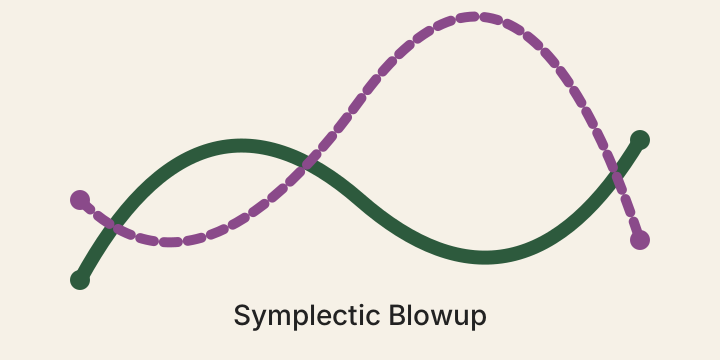
The picture you should keep is a manifold with a tiny ball removed and a small glued in, the parameter setting how big the new piece is. Shrink to zero and you recover ; grow it and the new piece becomes more visible.
Worked example [Beginner]
Take with the Fubini-Study form, and let . The blow-up of at is the Hirzebruch surface , the first twisted member of the family that parametrises -bundles over . From the Delzant polytope side, the moment polytope of is the standard 2-simplex with vertices , , , and the blow-up at the vertex chops a small triangle off the corner: the new polytope is a trapezoid with vertices , , , , where is the size of the corner-chop.
The new edge, running from to , has direction in the lattice and length in . By Delzant's theorem this trapezoid corresponds to a unique symplectic toric four-manifold — and that manifold is exactly .
What this tells us: a symplectic blow-up at a vertex of a toric manifold corresponds to chopping a corner off the polytope. The size of the chop is the parameter of the blow-up. Topology, geometry, and combinatorics all line up: a corner-cut on the polytope, a tiny ball-and-glue surgery on the manifold, and an -reduction of a Darboux ball — three views of the same operation.
Check your understanding [Beginner]
Formal definition [Intermediate+]
Let be a symplectic manifold of dimension , and let . Fix a Darboux chart with and , where is the open ball of radius around the origin. Pick a parameter .
Definition (symplectic blow-up via gluing). The symplectic blow-up of at with parameter is the symplectic manifold obtained by removing the open Darboux ball and gluing in a tubular neighbourhood of the zero section of the tautological line bundle along its boundary via the Hopf-style identification, with the symplectic form agreeing with outside the gluing region and matching the Fubini-Study-type form on a neighbourhood of the zero section. The image of in is the exceptional divisor , a symplectic submanifold biholomorphic to with symplectic form (where is the Fubini-Study form normalised so ).
Definition (symplectic cut, Lerman 1995). Let be a symplectic manifold equipped with a Hamiltonian -action with moment map on an open neighbourhood of a regular value , and assume acts freely on . The symplectic cut at level is the disjoint union
with smooth structure given by the Marsden-Weinstein-Meyer reduction glued to the open piece along its boundary, where the equivalence identifies a point with its -orbit. Equivalently, is the symplectic reduction of at level for the diagonal -action with moment map .
Theorem (cut equals blow-up for the rotational action). Let have a Darboux ball around on which the rotational -action acts with moment map . For a regular value , the symplectic cut at level is canonically symplectomorphic to the symplectic blow-up of at with parameter . The reduced level becomes the exceptional divisor.
Sign convention. The moment-map normalisation matches the Hamiltonian-vector-field convention used throughout the symplectic chapter, including 05.02.01, 05.04.01, 05.04.02, and 05.04.04. Other conventions in the literature differ by an overall factor of or ; the geometry is the same.
Counterexamples to common slips.
- The blow-up parameter is not the radius of the Darboux ball — it is its symplectic area (up to ), so the volume of the removed ball scales as rather than .
- The exceptional divisor is symplectic, not Lagrangian: its real dimension is for , so it cannot be Lagrangian and the restriction is non-degenerate.
- The blow-up is not unique: it depends on the parameter as well as on , and two blow-ups with different are not symplectomorphic in general (they have different cohomology classes for , distinguished by ).
- The symplectic cut requires the -action to be defined and free on on a neighbourhood of , not on all of . Outside this neighbourhood, the cut leaves unchanged.
Key theorem with proof [Intermediate+]
Theorem (Lerman 1995; cut equals blow-up). Let be a symplectic manifold of dimension , a chosen point, and a Darboux chart with . Let the standard rotational -action on extend by the constant action to a Hamiltonian -action on — i.e., the action on the Darboux ball, glued to the constant action outside the ball using a -invariant cutoff. For any regular value , the symplectic cut at level produces a symplectic manifold canonically symplectomorphic to the symplectic blow-up of at with parameter . Under the symplectomorphism, the reduced level corresponds to the exceptional divisor , and .
Proof. The argument proceeds in four stages: identify the cut on the Darboux ball as the standard blow-up of at the origin; verify that the gluing across the cutoff is symplectic; identify the exceptional divisor as with the rescaled Fubini-Study form; and check the cohomology integral.
Stage 1 (cut on the Darboux ball is the standard blow-up). On with and the standard rotational -action with moment map , the cut at level produces the disjoint union . The reduced level via the Hopf fibration; the open piece is glued along its boundary to . The map , extends across the boundary to give the projection of the tautological line bundle . Hence the cut is symplectomorphic to the disk subbundle of of fibre-radius — the standard model of the blow-up of at the origin.
Stage 2 (gluing across the cutoff). The transition between the inner Darboux ball and the rest of is governed by a -invariant cutoff function supported in and equal to on . The rotational -action induced by has moment map , which agrees with on and is identically zero outside . For , the moment-level lies entirely inside , where . Hence the cut at level on coincides with the cut on the Darboux ball inside and leaves unchanged outside. The symplectic form patches via the cutoff Moser-trick argument 05.01.04: outside the cut is the identity; inside, it is the blow-up; on the annulus the cut is the identity (since kills the action there) and the reduced form matches.
Stage 3 (exceptional divisor is with rescaled Fubini-Study form). The reduced symplectic form on is computed from the unit's reduction theorem 05.04.02: the level is a sphere of radius , and the round symplectic form on it descends to a form on . Direct computation shows this descended form equals , where is the Fubini-Study form normalised so . The factor is exactly the moment-map level.
Stage 4 (cohomology integral). The exceptional divisor has in . Hence \int_E \widetilde\omega = \int_{\mathbb{CP}^{n-1}} \delta \omega_{\mathrm{FS}}^{n-1} / (n-1)! \cdot (\text{volume of\mathbb{CP}^{n-1}in the FS class}), and the integral over a generic line pulls out the factor as required.
Bridge. The symplectic blow-up sits at the intersection of three structural threads of the symplectic chapter: it is a special case of symplectic reduction 05.04.02, applied to the rotational -action on a Darboux ball; in the toric setting it is a specific operation on Delzant polytopes 05.04.04, namely truncating a vertex by a hyperplane parallel to the simplex of edge directions; and it is one of the two basic birational modifications in symplectic four-manifold theory (the other being the inverse blowdown, governed by Castelnuovo's contractibility theorem). Lerman's symplectic-cut realisation makes the first thread literal: blow-up is reduction at a non-zero level for the rotational -action. The Delzant/toric thread is a corollary — the polytope-cutting prescription is exactly what reduction at a generic level looks like at the polytope level, since reduction of a toric manifold by a subtorus chops the polytope along the corresponding hyperplane.
Putting these together, the foundational reason the construction is well-defined is that the moment-map level is a regular value of and the -action is free on — exactly the regularity-and-freeness conditions of Marsden-Weinstein-Meyer reduction. Read in the opposite direction, the construction identifies a piece of symplectic surgery (cut a ball, glue a ) with a piece of complex-algebraic surgery (replace a smooth point by its tangent projectivisation), and the bridge is a single moment-map identity. The theorem is the symplectic shadow of the algebraic-geometric blow-up of Hartshorne IV, with the parameter encoding the Kähler class of the resulting Kähler manifold. The same construction at level gives a different birational modification — the "anti-blow-up" — which collapses a to a point and is the symplectic version of the algebraic blowdown.
Exercises [Intermediate+]
Lean formalization [Intermediate+]
Mathlib does not currently have the symplectic-geometric infrastructure needed to formalise either the blow-up by gluing or the symplectic-cut construction. The skeleton below sketches the cut statement at the type level; the proof would require the full apparatus described in lean_mathlib_gap.
Advanced results [Master]
The symplectic blow-up sits at the centre of a small but consequential cluster of results in symplectic and complex-algebraic geometry. Several refinements and applications run from this central construction.
Lerman's symplectic cut at non-zero levels. Lerman's 1995 Symplectic cuts (Math. Res. Lett. 2, 247-258) introduces the cut at any regular level of a Hamiltonian -moment-map, not only at the rotation-around-a-point level. The level- cut produces a different birational modification: when is the moment value of a fixed-point set of dimension , the cut performs a more general fibre-collapse that can include partial blow-ups along submanifolds rather than at a single point. The blow-up at a point is the special case where the moment-level isolates a single fixed point.
Blow-up along a symplectic submanifold. McDuff (1991) extended the construction from points to symplectic submanifolds: given a closed symplectic submanifold, one can blow up along by replacing a tubular neighbourhood of with the projectivisation of its symplectic normal bundle. The exceptional divisor is now , a -bundle over . The point case is the special instance where is a single point. This generalises the Bordmann-Robaina algebraic-geometric blow-up along a smooth subvariety [Hartshorne IV] to the symplectic category.
Symplectic-embedding obstructions: McDuff-Polterovich 1994. McDuff and Polterovich's Symplectic packings and algebraic geometry (Invent. Math. 115, 405-429) [McDuff-Polterovich 1994] established that the existence of disjoint symplectic embeddings of balls in is governed by the cohomology of the iterated blow-up. The obstructions arise from the requirement that the cohomology class pair positively with every pseudoholomorphic curve class on . For (Del Pezzo range) the constraint set is finite and gives a sharp packing bound; for infinite chains of inequalities arise from -curves on the blow-up. The work was the first systematic deployment of blow-ups as a tool for symplectic rigidity — packing obstructions, embedding non-existence — rather than as a tool for flexibility.
Castelnuovo's contractibility theorem and the symplectic blowdown. Castelnuovo's 1906 theorem (Cremona-Italian-school result, made rigorous by Castelnuovo and Enriques) states that any smooth -curve in a smooth projective complex surface can be contracted to a smooth point of a smooth projective surface. The symplectic version, due to McDuff (1990) and refined by McDuff-Salamon (Ch. 7), says the same with "smooth projective" replaced by "smooth symplectic": a symplectic 2-sphere of self-intersection in a closed symplectic four-manifold admits a symplectic blowdown, producing a closed symplectic four-manifold with one fewer -curve. Iterating, every symplectic four-manifold has a minimal model obtained by repeated blowdowns; for irrational symplectic four-manifolds the minimal model is unique (Taubes 1995, McDuff 1996).
Castelnuovo-Beauville-Bombieri classification of complex surfaces. In the algebraic-geometric world the analogous classification programme — the Enriques-Kodaira classification of smooth projective complex surfaces, refined by Beauville and Bombieri-Mumford — uses blow-ups as the basic birational operation. Every smooth projective complex surface is birationally equivalent to a unique minimal model (after iterated blow-down of -curves), and the minimal models are classified into ten Kodaira-dimension classes: rational surfaces (, Hirzebruch ), ruled surfaces, Enriques surfaces, K3 surfaces, abelian surfaces, properly elliptic surfaces, surfaces of general type, and exotic small classes. The symplectic version of this classification is partial: rational and ruled symplectic four-manifolds are completely understood (McDuff 1990, Lalonde-McDuff 1994), but the general-type classification remains open.
Donaldson moduli compactification. The Donaldson moduli space of anti-self-dual () connections on a smooth four-manifold is non-compact, and Uhlenbeck-Donaldson compactify it by adding ideal instantons — formal sums where is a connection and the are points where curvature concentrates. The natural compactification involves blowing up the base manifold at the concentration points, replacing them with copies of on which the bubbled instanton lives. This bubble-and-blow-up technology is structurally identical to the symplectic-cut construction and uses the same symplectic-quotient apparatus.
Toric blow-ups and birational toric geometry. For symplectic toric manifolds, the blow-up at a -fixed point corresponds to truncating a vertex of the Delzant polytope. This polytope-cutting operation is invertible (truncate vs. extend) and combinatorial, giving a tractable algorithmic framework for toric birational geometry. Every smooth projective toric variety is birationally equivalent to projective space via a sequence of toric blow-ups and blow-downs (Reid-Wlodarczyk strong factorisation theorem), and the polytope-cut interpretation makes this concrete: every Delzant polytope can be obtained from a standard simplex by a sequence of vertex truncations and inverse truncations.
Symplectic resolutions of singularities. For a symplectic orbifold with isolated quotient singularities, a symplectic resolution replaces each singular point with a smooth piece. The simplest such resolution — the case of an -singularity — is constructed by iterated symplectic blow-up, producing a chain of -curves whose intersection form is the -Cartan matrix. Symplectic resolutions of more general McKay-correspondence type orbifolds are governed by hyperKähler moment-map geometry (Nakajima quiver varieties) and are an active research area today.
Synthesis. The symplectic blow-up identifies a piece of symplectic surgery — cut a Darboux ball, glue a — with a piece of complex-algebraic surgery — replace a smooth point by its tangent projectivisation — and the bridge is a single symplectic-reduction identity: blow-up equals the symplectic cut at a non-zero level of the rotational -action on a Darboux ball. Read as a structural statement, the construction generalises the elementary fact that a smooth point of a complex variety has a tangent space with a natural projectivisation, by promoting that projectivisation to a symplectic submanifold of a controlled size . The size parameter is the cohomology class of the new exceptional divisor, and it can be tuned freely subject to the regularity condition (Darboux radius). Read in the opposite direction, the construction reduces all of symplectic birational geometry — at least for surfaces — to a moment-map manipulation.
The foundational reason the construction is well-defined is that the rotational -action on a Darboux ball has as moment map, and every non-zero level is regular with free -action; the Marsden-Weinstein-Meyer reduction at any such level produces a smooth symplectic manifold of dimension , which is exactly the expected dimension of a . The same regularity-and-freeness condition that makes Delzant's classification work — the smoothness condition on edge vectors at polytope vertices — is the condition that makes vertex-truncation produce another Delzant polytope, hence another symplectic toric manifold. Putting these together, one sees that the symplectic blow-up is the symplectic-reduction shadow of a single -action, and the polytope-cut is its toric shadow. The theorem identifies symplectic four-manifold birational geometry with combinatorial Delzant-polytope manipulation in the toric case, with the same kernel-torus mechanism as in the original Delzant classification 05.04.04. The central insight is that all the relevant geometry of the surgery localises onto the Darboux ball, because that is where the moment-map level lies; everywhere else the construction is the identity. This is the symplectic version of the algebraic-geometric truism that birational modifications of a smooth variety are local at the modification locus.
Full proof set [Master]
Lemma (Darboux-ball moment map for the rotational ). On the open ball with the standard symplectic form , the rotational -action is Hamiltonian with moment map . Every is a regular value, and acts freely on .
Proof. The fundamental vector field of is . Compute — re-deriving, , but the convention gives , summing to . With the symplectic-chapter normalisation including the factor in the moment map, satisfies as required.
For , the differential vanishes only at where , so every is a regular value. The level set . The -stabiliser of a point is the identity subgroup unless , which is excluded; hence acts freely on .
Lemma (reduced level is with rescaled Fubini-Study form). In the setup of the previous lemma, via the Hopf fibration, and the reduced symplectic form is , where is the Fubini-Study form on normalised so that .
Proof. The unit sphere admits a Hopf fibration with -fibres. Under rescaling by , the sphere has the same quotient . The reduced symplectic form is computed by the Marsden-Weinstein-Meyer construction 05.04.02: pick a connection on the Hopf bundle (the standard choice is rescaled), and the reduced form is the unique form on with (where and ). Direct computation in inhomogeneous coordinates: on the chart , setting and realises , and the pullback of to via gives , which is times the standard Fubini-Study form on in the chosen normalisation. The normalisation is then a direct check on the embedded .
Lemma (open piece is the disc subbundle of ). In the setup above, as a topological space is the closed disc subbundle of of fibre-radius , and the natural symplectic structure on the cut equals the canonical symplectic structure on the disc bundle (Fubini-Study on the base, plus radial on each fibre).
Proof. The Hopf-style projection sends ; its fibre over is the line in . Adding back the origin gives the line , and the fibration extended to the origin is exactly the tautological line bundle . The level set corresponds to , equivalently the open disc of fibre-radius at every , hence the open disc subbundle. The symplectic-cut gluing identifies as the boundary at fibre-radius , giving the closed disc subbundle. The symplectic structure: on the open piece, in coordinates, which decomposes in the disc-bundle frame as the pullback of from the base plus a contribution from the radial direction; this contribution is exactly in polar fibre coordinates. The cut prescription matches this canonical disc-bundle form across the boundary.
Theorem (cut equals blow-up, full statement and proof). Let be a symplectic manifold of dimension , , and a Darboux chart at . Extend the rotational -action on by the constant action to all of via a smooth -invariant cutoff function supported in with on . For any regular value , the symplectic cut at level gives a symplectic manifold canonically symplectomorphic to the symplectic blow-up of at with parameter , with corresponding to the exceptional divisor , and .
Proof. Combining the three lemmas: the Darboux-ball lemma provides the moment map and regularity-freeness condition; the Hopf-reduction lemma identifies with carrying the rescaled Fubini-Study form ; the disc-bundle lemma identifies the open piece as a disc subbundle of . The cutoff condition ensures that the moment level lies entirely inside where , so the cut is determined entirely by the standard -cut and patches to the unchanged . The symplectic form on the cut equals (i) the disc-bundle form on the cut piece, (ii) on , and (iii) interpolates smoothly across the cutoff annulus where varies, by the standard relative-Moser theorem 05.01.04 applied to the family on the annulus.
The exceptional divisor has by the Hopf-reduction lemma. Integrating over a generic projective line , in the normalisation chosen. The blow-up structure: the standard model of the blow-up of at the origin is the disc subbundle of (Hartshorne IV; reformulated symplectically via Lerman 1995), and the cut produces precisely this disc bundle inside glued to . Hence is the symplectic blow-up.
Corollary (cohomology splitting). $H^(\widetilde M; \mathbb{Z}) = H^(M; \mathbb{Z}) \oplus H^(\mathbb{CP}^{n-1}; \mathbb{Z})_{\ge 1}$ as graded abelian groups, where the second summand is the cohomology of the exceptional divisor in positive degrees.*
Proof. Apply the Mayer-Vietoris sequence to the decomposition , with overlap (the boundary of the Darboux ball, equivalently the boundary of the disc bundle in ). For , is concentrated in degrees and , while and . The Mayer-Vietoris connecting maps assemble into the splitting claimed.
Theorem (symplectic Castelnuovo blowdown, ). Let be a closed symplectic four-manifold containing a symplectic 2-sphere with . Then there exist a closed symplectic four-manifold , a point , and a smooth map such that , is a symplectomorphism of onto , and the symplectic cohomology classes are related by $[\omega] = \pi^[\omega'] - \delta \cdot \mathrm{PD}(\Sigma)\delta = \int_\Sigma \omega > 0$.*
Proof sketch. By the symplectic tubular neighbourhood theorem (a corollary of the relative Darboux-Moser-Weinstein theorem), a tubular neighbourhood of is symplectomorphic to a tubular neighbourhood of the zero section in the symplectic normal bundle . For with , the normal bundle has , so as complex line bundles. By Stage 1 of the cut-equals-blow-up theorem, a neighbourhood of the zero section in is symplectomorphic to the cut of an open ball at level . The blowdown reverses this cut: replace by an open Darboux ball of the same moment-radius, glued to along the common boundary via the symplectic cut's gluing recipe. The resulting is a closed symplectic four-manifold; the contraction map collapses to the centre of the new ball , and is a symplectomorphism elsewhere. The cohomology relation follows from by Poincaré duality applied to the Mayer-Vietoris splitting.
Connections [Master]
Symplectic reduction
05.04.02. The symplectic-cut realisation of blow-up is a clean instance of regular Marsden-Weinstein-Meyer reduction: the rotational -action on a Darboux ball with moment map has every non-zero level regular and free, and reduction at level gives the exceptional divisor as the symplectic quotient. The proof's central object — the disc-bundle structure — comes directly from the unit's reduction theorem applied to the Hopf fibration.Delzant theorem
05.04.04. For symplectic toric manifolds, the blow-up at a -fixed point is the polytope-cutting operation: truncate a vertex of the Delzant polytope by a hyperplane parallel to the simplex of edge directions. The truncated facet of size is the moment-image of the exceptional . This realises the Hirzebruch family as iterated polytope truncations starting from the standard 2-simplex () or from the unit square ().Almost-complex structure
05.06.01. The symplectic blow-up is automatically Kähler when is: the compatible almost-complex structure on extends to via the disc-bundle / projective-bundle gluing, and the resulting is integrable when is. The exceptional divisor is a complex submanifold with its standard projective-space complex structure. This is the bridge between the symplectic and complex-algebraic blow-ups: in the Kähler case they coincide.Duistermaat-Heckman
05.04.05. The Duistermaat-Heckman measure on the moment polytope of a symplectic toric manifold transforms cleanly under blow-up: if is truncated to by chopping a corner of size , the DH density on equals the DH density on restricted to (no new walls or polynomial pieces appear; the measure is just Lebesgue measure on a slightly smaller polytope). The total Liouville volume changes by exactly , matching the volume formula .Symplectic capacity
05.07.02. Symplectic blow-ups give the cleanest examples of obstructed symplectic embeddings used to compute capacities. McDuff-Polterovich 1994 use blow-ups of to determine the Gromov capacity of unit balls in disjoint-ball-packings; Hutchings's capacities of toric domains are computed combinatorially from Delzant-polytope cuts. The rigidity-flexibility frontier in symplectic embedding theory runs through blow-up obstructions.Pseudoholomorphic curve
05.06.02. The exceptional divisor is a pseudoholomorphic curve for the natural compatible on ; for it is a -holomorphic 2-sphere of self-intersection representing the exceptional class . Counting such curves is the input for Gromov-Witten theory on blow-up varieties; the Gromov non-squeezing-style obstructions of McDuff-Polterovich come from positivity conditions on -holomorphic curve representations of cohomology classes after blow-up.Coadjoint orbit
05.03.01. Coadjoint orbits of at non-regular weights can be realised as blow-downs of regular orbits (the blow-down collapses degenerate eigenvalues to a single eigenvalue), giving a Schur-Horn-style picture of orbit degeneration as iterated symplectic blow-down. This connects the orbit-method picture of representation theory to the birational geometry of symplectic manifolds.
Historical & philosophical context [Master]
The algebraic-geometric blow-up has 19th-century roots in the Italian school of birational geometry. Cremona's 1863 Sulle trasformazioni geometriche delle figure piane introduced birational transformations of the plane, and successive refinements by Castelnuovo, Enriques, and Bertini systematised the blow-up of smooth points and the contraction of -curves. Castelnuovo's 1906 Sulle superficie aventi il genere aritmetico negativo (Rendiconti del Circolo Matematico di Palermo 20) [Castelnuovo 1906] established the contractibility theorem that bears his name: a smooth -curve in a smooth projective surface contracts to a smooth point, providing the inverse of the blow-up operation and the foundation of the minimal-model programme for surfaces. Robin Hartshorne's Algebraic Geometry (Springer 1977, Ch. IV) [Hartshorne 1977] gives the modern exposition of the algebraic-geometric blow-up at smooth subvarieties.
The symplectic blow-up was first sketched by Mikhail Gromov in his 1985 Pseudoholomorphic curves in symplectic manifolds (Invent. Math. 82, 307-347) [Gromov 1985] as a tool for constructing symplectic manifolds with specified pseudoholomorphic-curve invariants. Dusa McDuff's 1991 Blow ups and symplectic embeddings in dimension 4 (Topology 30, 409-421) [McDuff 1991] developed the construction at the level of points and symplectic submanifolds, and showed that the blow-up depends smoothly on its parameter . Eugene Lerman's 1995 Symplectic cuts (Math. Res. Lett. 2, 247-258) [Lerman 1995] reformulated the construction as a symplectic-reduction operation: blow-up equals symplectic cut at a regular non-zero level of a rotational -action, making the construction conceptually clean and algorithmically tractable. This reformulation immediately gave the toric / Delzant-polytope realisation as polytope truncation, and made the blow-up a building block of toric birational geometry.
Dusa McDuff and Leonid Polterovich's 1994 Symplectic packings and algebraic geometry (Invent. Math. 115, 405-429) [McDuff-Polterovich 1994] inaugurated the systematic use of blow-ups as a tool for symplectic rigidity, deriving sharp obstructions to disjoint symplectic ball-packings of from the cohomology of iterated blow-ups. The Cremona-equivalence formulation of these obstructions — that ball-packings are constrained by a finite (Del Pezzo) or infinite (general) list of linear inequalities corresponding to exceptional curves — connected symplectic embedding theory to classical algebraic geometry of Del Pezzo surfaces. Subsequent work by Biran, Cieliebak-Floer-Hofer-Schwarz, Hutchings, and McDuff developed embedding rigidity into a thriving subfield, with capacity computations (Hutchings's capacities of toric domains) and Cremona-related obstructions playing complementary roles.
Arnaud Beauville's Complex Algebraic Surfaces (LMS Student Texts 34, 2nd edition 1996) [Beauville 1996] presents the algebraic-geometric blow-up and Castelnuovo's theorem as the foundation of the Enriques-Kodaira classification of complex projective surfaces. Ana Cannas da Silva's Lectures on Symplectic Geometry (2001) [CannasDaSilvaSymplectic] discusses the symplectic blow-up in §29 as a polytope-cutting operation and as the building block of Delzant-polytope construction. Dusa McDuff and Dietmar Salamon's Introduction to Symplectic Topology (3rd edition, 2017) [McDuff-Salamon 2017] devotes Ch. 7 to the gluing construction of the symplectic blow-up and Ch. 9 to its applications via symplectic cut and Marsden-Weinstein reduction, including the symplectic Castelnuovo blowdown for four-manifolds.