Weinstein Lagrangian neighbourhood theorem
Anchor (Master): Weinstein 1971 (originator); Cannas da Silva §8; McDuff-Salamon Ch. 3 and Ch. 11
Intuition [Beginner]
If sits inside a symplectic manifold as a Lagrangian — a half-dimensional piece on which the symplectic pairing vanishes — then a small neighbourhood of inside is forced. There is only one symplectic shape it can have, and that shape is determined by alone.
The shape is the cotangent bundle . Picture as the zero section, and the directions normal to as the cotangent fibres above each point. The Weinstein theorem says: zoom in close enough to inside , and what you see is indistinguishable from zooming in close to inside .
This rigidity is the reason every Lagrangian carries the same local symplectic data as its own cotangent bundle. The global topology of may differ between embeddings, but the local symplectic geometry does not.
Visual [Beginner]
A schematic: the Lagrangian as a curved spine, with normal fibres rising perpendicularly. The neighbourhood inside matches a strip of near its zero section, with the matching arrows showing the symplectic-form correspondence.
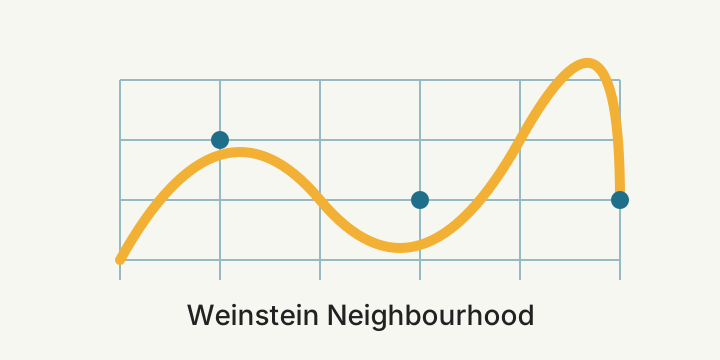
The picture is not a coordinate construction. It is a record of which two pieces are being identified: the chunk of near , and the chunk of near its zero section.
Worked example [Beginner]
Take the circle embedded as the equator of with its area form . The circle is half-dimensional in , and the area form restricted to a one-dimensional subspace is automatically zero, so is Lagrangian.
The cotangent bundle is an infinite cylinder with coordinates and area form . The Weinstein theorem says a small annulus around the equator of matches a small annulus around the zero section of the cylinder.
Zoom in: a thin strip on the sphere around its equator is a thin strip on the cylinder. Far from the equator the two are different; near it, the same.
What this tells us: a Lagrangian submanifold determines its own neighbourhood inside any symplectic manifold containing it.
Check your understanding [Beginner]
Formal definition [Intermediate+]
Let be a symplectic manifold and a closed embedded Lagrangian submanifold. Recall from 05.05.01 that "Lagrangian" means and .
Let be a smooth manifold. The canonical symplectic form on the cotangent bundle is , where the Liouville one-form is defined by
In any local chart on with conjugate fibre coordinates on ,
The zero section (the image of ) is a closed Lagrangian submanifold of , since vanishes along it and so does when both arguments are tangent to the zero section.
A symplectomorphism between symplectic manifolds is a diffeomorphism with . Two symplectic forms on the same manifold are equivalent on a neighbourhood of if such a exists between open neighbourhoods of , fixing pointwise.
Key theorem with proof [Intermediate+]
Theorem (Weinstein, 1971). *Let be a symplectic manifold and a closed embedded Lagrangian submanifold. Then there exist open neighbourhoods of and of the zero section, and a diffeomorphism*
with and $\phi^\omega_{\mathrm{can}} = \omega|U\omega{\mathrm{can}} = -d\lambdaT^L$.
Proof. The argument has three steps: build the tubular diffeomorphism, identify the normal bundle with using , then apply Moser's trick to a path of symplectic forms on the resulting model.
Step 1: Lagrangian splitting and the normal bundle. Along , the tangent bundle contains as a Lagrangian subbundle. The symplectic-orthogonal complement satisfies (Lagrangian = self-orthogonal). The bundle map
is well defined on any complement to in and descends to an isomorphism — nondegenerate because is nondegenerate, with kernel exactly . Choose any complement subbundle with ; then is a vector-bundle isomorphism over .
Step 2: tubular neighbourhood diffeomorphism. Choose a Riemannian metric on and let be the orthogonal complement to inside . Since is closed, the exponential map of restricts to a diffeomorphism
from an open disk subbundle onto an open tubular neighbourhood of . Composing with the bundle isomorphism from Step 1 produces a diffeomorphism
onto an open neighbourhood of the zero section. Both and act as the identity on , so .
Step 3: Moser's trick. On now consider two symplectic forms: and , the pushforward of the original form. Both restrict to closed forms; both are nondegenerate on after possibly shrinking (nondegeneracy is open). The Lagrangian splitting from Step 1 is engineered so that and agree on along the zero section: on , both forms are the canonical pairing up to sign, set by Step 1's choice .
Define the path for . Each is closed; nondegeneracy on a neighbourhood of holds because and nondegeneracy is an open condition along the compact . The difference is closed and vanishes along , so the relative Poincaré lemma — applied on the disk-bundle retracting to its zero section — produces a one-form with
By Moser's trick 05.01.05, define the time-dependent vector field on by
Because , we have , so the flow of exists on a (possibly smaller) neighbourhood of for all and fixes pointwise. Cartan's formula combined with gives
Therefore . Setting and shrinking to the open subsets where is defined produces the required symplectomorphism with and .
Bridge. The proof builds toward 05.04.02 (symplectic reduction): the regular-value normal-form argument there uses exactly this Lagrangian-neighbourhood machinery to identify a tubular neighbourhood of with a model from which the quotient symplectic structure descends. The same Moser-trick template appears again in 05.07.01 (non-squeezing) when the local model around a Lagrangian disk supplies the comparison geometry for symplectic capacities. Putting these together, the foundational insight is that a Lagrangian carries enough data to reconstruct its symplectic neighbourhood — this is the bridge between local algebra (the splitting ) and global geometry (a symplectomorphism with a model).
Exercises [Intermediate+]
Lean formalization [Intermediate+]
A statement-level skeleton (Mathlib does not yet have the full theorem; the gap is detailed in lean_mathlib_gap):
The three sorry-blocking pieces match Steps 1–3 of the proof. Each is a Mathlib-contribution-sized target.
Advanced results [Master]
The Weinstein neighbourhood theorem is a tubular-neighbourhood statement upgraded by a symplectic normal form. The same proof template — splitting, tubular embedding, Moser's trick on a path — yields several refinements.
Equivariant Weinstein. Suppose a compact Lie group acts on by symplectomorphisms preserving . Then the symplectomorphism may be chosen -equivariant. The proof: average the Riemannian metric over to produce a -invariant metric, average the primitive over to produce a -invariant primitive (still vanishing on because acts on ), and observe that the Moser vector field defined by inherits -invariance, hence so does its flow [Cannas da Silva §8].
Symplectic-neighbourhood theorem (Weinstein, general case). The Lagrangian-neighbourhood theorem extends to arbitrary symplectic submanifolds: if and are embedded symplectic submanifolds with isomorphic symplectic normal bundles, then neighbourhoods of in and are symplectomorphic. The Lagrangian case is the extremum where the normal bundle is forced to be by the symplectic structure; the symplectic case is the opposite extremum where is itself a symplectic subbundle and the symplectic-normal data is independent. Coisotropic and isotropic intermediates interpolate [McDuff-Salamon Ch. 3].
Cotangent-bundle universality and generating functions. The Weinstein theorem identifies every Lagrangian with the zero section of its own cotangent bundle locally. A Hamiltonian symplectomorphism has graph that is Lagrangian; near the diagonal , the Weinstein theorem identifies a neighbourhood with , and becomes a section of . For close to the identity, that section is the graph of an exact one-form for a function — the generating function of . Critical points of are exactly the fixed points of , the foundational identification used in Arnold's conjecture.
Floer-theoretic comparison. In Lagrangian Floer homology one studies pairs of Lagrangians intersecting transversally and the moduli of pseudoholomorphic strips between them. The energy estimate compares the symplectic action across the intersection: near each , Weinstein gives a cotangent-bundle model in which the action functional is the standard one, and the comparison theorem reduces global energy estimates to model computations. This is the local-to-global mechanism behind the unobstructed-pair theory of Fukaya-Oh-Ohta-Ono [McDuff-Salamon Ch. 11].
Synthesis. The Weinstein theorem identifies the local symplectic geometry near a Lagrangian with the canonical structure on its cotangent bundle, and putting these together, the consequence is that "Lagrangian" is exactly the geometric class for which neighbourhoods are determined by the submanifold's diffeomorphism type alone. This is precisely the phenomenon that Weinstein elevated into his programme: the central insight is that a Lagrangian is a generalised function — a section of where may not be a graph over a base — and the local theorem is what turns this slogan into a theorem. The result generalises the Darboux theorem (05.01.04) from points to half-dimensional submanifolds and is dual to the Weinstein tubular neighbourhood theorem for symplectic submanifolds, where the cotangent bundle is replaced by a symplectic-normal-bundle model. The bridge between local rigidity (Darboux at a point, Weinstein along a Lagrangian) and global flexibility (no symplectic invariants beyond cohomology, by Moser) is the same Moser-trick mechanism applied at different stratifications of the data.
Full proof set [Master]
Lemma (relative Poincaré lemma for tubular neighbourhoods). Let be an open neighbourhood of the zero section of a vector bundle , and a closed form vanishing on (meaning $\iota^\beta = 0\iota: L \hookrightarrow V\alpha \in \Omega^{k-1}(V)d\alpha = \beta\alpha|_L = 0$.*
Proof. Let be fibrewise scalar multiplication by , so and is projection to the zero section. The homotopy restricts to a homotopy on for in a neighbourhood of , possibly after shrinking . The standard chain homotopy
(with the radial vector field on the fibres) satisfies . Setting and noting because completes the proof.
Lemma (cotangent lift). *A diffeomorphism induces a symplectomorphism defined by . It satisfies and hence .*
Proof. For ,
The projection composed with equals , so , giving . Cancelling, . The two agree, so . Taking of both sides gives the symplectic-form identity.
Corollary (uniqueness up to symplectomorphism of -fixing maps). If are two Weinstein neighbourhood symplectomorphisms with , then they differ by a symplectomorphism of fixing the zero section.
Proof. The composition is a symplectomorphism preserving the zero section. The set of such forms a group; the corollary records that Weinstein gives a coset, not a unique map.
Theorem (Weinstein, restated for the proof set). As stated above; Steps 1–3 of the proof of the Key Theorem are the formal proof. The pieces cited above (relative Poincaré lemma, cotangent lift) supply the technical lemmas. Closedness of enters in three places, listed in Exercise 7.
Connections [Master]
Lagrangian submanifold
05.05.01. This unit's input. The Weinstein theorem says the data of a Lagrangian determines its neighbourhood; the previous unit is the input definition and the canonical examples (zero section, graph of a closed one-form, graph of a symplectomorphism) that the theorem applies to.Moser's trick
05.01.05. The technical engine. Step 3 is a verbatim instance: a path of symplectic forms with closed exact difference gives a symplectomorphism. Weinstein, Darboux, and the relative Darboux theorem are three applications of Moser at three different stratifications.Symplectic reduction
05.04.02. The Marsden-Weinstein-Meyer theorem in the regular case uses the Lagrangian-neighbourhood machinery to identify a normal-form model for as a coisotropic submanifold whose null foliation gives the quotient.Non-squeezing
05.07.01. The Gromov non-squeezing theorem and its capacity-theoretic consequences compare local Lagrangian neighbourhoods via the cotangent-bundle model the Weinstein theorem supplies.Arnold conjecture
05.08.01. The fixed-point version of Arnold's conjecture rests on the cotangent-bundle generating-function picture: graphs of symplectomorphisms become sections of cotangent bundles via Weinstein, and fixed points become critical points of generating functions.Floer homology
05.08.02. Lagrangian Floer homology uses the Weinstein neighbourhood near each Lagrangian to set up the local action functional and the energy estimates; the global theory is built by gluing model computations on cotangent neighbourhoods.
Historical & philosophical context [Master]
Alan Weinstein introduced the theorem in his 1971 paper Symplectic manifolds and their Lagrangian submanifolds (Advances in Mathematics 6, 329–346) [Weinstein 1971]. The paper opens with the slogan that became the title of his programme: Lagrangian submanifolds are generalised functions. A function has a graph in , and via the differential a closed one-form determines a Lagrangian section of — and any Lagrangian, locally, looks like a section. The neighbourhood theorem of the present unit is the technical foundation of that slogan.
The proof technique — Moser's trick applied along a Lagrangian — was Weinstein's adaptation of Jürgen Moser's 1965 path method, originally introduced for volume forms and extended by Moser himself to symplectic forms in arbitrary cohomology classes [Moser 1965]. The Lagrangian neighbourhood theorem appeared in Weinstein's paper alongside the broader symplectic-tubular-neighbourhood theorem (for any symplectic submanifold, with the symplectic-normal-bundle data) and the coisotropic-neighbourhood theorem.
Weinstein's programme matured over the next two decades into the categorical viewpoint underlying Lagrangian Floer homology, Fukaya categories, and homological mirror symmetry — all of which take "Lagrangian = generalised section" as a foundational identification. The Weinstein conjecture in contact geometry (every Reeb vector field on a closed contact manifold has a periodic orbit) is the contact analogue and remained open for decades; it was settled in dimension three by Taubes in 2007 using Seiberg-Witten theory.