Moser's trick
Anchor (Master): Moser 1965 (originator); Weinstein 1971 (symplectic extension); Cannas §3; McDuff-Salamon Ch. 3
Intuition [Beginner]
Moser's trick is a method for proving that two symplectic forms on the same manifold are the same up to a diffeomorphism. The setup: you have a manifold and a smooth path of symplectic forms , , all in the same de Rham cohomology class. The conclusion: there is an isotopy of (a smooth path of diffeomorphisms with ) that pulls back to . At time this gives a single diffeomorphism intertwining and .
The technique is purely calculational: pick a primitive of the time-derivative , use non-degeneracy of to convert that primitive into a vector field , integrate to get . The proof that is constant in is one application of Cartan's formula plus the cohomology assumption.
Moser introduced the method in 1965 for volume forms; Weinstein extended it to symplectic forms and to neighbourhoods of Lagrangian submanifolds. Almost every standard local-form result in symplectic geometry — Darboux, Weinstein neighbourhood, equivariant Darboux, the smooth structure of regular symplectic reduction — is one Moser argument away.
Visual [Beginner]
A manifold with two symplectic forms drawn schematically as two patterned tilings, connected by a path of intermediate forms. An arrow labelled connects them, indicating the diffeomorphism the trick produces.
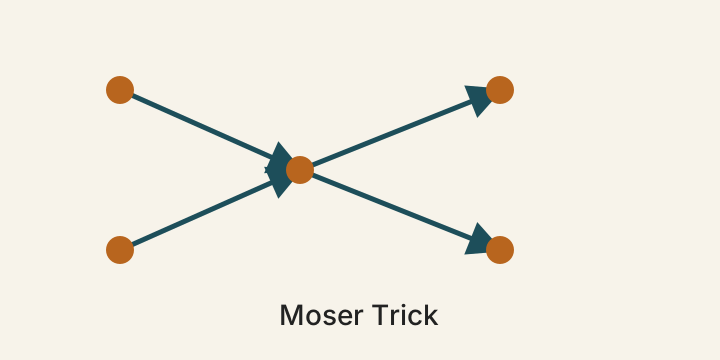
The key picture is the flow of the time-dependent vector field along the path of forms.
Worked example [Beginner]
Take with two symplectic forms: the standard and the perturbed . Both are exact on since de Rham cohomology of is zero in positive degree, so the cohomology hypothesis is automatic.
The path stays positive-definite and closed for every . Its time-derivative has a primitive that goes to zero rapidly at infinity, so the Moser vector field is compactly-essentially-supported and the flow exists for all .
The output: a smooth diffeomorphism of that pulls back to . The diffeomorphism stretches and shrinks the plane to even out the local symplectic density, but you never need to compute it explicitly — the Cartan-formula calculation guarantees its existence.
Check your understanding [Beginner]
Formal definition [Intermediate+]
Let be a smooth manifold and , , a smooth one-parameter family of symplectic forms (each closed, non-degenerate; smooth dependence on ). Suppose is exact for all — equivalently, for some smooth one-parameter family of one-forms .
The Moser construction is the time-dependent vector field on defined by
uniquely solvable for at each point and each time because is non-degenerate. The corresponding Moser flow is the isotopy obtained by integrating from the identity at . (When is non-compact the flow may not be defined for all ; the standard hypothesis is that is compactly supported, or that one works on a relatively compact subset.)
Key theorem with proof [Intermediate+]
Theorem (Moser stability). Suppose is a smooth path of symplectic forms on with exact for all . Let be the Moser vector field and its flow (assumed defined for ). Then $\psi_t^ \omega_t = \omega_0t$.*
Proof. Differentiate in :
Cartan's formula gives . Closedness kills the second term. The first term, by the defining equation of , equals . Hence
so is constant in and equals its value .
Bridge. The Moser computation here builds toward 05.05.02 (Weinstein Lagrangian neighbourhood theorem), where the same path-method appears again in a tubular neighbourhood: the symplectic form pulled back from and the canonical form on are connected by a linear path of forms vanishing-on- on a neighbourhood, and Moser's trick produces the symplectomorphism. The construction is exactly the smooth-structure argument behind regular symplectic reduction 05.04.02: different transversal slices give Moser-isotopic reduced symplectic forms. Putting these together, the foundational reason every standard local-form theorem in symplectic geometry holds is exactly that the Moser vector field defined by identifies primitives with diffeomorphisms — the cohomology hypothesis is dual to the diffeomorphism conclusion.
Exercises [Intermediate+]
Advanced results [Master]
The Moser argument is the prototype of a deformation method in geometry: a small set of cohomological hypotheses combined with non-degeneracy yields a diffeomorphism intertwining the data. The same structure recurs in many guises throughout symplectic and contact geometry.
Standard applications.
- Darboux's theorem. Every symplectic manifold is locally . Moser produces the chart change as above.
- Weinstein neighbourhood theorem. A neighbourhood of a closed Lagrangian in is symplectomorphic to a neighbourhood of the zero section in with its canonical form. The path connects pulled back to a tubular neighbourhood with ; both vanish on , so the relative Poincaré lemma gives a primitive vanishing on , hence the Moser vector field vanishes on and the flow fixes pointwise.
- Equivariant Darboux. When a compact group acts on preserving , choose a -invariant primitive (by averaging) and the resulting Moser flow is -equivariant.
- Symplectic stability of fibre bundles (Thurston-style symplectic forms on fibre bundles): two Thurston-compatible forms in the same cohomology class are connected by a Moser isotopy.
- Smooth structure on regular symplectic reduction (Marsden-Weinstein): different transversal slices of a moment-map level set give Moser-isotopic reduced forms.
- Generic Hamiltonian non-degeneracy (Floer-theoretic transversality): paths of Hamiltonians in the right cohomology class are Moser-isotopic up to the transversality fix.
Failure modes.
- No cohomology hypothesis. If is not exact, has no global primitive and cannot be constructed globally. Two volume forms with different total integrals on a closed manifold are not Moser-equivalent.
- Non-degeneracy fails along the path. If some for is degenerate, the inversion is undefined and the Moser field has a singularity. Pre-emptive convexity-style arguments (path of forms staying in the symplectic locus) handle this.
- Compactness of support / global flow. On non-compact the flow may not exist for ; one solves on relatively compact subsets or chooses with controlled support.
Synthesis. Moser's trick generalises the classical Poincaré-lemma-plus-flow strategy from one-forms to symplectic forms: the cohomology hypothesis is exactly the existence of the primitive, and the non-degeneracy hypothesis is exactly what converts the primitive into a vector field. Read in the opposite direction, the Moser construction is dual to the period map: the cohomology class is the obstruction to Moser-equivalence, and putting these together one sees that the moduli space of symplectic forms on a fixed closed manifold up to symplectomorphism is locally the same as the affine space of cohomology classes — exactly the statement that "symplectic geometry has no local invariants beyond dimension." The central insight is that the bridge between the analytic equation and the geometric conclusion is the foundational reason every standard local-form theorem in symplectic geometry follows from a single calculational template — and that template identifies primitives with diffeomorphisms.
Full proof set [Master]
Lemma (Moser identity). For a smooth path of differential forms and a smooth path of vector fields with flow ,
Proof. Direct from the chain rule: . The second piece is by definition of Lie derivative along a time-dependent flow.
Lemma (relative Poincaré). Let be a closed embedded submanifold and let be a tubular neighbourhood of . If is a closed -form on vanishing along , then for some -form on vanishing along .
Proof sketch. Tubular neighbourhood structure gives disk subbundle of . Use the standard fibrewise Poincaré-lemma cone construction: , where is fibrewise scaling by . Vanishing along follows from the integrand vanishing at .
Theorem (Darboux, via Moser). Around any point of a symplectic manifold, there exist coordinates in which .
Proof. See Exercise 2 above for the path argument. The relative Poincaré lemma is what gives the primitive vanishing at , and the Moser flow integrates to the chart change.
Connections [Master]
Symplectic manifold
05.01.02. Moser's trick is the standard tool for proving local and semi-local rigidity of symplectic structures — Darboux, Weinstein, equivariant Darboux all reduce to the same calculation.Darboux's theorem
05.01.04. The first major application; the modern proof of Darboux is exactly Moser's argument applied to the linear path between the standard form and the given form on a chart.Weinstein Lagrangian neighbourhood
05.05.02. The signature application beyond Darboux; Moser's trick produces the symplectomorphism between the tubular neighbourhood of in and the neighbourhood of the zero section in .Symplectic reduction
05.04.02. The smooth structure of the regular reduced manifold is established by a Moser argument comparing different transversal slices.Hamiltonian vector field
05.02.01. Two Moser primitives differ by a closed one-form; on simply-connected this difference is exact and induces a Hamiltonian-isotopy correction between the two Moser flows.
Historical & philosophical context [Master]
Jürgen Moser introduced the path method in 1965 On the volume elements on a manifold (Trans. AMS 120) [Moser 1965] for the volume-form setting: he proved that on a closed orientable manifold, any two cohomologous volume forms are connected by a diffeomorphism. The motivation was a question in dynamical systems about the genericity of measure-preserving maps. The construction of the Moser vector field and the Cartan-formula calculation are due to Moser; the only ingredients are exterior calculus and the existence of flows.
Alan Weinstein's 1971 paper Symplectic manifolds and their Lagrangian submanifolds (Adv. Math. 6) [Weinstein 1971] extended Moser's argument to the symplectic setting and to neighbourhoods of Lagrangian submanifolds. Weinstein's framing — "Lagrangian submanifolds are the right submanifolds in symplectic geometry" — turned the path method from a technical tool into the conceptual foundation of an entire programme.
Cannas da Silva's Lectures on Symplectic Geometry (Springer LNM 1764, 2001/2008) [Cannas da Silva] gives the standard pedagogical exposition of the trick along with its main applications. McDuff-Salamon Introduction to Symplectic Topology [McDuff-Salamon] develops the same material with more emphasis on global rigidity and the role of Moser stability in pseudoholomorphic-curve theory.
The path method has since been extended far beyond its original setting: equivariant Moser arguments in the presence of compact group actions, parametric Moser arguments for families of symplectic structures, Moser-style proofs in contact geometry (Gray's theorem), and infinite-dimensional analogues used in Floer theory. Each generalisation uses the same template — primitive of the time-derivative, vector field via non-degeneracy, Cartan-formula closure of the calculation.