Hamilton-Jacobi equation
Anchor (Master): Hamilton 1834 *On a general method in dynamics* (originator); Jacobi 1866 *Vorlesungen über Dynamik*; Abraham-Marsden *Foundations of Mechanics* §5.2; Arnold §47 + Appendix 11; Evans *Partial Differential Equations* Ch. 3 (viscosity solutions)
Intuition [Beginner]
The Hamilton-Jacobi equation is the partial differential equation a mechanical system's action satisfies, viewed as a function of the endpoint of a trajectory. Pick a starting configuration; let a particle evolve under Hamilton's equations to some final configuration at time ; record the action accumulated along the path. That action becomes a function on configuration space, and obeys a single first-order PDE that contains all of the dynamics.
The pay-off: instead of solving Hamilton's equations as a coupled system of ordinary differential equations, you can sometimes find a function in closed form by separation of variables, and then read off the trajectories from 's derivatives. For systems with enough symmetry — central potentials, separable Hamiltonians — this is the most powerful integration technique classical mechanics offers.
The deeper reason this works: is the generating function of a canonical transformation that takes the original Hamiltonian to zero. Once , the new coordinates are constants of motion. So solving Hamilton-Jacobi is the same as integrating the system completely.
Visual [Beginner]
A schematic: configuration space drawn as a base manifold, trajectories of a particle sketched above as curves, and the action pictured as a height function on the base whose gradient at each point gives the momentum of the trajectory passing through.
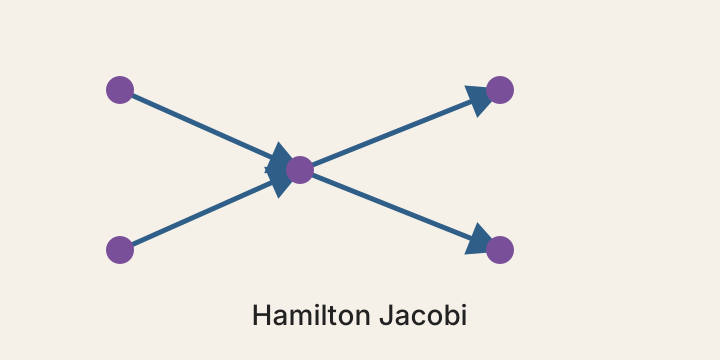
The picture records two facts: is a single scalar function whose gradient at each point recovers the momentum of the trajectory passing through, and the level sets of propagate normal to themselves at a rate set by the Hamiltonian — exactly the behaviour of wavefronts in geometric optics.
Worked example [Beginner]
Take the one-dimensional simple harmonic oscillator with mass and frequency . The energy is the sum of kinetic and potential pieces, written as . The time-independent Hamilton-Jacobi equation says: take the abbreviated action and replace momentum by the slope of at . The result must equal a constant total energy .
So the equation reads, in words: half the square of the slope of plus half the square of equals . Rearranging, the slope of at is . Adding up these slopes from a starting point gives as the area under the curve — geometrically, a quarter-disc of radius when runs from to .
The momentum along the trajectory is the slope of , namely , which gives the conserved-energy relation — a circle in phase space. The action variable, defined as the area enclosed by this circle divided by , equals . The angle variable comes out as , growing linearly in time at rate .
What this tells us: solving one PDE in one variable produced the entire phase-space trajectory, the action-angle coordinates, and the conserved energy, without solving Hamilton's equations as ODEs.
Check your understanding [Beginner]
Formal definition [Intermediate+]
Let be a smooth manifold and its cotangent bundle with canonical Liouville one-form and symplectic form . Let be a smooth Hamiltonian.
Definition (Hamilton-Jacobi equation). The time-dependent Hamilton-Jacobi equation for is the first-order partial differential equation
for an unknown smooth function . The function is called Hamilton's principal function.
When is time-independent, the substitution reduces this to the time-independent Hamilton-Jacobi equation
where is Hamilton's abbreviated action (also called Hamilton's characteristic function) and is the constant value of the Hamiltonian along a trajectory.
Definition (complete integral). A complete integral of the time-dependent Hamilton-Jacobi equation is a smooth function depending on parameters such that
throughout the domain of definition. The non-degeneracy condition asserts that the parameters are independent in the sense that no relation among the partial derivatives holds identically as varies.
Sign convention. Throughout this unit, generates the time-evolution map and the momentum is with no extra sign. Some sources reverse signs depending on whether is treated as a type-1 or type-2 generating function. The convention adopted here is the type-2 convention used in Goldstein §10 and Arnold §47.
Counterexamples to common slips
- The time-dependent equation is first-order in time, not second-order. The Schrödinger equation is second-order in time; the Hamilton-Jacobi equation is the short-wavelength limit of Schrödinger and loses one time derivative in the limit.
- A single solution to the Hamilton-Jacobi equation does not integrate the dynamics; only a complete integral with the non-degenerate Jacobian does. A degenerate family produces only a partial integration.
- The abbreviated action depends on energy as a parameter; treating as independent of the parameters that fix the level set is required for the complete-integral count to work.
- For non-simply-connected configuration spaces, may be globally multi-valued — the principal function lives on the universal cover, and only its differential descends to the base. This is the classical-mechanics shadow of geometric phases.
Key theorem with proof [Intermediate+]
Theorem (Jacobi 1837; complete integrals integrate Hamilton's equations). *Let be a smooth time-independent Hamiltonian and let be a complete integral of the time-independent Hamilton-Jacobi equation*
where is a smooth function of the parameters . Define new coordinates by
Then is a canonical transformation taking to . In the new coordinates, Hamilton's equations integrate to and .
Proof. Three steps: verify that the formulas define a canonical transformation, compute the new Hamiltonian, and integrate.
Step 1: canonical transformation. The function is a type-2 generating function for the transformation . Recall that a type-2 generator produces a canonical transformation by the rule , . The non-degeneracy condition is exactly the implicit-function-theorem hypothesis ensuring that can be inverted for in terms of , and that the resulting are smooth functions on phase space. By the standard theorem on type-2 generators (05.05.03), pulls back the canonical symplectic form, hence is canonical.
Step 2: new Hamiltonian. For a type-2 generator with no explicit time dependence, the new Hamiltonian in the transformed coordinates equals the old Hamiltonian expressed in the new variables:
By the Hamilton-Jacobi equation, the right-hand side equals identically. Hence .
Step 3: integrate. Hamilton's equations in the new coordinates read
These integrate to and . Substituting into the relations and recovers the original-coordinate trajectory by inverting these relations using the non-degeneracy of .
Bridge. Jacobi's theorem builds toward 05.02.04 (action-angle coordinates): when the energy surface is a compact level set foliated by Liouville tori, the complete integral in terms of the action variables supplies global angle coordinates , and the Liouville-Arnold theorem then asserts these are the canonical action-angle pair. The Hamilton-Jacobi method appears again in 05.09.01 (KAM theorem) where the iterative construction of perturbed invariant tori at each Newton step is exactly the approximate solution of a perturbed Hamilton-Jacobi equation, with the small-divisor problem arising from the inversion of along resonant directions. Putting these together, the central insight is that Hamilton-Jacobi is the linearisation of Hamiltonian dynamics into a single PDE whose complete integral encodes the entire phase-space foliation, and this is the foundational reason both classical integrability and KAM perturbation theory live inside the same analytic framework. The bridge from local algebra (one PDE for ) to global geometry (Liouville tori, KAM Cantor sets) runs through the complete-integral construction at every step.
Exercises [Intermediate+]
Lean formalization [Intermediate+]
A statement-level skeleton (Mathlib does not yet have the apparatus; the gap is detailed in lean_mathlib_gap):
The sorry blocks the full theorem on three Mathlib gaps: (1) the time-dependent type-2 generating-function theorem on , (2) the canonical-transformation calculus relating old and new Hamiltonians via the generator's time-derivative, and (3) a manifold-level implicit-function theorem in the form needed to invert for . Each is a Mathlib-contribution-sized target.
Advanced results [Master]
Theorem (geometric Hamilton-Jacobi). *A function satisfies the time-independent Hamilton-Jacobi equation if and only if the Lagrangian submanifold is contained in the energy level set . Hamilton's flow preserves and maps to a Lagrangian submanifold that may fail to be the graph of for any single-valued — caustics arise exactly where ceases to be a diffeomorphism.*
The geometric content: solutions of the Hamilton-Jacobi PDE correspond bijectively, in the smooth-section regime, to graphical Lagrangian submanifolds of contained in a fixed energy level. The PDE is the integrability condition for to be the graph of an exact one-form. A non-graphical Lagrangian — one whose projection to has folds — corresponds to a multi-valued classical solution and is the geometric origin of caustics.
Theorem (Stäckel separability, 1893). Suppose the Hamiltonian on $T^\mathbb{R}^n(q^1, \ldots, q^n)g^{ij}Vn \times n\Phi(q)W(q; \alpha) = \sum_i W_i(q^i; \alpha)W_i$ obtained by quadrature.*
The Stäckel conditions cut out a finite-dimensional algebraic variety inside the space of all Hamiltonians, and the major separable systems of classical mechanics — Kepler, isotropic harmonic oscillator, Stäckel's spheroidal coordinates, the Liouville quadratic-integrable ellipsoid — are points on this variety. Eisenhart (1934) characterised separability geometrically as the existence of a sufficient family of Killing tensors of order 2 satisfying a commutativity condition.
Theorem (action-angle from complete integral). *Let be a Hamiltonian on with Poisson-commuting integrals , and assume the joint level set is a compact connected -torus (Liouville-Arnold hypothesis). Then on a tubular neighbourhood of the Hamilton-Jacobi equation separates with respect to the level-set foliation, and the abbreviated action*
along any path on depends on the action variables
where is a basis of . The functions are the angle coordinates conjugate to , and the canonical pair realises the Liouville-Arnold theorem on the tubular neighbourhood.
The proof reduces, via the geometric Hamilton-Jacobi theorem, to the construction of the Liouville one-form on the universal cover of and the descent of to a closed one-form on whose periods are exactly the action variables [Arnold ch. 47]. The actions depend only on the integral level , not on the particular path, by the closedness of on (Liouville's theorem on level sets).
Theorem (viscosity solutions; Crandall-Lions 1983). Let be continuous and let be uniformly continuous. The Cauchy problem
admits a unique viscosity solution . The solution is given by the Lax-Oleinik formula
where the infimum is over absolutely continuous paths with , and is the Legendre transform of .
The viscosity-solution framework extends classical Hamilton-Jacobi past caustics: where the classical PDE has multiple smooth solutions corresponding to different sheets of the Lagrangian submanifold , the viscosity solution is the unique Lipschitz function picked out by the variational principle [Evans Ch. 10]. The technical machinery rests on the Crandall-Lions definition of sub- and super-solutions via test functions touching from above and below; this replaces the classical pointwise PDE with two one-sided inequalities that are stable under uniform limits. Putting these together, the variational and viscosity formulations agree on smooth regions and select the same canonical extension at caustics, identifying classical mechanics with optimal control of the Lagrangian.
Theorem (Hamilton-Jacobi and the Schrödinger semiclassical limit). Let solve the time-dependent Schrödinger equation with WKB initial data . As and away from caustics, the asymptotic ansatz yields:
- the eikonal: — the Hamilton-Jacobi equation;
- the transport: — conservation of along bicharacteristics;
- higher-order corrections in giving Maslov's series.
At caustics, the WKB ansatz breaks down at the same place classical becomes multi-valued; the Maslov index, taking values in , encodes the phase shift across each caustic crossing. The full asymptotic series, due to Maslov 1965, identifies the Lagrangian submanifold as the geometric carrier of the WKB approximation and the Maslov bundle as the sheaf giving the quantum-corrected wavefunction. Putting these together, Hamilton-Jacobi is the leading-order term in the high-frequency expansion of quantum mechanics, and the classical-quantum correspondence is encoded in the geometry of the Lagrangian carrier and its Maslov class [Arnold App. 11].
Synthesis. Hamilton-Jacobi is the bridge between the local algebra of generating functions and the global geometry of integrable systems and quantum-classical correspondence. The same PDE plays three roles, each governed by the same geometric object — a Lagrangian submanifold of contained in an energy level. As the equation for a type-2 generator of the Hamiltonian flow, it linearises Hamilton's equations into a single first-order PDE; as the integrability condition for a Lagrangian section, it identifies dynamics with the geometry of cotangent bundles; as the eikonal limit of Schrödinger, it identifies classical mechanics with the high-frequency limit of wave mechanics. Putting these together, the foundational reason Hamilton-Jacobi is useful is that a complete integral encodes the entire phase-space foliation in a single function on configuration space, and putting these together with Liouville-Arnold integrability one sees that an integrable Hamiltonian's complete integral is the global generating function of the action-angle transformation. The bridge from the classical theory (Hamilton 1834, Jacobi 1866) to the modern PDE viewpoint (Crandall-Lions 1983) is a single observation: the natural object is the Lagrangian submanifold , not the function , and viscosity-solution theory is the analytic infrastructure for extending 's shadow through caustics. The central insight is that the entire variational toolkit of nineteenth-century classical mechanics — least action, complete integrals, action-angle, Maupertuis-Jacobi reformulation — is the geometry of the Lagrangian submanifold of singled out by the Hamilton-Jacobi PDE.
Full proof set [Master]
Lemma (geometric Hamilton-Jacobi). *A smooth satisfies if and only if its graph lies in .*
Proof. The graph is the image of the map . For , by definition, so . The graph lies in iff for all , which is exactly the Hamilton-Jacobi equation.
Lemma (Lagrangian flow propagation). *Let be a Lagrangian submanifold and the flow of a Hamiltonian . Then is Lagrangian for every .*
Proof. The flow preserves the symplectic form on (Hamiltonian flows are symplectomorphisms). Let denote the inclusion; the Lagrangian condition is and . The composition has image , and pulls back to . Dimension is preserved. Hence is Lagrangian.
Theorem (Jacobi's complete-integrals theorem; full proof). Statement as in the Intermediate Key Theorem section. Proof: see the Intermediate proof. The full statement and proof for the time-dependent case follows the same three-step pattern with replaced by and the new Hamiltonian becoming ; the Hamilton-Jacobi equation enforces , after which Hamilton's equations integrate to and .
Theorem (separation of variables in spherical coordinates for central potentials). Let on $T^\mathbb{R}^3W(r, \theta, \phi; \alpha_\phi, \alpha_\theta, E) = W_r(r) + W_\theta(\theta) + \alpha_\phi \phi$.*
Proof. Substitute the ansatz into :
Multiply by to isolate angular terms, then by for the polar piece. The -derivative is automatic from the linear ansatz. The -equation reads ; integrate to . The radial equation reads ; integrate to . The Jacobian is block-diagonal and non-vanishing on the regular set, so the integral is complete. The constants correspond physically to , , and energy.
Theorem (Lax-Oleinik formula and viscosity solutions). For a uniformly continuous initial datum and a Hamiltonian that is convex and superlinear in , the function
is the unique viscosity solution of , .
Proof sketch. Existence: standard direct-method argument in the calculus of variations gives a minimiser for each ; the resulting is Lipschitz (by Tonelli's theorem under the convex superlinear hypothesis) and satisfies the dynamic-programming identity . The DPP implies is a viscosity sub- and super-solution by standard test-function arguments [Crandall-Lions 1983; Evans Ch. 10].
Uniqueness: comparison principle for viscosity sub/super-solutions of first-order Hamilton-Jacobi PDEs. If are both viscosity solutions with on the parabolic boundary (i.e., at ), then throughout. Apply with reversed roles to obtain . The comparison principle is proved by doubling the variables and exploiting the inequalities at maxima.
Theorem (action-angle integration of the simple harmonic oscillator). For , the action variable is , the angle is , and the abbreviated action is .
Proof. The energy ellipse has area . The action variable is , hence . The abbreviated action is ; computing the standard integral and substituting gives the stated formula. The angle is
The Hamilton-Jacobi flow has , so , recovering the standard simple-harmonic motion .
Connections [Master]
Generating functions
05.05.03. Hamilton-Jacobi is the time-dependent type-2 generating-function equation. Solving HJ produces a generator of the canonical transformation that takes the original Hamiltonian to zero; conversely, the generating-function formalism of the previous unit specialises in the time-dependent setting to the HJ PDE for the action.Cotangent bundle
05.02.05. The natural domain of the HJ equation is ; solutions correspond to Lagrangian submanifolds of contained in fixed energy level sets. The geometric Hamilton-Jacobi theorem reduces the analytic PDE to a statement about Lagrangian submanifolds of the cotangent bundle.Legendre transform
05.00.03. The Lagrangian and the Hamiltonian are Legendre duals, and the Lax-Oleinik viscosity-solution formula uses explicitly. The Legendre transform's convexity hypothesis is the same hypothesis that makes the variational principle well-posed for viscosity solutions.Action-angle coordinates
05.02.04. For an integrable Hamiltonian, separation of variables in HJ produces the abbreviated action as a global generating function; the angle variables are , and the Liouville-Arnold theorem identifies this with the action-angle decomposition on the torus foliation.KAM theorem
05.09.01. The KAM iteration solves a sequence of approximate Hamilton-Jacobi equations for perturbed integrable Hamiltonians, with each Newton step requiring inversion of a derivative that fails along resonant frequencies (the small-divisor problem). The HJ method is the analytic backbone of the perturbation theory of integrable systems.Hamilton's principle [05.05.01 ambient]. Hamilton's principle that physical trajectories are critical points of the action functional is the variational shadow of HJ: the minimising trajectory's action, evaluated as a function of endpoint, is exactly Hamilton's principal function.
Historical & philosophical context [Master]
William Rowan Hamilton derived the equation in his 1834 paper On a general method in dynamics (Phil. Trans. Roy. Soc. 124, 247-308) [Hamilton 1834] and its 1835 supplement, in the course of developing the principal-function formulation of mechanics. Hamilton's motivation was geometric optics: the analogy between Fermat's principle (light paths minimise optical length) and Maupertuis's principle (mechanical paths minimise abbreviated action) suggested that mechanical trajectories should be derivable from a wave-like principle. The principal function was Hamilton's construction of that wave-like quantity, and the Hamilton-Jacobi equation is the PDE it satisfies.
Carl Gustav Jacobi extracted the computational essence in his 1842-43 Königsberg lectures, published posthumously as Vorlesungen über Dynamik (1866) [Jacobi 1866]. Jacobi's complete-integrals theorem — that a non-degenerate -parameter family of solutions to the time-independent equation supplies the integration of Hamilton's equations — turned the equation into the standard tool of nineteenth-century analytical mechanics. Stäckel's 1893 paper on separability conditions and the Liouville-quadratic-integrable systems gave the algebraic framework for separation of variables in central potentials, ellipsoidal coordinates, and Kepler-type problems.
The modern PDE viewpoint developed in three waves. Constantin Carathéodory's 1909 Untersuchungen über die Grundlagen der Thermodynamik (Math. Ann. 67) [Carathéodory 1909] introduced the field-of-extremals framework, treating HJ as the integrability condition for a foliation of by Lagrangian submanifolds. Vladimir Maslov's 1965 Theory of Perturbations and Asymptotic Methods established the WKB / semiclassical correspondence and introduced the Maslov index as the topological invariant tracking caustic crossings. Michael Crandall and Pierre-Louis Lions's 1983 paper Viscosity solutions of Hamilton-Jacobi equations (Trans. AMS 277, 1-42) [Crandall-Lions 1983] introduced the viscosity-solution framework, providing a unique generalised solution that extends classical solutions through caustics and connects HJ to optimal-control theory and front propagation.