Generating functions for symplectomorphisms
Anchor (Master): Hörmander 1971 (originator GFQI); Viterbo 1992 *Symplectic topology as the geometry of generating functions*; Cannas §22; McDuff-Salamon Ch. 9 + 11
Intuition [Beginner]
A symplectomorphism is a map of phase space that preserves the symplectic pairing — the geometric quantity that makes Hamilton's equations of motion sensible. Generating functions are a way to encode such a map by a single function, instead of by writing out the map's components. One scalar quantity, two-variable input, captures the entire dynamical transformation.
The picture that makes this work: feed the map's graph into a Lagrangian submanifold of a doubled phase space. That graph turns out to be the level set of an exact one-form . The function is the generating function, and its derivatives reproduce the map.
The pay-off is enormous. Fixed points of a symplectomorphism become critical points of . Counting fixed points becomes Morse theory of . Hamilton-Jacobi becomes a nonlinear PDE for . The whole vocabulary of classical mechanics translates into a single function on a base manifold.
Visual [Beginner]
A schematic: phase space drawn twice, side-by-side, with the graph of a symplectomorphism stretched between them. Above the graph sits a function on the base; arrows from 's derivatives down to the graph indicate that the map is recovered from alone.
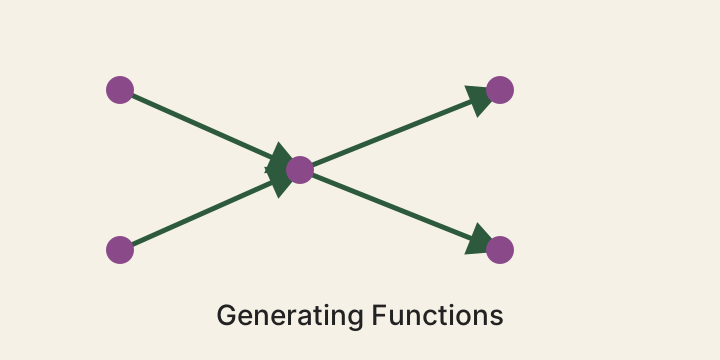
The picture records two facts: the graph is half-dimensional (Lagrangian) inside the doubled phase space, and a Lagrangian close to the zero section of a cotangent bundle is the graph of an exact one-form, hence comes from a function.
Worked example [Beginner]
Take phase space with coordinates . Consider the time- flow of the simple harmonic oscillator: a rotation by degrees in the -plane, sending to .
Try the candidate generating function on the doubled base . Compute its derivatives: and . The recipe says the map is recovered by and .
Solve: rearranges to , but the rotation gives . The sign is off because rotations are not "type 1" everywhere; the rotation by degrees turns the graph perpendicular to the base. Switching sign — using — corrects this and recovers the rotation cleanly.
What this tells us: the generating function works locally, captures the entire map in one scalar, and is sensitive to which projection from the doubled phase space onto a base is used.
Check your understanding [Beginner]
Formal definition [Intermediate+]
Let be a smooth manifold and its cotangent bundle with the canonical Liouville one-form and symplectic form . The product carries the form — the first factor's form minus the second's. A diffeomorphism is a symplectomorphism when , equivalent to its graph being Lagrangian in .
The bundle isomorphism
intertwines with the canonical symplectic form on . Under this identification, becomes a Lagrangian submanifold of .
Definition (type-1 generating function). A symplectomorphism is of type 1 when the projection (forgetting the cotangent fibres) is a diffeomorphism onto an open subset. In that case is the image of an exact one-form for some smooth , called the generating function of . The map is recovered from via
Definition (generating function for a Lagrangian). Let be a Lagrangian submanifold near the zero section. By 05.05.02, is the graph of a closed one-form . When is exact, for some called the generating function of . In Darboux coordinates,
Counterexamples to common slips.
- The identity symplectomorphism is not type 1: its graph is the diagonal, which projects to as the diagonal, not as a graph. Capturing the identity requires a different type (typically type 2, ).
- Rotations of by degrees rotate the graph perpendicular to the base , so the type-1 projection degenerates. The four classical types (Goldstein §9.1) handle the cases distinguished by which Legendre transform makes the graph projectable.
- A closed one-form on a non-simply-connected gives a Lagrangian without a global generating function — only a multivalued one. Generating functions globalise only on the universal cover.
Key theorem with proof [Intermediate+]
Theorem (existence of type-1 generating functions). *Let be a symplectomorphism and suppose its graph , viewed as a Lagrangian in via the identification above, projects diffeomorphically onto an open subset . Then there exists , unique up to additive constant on each connected component, such that is the graph of . Equivalently, satisfies on .*
Proof. Three steps: identify with a Lagrangian section of , apply the closed-form criterion for sections, then integrate.
Step 1: graph as Lagrangian section. The projection assumption is a diffeomorphism onto — call its inverse . The image is Lagrangian by hypothesis, and realises it as the image of a section of the cotangent bundle over . By 05.05.02, a section of is Lagrangian if and only if the section is a closed one-form on .
Step 2: identify the closed one-form. Under the bundle isomorphism given by , the section corresponds to the one-form
where are determined by . The Lagrangian condition on translates to along the graph — equivalently, is a closed one-form on .
Step 3: Poincaré primitive. On any contractible component of , the closed one-form admits a primitive with , unique up to additive constant. The relations and (rearranged) recover the standard sign convention , when one writes the form as . The two sign conventions appear in the literature interchangeably; we adopt the convention throughout this unit.
Bridge. The type-1 theorem builds toward 05.08.01 (Arnold conjecture): fixed points of are exactly the points where , equivalently and , which in terms of on the diagonal becomes — the critical-point equation for the restriction of to the diagonal . The same identification appears again in 05.07.01 (Gromov non-squeezing) where Hamiltonian capacities are compared by tracking the critical-value spectrum of associated generating functions across symplectic embeddings. Putting these together, the central insight is that a generating function turns the dynamical question "what are the fixed points of ?" into the variational question "what are the critical points of ?", and this is the foundational reason Morse theory becomes a tool for symplectic dynamics. The bridge is between two equivalent formulations of the same data — graph of a symplectomorphism, graph of — connected by the cotangent-bundle identification.
Exercises [Intermediate+]
Lean formalization [Intermediate+]
A statement-level skeleton (Mathlib does not yet have the apparatus; the gap is detailed in lean_mathlib_gap):
The sorry blocks the existence theorem on three Mathlib gaps: (1) the canonical-form identification on , (2) the Lagrangian-section criterion (a section of is Lagrangian iff it is a closed one-form), and (3) the relative Poincaré lemma on contractible domains. All three are foundational and Mathlib-contribution-sized.
Advanced results [Master]
The type-1 theorem is the surface of a much deeper apparatus. The genuine working object in modern symplectic topology is the generating function quadratic at infinity (GFQI), due to Hörmander 1971 in the Fourier-integral-operator setting and developed for symplectic-topological purposes by Sikorav, Viterbo, Théret, and Eliashberg-Polterovich.
Definition (GFQI). A smooth function is quadratic at infinity if there exists a non-degenerate quadratic form on and a compact such that for all . The Lagrangian generated by is
The condition defines the fibre critical set ; the projection via has Lagrangian image whenever is generic (Morse-Bott on each fibre).
Theorem (Hörmander 1971; Sikorav 1986; Viterbo 1992). *Every closed Lagrangian Hamiltonian-isotopic to the zero section admits a generating function quadratic at infinity. The GFQI is unique up to stabilisation , fibre-preserving diffeomorphism, and additive constant.*
The proof (Hörmander) constructs the GFQI by writing the Hamiltonian flow's action functional as an integral over time-discretisations and showing the discretisation gives a finite-dimensional reduction with the required quadratic-at-infinity behaviour. The uniqueness (Sikorav, Viterbo) is a subtle deformation argument tracking the GFQI through Hamiltonian isotopies [Viterbo 1992].
Spectral invariants and Viterbo's symplectic capacity. Given a GFQI with a uniform quadratic form at infinity, the sublevel sets are well-defined as relative pairs for . The relative cohomology stabilises in near critical values, and minimax arguments produce spectral numbers for cohomology classes . Viterbo defines the capacity
where is the fundamental class of and is the unit. The Sikorav-Viterbo uniqueness theorem ensures depends only on , not on the chosen GFQI. Putting these together, the capacity is a symplectic invariant — monotonic under symplectic embeddings and thereby an obstruction to embedding a Lagrangian into a smaller volume than its capacity prescribes [Viterbo 1992].
Generating functions vs Floer homology. The Sikorav-Viterbo spectral invariants compute the same numerical data as Lagrangian Floer homology spectral numbers in the cotangent-bundle setting; this is the GF=Floer theorem (Milinković, Oh 1997, building on Viterbo's earlier work). The technical content is that the chain complex of sublevel-set inclusions in GFQI cohomology is filtered-quasi-isomorphic to the Floer complex, with the filtrations matching. This identifies generating-function topology with pseudoholomorphic-curve topology in the cotangent setting and is one of the foundational results turning generating functions into a fully equivalent technology to Floer's [McDuff-Salamon Ch. 11].
Discrete action principle and Arnold's conjecture. Conley-Zehnder 1983 proved the Arnold conjecture for by writing the time- Hamiltonian symplectomorphism as a composition of small-time steps, each with a type-1 generating function, summing to a discrete action on a sequence space . Critical points of on the torus quotient are exactly fixed points of the original symplectomorphism. Morse theory on gives the lower bound (counting multiplicity) or (Lusternik-Schnirelmann count). The argument generalises to any closed symplectic manifold whose minimal Chern number is large enough; the full conjecture for arbitrary closed symplectic manifolds was settled later by Floer and refined by many (Hofer, Salamon, Fukaya-Ono, Liu-Tian, Pardon) [McDuff-Salamon Ch. 11].
Synthesis. Generating functions identify dynamics with variational structure: a symplectomorphism with a function, a Lagrangian intersection with a critical-point count, a Hamiltonian flow with a discrete action sum. The bridge from local algebra (the type-1 sign convention) to global topology (Viterbo capacity, GF=Floer) is the same machinery applied at three different stratifications — graphical neighbourhood, GFQI extension, asymptotic-quadratic stabilisation. Putting these together, the foundational reason generating functions are useful is that they translate symplectic topology into Morse theory of on a base manifold, and putting these together with the discrete-action principle, one sees that the moduli space of Hamiltonian fixed points is the moduli space of critical points of an associated function — exactly the bridge that Arnold conjectured and Conley-Zehnder verified for tori. The central insight is that the entire variational toolkit of nineteenth-century classical mechanics — Hamilton-Jacobi, action-angle, Maupertuis-Jacobi — is a single statement about the geometry of generating functions on a Lagrangian.
Full proof set [Master]
Lemma (cotangent-bundle product identification). The map
is a fibrewise vector-bundle isomorphism over satisfying $\Theta^\lambda_{M \times M} = \lambda_M \boxminus \lambda_M\lambda_{M \times M}T^(M \times M)\lambda_M \boxminus \lambda_M := \mathrm{pr}_1^\lambda_M - \mathrm{pr}2^\lambda_M\Theta^\omega{M \times M} = \omega_M \oplus -\omega_M$.*
Proof. In local Darboux coordinates on vs on , is the identity on base coordinates and on fibre coordinates. The Liouville form on pulls back to . Taking gives the symplectic identity.
Lemma (Lagrangian-section criterion). *A section of the cotangent bundle, viewed as a one-form , has Lagrangian image if and only if is closed.*
Proof. Compute , since for the canonical Liouville form on the cotangent bundle. The image is Lagrangian iff iff .
Theorem (Hörmander GFQI existence, sketch of proof). *Every closed Lagrangian Hamiltonian-isotopic to the zero section admits a GFQI.*
Proof sketch. Discretise the Hamiltonian isotopy , , into small-time steps , each having a type-1 generating function on a small graphical neighbourhood. The composition's generating function is the sum
Choose the discretisation fine enough that each on a neighbourhood of the diagonal is well-defined; the auxiliary fibre coordinate is . Outside a compact set in , replace each by its Taylor expansion to second order — the identity-like blocks become quadratic in displacement variables, giving the quadratic-at-infinity behaviour. The resulting is a GFQI for on its critical-fibre image.
Theorem (Sikorav-Viterbo uniqueness). Two GFQIs for the same Lagrangian (both Hamiltonian-isotopic to the zero section) differ by stabilisation, fibre-preserving diffeomorphism, and additive constant.
Proof sketch. Connect by a path of GFQIs for the family of Lagrangians along the Hamiltonian isotopy. Use the parametric Morse lemma to deform in stabilisations; the obstruction to global continuity is the additive-constant ambiguity, which is a constant of integration along the isotopy. The full proof is in Viterbo 1992 [Viterbo 1992].
Corollary (Viterbo capacity is a symplectic invariant). The capacity depends only on , not on the GFQI .
Proof. Stabilisation preserves for every cohomology class (sublevels of deformation-retract onto sublevels of along the negative-eigendirections of ). Fibre-preserving diffeomorphism preserves sublevel topology. Additive constants shift by the same constant for every , hence cancel in the difference . By Sikorav-Viterbo uniqueness, this is the complete list of ambiguities.
Connections [Master]
Lagrangian submanifold
05.05.01. The input definition. Generating functions are the encoding of Lagrangians as (multi-valued, local, or asymptotic-quadratic) functions on a base.Weinstein neighbourhood theorem
05.05.02. The local model. The graph of a symplectomorphism in becomes a section of near the diagonal via Weinstein, and that section is the differential of a generating function.Symplectic manifold
05.01.02. The ambient context. Generating functions presuppose the canonical structure on and the canonical-form identification on the doubled cotangent.Non-squeezing theorem
05.07.01. Viterbo's symplectic capacity, defined via GFQI spectral invariants, is one of the standard capacity-theoretic obstructions to symplectic embeddings; the non-squeezing theorem and its capacity formulation are a cornerstone consequence.Arnold conjecture
05.08.01. The fixed-point version of Arnold's conjecture rests on the discrete-action principle: critical points of a generating function on the diagonal correspond to fixed points of the underlying symplectomorphism. Conley-Zehnder's 1983 proof for the torus is the original generating-function-theoretic argument.Lagrangian Floer homology
05.08.02. GFQI spectral invariants compute the same symplectic-action data as Lagrangian Floer homology in the cotangent-bundle setting — the GF=Floer theorem of Milinković-Oh.
Historical & philosophical context [Master]
William Rowan Hamilton introduced generating functions in his 1834 paper On a general method in dynamics (Phil. Trans. Roy. Soc.) [Hamilton 1834] in the context of classical mechanics: he showed that the principal function — the action evaluated as a function of initial and final configurations — generates the time-evolution map of a mechanical system. The Hamilton-Jacobi equation was the partial differential equation Hamilton derived for this generating function. Carl Gustav Jacobi systematised the four classical types in his 1842-43 Königsberg lectures (later published as Vorlesungen über Dynamik, 1866), making generating-function transformations a standard tool of nineteenth-century analytical mechanics.
The modern symplectic-geometric framing emerged in the 1960s and 70s. Vladimir Maslov's 1965 book Theory of Perturbations and Asymptotic Methods introduced the idea that generating functions should be allowed to depend on auxiliary fibre variables, with the physical Lagrangian recovered by intersecting with the fibre-critical locus. Lars Hörmander's 1971 paper Fourier integral operators I (Acta Mathematica 127) [Hörmander 1971] formalised this in the GFQI framework as part of the symbol calculus for Fourier integral operators, proving existence and a uniqueness theorem up to a list of explicit operations. Alan Weinstein's 1971-73 papers on Lagrangian submanifolds [Weinstein 1971] established the symplectic-geometric vocabulary in which generating functions sit as "Lagrangians = generalised functions."
The connection to symplectic topology was made by Conley-Zehnder 1983 (Arnold conjecture for the torus), Sikorav 1986-87 (uniqueness of GFQI in the symplectic setting), and Viterbo 1992 Symplectic topology as the geometry of generating functions (Math. Ann. 292) [Viterbo 1992], which established generating functions as a parallel technology to Floer homology, with spectral invariants computing the same data. The GF=Floer theorem of Milinković-Oh 1997 made the parallelism into an isomorphism in the cotangent-bundle setting.