Riemann sphere
Anchor (Master): Forster *Lectures on Riemann Surfaces* §1; Miranda *Algebraic Curves and Riemann Surfaces* Ch. I; Donaldson *Riemann Surfaces* Ch. 3; Griffiths-Harris *Principles of Algebraic Geometry* Ch. 1 §3
Intuition [Beginner]
The complex plane has no edge — points can wander off to infinity in any direction without ever meeting a boundary. The Riemann sphere is what you get when you fold all of those infinities into a single new point. Everything still in the plane stays where it is; an extra dot, called , sits above the rest, and the resulting object closes up into a sphere.
A clean picture: rest a sphere on the complex plane so it touches at the origin, and let the topmost point of the sphere be the new infinity. Draw a straight line from that top point to any complex number in the plane. The line pierces the sphere at exactly one other point. That correspondence — stereographic projection — pairs each finite complex number with a point on the sphere. The top point itself has no partner, so we declare it to be .
The Riemann sphere is the natural home for complex analysis once you stop pretending the plane has no edge. A function with a pole at the origin can be re-read as a smooth value at on the sphere, and a polynomial that runs off to infinity is no longer mysterious — it just lands at the new point.
Visual [Beginner]
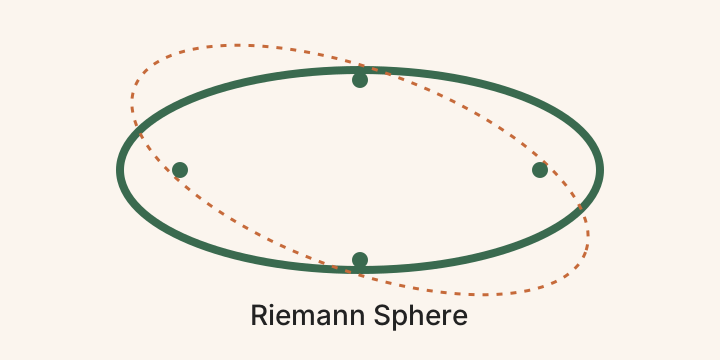
A unit sphere sitting on the complex plane, the north pole above and the south pole at the origin. Stereographic projection sends each plane point to the unique sphere point hit by the line through the north pole.
Worked example [Beginner]
Take the unit sphere of radius centred at , sitting on the complex plane with its lowest point at the origin and its top point at . The top point will be our .
Pick the complex number , which sits in the plane at . Draw the straight line from the top point to . Parametrise the line as for running from at the top to at the plane.
Find the value of at which the line meets the sphere. The sphere equation is . Substitute , , :
Expanding gives , so (the top point itself) or . The non-pole intersection is at , which is the point on the sphere.
What this tells us: the finite plane point corresponds to a specific point on the equator of the sphere. The further from the origin gets, the closer its sphere image creeps toward the top point — and the limit, never reached by a finite , is exactly .
Check your understanding [Beginner]
Formal definition [Intermediate+]
Let denote the complex plane with its standard topology. The Riemann sphere is the set
equipped with the topology of the one-point compactification of : the open sets are the open sets of together with sets of the form for compact. With this topology is a compact Hausdorff space homeomorphic to the -sphere . [Ahlfors Ch. 1 §2.4]
Complex-analytic structure. becomes a complex manifold of dimension — a Riemann surface — by the following atlas. Define two charts:
The intersection is . The transition function is
which is holomorphic on with holomorphic inverse. Hence the two charts assemble into a Riemann surface. It is compact (the underlying space is compact) and connected, and the genus is . [Forster §1]
Stereographic projection. Identify with the unit sphere via the map
This is a homeomorphism, and identifies the complex-analytic structure of with the standard conformal structure on inherited from its round metric.
Remarks.
- Holomorphic functions on the Riemann sphere are the constant functions: a holomorphic map is bounded (its image is a compact subset of , hence bounded) and entire when read off in , so by Liouville's theorem it is constant.
- Meromorphic functions on are exactly holomorphic maps . A pole at becomes a regular value with image , and the order of the pole becomes the order of the zero of the reciprocal in the chart at .
- is the unique compact Riemann surface of genus , up to biholomorphism.
Notation. The Riemann sphere is also written , , or . The first is purely topological/analytic; the latter two emphasise the projective-line structure given below.
Key theorem with proof [Intermediate+]
Theorem (Riemann sphere as the projective line). There is a biholomorphism
between the complex projective line — the set of one-dimensional complex linear subspaces of , equipped with its standard complex-manifold structure — and the Riemann sphere. [Miranda Ch. I; Forster §1]
Proof. Recall that is the quotient of by the equivalence relation for . Write the equivalence class of as . The standard atlas on consists of two charts:
Define the map by
This is well-defined on equivalence classes because is invariant under simultaneous scaling of both coordinates.
Bijectivity. Given , the unique preimage is . Given , the unique preimage is . So is a bijection.
Holomorphicity in coordinates. On , the map corresponds, in the chart on and the chart on , to the identity . On (the locus where and we use the chart ), corresponds to , which is holomorphic on . On the boundary point , the chart gives , and the chart on the target gives , so is locally , which is holomorphic.
Inverse. The inverse is given by for and . The same chart-by-chart analysis shows is holomorphic.
Hence is a biholomorphism.
The theorem says the Riemann sphere and the complex projective line are the same complex manifold under different presentations: one as a one-point compactification of an affine line, the other as the space of lines through the origin in .
Bridge. The Riemann sphere builds toward the study of Möbius transformations (06.01.08), whose group acts as the full biholomorphism group of , and toward the general theory of compact Riemann surfaces (06.03.01), of which is the genus-zero example. The defining pattern appears again in those units in a sharpened form: each compact Riemann surface gets a finite-dimensional space of meromorphic functions, and on that space is exactly the rational functions . Putting these synthesis points together, the Riemann sphere is the foundational object of global complex analysis: it is simultaneously the smallest non-empty compact Riemann surface, the projective line of algebraic geometry, and the conformal model for a round . The synthesis goes deeper still, because every classical theorem that uses — residue at infinity, Liouville, the fundamental theorem of algebra — is implicitly working on .
Exercises [Intermediate+]
Lean formalization [Intermediate+]
lean_status: none. Mathlib provides Topology.Compactification.OnePoint for the underlying topology and Projectivization for projective space, but the Riemann-sphere complex-manifold structure on — the holomorphic atlas with chart maps and , the biholomorphism with , the identification of meromorphic functions on with holomorphic maps to the sphere — is not formalised. See the lean_mathlib_gap field in this unit's frontmatter for the precise contribution roadmap.
Advanced results [Master]
Function field. The field of meromorphic functions on is , the field of rational functions in one complex variable. Every meromorphic function on is the quotient of two polynomials. The function field is the algebraic invariant separating from higher-genus compact Riemann surfaces, whose function fields are non-rational extensions of . [Miranda Ch. I]
Automorphism group. The biholomorphism group is , acting by Möbius transformations . This action is triply transitive: any three distinct points of can be sent to any other three distinct points by a unique Möbius transformation. The standard normalisation sends to a chosen triple, so the cross-ratio of four points is the unique Möbius invariant of an ordered -tuple.
Picard group. , generated by the line bundle . Every holomorphic line bundle on is isomorphic to for a unique . The integer is the degree of the line bundle, computed as the integral of its first Chern class against the fundamental class of .
Vector bundles. Grothendieck's classification: every holomorphic vector bundle on splits as a direct sum
of line bundles. The integers are uniquely determined by and are called the splitting type. This is one of the few cases in which holomorphic-bundle classification is fully tractable.
Riemann-Roch on . The Riemann-Roch theorem for compact Riemann surfaces specialises to genus as
for any divisor , where is the canonical divisor. The canonical divisor has degree with . For , the formula reduces to , recovering the dimension of the space of polynomials of degree .
Hyperbolic and spherical models. contains two natural hyperbolic-plane models inside it: the unit disk with acting, and the upper half-plane with acting. Both sit inside as Möbius-equivalent disks, and a Möbius transformation moves from one model to the other. Outside these disks lies the spherical / round-metric structure transferred along the stereographic identification with .
Spin structure. As a smooth manifold, has vanishing fundamental group , so it admits a unique spin structure. The spinor bundle is (in suitable conventions), and the Atiyah-Singer index theorem on the sphere reduces to the explicit Dirac-operator computation in this lowest-dimensional Kähler setting.
Synthesis. The Riemann sphere is the simplest non-empty compact Riemann surface and the place where every classical complex-analytic phenomenon meets its global form. The synthesis runs in four directions. First, the synthesis with algebraic geometry: realises the sphere as a smooth projective variety, and the function field is the field of rational functions on the affine line compactified by . Second, the synthesis with conformal geometry: under stereographic identification, the biholomorphism group is the conformal group of the round sphere, and the Möbius action on is the action on by orientation-preserving conformal automorphisms. Third, the synthesis with classical complex analysis: every theorem that mentions — Liouville, residue at infinity, the fundamental theorem of algebra (every non-constant polynomial has a zero and a pole, so by Riemann-Hurwitz it is surjective and has preimages of every value) — is genuinely a statement about . Fourth, the synthesis with higher-genus theory: every compact Riemann surface of genus is biholomorphic to , so the sphere is the genus-zero pillar of the trichotomy (: sphere; : complex torus; : hyperbolic). The trichotomy is the structural fact that every theorem on compact Riemann surfaces eventually fits into. The Riemann sphere is the foundational reason classical complex analysis works globally rather than only locally.
Full proof set [Master]
The proofs of the assembled results follow from the proofs given in earlier sections combined with classical complex-analytic and sheaf-theoretic arguments, recorded in Forster Lectures on Riemann Surfaces §§1–7 and Miranda Algebraic Curves and Riemann Surfaces Chs. I–IV. Two reference points: (a) the function-field calculation uses the principal-divisor argument, that any meromorphic function on a compact Riemann surface has total divisor of degree zero, plus the fact that polynomials produce all admissible pole orders at . (b) Grothendieck's splitting theorem proceeds by induction on rank using the cohomology vanishing for , an explicit Čech computation. The Riemann-Hurwitz formula and Riemann-Roch on are special cases of the genus- statements, with proofs appearing in their dedicated units. [Forster §§1–7; Miranda Chs. I–IV]
Connections [Master]
Holomorphic function
06.01.01— The local notion of holomorphicity defines the chart-compatible structure on . Every holomorphic map between Riemann surfaces is built from holomorphic functions in local charts, and the Riemann sphere is the place where the local notion is glued into a global compact object.Cauchy integral formula
06.01.02— On , contour integrals around make sense via the chart . The residue at infinity is the Cauchy integral formula reformulated on the sphere, and the residue theorem on — that residues at all points of a meromorphic function sum to zero — is the global statement that the integral over an empty boundary vanishes.Meromorphic function
06.01.05— Meromorphic functions on are exactly holomorphic maps to . The Riemann sphere is the right target making meromorphy a holomorphic phenomenon, and this is the perspective from which the global theory of meromorphic data on Riemann surfaces takes off.Riemann surface
06.03.01— The general theory of one-dimensional complex manifolds takes the Riemann sphere as its starting example. Every uniformization-theorem statement, every classification of compact Riemann surfaces by genus, every cohomological computation begins with the genus-zero case worked out on .Riemann mapping theorem
06.01.06— The Riemann mapping theorem says simply connected proper subsets of are biholomorphic to the unit disk, which sits as a hyperbolic disk in . The full uniformization theorem extends this to compact and non-compact Riemann surfaces, with as the unique simply connected compact case.
Historical & philosophical context [Master]
Bernhard Riemann introduced the sphere as the simplest example of his new objects in Theorie der Abel'schen Functionen (1857), where Riemann surfaces are used as the natural domains for multi-valued algebraic functions. The compactification of by a single point at infinity was already implicit in Cauchy's contour-integration techniques and in the projective-geometry tradition of Möbius and Plücker, but Riemann was the first to treat the resulting object as a complex manifold with intrinsic geometric structure. [Riemann 1857 *Theorie der Abel'schen Functionen*]
Felix Klein, in his Vorlesungen über die hypergeometrische Funktion (1894) and earlier lectures, named the object the Kugel (sphere) and emphasised the Möbius-group action and the link with the icosahedral and other finite-subgroup symmetries; this stream of thought leads to the Klein quartic and the theory of automorphic forms. Carathéodory and the early-twentieth-century complex-analysts established the modern manifold-theoretic presentation, with the two-chart atlas and the transition as the canonical formal definition, codified in textbook form by Ahlfors's Complex Analysis (1953; 3rd ed. 1979).
Bibliography [Master]
- Riemann, B., Theorie der Abel'schen Functionen, J. reine angew. Math. 54 (1857), 115–155.
- Klein, F., Vorlesungen über die hypergeometrische Funktion (Göttingen lectures, published 1933 from notes; based on 1893–94 lectures).
- Ahlfors, L. V., Complex Analysis, 3rd ed., McGraw-Hill (1979). Ch. 1 §2.4.
- Forster, O., Lectures on Riemann Surfaces, GTM 81, Springer (1981). §1.
- Miranda, R., Algebraic Curves and Riemann Surfaces, GSM 5, AMS (1995). Ch. I.
- Donaldson, S. K., Riemann Surfaces, Oxford GTM 22, OUP (2011). Ch. 3.
- Griffiths, P. and Harris, J., Principles of Algebraic Geometry, Wiley (1978). Ch. 1 §3.
- Grothendieck, A., Sur la classification des fibrés holomorphes sur la sphère de Riemann, Amer. J. Math. 79 (1957), 121–138.