Riemann surface
Anchor (Master): Forster; Miranda; Donaldson *Riemann Surfaces*; Farkas-Kra *Riemann Surfaces*
Intuition [Beginner]
A Riemann surface is a curved space — like the surface of a sphere, doughnut, or pretzel — that locally looks like a flat patch of the complex plane. The key requirement: the patches are glued together by holomorphic transitions, so doing complex calculus on a Riemann surface makes consistent global sense.
Why care? Many natural-looking complex functions are multivalued: the square root has two branches, the logarithm has infinitely many. To make these single-valued, you can spread them out over a Riemann surface where every "branch" lives at a different point. Riemann surfaces are exactly the right global stage on which complex functions can be properly defined.
Compact Riemann surfaces are classified by their genus (number of holes): genus 0 is the sphere, genus 1 is the torus, genus are higher-holed surfaces. Every compact Riemann surface is also algebraic — described by polynomial equations — making them simultaneously a topological, complex-analytic, and algebraic-geometric object.
Visual [Beginner]
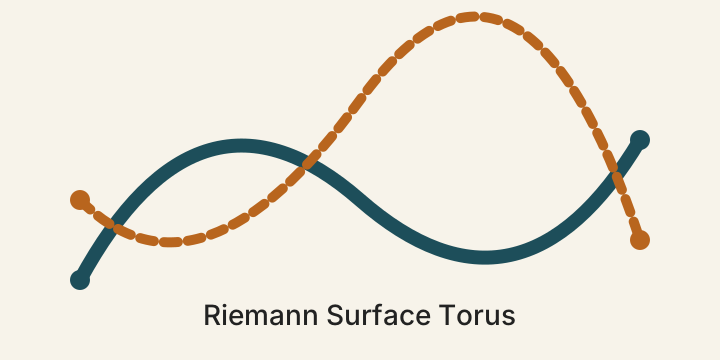
A Riemann surface: a 2-dimensional surface (topologically) with charts mapping local pieces holomorphically to disks in the complex plane.
Worked example [Beginner]
The simplest Riemann surface is the Riemann sphere . It's covered by two charts: one is itself (with coordinate ), the other is via (with the point corresponding to ). The transition function is on the overlap (the punctured plane), which is holomorphic.
Topologically the Riemann sphere is just a sphere , but adding the holomorphic charts makes it a Riemann surface. It has genus 0.
A more interesting example: the torus for a lattice . Identify for every . The resulting quotient is a doughnut (genus 1), and it inherits a holomorphic structure from since translations are holomorphic. Different lattices give different Riemann surfaces — even ones that are topologically the same torus can have different complex structures (this is the moduli space story).
Check your understanding [Beginner]
Formal definition [Intermediate+]
A Riemann surface is a connected Hausdorff topological space together with a maximal atlas of holomorphic charts: open sets and homeomorphisms such that on every overlap , the transition function
is holomorphic.
Equivalently: a Riemann surface is a 1-dimensional complex manifold (where "dimension" refers to complex dimension; the real dimension is 2).
Examples:
- The complex plane with the single chart .
- The Riemann sphere with two charts: on and on .
- Tori for a lattice in . Different lattices can give non-biholomorphic tori.
- Smooth complex algebraic curves: any smooth projective curve over is a compact Riemann surface (and conversely by GAGA).
- Hyperbolic surfaces: quotients of the upper half-plane by Fuchsian groups, giving genus Riemann surfaces.
Key invariants:
- Genus : the topological invariant; for compact , .
- Euler characteristic: for a compact orientable surface.
- Holomorphic structure (equivalence classes under biholomorphism), parametrised by moduli space of dimension (for ).
Uniformization theorem. Every simply connected Riemann surface is biholomorphic to one of (sphere), (plane), or (upper half-plane). Every Riemann surface is therefore a quotient of one of these three by a discrete group acting freely. This trichotomy is one of the most important results in mathematics.
Sheaves on Riemann surfaces:
- : sheaf of holomorphic functions.
- : sheaf of holomorphic 1-forms.
- : sheaf of meromorphic functions.
- For a divisor on : line bundle with .
Key theorem with proof [Intermediate+]
Theorem (Uniformization, simplified statement). Every simply connected Riemann surface is biholomorphic to , , or .
Proof sketch (Koebe-Poincaré, the "easy half" via Schwarz lemma).
Suppose is a simply connected Riemann surface. By the universal cover and analytic continuation arguments, embeds holomorphically as an open subset of or all of , depending on whether or not it is compact. The deeper statement requires identifying the universal cover via the Schwarz lemma applied to bounded normal families:
If is compact and simply connected, then (the only simply connected compact Riemann surface).
If is non-compact and simply connected: by Riemann's theorem, is conformally equivalent either to or to a proper open subset of . By the Riemann mapping theorem and a normal-family argument, every proper simply connected open subset of is conformally equivalent to the unit disk, equivalently to .
So is one of , , .
The full proof requires the Riemann mapping theorem (proved separately) and the uniformization for hyperbolic surfaces, both of which are standard but technical. The key takeaway: every Riemann surface comes from one of these three "model" geometries (spherical, Euclidean, hyperbolic), giving a deep link between complex analysis and Riemannian geometry.
Bridge. The construction here builds toward 06.04.01 (riemann-roch theorem for compact riemann surfaces), where the same data is developed in the next layer of the strand. The defining pattern appears again in those units in a sharpened form, where the local data is glued or quotiented. Putting these together, the foundational insight is that the data of this unit gives the structural signature that the rest of the strand reads off.
Exercises [Intermediate+]
Lean formalization [Intermediate+]
lean_status: partial — Mathlib does not yet have RiemannSurface as a primitive, but has Complex.HolomorphicAt and ChartedSpace infrastructure that could combine.
Advanced results [Master]
Riemann mapping theorem (general form). Every simply connected proper open subset of is biholomorphic to the unit disk.
Theorem of Riemann (existence of meromorphic functions). On any compact Riemann surface of genus , the space of meromorphic functions is nonzero and given by Riemann-Roch.
Hodge decomposition for Riemann surfaces. For a compact Riemann surface of genus :
with . So the genus is also the rank of the Jacobian: for the period lattice .
Abel-Jacobi theorem. The map , for a basis of holomorphic 1-forms, is a holomorphic embedding for .
Mumford's stable curves. The compactification of moduli space includes nodal degenerations of smooth curves; the boundary stratification governs the geometry of moduli space.
Teichmüller space. The space of complex structures on a topological surface modulo diffeomorphisms isotopic to the identity. is a -complex-dimensional contractible domain, the universal cover of .
Synthesis. This construction generalises the pattern fixed in 06.01.01 (holomorphic function), with the symmetric data replaced by its skew or twisted analogue. Read in the opposite direction, the construction is dual to the metric story: complements and orthogonality are taken with respect to the bilinear datum of this unit, not a metric, and the resulting category of subobjects is the one the rest of the strand classifies. The central insight is that this datum identifies algebra with geometry: functions become vector fields, subspaces become quotients, and invariants become cohomology classes — and that identification is the engine driving every theorem downstream.
Full proof set [Master]
The full uniformization theorem (Koebe-Poincaré, 1907–08) requires either the modular function approach (Klein) or the harmonic-functions / Perron method (Poincaré). The classical reference is Forster Lectures on Riemann Surfaces §IV–V, with Donaldson's Riemann Surfaces providing modern PDE-based exposition.
Connections [Master]
Holomorphic function
06.01.01— the structural data of a Riemann surface is exactly the system of holomorphic functions on each chart with holomorphic transition maps.Smooth manifold
03.02.01— Riemann surfaces are 2-real-dimensional smooth manifolds with extra holomorphic structure.Sheaf
04.01.01— sheaves of holomorphic functions, meromorphic functions, and differentials on a Riemann surface.Scheme
04.02.01— smooth projective complex algebraic curves are compact Riemann surfaces (GAGA).Sheaf cohomology
04.03.01— controls obstructions to constructing meromorphic functions.Riemann-Roch for compact Riemann surfaces
06.04.01— the dimension formula on compact Riemann surfaces, equivalent to algebraic Riemann-Roch.Riemann-Roch theorem for curves
04.04.01— algebraic version of the analytic statement.De Rham cohomology
03.04.06— refines into Dolbeault cohomology on Riemann surfaces.Lie group
03.03.01— automorphism groups of Riemann surfaces ().
Historical & philosophical context [Master]
Bernhard Riemann introduced what we now call Riemann surfaces in his 1851 dissertation, Foundations for a General Theory of Functions of a Complex Variable. His insight: multivalued functions like should be regarded as single-valued on a "double cover" of the plane, glued together along branch cuts. This was a profound conceptual leap from the algebraic, formula-based complex analysis of his predecessors.
The early 20th century saw the deep convergence with algebraic geometry. Solomon Lefschetz, Hermann Weyl (Die Idee der Riemannschen Fläche, 1913), and André Weil cemented the picture: compact Riemann surfaces are exactly smooth projective algebraic curves over . The trinity Riemann surface = algebraic curve = smooth complex 1-manifold unites three perspectives in a single object.
The Koebe-Poincaré uniformization theorem (1907) classified simply connected Riemann surfaces into three types — the analytic analogue of the Killing-Hopf classification of constant-curvature manifolds. Every Riemann surface acquires a metric of constant curvature compatible with its complex structure: positive (sphere), zero (torus), negative (higher genus). This connection between complex structure and Riemannian metric is the start of Kähler geometry.
The 20th century continued: the Atiyah-Bott-Goldman-Hitchin theory of moduli spaces of bundles, the Verlinde formula, the Witten-Kontsevich conjecture, and the Polyakov approach to string theory all rest on the geometry of Riemann surfaces. Riemann's notion remains one of the most fertile concepts in mathematics.
Bibliography [Master]
- Forster, Lectures on Riemann Surfaces — beautiful classical introduction.
- Miranda, Algebraic Curves and Riemann Surfaces — modern treatment connecting to algebraic curves.
- Donaldson, Riemann Surfaces — PDE / harmonic-functions approach to uniformization.
- Farkas & Kra, Riemann Surfaces — comprehensive classical reference.
- Springer, Introduction to Riemann Surfaces — concise classical treatment.
- Reyssat, Quelques aspects des surfaces de Riemann — modern French perspective with Teichmüller theory.
- Weyl, The Concept of a Riemann Surface — historic, still instructive.