Argument principle and Rouché's theorem
Anchor (Master): Cauchy 1825 *Mémoire sur les intégrales définies prises entre des limites imaginaires* and 1826 *Sur un nouveau genre de calcul analogue au calcul infinitésimal* (originating residue theorem and the special case of the argument principle); Rouché 1862 *Mémoire sur la série de Lagrange* (eponymous theorem); Hurwitz 1889 *Über die Bedingungen, unter welchen eine Gleichung nur Wurzeln mit negativen reellen Theilen besitzt*; Picard 1879, Landau 1904 (refined applications); Ahlfors *Complex Analysis* Ch. 4 §5
Intuition [Beginner]
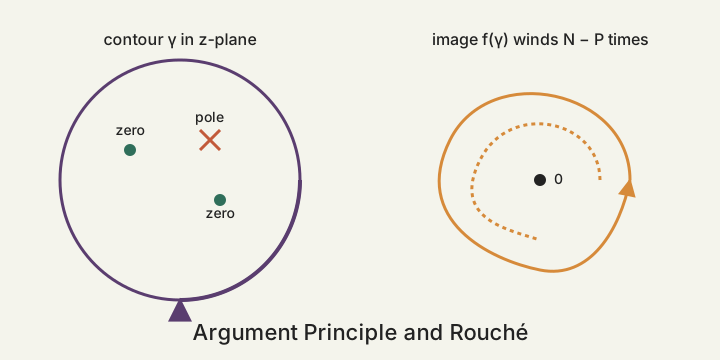
Imagine walking once around a closed loop in the complex plane. As you walk, you keep your eye on the value — another complex number that depends on where you stand. This second value traces out its own loop, and that image loop may wrap around the origin several times. The argument principle says the number of times the image loop wraps around the origin equals the number of zeros of inside your walking path, minus the number of poles, counted with multiplicity.
The picture is striking. Each zero of inside the loop contributes one positive wrap. Each pole contributes one negative wrap. Knowing only the topology of the image loop, you can count zeros and poles. The hidden arithmetic of — where it vanishes, where it explodes — is encoded entirely in how its boundary image winds.
The companion result is Rouché's theorem. If two functions and are close enough on a boundary loop — close enough that the smaller has modulus strictly less than the larger — then and have the same number of zeros inside the loop. This lets you count the zeros of a complicated function by comparing it with a simpler one whose zeros you already know.
Visual [Beginner]
A closed contour in the -plane encloses a few zeros and a pole. The image curve in the -plane winds around the origin with a signed total equal to zeros-minus-poles.
Worked example [Beginner]
Take and ask: how many zeros does have inside the circle ?
Rouché lets you compare with a simpler function on the boundary. Split and check moduli on the circle . The cube term has modulus . The remaining piece has modulus . On the whole boundary circle, .
The Rouché hypothesis holds on the boundary, with and . The conclusion: and have the same number of zeros inside the disc of radius . The simpler function has one zero of order at the origin, contributing to the zero count.
What this tells us: the original polynomial has zeros inside the disc . No factoring, no quadratic formula, no closed-form root extraction — only a one-line modulus comparison on the boundary circle. Rouché supplies a counting tool that survives intact even when explicit roots are out of reach.
Check your understanding [Beginner]
Formal definition [Intermediate+]
Argument principle. Let be open, let be a Jordan domain whose boundary is a piecewise- simple closed curve oriented counterclockwise, and let be meromorphic on a neighbourhood of with no zeros and no poles on . Let denote the total number of zeros of in , counted with multiplicity, and let denote the total number of poles of in , counted with multiplicity. Then
Equivalently, the winding number of the image curve around the origin in equals . [Ahlfors Ch. 4 §5]
Generalised argument principle. Under the same hypotheses on and , for any holomorphic on a neighbourhood of ,
where is the order of the zero and is the order of the pole inside .
Rouché's theorem. Let be holomorphic on a neighbourhood of where is a Jordan domain with boundary . If for every , then and have the same number of zeros in , counted with multiplicity. [Rouché 1862]
A symmetric form: if for every , then and have the same number of zeros in . The symmetric form drops the asymmetry between the "main" and "perturbing" pieces and applies whenever and point in genuinely different directions on the boundary.
Sign convention. The contour is oriented counterclockwise (positively oriented with respect to the bounded component ); reversing orientation negates the integral and the winding number while leaving unchanged in absolute value.
Counterexamples to common slips
- The hypothesis "no zeros on " is genuine. Without it the contour integral is undefined: the integrand has a pole on the contour. Standard fix: shrink or perturb the contour to avoid boundary zeros.
- Rouché requires strict inequality. The function and on satisfy , but has every point as a zero, in contrast to which has only the zero at the origin. Equality on the boundary can swing the zero count.
- The functions must be holomorphic, not merely continuous. Rouché fails for general continuous functions: the topological-degree count is preserved under continuous homotopies of non-vanishing maps, but the conclusion "same zero count" requires the holomorphic structure to interpret the degree as a zero count.
Key theorem with proof [Intermediate+]
Theorem (Argument principle). Let be a Jordan domain with piecewise- boundary , and let be meromorphic on a neighbourhood of with no zeros and no poles on . Then , where and are respectively the total zero and pole counts of in , with multiplicity. [Ahlfors Ch. 4 §5]
Proof. The integrand is the logarithmic derivative of . Examine its local structure at the points where it fails to be holomorphic — exactly at the zeros and poles of in , since on a neighbourhood of any other point is holomorphic and non-vanishing and inherits holomorphicity.
At a zero of order , the local expansion is with . Differentiating, . The quotient
where is holomorphic on a neighbourhood of . The residue of at is — the order of the zero.
At a pole of order , the local expansion is with . The derivative is . The quotient
with holomorphic on a neighbourhood of . The residue of at is — the negative order of the pole.
Apply the residue theorem (06.01.03) to the function on the contour :
The hypothesis that has neither zeros nor poles on is what makes continuous on and allows the contour integral to be defined.
To interpret the integral as a winding number, parametrise by on with , and note . The substitution transforms the integral into , which by definition is the winding number of the curve around .
Theorem (Rouché). Let be holomorphic on a neighbourhood of with for every . Then and have the same number of zeros in , counted with multiplicity. [Rouché 1862]
Proof. Define a homotopy of functions for . The boundary hypothesis on gives a uniform lower bound: for every and every ,
Each is holomorphic on and non-vanishing on . The argument principle applied to gives the zero count of in (the pole count is zero since is holomorphic):
The function takes integer values, since counts zeros with multiplicity. The integrand is continuous in uniformly in — the denominator stays bounded away from zero by the uniform bound established above, and the numerator is continuous in . The contour-integral expression therefore depends continuously on . A continuous integer-valued function on the connected interval is constant. Hence , that is, the zero count of equals the zero count of in .
Bridge. The argument principle and Rouché's theorem occupy a structural junction in complex analysis from which a wide network of results unfolds, and the synthesis runs in four directions. First, they build toward the open mapping theorem: a non-constant holomorphic function on a connected open set sends open subsets to open subsets. The proof passes through Rouché applied to for near a target value , with the auxiliary small relative to on a small circle around any preimage of . The Rouché conclusion is that has the same number of zeros as in the small disc, so the image of the disc contains a full neighbourhood of . This is the gateway to the local geometry of holomorphic maps and to the maximum modulus principle (06.01.12) via a direct contradiction route.
Second, they build toward the fundamental theorem of algebra: every non-constant complex polynomial of degree has exactly zeros in , counted with multiplicity. On a large circle the leading term dominates the lower-degree perturbation, so Rouché applied to and on the boundary for sufficiently large concludes that has the same zero count as inside the disc, namely .
Third, they build toward Hurwitz's theorem: if a sequence of holomorphic functions converges uniformly on compact subsets of a connected open to a holomorphic limit , and each is non-vanishing on , then is either non-vanishing on or identically zero. The proof applies the argument principle to on small circles surrounding a candidate zero of ; uniform convergence preserves the integer-valued integral , which equals zero for each , forcing the limit value to be zero — meaning has no zero inside the small circle, contradicting the choice of a candidate zero unless . Hurwitz powers the existence half of the Riemann mapping theorem (06.01.06) and the entire normal-families machinery ([06.01.14 forthcoming]).
Fourth, they build toward inversion of holomorphic maps: a holomorphic on a neighbourhood of with is locally injective and has a holomorphic local inverse. The argument principle counts the preimages of any near as the integer for a small circle around . The hypothesis makes this integer equal , so is locally injective with a single preimage. Putting these together, the argument principle is the operational reason meromorphic geometry equals topological winding — Riemann's central insight that zero-and-pole counts on a domain are organised by a single contour integral, made fully precise.
Exercises [Intermediate+]
Lean formalization [Intermediate+]
lean_status: none. Mathlib has the residue-calculus building blocks via Complex.circleIntegral, MeromorphicAt, and the underlying Function.HasDerivAt API, with scattered contour-integral identities for , but the curriculum-facing argument principle and Rouché's theorem are not packaged as standalone theorems. Specifically missing: the ArgumentPrinciple statement equating the normalised contour integral to the signed zero-pole count on a Jordan domain; the generalised form weighting the integrand by a holomorphic ; Rouche.equal_zero_counts in both the asymmetric form on and the symmetric form on ; Hurwitz's limits-of-non-vanishing theorem; and the open mapping theorem packaged via Rouché. The lean_mathlib_gap field in this unit's frontmatter records the precise contribution roadmap. The unit ships without a lean_module while the upstream Mathlib gaps remain open; the human-reviewer gate covers correctness in the interim.
Advanced results [Master]
Generalised argument principle. Under the standing hypotheses on meromorphic on a neighbourhood of with no zeros or poles on , and holomorphic on a neighbourhood of : $$ \frac{1}{2 \pi i} \oint_{\partial D} g(z) \frac{f'(z)}{f(z)} , dz = \sum_{f(z_k) = 0} m_k g(z_k) - \sum_{f(p_j) = \infty} k_j g(p_j), $$ where and are the zero and pole orders. Specialisations recover the unweighted statement (), summation of zero locations (), and Newton's power sums (, a polynomial). The proof is identical to the standard argument principle, with the residue of at a zero or pole computed by the same local expansion, yielding and respectively.
Hurwitz's theorem. Let be a connected open set, let be a sequence of holomorphic functions on converging uniformly on compact subsets of to a holomorphic limit . If each is non-vanishing on , then is either non-vanishing on or identically zero. A sharper local version: if uniformly on compact subsets and has a zero of order at , then for every sufficiently small disc and every sufficiently large , the function has exactly zeros in , counted with multiplicity. Exercise 6 above gives the proof of the global statement; the local refinement is the same argument with the integer-valued count approaching rather than . [Hurwitz 1889]
Open mapping theorem. A non-constant holomorphic function on a connected open is an open map. Exercise 5 supplies the proof via Rouché. The local stronger statement: at a point with where has a zero of order , the map is locally -to- — each in a small neighbourhood of has exactly preimages in a small neighbourhood of , counted with multiplicity. The open mapping theorem is the analytic reason for the maximum modulus principle (06.01.12): an interior modulus maximum would force the image of a neighbourhood to lie inside a closed disc, contradicting openness.
Fundamental theorem of algebra via Rouché. A non-constant polynomial has exactly zeros in , counted with multiplicity. Exercise 4 supplies the proof. The argument is the cleanest among the many proofs of the FTA — neither Liouville's theorem, nor topology of , nor algebraic-closure arguments are required, only Rouché on a large circle.
Local degree and branched coverings. At a point where has a zero of order , the map behaves locally like the -th power map: there exists a local biholomorphism near with and on a neighbourhood of . The order is the local degree of at . This is the analytic foundation of the branched-covering theory of Riemann surfaces (06.02.02): a holomorphic map between compact Riemann surfaces is a branched covering, with branch points exactly where the local degree exceeds .
Argument principle on Riemann surfaces. For a non-constant holomorphic map between compact Riemann surfaces, the Riemann-Hurwitz formula generalises the argument principle: the degree of (the cardinality of a generic fibre) equals the local-degree sum over any fibre, and the Euler characteristics satisfy , where is the local degree (ramification index) of at . The argument principle is the genus-zero, single-chart case; Riemann-Hurwitz is the global statement on positive-genus surfaces.
Several complex variables. The argument principle has no direct generalisation to for . A meromorphic function on a domain has its zero set as a complex-analytic hypersurface (of complex codimension ), not a discrete set of points; the contour-integral count is replaced by an intersection-number count in algebraic geometry, via the Lefschetz fixed-point theorem and the Atiyah-Bott-Lefschetz formula. The Cauchy integral formula, similarly, generalises to higher dimensions only with substantial reformulation — the Bochner-Martinelli kernel replaces , and the zero-counting is replaced by intersection theory in the Picard group.
Synthesis. The argument principle and Rouché's theorem are the structural junction of one-complex-variable analysis, and their synthesis runs in five directions. First, the synthesis with zero-counting in entire-function theory: combined with growth estimates on , the argument principle produces sharp asymptotic counts in terms of the maximum modulus , via Jensen's formula . Jensen's formula is the modulus-and-argument decomposition of the argument-principle integral, applied to on a small disc avoiding zeros. The chain Jensen Nevanlinna characteristic Nevanlinna theory underlies modern value-distribution theory.
Second, the synthesis with complex dynamics and the local geometry of fixed points: at a fixed point of a holomorphic self-map with , the argument principle counts the perturbations of under iteration, and the Koenigs theorem ([06.01.12 connections]) realises locally as conformally conjugate to . The argument principle is the analytic instrument that confirms preservation of the local-multiplicity structure of fixed points under deformation.
Third, the synthesis with algebraic geometry and intersection theory: the argument principle is the topological essence of an intersection number in — the zero count of in a domain equals the intersection number of the divisor with the domain class. The generalisation to algebraic curves uses divisors and their degrees, with Bézout's theorem ( for plane projective curves) as the projective-algebraic counterpart of Rouché plus FTA, and Riemann-Roch ([06.04 forthcoming]) as the higher genus generalisation.
Fourth, the synthesis with PDE and elliptic regularity: the integrand is the logarithmic derivative of , and the contour-integral formula is a special case of the index theorem for the Cauchy-Riemann operator . The argument principle is the dimension-one statement; the Atiyah-Singer index theorem generalises to elliptic operators on higher-dimensional manifolds, with the index — the difference between dimensions of kernel and cokernel — playing the role of the integer count.
Fifth, the synthesis with normal families and the Riemann mapping theorem: Hurwitz's theorem is what guarantees that the extremal in the Montel-normal-family proof of the Riemann mapping theorem (06.01.06) is injective. Without Hurwitz, the limit of a sequence of injective maps could fail to be injective — exactly the failure mode Hurwitz rules out by sending injective non-vanishing to a non-vanishing limit. The combination "Montel compactness + Hurwitz preservation" is the analytic machinery powering existence proofs in conformal-mapping theory and complex dynamics.
Full proof set [Master]
The advanced results follow from the proofs given in earlier sections together with classical results recorded in Ahlfors Complex Analysis Ch. 4 §5, Stein-Shakarchi Vol. II §3.4, and the original sources. Five reference points complete the proof set.
(a) The argument principle is proved in the Key theorem with proof section above. The residue computation at a zero of order and at a pole of order is the load-bearing local input; the residue theorem (06.01.03) supplies the global passage from local residues to the contour integral. The winding-number interpretation comes from the substitution in the contour-integral formula. [Ahlfors Ch. 4 §5]
(b) The generalised argument principle has the same proof structure: compute the residue of at a zero of to get (since is holomorphic, hence holomorphic-continuous at , and the local expansion of is , so the residue of is ). Likewise the residue at a pole is . The residue theorem sums these contributions to the global contour integral. The hypothesis on — holomorphic on a neighbourhood of — is what makes meromorphic on a neighbourhood of with the same singular locus as .
(c) Rouché's theorem is proved in the Key theorem with proof section via the homotopy and the continuity-and-integer-valued argument. The strict-inequality hypothesis on supplies the uniform lower bound that keeps continuous on for every . The symmetric form on is proved in Exercise 7 via the homotopy . [Rouché 1862]
(d) Hurwitz's theorem is proved in Exercise 6 via the argument principle applied to on a small circle around a candidate zero of the limit . The technical step is uniform convergence of derivatives ( uniformly on compact subsets, a corollary of uniform convergence via the Cauchy integral formula for ), which combined with the uniform lower bound on on the boundary circle gives uniform convergence of on the circle, and therefore convergence of contour integrals. The local sharpening — has exactly zeros in for large , where has a zero of order at — uses the same argument with the integer replacing as the limit value. [Hurwitz 1889]
(e) The open mapping theorem is proved in Exercise 5 via Rouché. The local stronger statement — is -to- near where has a zero of order — is proved by the same Rouché argument: the count is for and stays for by continuity, with the integer-valued constraint forcing constancy on the connected disc of small . The branched-covering local form comes from the analytic-implicit-function theorem applied to the auxiliary , with a single-valued branch chosen on a small enough neighbourhood by the absence of further zeros of in the punctured neighbourhood.
Connections [Master]
Residue theorem
06.01.03— The argument principle is the residue theorem applied to the logarithmic derivative . The residue of at a zero of order is , and at a pole of order is , with both residues local consequences of the analytic-expansion formula. The connection is structural: every refinement of the residue theorem (cycle-class residues, residues on Riemann surfaces, several-variable residues) supplies a corresponding generalisation of the argument principle. The standing hypothesis of the argument principle — that has no zeros or poles on the contour — is the residue-theorem hypothesis that the integrand is regular on the contour.Maximum modulus and Schwarz lemma
06.01.12— The open mapping theorem, which follows from Rouché via the argument principle, gives a direct route to the maximum modulus principle: an interior modulus maximum at would force the image of a small neighbourhood of to lie inside the closed disc of radius centred at , contradicting the open-mapping property (which says the image of a neighbourhood is a full open neighbourhood of ). The chain "argument principle Rouché open mapping maximum modulus" is the foundational hierarchy of complex-analytic rigidity in one variable.Riemann mapping theorem
06.01.06— The existence half of the Riemann mapping theorem uses Hurwitz's theorem (a consequence of the argument principle) to confirm that the Montel-extremal limit of injective holomorphic maps is itself injective. Without Hurwitz the limit could fail to be injective, breaking the existence argument. The argument principle is the analytic engine for the entire normal-families method in conformal mapping. The uniqueness half uses the Schwarz lemma (06.01.12), via a separate route, but the existence half rests on the argument-principle-derived Hurwitz statement.Branched coverings and Riemann-Hurwitz
06.02.02— The local degree of a holomorphic map at a point is the integer such that has a zero of order at . The local-degree statement is the open mapping theorem's strong form (local -to- behaviour), proved by Rouché in Exercise 5. Globalising on a compact Riemann surface gives the Riemann-Hurwitz formula for branched coverings, with the ramification index at each branch point. The argument principle on a domain in is the genus-zero local instance of the global Riemann-Hurwitz count on compact Riemann surfaces.Fundamental theorem of algebra [foundations.fta] — Every non-constant complex polynomial of degree has exactly zeros in , counted with multiplicity. The Rouché proof (Exercise 4 above) — pick large enough that dominates the lower-degree terms on , then apply Rouché to count zeros inside the disc — is the cleanest among the many proofs of the FTA. The argument is one of the foundational reasons the field is algebraically closed, and the polynomial-zero statement extends to entire functions of finite order via Hadamard's factorisation theorem.
Historical & philosophical context [Master]
Augustin-Louis Cauchy introduced the residue calculus in Mémoire sur les intégrales définies prises entre des limites imaginaires (1825) and Sur un nouveau genre de calcul analogue au calcul infinitésimal (1826), establishing the residue theorem and noting the special case where the integrand is a logarithmic derivative . The argument principle in its modern form — the contour-integral identity — was implicit in Cauchy's work and reached explicit formulation in his lectures at the Faculté des Sciences in Paris through the 1840s. The interpretation as a winding number of the image curve became standard with Bernhard Riemann's 1851 dissertation Grundlagen für eine allgemeine Theorie der Functionen einer veränderlichen complexen Grösse, which framed complex-function-theoretic counting in topological terms. [Cauchy 1825]
Eugène Rouché, in Mémoire sur la série de Lagrange (Journal de l'École Polytechnique 22, 1862), proved the eponymous comparison theorem in the asymmetric form on same zero count for and . Rouché's original motivation was a problem on the convergence of the Lagrange series for the inversion of a holomorphic function; the comparison lemma was extracted from the original argument and given the standalone formulation now universally cited. The symmetric form on was established in the early twentieth century by Estermann and others. [Rouché 1862]
Adolf Hurwitz, in Über die Bedingungen, unter welchen eine Gleichung nur Wurzeln mit negativen reellen Theilen besitzt (Mathematische Annalen 33, 1889), proved the limits-of-non-vanishing theorem that now bears his name as part of a study of stability in differential equations. Émile Picard and Edmund Landau, in the 1900s, refined zero-counting in entire-function theory using the argument principle in combination with growth estimates: Picard's 1879 theorem (a non-constant entire function omits at most one value), Landau's 1904 refinements, and the Nevanlinna characteristic of the 1920s built on the argument-principle foundation. The pedagogical synthesis of this nineteenth-century arc as the foundational chapter of one-complex-variable zero-counting is Lars Ahlfors's Complex Analysis Ch. 4 §5 (1979). [Hurwitz 1889]
Bibliography [Master]
Cauchy, A.-L., Mémoire sur les intégrales définies prises entre des limites imaginaires, Paris (1825).
Cauchy, A.-L., Sur un nouveau genre de calcul analogue au calcul infinitésimal, Exercices de Mathématiques 1 (1826), 11–24.
Riemann, B., Grundlagen für eine allgemeine Theorie der Functionen einer veränderlichen complexen Grösse (Inaugural Diss.), Göttingen (1851).
Rouché, E., Mémoire sur la série de Lagrange, J. École Polytech. 22 (1862), 193–224 (with the comparison lemma at pp. 217–218).
Picard, É., Mémoire sur les fonctions entières, Annales scientifiques de l'É.N.S. 2e série, 9 (1880), 145–166.
Hurwitz, A., Über die Bedingungen, unter welchen eine Gleichung nur Wurzeln mit negativen reellen Theilen besitzt, Math. Ann. 33 (1889), 273–284.
Landau, E., Über den Picardschen Satz, Vierteljahrsschr. Naturforsch. Ges. Zürich 51 (1906), 252–318.
Nevanlinna, R., Le théorème de Picard-Borel et la théorie des fonctions méromorphes, Gauthier-Villars (1929).
Ahlfors, L. V., Complex Analysis, 3rd ed., McGraw-Hill (1979). Ch. 4 §5.
Conway, J. B., Functions of One Complex Variable I, 2nd ed., GTM 11, Springer (1978). §V.3.
Stein, E. M. and Shakarchi, R., Complex Analysis, Princeton Lectures in Analysis II, Princeton (2003). §3.4.
Needham, T., Visual Complex Analysis, Oxford University Press (1997). Ch. 7.
Markushevich, A. I., Theory of Functions of a Complex Variable, AMS Chelsea (2005). §17.