Maximum modulus + Schwarz lemma
Anchor (Master): Schwarz 1869 *Über einige Abbildungsaufgaben*; Carathéodory 1907; Lindelöf 1908; Pick 1916 *Über eine Eigenschaft der konformen Abbildung*; Phragmén-Lindelöf 1908 *Sur une extension d'un principe classique de l'analyse*; Ahlfors 1938 *An extension of Schwarz's lemma*; Hadamard 1893 *Sur les fonctions entières*; Ahlfors *Complex Analysis* Ch. 4 §3.4 and Ch. 6 §1; Krantz *Geometric Function Theory*
Intuition [Beginner]
A holomorphic function on the plane has a modulus — its absolute value at each point. The maximum modulus principle says something striking about that modulus: on a connected open region, a non-constant holomorphic function can never attain its largest absolute value at an interior point of the region. The biggest value of lives on the boundary.
The picture to keep in mind is a stretched soap film over a circular frame. The film settles into a shape whose height at every interior point is the average of heights nearby. The highest point on the film is on the rim. Now replace "height" with "absolute value of " and "soap film" with "holomorphic function". The maximum of the modulus sits on the boundary of the region, never tucked inside.
The Schwarz lemma sharpens this idea for one of the most studied domains in complex analysis: the open unit disc . The lemma considers holomorphic functions — disc-to-disc maps that send the origin to itself, — and concludes that they contract. Every such satisfies . Holomorphic disc-to-disc maps fixing the origin push every point closer to the centre, not further away.
Visual [Beginner]
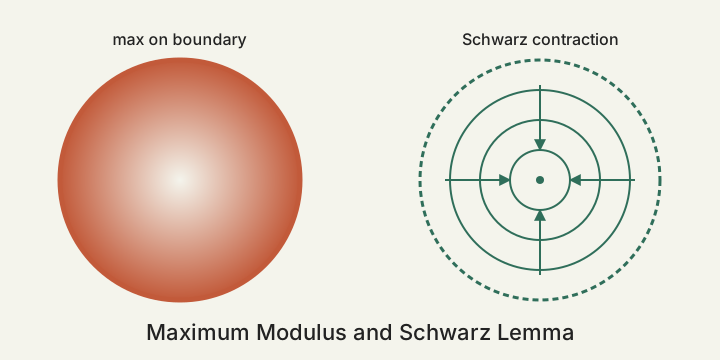
A disc whose interior modulus surface lightens toward the boundary, where the maximum lives, sits beside a disc whose holomorphic self-map contracts every concentric circle inward toward the centre.
Worked example [Beginner]
Take on the closed unit disc . The modulus is
On the interior , the modulus is strictly less than . On the boundary , the modulus . So the maximum is attained on the boundary circle and nowhere inside. The maximum modulus principle is confirmed.
Now check that also satisfies the Schwarz lemma. The map sends the open disc into itself (since gives ), and it sends the origin to itself (). The Schwarz bound asks for :
valid because forces . The lemma is confirmed for this .
What this tells us: is a textbook witness to both principles at once. The maximum of on the closed disc lives on the boundary, and the disc-to-disc contraction inequality holds at every interior point. Both phenomena are special cases of the same rigidity that holomorphic functions exhibit on the disc.
Check your understanding [Beginner]
Formal definition [Intermediate+]
Maximum modulus principle. Let be a connected open set and let be holomorphic. If attains a local maximum at some interior point — that is, there exists with such that for every — then is constant on .
A corollary on bounded domains: if is bounded open, is holomorphic on and continuous on , then . The supremum on the closed region is attained on the boundary. [Ahlfors Ch. 4 §3.4]
Schwarz lemma. Let be holomorphic, where is the open unit disc, and suppose . Then:
- for every .
- .
- If equality holds in (1) for some in , or if equality holds in (2), then there exists such that for every — that is, is a rotation.
The lemma asks no extra regularity beyond holomorphicity, and the two inequalities together pin down rotations as the only equality cases. [Ahlfors Ch. 6 §1; Schwarz 1869]
Disc automorphism group. A disc automorphism is a biholomorphic map . The collection of all disc automorphisms forms a group under composition. Möbius theory (06.01.08) supplies a parametrised family of such maps:
Each sends to , has modulus on the boundary circle, and is biholomorphic from to itself. The Schwarz lemma supplies the converse: every disc automorphism is of the form for some and .
Sign convention. Both principles are stated for the open disc as the model simply-connected proper subdomain of . The maximum-modulus statement on a bounded uses the supremum over , attained on , with the open-set formulation under the continuity-on-closure hypothesis.
Counterexamples to common slips
- Connectedness is needed. On a disconnected with both open and connected, the function equal to on and equal to on is holomorphic, has an interior modulus maximum on , and is not constant on . The principle is genuinely a connected-component statement; one applies it on each connected component separately.
- The continuity-on-closure hypothesis in the bounded-domain corollary is needed. The function on is holomorphic on but not continuous on , since it diverges as . The supremum of on is infinite, not attained on the boundary in any classical sense. The bounded-domain corollary holds only when extends continuously to the closure.
- The Schwarz hypothesis is genuine. Without it the conclusion fails: the constant function maps to itself, has for all , and satisfies only when . The Schwarz-Pick theorem ([Advanced results]) is the no-fixed-point-required generalisation, with the hyperbolic metric replacing the Euclidean inequality.
Key theorem with proof [Intermediate+]
Theorem (Schwarz lemma). Let be holomorphic with . Then for every and . If equality holds in either inequality at some interior point — in for some , or in — then there exists with on . [Ahlfors Ch. 6 §1]
Proof. Define by
Holomorphicity of on is immediate from the holomorphicity of and the absence of a zero of on the punctured disc. At , the hypothesis together with the existence of gives the Taylor expansion valid on some disc around , so extends holomorphically across with value at the origin. The piecewise definition produces a single holomorphic function on .
Fix a radius with . On the circle , the function takes values in by hypothesis, hence , and so
The function is holomorphic on the open disc and continuous on the closed disc (any closed disc of radius less than is compactly contained in ). The maximum modulus principle applied to on the bounded then gives
This bound is valid for every . Fix any and choose with . Then . Letting keeps fixed and gives the limiting bound at every .
For , the bound translates back to , that is . For , the bound is . Both displayed Schwarz-lemma inequalities are established.
For the rigidity statement, suppose either for some , or . In the first case at an interior point of ; in the second case at an interior point. Either way, attains its maximum value at an interior point of . The maximum modulus principle then forces to be constant on . The constant has modulus , so for some real and every . Multiplying back through the defining relation at gives , and the equation extends to by continuity. The map is a rotation.
The proof's structure is the maximum modulus principle reused twice: once to bound on each smaller disc by its boundary values, with a limit-as- step to pass to the open disc ; and once to extract the rigidity, where equality at an interior point of forces constancy of via the same maximum modulus argument. The hypothesis enters through the removability of the singularity at in the quotient , which is what makes a holomorphic function on at all.
Bridge. The Schwarz lemma is the structural pivot from which a substantial portion of disc-and-half-plane complex analysis radiates, and the synthesis runs in four directions. First, it builds toward the disc automorphism group : combining Schwarz with Möbius theory (06.01.08) shows that the maps exhaust the biholomorphic self-maps of the disc, and this group becomes the model isometry group for hyperbolic plane geometry. Second, it builds toward the Schwarz-Pick theorem ([Advanced results]) — the hypothesis is dropped and the conclusion is reformulated as a contraction inequality in the hyperbolic Poincaré metric , with disc automorphisms achieving equality. Schwarz becomes the special case at the origin of the metric form.
Third, it builds toward the Riemann mapping theorem (06.01.06): the uniqueness statement (a biholomorphism on a simply-connected proper subdomain is determined by sending a chosen interior point to together with a chosen direction) is a Schwarz-lemma argument applied to the composition of two candidate biholomorphisms, with the conclusion that the composition is a rotation. Fourth, it builds toward complex dynamics: the Schwarz lemma controls the local behaviour of a holomorphic map at a fixed point. At a fixed point of with , Schwarz applied to a local conjugate produces a contraction estimate that proves the Koenigs linearisation theorem and underlies the entire theory of attracting and repelling cycles in complex dynamics. Putting these together, the Schwarz lemma is the foundational reason holomorphic maps on the disc are rigid — far more controlled than smooth self-maps, which form an infinite-dimensional configuration space, while the holomorphic self-maps with form a compact contraction class.
Exercises [Intermediate+]
Lean formalization [Intermediate+]
lean_status: none. Mathlib has scattered Complex.norm_max_principle and Complex.differentiableAt results in Analysis.Complex.AbsMax and the broader complex-analysis API, but does not assemble the curriculum-facing planar package: the maximum modulus principle as a single theorem deducing constancy from interior modulus extrema, the disc Schwarz lemma with its rigidity statement (equality forces rotation), the Schwarz-Pick hyperbolic-metric contraction inequality, the disc automorphism characterisation , the Phragmén-Lindelöf principle on unbounded sectors, and the Hadamard three-circles theorem. The lean_mathlib_gap field in this unit's frontmatter records the precise contribution roadmap. The unit ships without a lean_module while the upstream Mathlib gaps remain open; the human-reviewer gate covers correctness in the interim.
Advanced results [Master]
Schwarz-Pick theorem. Let be holomorphic — no fixed-point hypothesis. Then for every , $$ \frac{|f'(z)|}{1 - |f(z)|^2} \leq \frac{1}{1 - |z|^2}, \qquad \left|\frac{f(z) - f(w)}{1 - \overline{f(w)} f(z)}\right| \leq \left|\frac{z - w}{1 - \bar w z}\right|, \quad z, w \in \mathbb{D}. $$ The first inequality is the infinitesimal contraction in the hyperbolic Poincaré metric on , and the second is the corresponding finite-distance contraction in the hyperbolic distance with . Equality at some (equivalently every) interior pair holds if and only if . The Schwarz lemma is the special case at , , , where the metric form collapses to the Euclidean inequality . Exercise 7 above proves the Schwarz-Pick form by conjugating with disc automorphisms. [Pick 1916]
Disc automorphism group. The full automorphism group of the unit disc is $$ \mathrm{Aut}(\mathbb{D}) = \left{z \mapsto e^{i \alpha} \frac{z - a}{1 - \bar a z} : a \in \mathbb{D}, ; \alpha \in \mathbb{R}\right} \cong \mathrm{PSU}(1, 1), $$ where is the projective special unitary group of the form of signature on . The identification with proceeds by lifting the disc to via the open cone and identifying the disc as a chart on . The Schwarz lemma is the analytic ingredient that shows the explicit Möbius family above is all of , with no further holomorphic self-equivalences. The group is the orientation-preserving isometry group of the hyperbolic plane in the Poincaré disc model, with the Schwarz-Pick inequality the analytic statement of distance contraction.
Schwarz-Ahlfors-Pick theorem. Let be Riemann surfaces equipped with smooth Hermitian metrics of constant Gaussian curvature . Then every holomorphic map is distance-decreasing with respect to these metrics: as Hermitian forms. The classical Schwarz-Pick theorem is the case with the Poincaré metric (curvature when normalised as ). Ahlfors's 1938 extension introduced the use of the maximum principle on to extract distance-decreasing properties from the curvature hypothesis, opening the door to Kobayashi hyperbolic manifolds, complex hyperbolic geometry, and the modern theory of value distribution.
Phragmén-Lindelöf principle. The maximum modulus principle requires the domain to be bounded. On an unbounded domain — for instance an angular sector or a half-strip — the principle fails in its naive form: is bounded on the imaginary axis by and unbounded on the positive real axis. Phragmén-Lindelöf (1908) recovers the principle in the presence of a growth bound. The model statement on a sector for : if is holomorphic on , continuous on , satisfies on , and grows no faster than for some , then on . The auxiliary comparison uses , applies the maximum modulus principle on a large bounded subsector, and then sends . The growth condition is sharp — examples like with growth at the critical rate violate the bound. [Phragmén-Lindelöf 1908]
Hadamard three-circles theorem. Let be holomorphic on the annulus and continuous up to the boundary. Set . Then is a convex function of on . Exercise 8 gives the proof via comparison with and optimisation over . The three-circles theorem is the function-theoretic content of the maximum modulus principle on annuli, and it is the analytic foundation for Hadamard's three-lines theorem on horizontal strips and for the theory of interpolation between spaces in the Riesz-Thorin convexity argument.
Cartan's lemma. In several complex variables, a Schwarz-style estimate holds for holomorphic maps fixing the origin on a bounded balanced (circular) domain. Let be a bounded balanced domain (i.e., and implies ) and let be holomorphic with . Cartan (1932) showed that if is the identity, then is the identity on . The proof iterates and applies a multi-variable analog of the Schwarz-lemma rigidity to the higher-order Taylor coefficients. Cartan's lemma is the structural reason holomorphic-automorphism groups of bounded balanced domains are linear: every automorphism fixing is determined by its linearisation, and the group of such automorphisms embeds in .
Synthesis. The maximum modulus principle and Schwarz lemma are the foundational pivot of disc-and-half-plane complex analysis, and the synthesis runs in five directions. First, the synthesis with hyperbolic geometry through Schwarz-Pick: the disc carries the Poincaré metric of constant curvature , every holomorphic self-map is a contraction in this metric, and the isometry group of the hyperbolic plane is exactly the disc automorphism group . The Schwarz lemma is the analytic statement of hyperbolic-distance contraction at the origin; Schwarz-Pick is its metric form at every point. The bridge to negatively-curved Riemannian geometry runs through the Schwarz-Ahlfors-Pick generalisation and underlies the theory of Kobayashi-hyperbolic complex manifolds.
Second, the synthesis with conformal mapping and the Riemann mapping theorem (06.01.06): the uniqueness statement of the Riemann mapping theorem — that a biholomorphism on a simply-connected proper is unique once the image of a point and the direction at that point are prescribed — is a Schwarz-lemma argument applied to the composition of two candidate biholomorphisms. The existence half of the Riemann mapping theorem uses normal-families machinery combined with an extremal-Schwarz argument that picks out the biholomorphism by maximising over the class of injective holomorphic maps .
Third, the synthesis with complex dynamics: the Schwarz lemma controls the local behaviour of a holomorphic self-map at a fixed point. At an attracting fixed point with , the Koenigs linearisation theorem realises in a neighbourhood of as conformally conjugate to its linearisation ; the proof iterates and applies a Schwarz-style geometric-series estimate. The entire theory of attracting and repelling cycles, Fatou and Julia sets, and the dynamical decomposition of holomorphic self-maps of chains off this local Schwarz control.
Fourth, the synthesis with Picard's theorems and value distribution: the Schwarz lemma combined with the modular function produces a sharp constraint on the image of a holomorphic map omitting two values. Picard's little theorem (a non-constant entire function omits at most one value) and Picard's great theorem (an essential singularity attains every value with at most one exception, infinitely often) follow from a Schwarz-Pick argument applied to compositions with . The maximum modulus principle is the analytic foundation; Schwarz refines it to the disc; Schwarz-Pick metricises it; Picard's theorems are the value-distribution payoff.
Fifth, the synthesis with subharmonic-function theory and the maximum-principle hierarchy: the maximum modulus principle for holomorphic is a corollary of the subharmonic maximum principle applied to , which is subharmonic precisely because is holomorphic. The hierarchy is harmonic < subharmonic ≤ , with each layer's maximum principle inheriting from the next via increasingly weak inequalities < . Hadamard three-circles, Phragmén-Lindelöf, and the Riesz-Thorin interpolation theorem are corollaries of subharmonicity on log-coordinates, with the maximum modulus principle as the engine.
Full proof set [Master]
The advanced results follow from the proofs given in earlier sections together with classical results recorded in Ahlfors Complex Analysis Ch. 4 §3.4 and Ch. 6 §1, Krantz Geometric Function Theory, and the original sources. Six reference points complete the proof set.
(a) The maximum modulus principle has two standard proofs. Route 1 (mean value). On a small closed disc , the value equals the boundary-circle average by the Cauchy integral formula. If is a local maximum, then for every in the disc, so is at least the average of on the circle. Combining with the triangle inequality , equality forces to be constant on the circle and (by varying the radius) on the whole closed disc. The argument iterates to a connected component, giving constancy of on . A separate Cauchy-Riemann argument (Exercise: a holomorphic with constant is constant — differentiate formally and use ) then deduces is constant. Route 2 (open mapping). A non-constant holomorphic function on a connected open is an open map (sends open sets to open sets), so the image of a neighbourhood of contains a disc around , whose boundary contains points with modulus exceeding . This contradicts the local-maximum hypothesis. The open mapping theorem itself follows from the argument principle (06.01.13) applied to for near . [Ahlfors Ch. 4 §3.4]
(b) The Schwarz lemma is proved in the Key theorem with proof section above. The key technical input is the removable-singularity argument for at the origin, which extends holomorphically across with value . The two inequalities are extracted from the maximum modulus bound on as , and the rigidity statement comes from interior-maximum forcing of constancy.
(c) The Schwarz-Pick theorem is Exercise 7 above. The auxiliary is the disc-automorphism conjugate that normalises both and to the origin, reducing Schwarz-Pick at to the standard Schwarz lemma at for the conjugate. The chain-rule computation extracts the metric factor .
(d) The disc automorphism characterisation proceeds in two stages, given as Exercises 5 and 6 above. Stage 1 (Exercise 5): every origin-fixing disc automorphism is a rotation, via the Schwarz lemma applied to both and . Stage 2 (Exercise 6): every disc automorphism is the composition of a Möbius (sending a chosen to ) with a rotation, by reducing to Stage 1. The identification with uses the lifting of to the open cone in and the action of the unitary group preserving the form .
(e) **Phragmén-Lindelöf on the sector ** with proceeds via the comparison function for . On the boundary , the modulus of is bounded by . On the part of the boundary at infinity inside the sector, the modulus is bounded by with (since and ). So as inside . The maximum modulus principle applied to on the bounded subsector for large then gives on , hence on all of by letting . Letting recovers on . The growth condition for some is the input needed to make the comparison go through. [Phragmén-Lindelöf 1908]
(f) Hadamard three-circles is Exercise 8 above. The technical step is the maximum-modulus comparison for , with chosen via the convex-combination relation between and . The auxiliary function is multi-valued for non-integer , and the careful approach uses an annulus slit along a ray to define a single-valued branch, then takes a limit as the slit width shrinks to zero. The convexity inequality is the displayed three-circles statement. [Hadamard 1893]
Connections [Master]
Harmonic functions on the plane
06.01.11— The maximum modulus principle for holomorphic is a corollary of the maximum principle for the subharmonic function (subharmonic because is harmonic at points where and equal to at zeros of , with the subharmonic mean-value inequality on circles around ). The harmonic maximum principle established in06.01.11is the parent statement; the holomorphic version is its restriction to the modulus of a holomorphic function. The mean-value property and the maximum principle thereby chain: harmonic maximum principle (06.01.11) ⇒ subharmonic maximum principle ⇒ maximum modulus principle (this unit).Cauchy-Riemann equations
06.01.10— The hypothesis " holomorphic" in the maximum modulus principle and Schwarz lemma is exactly the Cauchy-Riemann conditions , and the closed form of the Cauchy integral formula used in the mean-value-route proof rests on the closedness of the form , which is the Cauchy-Riemann conditions in differential-form language. Without the Cauchy-Riemann equations there is no Cauchy integral formula and no maximum modulus principle. The Wirtinger formalism from06.01.10supplies the modern packaging: the maximum modulus principle is a statement about kernels of .Möbius transformations
06.01.08— The disc automorphism group is the subgroup of the Möbius group preserving the unit disc. The Schwarz lemma is the analytic ingredient that characterises this subgroup as the explicit Möbius family , with no further holomorphic self-equivalences. The Möbius cross-ratio invariant of06.01.08is the building block for the hyperbolic distance on , with the Schwarz-Pick contraction inequality the analytic statement of cross-ratio decrease under holomorphic self-maps.Riemann mapping theorem
06.01.06— The uniqueness statement of the Riemann mapping theorem, that a biholomorphism on a simply-connected proper subdomain is determined by sending a chosen interior point to and a chosen direction at that point to the positive real axis, is a Schwarz-lemma argument applied to the composition of two candidate biholomorphisms — the composition is a disc automorphism fixing with , hence the identity, so . The existence half of the theorem uses an extremal-Schwarz argument: maximise over the family of injective holomorphic maps sending to , and show the maximiser is a biholomorphism.Argument principle and Rouché [06.01.13, pending] — The argument principle counts zeros and poles of a meromorphic function via the contour integral , and combined with the maximum modulus principle (via Hurwitz's theorem on uniform limits of zero-free holomorphic functions) it gives Rouché's theorem and the open-mapping theorem. The chain "maximum modulus principle ⇒ open mapping theorem ⇒ argument principle ⇒ Rouché" is the foundational hierarchy of zero-counting in one complex variable.
Historical & philosophical context [Master]
Hermann Amandus Schwarz introduced the inequality for holomorphic disc-to-disc maps fixing the origin in his lectures at the ETH Zürich in 1869–70, recorded in Über einige Abbildungsaufgaben (J. Reine Angew. Math. 70, 1869). Schwarz's original proof used the Cauchy integral formula on a sequence of circles and a direct estimate; the modern presentation via the auxiliary function and the maximum modulus principle is due to Carathéodory in lectures at Göttingen in the early 1900s. Constantin Carathéodory and Ernst Lindelöf, in independent 1907 papers, established the standard form of the lemma now used and the rigidity statement (equality forces rotation); their treatments became the basis for the textbook proof. [Schwarz 1869]
The maximum modulus principle itself was already implicit in Cauchy's foundational Mémoire sur les intégrales définies prises entre des limites imaginaires (1825) via the integral formula, but the explicit statement and free-standing proof came later. Bernhard Riemann's 1851 dissertation Grundlagen für eine allgemeine Theorie der Functionen einer veränderlichen complexen Grösse used maximum-principle arguments throughout, and the principle reached its modern textbook form in Karl Weierstrass's lectures and Edouard Goursat's Cours d'Analyse (1902). Georg Pick, in Über eine Eigenschaft der konformen Abbildung kreisförmiger Bereiche (Math. Ann. 77, 1916), generalised Schwarz to the hyperbolic-metric contraction inequality and identified the disc automorphism group with the isometry group of the Poincaré disc, opening the bridge to hyperbolic geometry. [Pick 1916]
Lars Phragmén and Ernst Lindelöf, in Sur une extension d'un principe classique de l'analyse (Acta Math. 31, 1908), extended the maximum modulus principle to unbounded sectors and half-strips by an auxiliary-comparison argument that traded a polynomial growth bound for boundedness on the unbounded boundary. Their principle became the analytic foundation for value-distribution theory and the Riesz-Thorin interpolation theorem. Lars Ahlfors, in his 1938 paper An extension of Schwarz's lemma (Trans. Amer. Math. Soc. 43), generalised Pick's hyperbolic-contraction inequality from the disc to arbitrary Hermitian metrics of curvature , with the comparison-of-curvatures argument opening Kobayashi-hyperbolic and complex-hyperbolic geometry as the higher-dimensional descendants. The pedagogical synthesis of this seventy-year arc as the foundational chapter of disc-and-half-plane complex analysis is Ahlfors's Complex Analysis Ch. 4 §3.4 and Ch. 6 §1 (1979). [Phragmén-Lindelöf 1908; Ahlfors 1938]
Bibliography [Master]
Cauchy, A.-L., Mémoire sur les intégrales définies prises entre des limites imaginaires, Paris (1825).
Riemann, B., Grundlagen für eine allgemeine Theorie der Functionen einer veränderlichen complexen Grösse (Inaugural Diss.), Göttingen (1851).
Schwarz, H. A., Über einige Abbildungsaufgaben, J. Reine Angew. Math. 70 (1869), 105–120.
Hadamard, J., Sur les fonctions entières, Bull. Soc. Math. France 24 (1893), 186–187.
Goursat, É., Cours d'Analyse Mathématique, Tome II, Gauthier-Villars (1902).
Carathéodory, C., Untersuchungen über die konformen Abbildungen von festen und veränderlichen Gebieten, Math. Ann. 72 (1912), 107–144.
Lindelöf, E., Mémoire sur certaines inégalités dans la théorie des fonctions monogènes et sur quelques propriétés nouvelles de ces fonctions dans le voisinage d'un point singulier essentiel, Acta Soc. Sci. Fennicae 35 (1908), no. 7.
Phragmén, L. E. and Lindelöf, E., Sur une extension d'un principe classique de l'analyse et sur quelques propriétés des fonctions monogènes dans le voisinage d'un point singulier, Acta Math. 31 (1908), 381–406.
Pick, G., Über eine Eigenschaft der konformen Abbildung kreisförmiger Bereiche, Math. Ann. 77 (1916), 1–6.
Cartan, H., Sur les fonctions de deux variables complexes, Bull. Sci. Math. 54 (1930), 99–116; Les fonctions de deux variables complexes et le problème de la représentation analytique, J. Math. Pures Appl. 10 (1931), 1–114.
Ahlfors, L. V., An extension of Schwarz's lemma, Trans. Amer. Math. Soc. 43 (1938), 359–364.
Ahlfors, L. V., Complex Analysis, 3rd ed., McGraw-Hill (1979). Ch. 4 §3.4; Ch. 6 §1.
Conway, J. B., Functions of One Complex Variable I, 2nd ed., GTM 11, Springer (1978). §VI.2.
Stein, E. M. and Shakarchi, R., Complex Analysis, Princeton Lectures in Analysis II, Princeton (2003). §2.5 and §8.1.
Krantz, S. G., Geometric Function Theory: Explorations in Complex Analysis, Birkhäuser (2006).
Needham, T., Visual Complex Analysis, Oxford University Press (1997). Ch. 6.