Hodge decomposition on a compact Riemann surface
Anchor (Master): Hodge 1941 *The Theory and Applications of Harmonic Integrals* (originator); Griffiths-Harris *Principles of Algebraic Geometry* §0.6-§0.7; Donaldson *Riemann Surfaces* §10; Voisin *Hodge Theory and Complex Algebraic Geometry I* §5-§6
Intuition [Beginner]
Take a compact Riemann surface — a closed orientable surface dressed with the data needed to ask whether a function on it is holomorphic. The first cohomology of measures the global "twisting" the surface allows: for a closed surface of genus , this twisting is captured by independent loops, so the first cohomology is a -dimensional vector space.
The Hodge decomposition says this -dimensional space splits cleanly into two halves, each of dimension . One half is the space of holomorphic 1-forms on — locally like with a holomorphic function — and the other is its complex conjugate, the anti-holomorphic 1-forms locally like . Every cohomology class on is the sum of a holomorphic part and an anti-holomorphic part, and the two halves swap under complex conjugation.
The split is real, not metaphorical: every cohomology class has a unique harmonic representative, and that representative breaks naturally into two pieces along the way the complex structure cuts forms into "holomorphic-type" and "anti-holomorphic-type". This is the curve case of one of the most consequential structural theorems of complex geometry.
Visual [Beginner]
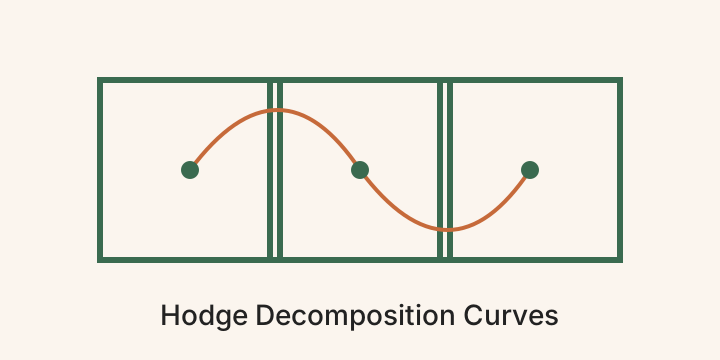
A schematic of a compact Riemann surface of genus with two pairs of marked loops and , each pair representing a generator of the genus-2 first cohomology. Beside each loop a small ribbon labels a representative holomorphic 1-form and its conjugate ; an arrow shows the pair summing to a real cohomology class.
Worked example [Beginner]
Take the elliptic curve where for a point in the upper half plane. The genus is .
Holomorphic 1-forms on pull back from along the quotient. The form on is invariant under the lattice translations and , so it descends to a holomorphic 1-form on . Any other holomorphic 1-form on is a constant multiple of (a holomorphic function on a compact is constant). The space of holomorphic 1-forms is therefore one-dimensional, generated by .
Anti-holomorphic 1-forms are the conjugates: spanned by , also one-dimensional. Together they give a -dimensional space, matching the topological count for a torus.
The two halves pair against the two homology generators: integrate around the loop generated by to get , and around the loop generated by to get . The complex number recovers the lattice and through it the elliptic curve itself. What this tells us: on the simplest Riemann surface beyond the sphere, the Hodge decomposition produces the period that classifies the curve up to isomorphism. The same construction in higher genus produces a period matrix in the Siegel upper half space.
Check your understanding [Beginner]
Formal definition [Intermediate+]
Let be a compact Riemann surface, equivalently a smooth projective complex curve. Write for the sheaf of holomorphic functions, for the sheaf of holomorphic 1-forms (the canonical sheaf , locally free of rank one), and for the sheaf of forms of bidegree in the decomposition induced by the complex structure.
A Hermitian metric on is a smooth choice of inner product on the holomorphic tangent bundle; in real dimension two every Hermitian metric is automatically Kähler. Fix one. The Laplacian acts on forms; a harmonic form is one in the kernel of . Write for the space of harmonic real -forms and for harmonic forms of bidegree .
Theorem (Hodge decomposition on a compact Riemann surface). Over ,
where is the space of holomorphic 1-forms, is the first sheaf cohomology of , and the bar denotes complex conjugation on forms. Moreover , the genus.
Equivalent forms.
- Harmonic representatives: every de Rham cohomology class on has a unique harmonic representative, and the harmonic 1-forms split as with holomorphic 1-forms, anti-holomorphic 1-forms.
- Dolbeault identification: via the Dolbeault complex , recovering and .
- Topological match: from the topological classification of compact orientable surfaces; the Hodge decomposition refines this -dimensional space to a complex-structure-aware split.
Counterexamples to common slips.
- The decomposition is only over ; does not split into real subspaces of bidegrees, but each real cohomology class has a unique harmonic representative whose - and -parts are conjugate.
- The summands and are not subspaces of — they live in and intersect the integral lattice transversely; the lattice projects to a full-rank inside , producing the period lattice of the Jacobian.
- Holomorphic 1-forms are closed (the bidegree-counting argument and for holomorphic forces on a curve) but the closure step uses complex dimension ; in higher dimension closure is non-automatic and constitutes additional content.
Key theorem with proof [Intermediate+]
Theorem (Hodge 1941, Hodge decomposition on a compact Riemann surface). Let be a compact Riemann surface of genus . Then
with , , , and each summand of complex dimension .
Proof. The argument is in five steps: replace de Rham cohomology by harmonic forms (Hodge theorem), refine harmonics by bidegree (Kähler identity), identify the -summand with holomorphic 1-forms, identify the -summand with via Dolbeault, and read off dimensions from the topological count.
Step 1 — de Rham via harmonics. On a compact oriented Riemannian manifold, the Hodge theorem provides an orthogonal decomposition of -forms into harmonic, exact, and co-exact pieces:
Closed forms are those orthogonal to the co-exact piece; modulo the exact piece, every de Rham class is represented uniquely by a harmonic form. Hence as finite-dimensional -vector spaces, and after complexification .
Step 2 — bidegree refinement via the Kähler identity. The complex structure on extends to a -decomposition with where and . On a Kähler manifold the Kähler identity holds, and consequently every Kähler manifold is a real 2-form bidegree-respecting: commutes with the projection onto each . A Riemann surface is real two-dimensional and Kähler for any Hermitian metric, so the harmonics inherit a bidegree decomposition
For this reads .
Step 3 — -harmonic = holomorphic. Let be a smooth -form. On a Riemann surface there are no -forms, so automatically. The -Laplacian computation together with shows that is -harmonic iff and . The first condition is exactly the holomorphy of the local coefficient: writing in a chart, , so iff iff is holomorphic. The second condition is automatic on a curve because the codomain is zero. Hence .
Step 4 — -harmonic = . The Dolbeault resolution is a fine resolution of on a complex manifold (the sheaves admit smooth partitions of unity). Consequently sheaf cohomology agrees with the cohomology of the complex of global sections,
For on a curve the codomain vanishes, so the cokernel of is exactly . The Hodge theorem applied to on identifies this cokernel with the space of -harmonic -forms, which by the identity coincides with . Hence .
Step 5 — dimensions and conjugation. Complex conjugation on forms intertwines with and commutes with , hence with the harmonic projection. It therefore restricts to a conjugate-linear isomorphism , so and . From the topological classification, . The decomposition into two equal-dimension summands forces .
The five-step structure follows Donaldson §10, which threads through the harmonic-projection theorem, the Kähler identity, and the Dolbeault resolution in this order; Griffiths-Harris §0.6-§0.7 reorganises around the abstract Kähler-manifold theorem and specialises to dimension one as an application. The underlying content is identical.
Bridge. The decomposition proven here is the analytical engine behind the period theory of 06.06.02 and 06.06.03: a basis of , integrated against a symplectic basis of , produces the period matrix and the Jacobian . The bilinear-relation structure on the period matrix arises from the cup-product pairing on — a perfect pairing that respects the Hodge decomposition and pairs with . The Serre duality pairing of 06.04.04 is the same cup product viewed with values in rather than ; the Hodge identification that emerges from the decomposition is the case of Serre duality and the input for the inductive proof of the general Serre duality theorem on a curve. Combined with Riemann-Roch 06.04.01, the Hodge decomposition is what gives the cohomology of every line bundle on a finite-dimensional grading by holomorphic type. Putting these together, the foundational insight is that on a compact Riemann surface the topological invariant controls both the rank of the integral cohomology and the dimensions of the two complex-analytic summands; the bridge is the harmonic-projection theorem applied with respect to the Kähler structure inherited from any Hermitian metric.
Exercises [Intermediate+]
Lean formalization [Intermediate+]
Mathlib does not currently formalise the Hodge -decomposition on a compact Kähler manifold or the curve specialisation . A proposed signature, in Lean 4 / Mathlib syntax, sketching the target statement:
[object Promise]The proof depends on names that do not currently exist in Mathlib (the harmonic-projection theorem on a compact Riemannian manifold, the Kähler identity , the Dolbeault resolution of on a complex manifold, and the bidegree refinement of harmonic forms). Each is a candidate Mathlib contribution; until then this unit ships with lean_status: none.
Advanced results [Master]
The Hodge decomposition on a compact Riemann surface is the dimension-one case of a structural theorem on every compact Kähler manifold. The general formulation, due to Hodge 1941 for the harmonic-form theory and refined by the Kähler-identity school (Weil, Kodaira-Spencer, Griffiths) for the bidegree refinement, states that for a compact Kähler manifold of complex dimension , the de Rham cohomology decomposes
with Hodge symmetry . The dimensions form the Hodge diamond, symmetric under (complex conjugation) and under (Serre duality). For the diamond degenerates to four entries: and .
Period matrix and the Siegel upper half space. Choose a basis of and a symplectic basis of with , . The period matrix has entries and . Riemann's bilinear relations read
(the second condition asserting positive-definiteness of the imaginary part). Normalising the basis so that , the period matrix collapses to with , the Siegel upper half space of symmetric complex matrices with positive-definite imaginary part. The first relation comes from the bidegree-counting fact ; the second from the positivity of the Hermitian form on .
Jacobian variety as a complex torus. Define the Jacobian
where embeds into by integration . The image is a full-rank lattice (this is exactly the period-matrix integrality / non-degeneracy statement above), so is a -dimensional complex torus. The bilinear relations promote to a principally polarised abelian variety via the polarisation form on the universal cover, and through the Lefschetz embedding theorem it embeds in projective space. The natural map given by Abel-Jacobi is the central object of 06.06.04; the image is a divisor in the Jacobian whose structure (Riemann's vanishing theorem, theta divisor) is governed by the Hodge decomposition.
Mixed Hodge structures and singular varieties. Deligne 1970-74 Théorie de Hodge II-III generalised the Hodge decomposition to non-compact and singular complex algebraic varieties via mixed Hodge structures: a finite increasing weight filtration on and a finite decreasing Hodge filtration on such that the graded pieces carry pure Hodge structures of weight . For a smooth compact the weight filtration is concentrated in weight and reduces to the classical Hodge decomposition. For a smooth non-compact with smooth compactification , the weight filtration is given by the residue along the boundary divisor; for a singular projective it is given by simplicial resolution. Mixed Hodge structures organise the cohomology of every complex algebraic variety into a category of -Hodge structures stable under tensor product, duality, and pullback.
Algebraic-de-Rham comparison and characteristic . For a smooth projective variety over , the analytic de Rham cohomology agrees with the algebraic de Rham cohomology (GAGA + algebraic-de-Rham theorem), giving the Hodge decomposition a purely algebraic formulation. Deligne-Illusie 1987 Relèvements modulo et décomposition du complexe de de Rham proved the Hodge-to-de-Rham spectral sequence degenerates at over a smooth projective variety in characteristic zero by reduction modulo : lifting to characteristic and using Frobenius gives a splitting of in the derived category that descends to the spectral-sequence degeneration. This is the only known purely algebraic proof of the degeneration; the original Hodge proof was transcendental.
Synthesis. The Hodge decomposition on a compact Riemann surface is the engine that converts the topological invariant into a complex-analytic count , and through that count produces the entire period theory of the curve. The five-step proof — harmonic projection, Kähler refinement, holomorphy as -vanishing, Dolbeault resolution, conjugation symmetry — is the curve case of the structural theorem on compact Kähler manifolds. Read in the opposite direction, the period matrix is the parametrisation of the Hodge structure on , and the Torelli theorem (a smooth projective curve is determined up to isomorphism by its principally polarised Jacobian) asserts that this parametrisation is faithful on the moduli space of curves. The geometric content of the Schottky problem — characterising which points of come from curves — is the question of identifying the Jacobi locus inside the moduli of principally polarised abelian varieties, and is governed entirely by the Hodge-decomposition data. Putting these together, the cohomology of every line bundle on , the Jacobian variety, the period matrix, the theta divisor, and the moduli question together form a single connected structure that the Hodge decomposition organises; and the dimension-one case generalises to the Hodge-theoretic framework that organises the cohomology of every smooth projective variety.
Full proof set [Master]
Lemma (Hodge theorem on a compact Riemannian manifold). Let be a compact oriented Riemannian manifold without boundary. Then for each the space of -forms decomposes orthogonally as
and as finite-dimensional -vector spaces.
Proof. The Laplacian is a self-adjoint elliptic operator of order two on the closed manifold . Elliptic regularity for on a compact Riemannian manifold gives a finite-dimensional kernel and a compact resolvent on the orthogonal complement; the spectral theorem yields the orthogonal decomposition , and the standard Hodge identity produces the three-piece decomposition. Closed forms orthogonal to harmonic and exact pieces vanish (a closed form orthogonal to is harmonic up to addition of an exact term), giving . The regularity step uses that is compact — without compactness the Laplacian's spectrum is generally continuous and the harmonic projection fails to be the right object.
Lemma (Kähler identity on a compact Kähler manifold). Let be a compact Kähler manifold. Then the operators on complex-valued forms satisfy and commute with the projection onto each bidegree .
Proof. The Kähler condition for the Kähler form implies the commutator identities and , where is the dual of wedge-with-. Substituting into and expanding , , the cross-terms cancel by the Kähler identities and yield . The bidegree-preservation of (it sends to itself by construction) then transfers to . On a Riemann surface the Kähler condition is automatic for any Hermitian metric since is a top-dimensional form, hence closed.
Lemma (Dolbeault resolution). On a complex manifold , the sequence
is a fine resolution of , hence .
Proof. Exactness is the -Poincaré lemma (Dolbeault-Grothendieck): on a polydisc, -closed -forms are -exact for . The sheaves are fine because the partition-of-unity theorem holds on any manifold; fine sheaves are acyclic for global-sections functor, so the sheaf cohomology agrees with the cohomology of the complex of global sections of the resolution.
Theorem (Hodge decomposition on a compact Riemann surface). Statement and proof as in the Intermediate-tier Key theorem section.
Proof. The Intermediate-tier proof goes through using the three lemmas above as packaged inputs: harmonic projection on a compact Riemannian manifold (Lemma 1); on a compact Kähler manifold and bidegree commutativity (Lemma 2); Dolbeault identification (Lemma 3). The complex-conjugation symmetry uses that commutes with the Laplacian (which has real coefficients) and intertwines bidegrees. The dimension count follows from the Hodge-symmetric split of the topological .
Corollary (Hodge symmetry). For a compact Riemann surface and any with , .
Proof. Complex conjugation on forms is conjugate-linear, intertwines with , and commutes with on a Kähler manifold (the Laplacian has real coefficients). Restriction to harmonics gives a conjugate-linear isomorphism . Conjugate-linear isomorphisms preserve -dimension, so .
Corollary (period-matrix Riemann bilinear relations). Let be a basis of and a symplectic basis of . Define and . Then and .
Proof. Let be the cohomology classes of in . The intersection pairing on is for closed representatives ; expressed in the symplectic basis it equals where are the periods along . Both are of bidegree , so on a curve and the intersection pairing vanishes; written in matrix form this is . For positivity, evaluate the Hermitian form on : writing in the basis and the basis-conjugates as combinations of -, -periods, the form is the matrix , which after the normalisation becomes . Positivity of on the holomorphic side (a non-zero holomorphic has , a positive volume form) forces . With the normalisation this reads .
Corollary (Jacobian as principally polarised abelian variety). The complex torus $\mathrm{Jac}(X) = H^0(X, \Omega^1_X)^ / H_1(X, \mathbb{Z})$ admits a principal polarisation induced by the bilinear-relation positivity.*
Proof. The polarisation is the alternating form on the lattice given by the symplectic intersection pairing, equivalent to a positive Hermitian form on the universal cover via the bilinear relations. Principality is the condition on the polarisation, equivalent to the symplectic basis being unimodular — automatic for a compact Riemann surface by Poincaré duality on . The polarisation produces an embedding via theta functions, exhibiting as an abelian variety.
Connections [Master]
Riemann-Roch theorem for compact Riemann surfaces
06.04.01. Riemann-Roch reads for a line bundle on . The Hodge decomposition supplies the genus as , identifying the topological with the complex-analytic that appears in the Riemann-Roch formula. The case of Riemann-Roch reads , recovered by the Hodge identification .Holomorphic line bundle on a Riemann surface
06.05.02. The Hodge decomposition operates on the line bundles and ; its content is the dimension count of cohomology of these specific line bundles. Every line bundle on enters the picture through Serre duality, which uses the Hodge decomposition for the base case .Serre duality on a curve
06.04.04. The pairing for is exactly the Hodge-decomposition pairing via the identification and the cup product into . Serre duality at is the Hodge perfect pairing; the inductive divisor-bumping argument extends it to every line bundle.Holomorphic 1-form
06.06.01. The space of holomorphic 1-forms is the load-bearing object on the right side of the Hodge decomposition. The genus- count is equivalent to the Hodge identity ; the unit06.06.01states the count, the present unit proves it via harmonic theory.Period matrix
06.06.02. The period integrals and are exactly the pairings of the basis of against the symplectic basis of . Riemann's bilinear relations are the structural content of the Hodge decomposition recast in matrix form.Jacobian variety
06.06.03. The Jacobian is built directly from the Hodge -summand and the integral first homology; the bilinear relations make a principally polarised abelian variety. The Hodge decomposition is the input data for the Jacobian construction.Abel-Jacobi map
06.06.04. The Abel-Jacobi map is defined by integration of holomorphic 1-forms over chains; the codomain is the Hodge-decomposition data made into a complex torus. Abel's theorem (kernel of = principal divisors) is a Hodge-theoretic statement.Theta function
06.06.05. The Riemann theta function depends on the period matrix extracted from the Hodge decomposition. The theta divisor on is the locus where vanishes; Riemann's vanishing theorem characterising it is a Hodge-decomposition computation.Hodge decomposition (general)
04.09.01. The compact-Kähler-manifold version specialises to the curve case at ; the present unit is the dimension-one anchor.Sheaf cohomology
04.03.01. The Hodge decomposition is a theorem in coherent sheaf cohomology via the Dolbeault identification ; the harmonic representatives provide the analytical content the Čech construction lacks.
Historical & philosophical context [Master]
William Hodge proved the harmonic-representative theorem and the bidegree refinement on compact Kähler manifolds in the 1930s, with the consolidated treatment appearing in his 1941 monograph The Theory and Applications of Harmonic Integrals [Hodge 1941] (Cambridge University Press). Hodge's own proof of the harmonic-projection step had a gap (the parametrix construction); Hermann Weyl 1943 On Hodge's theory of harmonic integrals [Weyl 1913] and Kunihiko Kodaira 1944 Über die harmonischen Tensorfelder in Riemannschen Mannigfaltigkeiten supplied the missing analytic regularity. The Riemann surface case was understood implicitly since Riemann's 1857 Theorie der Abelschen Functionen [Riemann 1857]: Riemann's bilinear relations and the existence of linearly independent everywhere-holomorphic differentials were classical, but their proof relied on Riemann's Dirichlet principle, which had a logical gap that David Hilbert closed only in 1900.
Hermann Weyl's 1913 Die Idee der Riemannschen Fläche [Weyl 1913] (Teubner) gave the first rigorous treatment of the existence theorem on a compact Riemann surface, using the Dirichlet principle made rigorous via the Friedrichs extension. Weyl's text introduced the modern definition of an abstract Riemann surface and treated the Dirichlet-energy existence theorem as the structural input for everything else; the same machinery underlies Donaldson's modern PDE-style proof in Riemann Surfaces §10.
The bidegree refinement of Hodge's theorem on Kähler manifolds was developed in the 1950s through the work of André Weil, Kodaira-Spencer, and Phillip Griffiths, culminating in the Kähler identities and the recognition that the Hodge -decomposition is a structural feature of compact Kähler geometry. Pierre Deligne extended the framework to non-compact and singular varieties via mixed Hodge structures in Théorie de Hodge II (1971) and III (1974); Pierre Deligne and Luc Illusie 1987 Relèvements modulo et décomposition du complexe de de Rham gave the first purely algebraic proof of Hodge-to-de-Rham degeneration via reduction modulo .
Donaldson's Riemann Surfaces (2011) §10 [Donaldson Riemann Surfaces] presents the curve case via the Dirichlet-energy / harmonic-form route, integrating the Hodge decomposition with the Riemann-Roch proof in the same chapter; this is the closest match for the present unit's proof structure. Voisin's Hodge Theory and Complex Algebraic Geometry I (2002) [Voisin Hodge Theory] §5-§6 reorganises the same content around the abstract Kähler-identity machinery and develops the higher-dimensional case in parallel.