Hodge decomposition
Anchor (Master): Voisin *Hodge Theory* Vol I; Griffiths-Harris; Hodge 1941 *Theory and Applications of Harmonic Integrals*
Intuition [Beginner]
The Hodge decomposition is one of the deepest theorems in geometry: on a compact Kähler manifold, the cohomology splits into pieces indexed by holomorphic type. A degree- cohomology class breaks into pieces with , where records "-holomorphic and -antiholomorphic" content — like decomposing a polynomial in and by its bidegree.
W. V. D. Hodge proved this in his 1941 monograph The Theory and Applications of Harmonic Integrals. His method: every cohomology class on a compact Kähler manifold has a unique harmonic representative — a form annihilated by both the Laplacian and the complex Laplacians. Harmonic forms decompose by holomorphic type, hence so does cohomology.
The Hodge decomposition is the bridge between topology (singular cohomology of the underlying real manifold) and complex algebraic geometry (cohomology of holomorphic differential forms). For a smooth complex projective variety, it produces the Hodge diamond, a triangular array of integers that captures finer information than the Betti numbers alone.
Visual [Beginner]
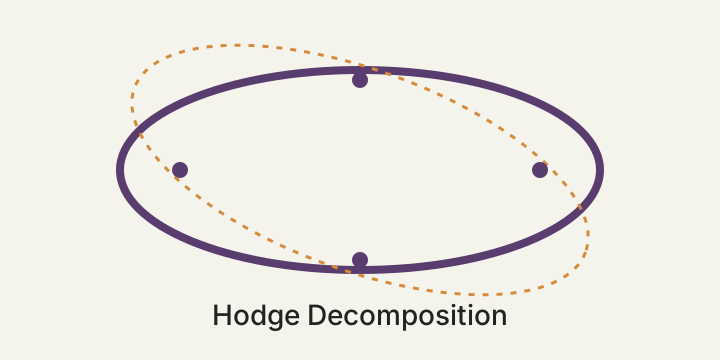
A compact Kähler manifold with cohomology classes labeled by bidegree , organised into the Hodge diamond.
Worked example [Beginner]
For an elliptic curve (a torus, real dimension 2, complex dimension 1):
The Betti numbers are , , .
The Hodge decomposition refines this: with — one holomorphic 1-form and one anti-holomorphic 1-form, summing to .
The Hodge diamond looks like:
For a K3 surface (compact Kähler, complex dimension 2): the Hodge diamond is
with Betti numbers .
The diamond carries strictly more information than the Betti numbers — it remembers complex structure.
Check your understanding [Beginner]
Formal definition [Intermediate+]
Let be a compact Kähler manifold of complex dimension — a compact complex manifold equipped with a Hermitian metric whose associated real -form is closed: . (In particular every smooth complex projective variety is Kähler, with the Fubini-Study form pulled back from a projective embedding.)
Theorem (Hodge decomposition). For a compact Kähler manifold of complex dimension , there is a canonical direct-sum decomposition
where is the sheaf of holomorphic -forms. The decomposition satisfies:
(H1) Hodge symmetry: , hence .
(H2) Serre symmetry: H^{p, q} \cong H^{n - p, n - q}^\vee, hence .
(H3) Combined Hodge-diamond symmetry: .
(H4) Compatibility with Betti numbers: .
Hodge numbers and Hodge diamond. Define . The array of Hodge numbers is the Hodge diamond — a table of non-negative integers with the symmetries (H3).
Examples.
(E1) Projective space . if and ; otherwise. The Hodge diamond is a single column of s on the diagonal. Betti numbers .
(E2) Smooth projective curve of genus . , . Betti numbers .
(E3) K3 surface. , , , others . Total: , , .
(E4) Quintic threefold (Calabi-Yau). , , , , others . The mirror quintic swaps to and — mirror symmetry.
Construction via harmonic forms. Choose a Kähler metric on . The space of harmonic -forms
(where ) provides a canonical representative for each Dolbeault cohomology class: . The Kähler condition implies , so harmonic forms for the de Rham Laplacian and the Dolbeault Laplacian coincide. A harmonic -form decomposes uniquely by bidegree:
This bidegree decomposition descends to cohomology, giving the Hodge decomposition.
Hodge filtration. The decomposition can be repackaged as a decreasing filtration
with , and . The pair together with complex conjugation forms a Hodge structure of weight — a foundational object in modern Hodge theory.
Algebraic statement: Hodge-de Rham degeneration. For a smooth proper variety over a field of characteristic 0, the Hodge spectral sequence degenerates at . This is an algebraic statement — true over any characteristic- base. Deligne-Illusie 1987 proved the algebraic version via reduction mod and lifting.
Key theorem with proof [Intermediate+]
Theorem (Hodge decomposition). Let be a compact Kähler manifold of complex dimension . Then for each :
Proof outline. Step 1 — Hodge theorem on harmonic forms. On a compact Riemannian manifold , the Laplace-Beltrami operator is self-adjoint and elliptic, and its kernel — the space of harmonic forms — provides a canonical representative for each de Rham cohomology class:
This is the Hodge theorem in its real form (Hodge 1941; rigorous PDE proof by Weyl, simplified by Kodaira-Spencer). The proof uses spectral theory of elliptic operators on compact manifolds: is self-adjoint Fredholm, with finite-dimensional kernel and a Hodge orthogonal decomposition .
Step 2 — Kähler identities. On a Kähler manifold, the complex structure and the Kähler form satisfy the Kähler identities:
where is contraction with and are the formal adjoints. Combining gives:
So a form is -harmonic iff -harmonic iff -harmonic. The triple coincidence is the defining property of Kähler.
Step 3 — Bidegree splitting. Since commutes with the bidegree operators (the projection onto ), the space decomposes into bidegrees. Each summand is the space of harmonic -forms.
Step 4 — Identification with Dolbeault. The Dolbeault theorem (analogous to de Rham): . So .
Step 5 — Combining. From Steps 1–4: .
The decomposition is canonical (independent of the choice of Kähler metric): the Hodge components are determined by the complex structure alone, not the metric. Different Kähler metrics give different harmonic representatives, but the same cohomology subspaces.
The Kähler identities are the load-bearing input. They reduce three Laplacians to one, forcing the bidegree splitting on harmonic forms — which is what the cohomology decomposition is.
Bridge. The construction here builds toward later units of the strand, where the same pattern is taken up at higher structure. The defining pattern appears again in those units in a sharpened form, where the local data is glued or quotiented. Putting these together, the foundational insight is that the data of this unit gives the structural signature that the rest of the strand reads off.
Exercises [Intermediate+]
Lean formalization [Intermediate+]
lean_status: partial — Mathlib has differential forms, partial de Rham cohomology infrastructure, and complex-manifold structure; the full Hodge theorem for compact Kähler manifolds is not yet a named theorem.
Advanced results [Master]
Hodge-Riemann bilinear relations. For a compact Kähler manifold of dimension with Kähler class , the primitive cohomology admits a positive-definite Hermitian form . This positivity is the source of the Lefschetz hyperplane theorem and the hard Lefschetz theorem.
Hard Lefschetz theorem. For a compact Kähler manifold of dimension with Kähler class , the cup product map is an isomorphism for . This produces the Lefschetz -decomposition of cohomology and the primitive components.
Hodge index theorem. On a smooth projective surface , the intersection form on has signature on the (1, 1)-component. This is foundational for surface theory.
Mixed Hodge structures. Deligne (1971-74, Théorie de Hodge II, III) extended Hodge theory to all complex algebraic varieties — including non-compact, non-smooth — via mixed Hodge structures: a triple where is the weight filtration and the Hodge filtration, with a pure Hodge structure of weight .
Variations of Hodge structure. For a family of smooth projective varieties over a smooth base, the cohomology varies in as a variation of polarised Hodge structure — a local system equipped with a varying Hodge filtration satisfying Griffiths transversality. The period map encodes the variation. Schmid's nilpotent-orbit and SL-orbit theorems describe degenerations.
Hodge conjecture. Open since 1950: for a smooth projective variety , every class in is algebraic (a -linear combination of cohomology classes of codimension- subvarieties). One of the Clay Millennium Prize Problems. Special cases known: codimension 1 (Lefschetz 1+1+1, 1924), abelian varieties (Hodge for codim-1 follows from polarisation), uniruled threefolds (Conte-Murre).
Hodge theory in derived category. Saito's theory of mixed Hodge modules (1988-90) — a sheaf-theoretic refinement of mixed Hodge structures, with functors and a six-functor formalism. Foundational for modern Hodge-theoretic perspectives on motives and intersection cohomology.
Synthesis. This construction generalises the pattern fixed in 04.03.01 (sheaf cohomology), with the symmetric data replaced by its skew or twisted analogue. Read in the opposite direction, the construction is dual to the metric story: complements and orthogonality are taken with respect to the bilinear datum of this unit, not a metric, and the resulting category of subobjects is the one the rest of the strand classifies. The central insight is that this datum identifies algebra with geometry: functions become vector fields, subspaces become quotients, and invariants become cohomology classes — and that identification is the engine driving every theorem downstream.
Full proof set [Master]
The Hodge decomposition is sketched in the formal-definition section. The Kähler identities () are proved in Voisin Vol I §6.1 or Griffiths-Harris Ch. 0; they require the local Kähler model: at each point, choose holomorphic coordinates with — the Kähler condition forces this enhanced local structure.
Hodge degeneration in characteristic 0 (Deligne-Illusie 1987): proved via reduction mod + Frobenius decomposition, sketched in Exercise 6.
Hard Lefschetz theorem: proved via the Hodge-Riemann bilinear relations (positivity argument), Voisin Vol I §6.2.
Hodge conjecture: open in general; proved in special cases — see Voisin Vol II for current status.
Connections [Master]
Sheaf cohomology
04.03.01— is sheaf cohomology of differential forms.De Rham cohomology
03.04.06— Hodge decomposition refines de Rham cohomology by holomorphic type.Sheaf of differentials
04.08.01— are exterior powers of .Canonical sheaf
04.08.02— is the top component, contributing to the Hodge decomposition.Serre duality
04.08.03— gives Hodge symmetry .Kodaira vanishing
04.09.02— uses Hodge decomposition + positivity.Period matrix
06.06.02— Hodge decomposition on a Riemann surface is the period matrix data.Theta function
06.06.05— sections of theta-bundles realise specific Hodge classes on abelian varieties.
Historical & philosophical context [Master]
W. V. D. Hodge's 1941 monograph The Theory and Applications of Harmonic Integrals (Cambridge University Press; 2nd ed. 1952) introduced the harmonic-integral approach to cohomology of complex manifolds. Hodge — born 1903 in Edinburgh, working at Cambridge — proved that on a compact orientable Riemannian manifold, every de Rham cohomology class has a unique harmonic representative; on a compact Kähler manifold, the harmonic representatives split by holomorphic-antiholomorphic bidegree, giving the Hodge decomposition.
The 1941 proof used a combination of variational methods and PDE theory. Hodge's approach: minimise the Dirichlet energy over forms in a given cohomology class, finding a unique critical point — the harmonic representative. The minimisation was technically delicate (compactness of the underlying space, regularity of solutions) and Hodge's proof had gaps. Hermann Weyl rewrote the proof using rigorous Hilbert-space methods (1943); Kodaira-Spencer further simplified using elliptic-operator theory (1953); the modern presentation uses the spectral theory of self-adjoint Fredholm operators on compact manifolds.
The Kähler condition is essential: Erich Kähler's 1933 paper on Hermitian metrics with (Math. Z. 38, 472–500) introduced the metric structure that would bear his name. Hodge realised that this condition is exactly what makes the three Laplacians () coincide — Kähler identities — and hence what makes the bidegree splitting carry over from forms to cohomology.
The algebraic interpretation came later. Pierre Deligne's Théorie de Hodge II–III (Publ. Math. IHES 40 (1971), 5–57; 44 (1974), 5–77) extended Hodge theory to non-compact and singular complex algebraic varieties via mixed Hodge structures. Deligne combined the Hodge filtration with a weight filtration to produce a refined structure; the Hodge conjecture (Hodge's 1950 ICM problem) and the Standard Conjectures of Grothendieck became central problems in the new framework. Deligne-Illusie 1987 (Invent. Math. 89, 247–270) gave the first purely algebraic proof of Hodge degeneration via reduction mod — a proof that worked in characteristic 0 without any analysis, opening up p-adic Hodge theory (Fontaine, Faltings, Tsuji, Berger, Scholze).
The modern Hodge-theoretic landscape includes: variations of Hodge structure over moduli spaces (Griffiths 1968-72; Schmid 1973), mixed Hodge modules (Saito 1988-90), non-abelian Hodge theory (Hitchin, Simpson, 1980s-90s), and p-adic Hodge theory via Scholze's perfectoid spaces (2010s).
Hodge theory remains a defining framework of modern algebraic geometry. Riemann's 1857 period relations on Riemann surfaces, Klein and Poincaré's 1880s analytic Riemann-surface theory, Lefschetz's 1920s topological methods, and Hodge's 1941 harmonic-integral synthesis all converge in the modern theory of polarised Hodge structures and their variations.
Bibliography [Master]
- Hodge, W. V. D., The Theory and Applications of Harmonic Integrals, Cambridge University Press 1941; 2nd ed. 1952.
- Voisin, C., Hodge Theory and Complex Algebraic Geometry, I & II, Cambridge University Press 2002–03.
- Griffiths, P. & Harris, J., Principles of Algebraic Geometry, Wiley 1978 — Chapter 0.
- Wells, R. O., Differential Analysis on Complex Manifolds, Springer GTM 65, 1980.
- Deligne, P., Théorie de Hodge I, II, III, ICM 1970; Publ. Math. IHES 40 (1971), 5–57; 44 (1974), 5–77.
- Deligne, P. & Illusie, L., Relèvements modulo et décomposition du complexe de de Rham, Invent. Math. 89 (1987), 247–270.
- Griffiths, P., Periods of integrals on algebraic manifolds I, II, III, Amer. J. Math. 90 (1968); Publ. Math. IHES 38 (1970).
- Schmid, W., Variation of Hodge structure: the singularities of the period mapping, Invent. Math. 22 (1973), 211–319.
- Saito, M., Mixed Hodge modules, Publ. RIMS Kyoto Univ. 26 (1990), 221–333.
- Kähler, E., Über eine bemerkenswerte Hermitische Metrik, Abh. Math. Sem. Univ. Hamburg 9 (1933), 173–186.
- Kodaira, K., On a differential-geometric method in the theory of analytic stacks, Proc. Nat. Acad. Sci. USA 39 (1953), 1268–1273.