Cousin I (additive)
Anchor (Master): Cousin 1895 *Sur les fonctions de $n$ variables complexes* (Acta Math. 19, originator); Forster *Lectures on Riemann Surfaces* §26; Hörmander *An Introduction to Complex Analysis in Several Variables* Ch. III; Grauert-Remmert *Theory of Stein Spaces* (Grundlehren 236)
Intuition [Beginner]
Imagine you live on a non-compact Riemann surface — the complex line , the punctured plane , an annulus, the upper half-plane, or a compact curve with a discrete point set removed. You have a list of places where you want a meromorphic function to behave badly: at each point you specify a local recipe like , or a longer Laurent tail with several inverse-power terms. The Cousin I problem asks whether you can find a single global meromorphic function on whose local singular behaviour matches every recipe at once, with the regular parts free to be whatever they need to be in order to fit together.
The classical case on the complex line is Mittag-Leffler's theorem from 1884. Choose a sequence in and a desired principal part at each . Mittag-Leffler builds a global meromorphic function on whose pole at every has exactly that principal part, by adding correction polynomials that make the sum converge. The Cousin I problem on a Riemann surface is the natural generalisation: the local recipes are now patched together along an open cover, with consistency conditions that the recipes overlap holomorphically where two patches meet, and the question is whether the patched data assembles into a global object.
Pierre Cousin posed this question in his 1895 thesis on functions of several complex variables. On a non-compact Riemann surface, the answer is always yes — every Cousin I datum is solvable, no matter how the prescribed singularities are arranged. The reason is the Stein structure: enough global holomorphic functions exist to absorb every local mismatch.
Visual [Beginner]
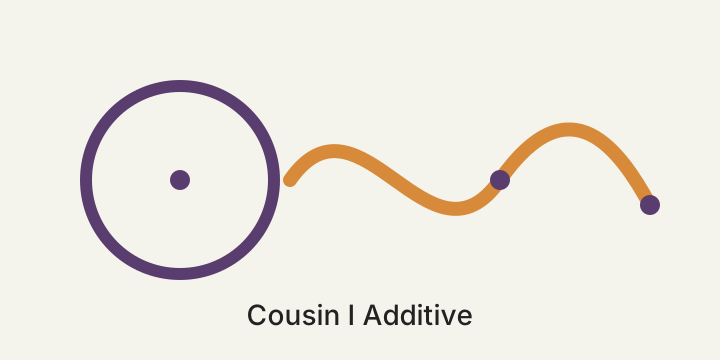
A non-compact Riemann surface is shown as an open band stretching to the right, covered by overlapping open patches in alternating tones. On each patch a meromorphic recipe is depicted with a small starburst marking the prescribed pole. Where two patches overlap, the difference is drawn as a smooth curve free of starbursts. Beneath the surface a single curve labelled runs across all of , with starbursts only where the local recipes asked for them. An arrow from the patched data to the global is labelled "Theorem B: ", recording the cohomological identity that makes the assembly work.
Worked example [Beginner]
Take and ask for a meromorphic function with a simple pole of residue at every positive integer . The naive guess — add up over all — does not converge: the terms decay like for fixed , and the harmonic-like series diverges.
Mittag-Leffler's correction is to subtract from each term the partial Taylor expansion of at the origin, taken to as many terms as needed to make the corrected series converge uniformly on every compact subset of . For this example, subtracting the constant term already suffices: the corrected term at index becomes
which decays like for fixed and large . Adding these corrected terms over gives a series that converges absolutely and uniformly on every compact subset of avoiding the positive integers, and the limit is meromorphic on with a simple pole of residue at each and no other poles.
Check: at , the principal part of is the principal part of , since the rest of the series is holomorphic at . The Cousin I datum (simple pole of residue at every positive integer) is realised by the explicit global meromorphic function . The correction terms are holomorphic on , so they do not change the local recipe at any of the prescribed poles; they only adjust the regular part, which the problem leaves free.
What this tells us: on the simplest non-compact Riemann surface, a Cousin I datum is solvable by an explicit convergent series with concrete correction polynomials. The Mittag-Leffler trick — subtract enough Taylor partial sums from each term to make the series converge — is a hands-on instance of the cohomological vanishing that the Behnke-Stein theorem produces on every non-compact Riemann surface.
Check your understanding [Beginner]
Formal definition [Intermediate+]
Let be a Riemann surface and its structure sheaf. Write for the sheaf of meromorphic functions on — a sheaf of -modules whose stalk at is the field of fractions of the local ring (concretely, the formal Laurent ring in any local coordinate at ). The inclusion is a sheaf morphism whose quotient
is the principal-parts sheaf. Its stalk at is the local Laurent-tail group , isomorphic to the formal Laurent tails in any chart at . The principal-parts sheaf is a coherent skyscraper sheaf supported on each candidate pole locus — its sections globalise the local Laurent-tail data in a sheaf-theoretic package.
Definition (Cousin I datum). A Cousin I datum on is a pair consisting of an open cover of and meromorphic functions such that the differences are holomorphic on every overlap , i.e. .
Definition (solution). A Cousin I datum is solvable when there exists a global meromorphic function such that for every . The Cousin I problem on is the question of whether every Cousin I datum is solvable.
Equivalent reformulations.
- Sheaf-theoretic. A Cousin I datum is the same as a global section of the principal-parts sheaf, : each projects to a local section , and the holomorphic-difference condition is exactly on overlaps. A solution projects to the same global section . The Cousin I problem asks whether the global-section map is surjective.
- Cohomological. The short exact sequence produces a long exact sequence in cohomology with connecting map The image is the Cousin I obstruction. The datum is solvable when ; the Cousin I problem on is solvable for every datum when is the zero map, which happens whenever .
- Čech. On a fine enough cover , the differences on overlaps satisfy the cocycle condition on triple overlaps automatically and define a Čech 1-cocycle in . The datum is solvable when is a coboundary for some , and the global solution is then .
Notation. denotes the sheaf of meromorphic functions on ; the principal-parts sheaf; the connecting homomorphism; the Čech 1-cocycles and 1-coboundaries; the relation "relatively compact in".
Counterexamples to common slips
Cousin I is the additive problem. The differences are required to lie in . The multiplicative Cousin II problem replaces differences with ratios and asks for global with .
Cousin I and Cousin II diverge in higher dimension. Cousin II is governed by and the exponential sequence, and can fail in higher dimension where Cousin I succeeds: Stein in has but may not vanish, since can be non-zero.
Cousin I is dimension-one unconditional, higher-dimension conditional. On every non-compact Riemann surface, Cousin I is solvable (Behnke-Stein + Theorem B). In complex dimension , Cousin I is solvable on every Stein manifold (Cartan-Serre 1953, generalising Oka 1937 on domains of holomorphy) but fails on non-Stein non-compact complex manifolds. The standard counterexample is , where Hartogs extension breaks the Stein hypothesis and obstructs Cousin I.
The principal-parts sheaf is not the meromorphic sheaf. The sheaf records all meromorphic functions, including their regular parts; the quotient retains only the singular Laurent-tail information. A Cousin I datum is a section of , not of ; the difference is exactly the freedom in the regular part.
The cover need not be Stein, and any cover can be refined. A Cousin I datum on a coarse cover of refines to a Cousin I datum on any finer cover (restrict each ). The cohomological reformulation is independent of the cover by colimit over refinements; the Čech-1-cocycle picture is most computable on a Stein cover, where Čech and derived-functor cohomology agree on the nose.
Key theorem with proof [Intermediate+]
Theorem (Cousin I on a non-compact Riemann surface). Let be a connected non-compact Riemann surface. Every Cousin I datum on is solvable: for every open cover of and every collection of meromorphic functions with on every overlap, there exists a global meromorphic function with for every .
Proof. The argument runs in four steps: package the datum as a Čech 1-cocycle in the structure sheaf, identify the Cousin I obstruction with a cohomology class in , invoke the Behnke-Stein vanishing of that group, and assemble the global meromorphic solution from the resulting coboundary trivialisation.
Step 1 — cocycle assembly. For each pair with , set on . By hypothesis . On every triple overlap , the algebraic identity $$ g_{ij} + g_{jk} + g_{ki} = (f_i - f_j) + (f_j - f_k) + (f_k - f_i) = 0 $$ holds pointwise, so is a Čech 1-cocycle in the alternating Čech complex for the cover with values in the structure sheaf. The cocycle is antisymmetric () and has the cocycle condition above; both conditions are read off the algebraic definition of as a difference, with no analytic input.
Step 2 — obstruction class. The cohomology class is the Čech-Cousin obstruction. Refine the cover to a Stein cover (each chart is a disc, automatically Stein) and pass to the colimit; the resulting class lives in , and the Cartan-Leray comparison 06.04.02 identifies this with the derived-functor sheaf cohomology . Sheaf-theoretically the class is the image of the Cousin I datum's principal-parts section under the connecting map in the long exact sequence attached to ; the Čech and connecting-map descriptions agree by a standard zigzag chase on the cover.
Step 3 — Behnke-Stein vanishing. The Behnke-Stein theorem 06.09.03 makes a Stein Riemann surface. Cartan's Theorem B 06.09.02 then gives for every coherent analytic sheaf on and every . Specialising and produces . The Cousin I obstruction class in this group is therefore the zero class, and the cocycle is a Čech coboundary: there exist holomorphic with on every overlap.
Step 4 — global assembly. Define on piecewise by . On every overlap , $$ (f_i - h_i) - (f_j - h_j) = (f_i - f_j) - (h_i - h_j) = g_{ij} - g_{ij} = 0, $$ so the local definitions agree and is a well-defined function on . On each , is a difference of a meromorphic function and a holomorphic function, hence meromorphic on , with the same singular Laurent tails as (since is regular). The global is therefore in with for every , the Cousin I conclusion.
The four-step structure follows Forster §26 (cocycle assembly + Theorem B + coboundary trivialisation + global lift) and dovetails with Hörmander Ch. III (the higher-dimensional Cousin I solution on a Stein manifold runs the same skeleton, with the -method supplying the -PDE engine that produces the coboundary).
Bridge. The proof binds two pieces of upstream machinery into one statement. From 06.09.03 comes the Behnke-Stein theorem: every non-compact Riemann surface is Stein, with a strictly subharmonic exhaustion as the analytic witness. From 06.09.02 comes Cartan's Theorem B: on a Stein manifold, every coherent analytic sheaf has vanishing higher cohomology. The Cousin I theorem here is exactly the corollary of that vanishing applied to the structure sheaf at degree one. The foundational reason Cousin I is unconditional on a Riemann surface is that the cohomological obstruction lives in a single group, and the geometric hypothesis "non-compact" is generous enough to kill that group on the analytic side.
This is exactly the abstraction Cousin himself anticipated in 1895 — the question of whether an additive principal-parts datum globalises is intrinsically a first-cohomology question — but the cohomological language was not yet available until the Cartan séminaire half a century later. The bridge is short: a Čech cocycle assembly, a connecting-map identification, a Theorem B vanishing, and a coboundary lift. The classical Mittag-Leffler theorem on , with its convergence-factor series, is one explicit instantiation of the same chain on the simplest non-compact Riemann surface. The downstream pattern recurs: putting these together, every classical existence problem on a Stein space (Cousin II, Mittag-Leffler, Picard-group identity, Runge approximation) becomes a corollary of one cohomological vanishing, and Cousin I is the cleanest example because the obstruction sheaf is the structure sheaf itself. The central insight is that the theorem builds toward the higher-dimensional Cartan-Serre framework and appears again in 06.07.01 when the same skeleton runs on Stein manifolds in arbitrary complex dimension.
Exercises [Intermediate+]
Lean formalization [Intermediate+]
Mathlib does not currently formalise the Cousin I problem, the meromorphic-function sheaf, or the principal-parts quotient sheaf on a Riemann surface. A proposed signature, in Lean 4 / Mathlib syntax, sketching the target statement:
[object Promise]The proof depends on names that do not currently exist in Mathlib (the meromorphic-function sheaf, the principal-parts quotient sheaf, the connecting homomorphism , sheaf cohomology in the analytic setting on a manifold, Cartan's Theorem B). Each is a candidate Mathlib contribution; until then this unit ships with lean_status: none.
Advanced results [Master]
The Cousin I problem is the cleanest illustration of Stein theory's power as a uniform principle. A single cohomological vanishing collapses the question of additive-singularity globalisation on every non-compact Riemann surface to a coboundary trivialisation, with the Behnke-Stein theorem 06.09.03 providing the Stein hypothesis automatically. Three threads run from this base: the higher-dimensional generalisation, the failure modes that delineate where the framework stops, and the connections to the broader Cousin / Mittag-Leffler / Picard-group package on a Stein space.
The sheaf-theoretic formulation and the principal-parts sheaf. The cleanest packaging of the Cousin I problem uses the short exact sequence of sheaves
on a complex manifold , where is the meromorphic-function sheaf and is the principal-parts sheaf. The stalk of at a point is the formal Laurent-tail group , which on a Riemann surface in a local coordinate at is the additive group of finite formal Laurent tails . A global section of is therefore a discrete locally finite assignment of Laurent tails on — exactly a Mittag-Leffler datum in the classical language. The connecting homomorphism in the long exact sequence is the Cousin I obstruction map, and the entire content of the Cousin I theorem on a non-compact Riemann surface is the assertion , equivalent to the vanishing . The principal-parts sheaf is coherent on when restricted to its support (a discrete divisor), and Theorem B 06.09.02 applies directly.
Mittag-Leffler on as the planar case. The 1884 Mittag-Leffler theorem is the special case of the Cousin I theorem. Magnus Mittag-Leffler proved [Mittag-Leffler 1884] (Acta Math. 4, 1–79) that for any sequence in and any choice of finite Laurent tails at each , the convergence-factor series $$ f(z) = \sum_n \left( P_n!\left(\frac{1}{z - a_n}\right) - q_n(z) \right) $$ converges to a meromorphic function on with the prescribed principal parts, where is a polynomial chosen as a partial Taylor expansion of at the origin to make the series converge uniformly on compact sets. The convergence-factor polynomials are the explicit Čech coboundary trivialisation of the Cousin I cocycle, on the cover with a small disc around and . The 1884 theorem predates the Cousin I formulation (1895) by a decade and the cohomological language (1951–53) by seventy years; it is the empirical instance from which the abstraction generalises.
Higher-dimensional Cousin I — Oka, Cartan-Serre. Cousin himself posed the problem in arbitrary complex dimension in 1895 [Cousin 1895] (Acta Math. 19, 1–61). On a polydisc in , Cousin gave a direct proof using iterated Cauchy integrals — the dimension-by-dimension trick that became the prototype for Bochner's later -cohomology computations. On a general domain in , the Cousin I problem is governed by the same connecting map , and solvability is the cohomological vanishing . Kiyoshi Oka's 1937 paper [Oka 1937] (J. Sci. Hiroshima Univ. Ser. A, 6) proved this vanishing on every domain of holomorphy in , settling Cousin I in arbitrary complex dimension on the most natural class of Stein domains. The Cartan séminaire 1951–53 [Cartan 1951–53] and Cartan-Serre 1953 [Cartan-Serre 1953] (CRAS 237) extended the result from domains to abstract Stein manifolds, with Theorem B making the cohomological vanishing automatic. Hörmander's 1965 -method gave the modern analytic engine [Hörmander 1965] (Acta Math. 113), and the textbook treatment in Hörmander's Several Complex Variables Ch. III [Hörmander HSCV] presents Cousin I as a one-page corollary of -existence on a strictly plurisubharmonic exhaustion.
Failure on non-Stein manifolds — Hartogs and . The Cousin I problem fails on non-Stein non-compact complex manifolds in dimension . The standard counterexample is , where Hartogs' 1906 theorem [Hartogs 1906] (Math. Ann. 62, 1–88) forces every holomorphic function on the punctured space to extend to all of . A Cousin I datum on involving a non-zero meromorphic difference across a cover by two coordinate-hyperplane complements has non-zero obstruction in , witnessing that the Stein hypothesis genuinely binds. The cohomological description is sharp: on every Stein manifold Cousin I is solvable, and on every non-Stein non-compact complex manifold there exists at least one non-solvable Cousin I datum. The dichotomy Cousin-I-solvable-versus-not is therefore exactly the dichotomy Stein-versus-not in arbitrary complex dimension.
Compact case — the obstruction equals the genus. On a compact Riemann surface of genus , the Cousin I obstruction group has dimension by Hodge theory (, the antiholomorphic differentials) or equivalently by Serre duality on the curve 06.04.04 (, with ). A generic Cousin I datum on a compact RS of positive genus is therefore not solvable, and the failure mode is dimension-counted by the genus. The compact-versus-non-compact dichotomy on a Riemann surface, which Behnke-Stein exposes as the Stein-versus-not dichotomy, also exposes itself here as the obstructed-Cousin-I-versus-unobstructed dichotomy.
Cousin II and the multiplicative analogue. The Cousin II problem replaces additive principal parts with multiplicative divisor data: given a cover and non-zero meromorphic with , find a global with . The Cousin II obstruction lives in , and the exponential exact sequence relates it to and . On a non-compact connected Riemann surface, both groups vanish (the first by Theorem B, the second by the topology of a non-compact connected real-2-surface), so and Cousin II is also unconditionally solvable. In higher dimension, Cousin II can fail even on Stein manifolds when the topological obstruction in is non-zero — Cousin's original 1895 problem on a bidisc with a non-zero second Betti number is exactly this failure mode. The Cousin I problem is therefore strictly more robust than Cousin II in higher dimension.
Approximation and density. The Cousin I theorem combines with Runge approximation to give a powerful density statement: on a non-compact Riemann surface , the global meromorphic functions are dense in the space of locally meromorphic data, in the sense that every locally consistent Mittag-Leffler datum is the principal-parts projection of some global . The Runge approximation theorem [recorded in 06.09.03] supplies the convergence machinery for series of correction polynomials in the Mittag-Leffler tradition, and the Cousin I theorem packages the existence of such a series in cohomological form. The density of meromorphic functions in locally meromorphic data is the analytic spine of post-Stein complex analysis on Riemann surfaces.
Synthesis. The Cousin I problem on a non-compact Riemann surface is the foundational reason behind the entire Stein-theory corollary list: a Mittag-Leffler datum is realised by a global meromorphic function exactly when the cohomology class of its difference cocycle in vanishes, and the Behnke-Stein theorem 06.09.03 makes this happen unconditionally. This is exactly the principle Pierre Cousin formulated in 1895 — a half-century before sheaf cohomology — and the bridge is short: cocycle assembly, Theorem B, coboundary trivialisation, global lift. The 1884 Mittag-Leffler theorem on is the planar case; the higher-dimensional Cartan-Serre extension generalises to every Stein manifold; the Hartogs counterexample on traces the failure to non-Stein-ness. Putting these together, the central insight is that Cousin I is the cleanest of the four classical existence problems on a Stein space — Cousin I, Cousin II, Mittag-Leffler, Picard-group triviality — because its obstruction sheaf is itself, and every cohomological vanishing in the Stein corollary list flows from this one identity. The pattern recurs in 06.07.01 when the same skeleton is run on Stein manifolds in arbitrary complex dimension and builds toward the full Cartan-Serre framework of coherent-sheaf cohomology on a Stein space. The bridge is from the 1884 planar Mittag-Leffler series of correction polynomials to a uniform sheaf-theoretic vanishing principle that subsumes every classical existence problem on a non-compact curve.
Full proof set [Master]
Lemma (cocycle assembly). Given a Cousin I datum on a Riemann surface , the differences on overlaps form a Čech 1-cocycle in .
Proof. Holomorphy of on is the hypothesis of the Cousin I datum. Antisymmetry is immediate from the algebraic definition. The cocycle condition on triple overlaps is the algebraic identity , which holds pointwise. The collection therefore lies in for the alternating Čech complex with values in the structure sheaf.
Lemma (connecting-map identification). The Čech-cocycle class equals , where is the global principal-parts section determined by the Cousin I datum and is the connecting homomorphism in the long exact sequence of .
Proof. Standard zigzag in the snake lemma applied to the short exact sequence at the level of Čech cochains. Choose lifts: each lifts to by the surjectivity of . Apply the Čech differential: on , which lies in because is a global section of . The connecting-map definition reads , with the sign convention. The Cartan-Leray comparison 06.04.02 identifies Čech with derived-functor cohomology on the paracompact .
Lemma (Behnke-Stein vanishing of ). On a connected non-compact Riemann surface , .
Proof. By Behnke-Stein 06.09.03, is Stein. By Cartan's Theorem B 06.09.02 applied to the coherent structure sheaf , for every . Specialise .
Theorem (Cousin I on a non-compact Riemann surface, full statement). Every Cousin I datum on a connected non-compact Riemann surface is solvable.
Proof. Combine the three lemmas. The Čech-cocycle from Lemma 1 has cohomology class equal to the connecting-map image by Lemma 2. By Lemma 3, this class is zero, so is a Čech coboundary: there exist with on every overlap. Set . On overlaps, $$ (f_i - h_i) - (f_j - h_j) = g_{ij} - (h_i - h_j) = 0, $$ so is a well-defined function on . On each , is a difference of a meromorphic and a holomorphic function, hence meromorphic, with . The global realises the Cousin I datum.
Corollary (Mittag-Leffler theorem on a non-compact Riemann surface). Let be a non-compact connected Riemann surface, a discrete (locally finite) subset, and a prescribed Laurent tail at each . Then there exists whose principal part at is for every , and which is holomorphic on .
Proof. Form the cover where and is a chart neighbourhood of chosen so that no two for overlap. On each for , choose a local meromorphic function with the prescribed Laurent tail (using a chart at and the local power-series expansion). On , set . The differences on are holomorphic by construction; differences across for with are zero. The Cousin I theorem gives a global with for every , i.e. principal part at and holomorphic away from .
Corollary (Mittag-Leffler on , classical form). For every sequence in and every choice of finite Laurent tails , there exist polynomials such that the series converges uniformly on compact subsets of to a meromorphic function on with prescribed principal part at .
Proof. The previous corollary applied to with the discrete divisor produces . The convergence factors are the Čech coboundary terms from the proof of the Cousin I theorem, expressed concretely as partial Taylor expansions of at the origin chosen so that the resulting series converges uniformly on compact subsets — Mittag-Leffler's 1884 explicit construction.
Corollary (Cousin I solvable on every Stein manifold). Let be a Stein complex manifold of arbitrary dimension. Every Cousin I datum on is solvable.
Proof. Cartan's Theorem B 06.09.02 on a Stein manifold gives in arbitrary complex dimension. The Čech-cocycle assembly + connecting-map identification + coboundary lift argument is dimension-independent. The dimension-one case (Riemann surface) is the unconditional consequence of Behnke-Stein; the general Stein case is the Cartan-Serre framework.
Connections [Master]
Cartan's Theorems A and B for Stein Riemann surfaces
06.09.02. Theorem B applied to the structure sheaf at degree one is exactly the cohomological vanishing that makes the Cousin I obstruction the zero map. The unit at hand is the cleanest single-corollary expression of Theorem B on a non-compact Riemann surface, with the principal-parts sheaf as the analytic interface and the connecting homomorphism as the obstruction map.Behnke-Stein theorem
06.09.03. The geometric input that supplies the Stein hypothesis for the Cartan-Serre theorems on a non-compact Riemann surface. Without Behnke-Stein, the Cousin I theorem here would be conditional on the Stein property; with it, every non-compact Riemann surface satisfies the hypothesis automatically and the Cousin I solvability is unconditional.Stein Riemann surfaces
06.09.01. The Stein definition (holomorphic convexity, holomorphic separability, strictly subharmonic exhaustion) is the geometric foundation on which Cartan-Serre and Cousin I rest. The unit06.09.01introduces the equivalent characterisations and lists the classical corollary package — Cousin I, Cousin II, Mittag-Leffler, Picard-group triviality, Runge approximation — of which the unit at hand is the first detailed expansion.Hilbert-space PDE for
06.04.05. The analytic engine of the higher-dimensional Cousin I solution on a Stein manifold: Hörmander's weighted -existence theorem on a strictly plurisubharmonic exhaustion solves the -equation that, after smoothing, produces the Čech coboundary trivialisation. In dimension one, the same engine drives the Behnke-Stein vanishing that makes the Cousin I obstruction zero.Čech cohomology of holomorphic line bundles
06.04.02. The cohomological language in which the Cousin I obstruction is stated: via the Cartan-Leray comparison on a paracompact , with the structure sheaf as the value sheaf for the Cousin I cocycle. The non-compact Stein case here makes this group vanish; on a compact RS of genus the same group has dimension , and the Cousin I problem then has a -dimensional space of obstructions.Holomorphic line bundle on a Riemann surface
06.05.02. The Cousin II problem (multiplicative analogue) lives in the Picard group , related to the Cousin I obstruction via the exponential exact sequence. On a non-compact Riemann surface, both vanish, and the Cousin I solution interlocks with the Picard-group triviality recorded in06.05.02to give the multiplicative-Cousin-II analogue.Meromorphic function
06.01.05. The classical Mittag-Leffler theorem on is the planar case of the Cousin I corollary on a non-compact Riemann surface. The unit06.01.05introduces meromorphic functions as the natural generalisation of holomorphic functions allowing isolated poles; the Cousin I theorem promotes the local Laurent-tail data to a global existence statement on every non-compact RS.Hartogs phenomenon
06.07.02. The failure mode of Cousin I in higher dimension: on , Hartogs' theorem forces every holomorphic function to extend to all of , which obstructs the Stein hypothesis and produces a non-zero . The Cousin I obstruction map then has non-zero image, and explicit Cousin I data exist that are not solvable on the punctured plane.Holomorphic functions of several complex variables
06.07.01. The higher-dimensional analogue of Cousin I on Stein manifolds — Oka 1937 on domains of holomorphy, Cartan-Serre 1953 on abstract Stein manifolds — generalises the dimension-one statement here. The unit06.07.01supplies the multivariable analytic framework on which the Cartan-Serre proof runs; the Cousin I theorem here is the dimension-one specialisation where the Stein hypothesis is automatic.Riemann-Roch theorem for compact Riemann surfaces
06.04.01. On a compact RS of genus , the Cousin I obstruction has dimension (Hodge or Serre duality), and the Riemann-Roch identity records the failure mode quantitatively. The dichotomy compact-vs-non-compact on a Riemann surface — which Behnke-Stein exposes as the Stein-vs-not dichotomy — appears here as the obstructed-Cousin-I-vs-unobstructed dichotomy, with the genus as the obstruction dimension.
Historical & philosophical context [Master]
Pierre Cousin posed the additive Cousin I problem and the multiplicative Cousin II problem in his 1895 doctoral thesis Sur les fonctions de variables complexes [Cousin 1895] (Acta Math. 19, 1–61). The thesis worked in on bidiscs and polydiscs, with iterated Cauchy integrals as the analytic tool. Cousin solved the polydisc case directly: given a Cousin I datum on a polydisc with Laurent-tail singularities along coordinate hyperplanes, the iterated-Cauchy-integral construction produces an explicit global meromorphic function with the prescribed singular behaviour. The solution on a general domain in remained open until Oka's 1937 paper [Oka 1937] (J. Sci. Hiroshima Univ. Ser. A, 6, 245–255), which proved Cousin I solvable on every domain of holomorphy in . The cohomological language was not yet available; Oka's argument used a direct construction along an exhausting sequence of polydiscs.
Magnus Mittag-Leffler had proved the planar special case in 1884 in Sur la représentation analytique des fonctions monogènes uniformes d'une variable indépendante [Mittag-Leffler 1884] (Acta Math. 4, 1–79). Mittag-Leffler's construction is the convergence-factor series: for a sequence in and prescribed Laurent tails , the corrected series converges to a global meromorphic function on when each is taken to be a partial Taylor expansion of at the origin to enough terms. The 1884 theorem predates the Cousin formulation by eleven years and the Cartan-Serre cohomological reframing by sixty-eight years; it is the empirical instance from which the abstraction generalises.
Henri Cartan and Jean-Pierre Serre's 1951–53 séminaire at the École Normale Supérieure [Cartan 1951–53] and the published 1953 Comptes Rendus note [Cartan-Serre 1953] (CRAS 237, 128–130) extended the Oka 1937 result to abstract Stein manifolds in arbitrary complex dimension, with Theorem B as the cohomological packaging that makes Cousin I a one-line corollary of . The Cartan séminaire framework also clarified the Cousin II problem, which lives in and can fail on Stein manifolds with non-zero second integer cohomology even when Cousin I succeeds. Behnke and Stein's 1949 paper Entwicklung analytischer Funktionen auf Riemannschen Flächen [Behnke-Stein 1949] (Math. Ann. 120, 430–461) established that every non-compact Riemann surface is Stein, which made the Cartan-Serre Cousin I theorem unconditional in the dimension-one case — the unit at hand is the explicit consequence of that combination.
Friedrich Hartogs' 1906 paper Zur Theorie der analytischen Funktionen mehrerer unabhängiger Veränderlichen [Hartogs 1906] (Math. Ann. 62, 1–88) introduced the extension phenomenon that delineates where Cousin I stops working: in complex dimension , every holomorphic function on a punctured polydisc extends to the full polydisc, breaking the Stein hypothesis on and similar non-pseudoconvex spaces. The Hartogs-extension counterexample is the boundary marker for the Cousin I solvability: the dichotomy Cousin-I-solvable-versus-not coincides with the dichotomy Stein-versus-not in arbitrary complex dimension.
Lars Hörmander's 1965 -estimates and existence theorems for the -operator [Hörmander 1965] (Acta Math. 113, 89–152) supplied the modern analytic engine for Cousin I, replacing the Cartan séminaire's Schwartz-finiteness argument with a self-contained PDE proof on a strictly plurisubharmonic exhaustion. Hörmander's monograph An Introduction to Complex Analysis in Several Variables [Hörmander HSCV] (North-Holland 1973, Ch. III) presents the textbook treatment, with Cousin I as a one-page corollary of -existence. Hans Grauert and Reinhold Remmert's Theory of Stein Spaces [Grauert-Remmert] (Springer Grundlehren 236, 1979) is the canonical reference for Cousin theory on Stein analytic spaces, extending the manifold framework to allow analytic singularities.