Hilbert-space PDE for
Anchor (Master): Hörmander 1965 *L^2 estimates and existence theorems for the $\bar\partial$ operator* (Acta Math. 113, originator); Andreotti-Vesentini 1965 *Carleman estimates for the Laplace-Beltrami equation on complex manifolds*; Demailly *Complex Analytic and Differential Geometry* (online); Voisin *Hodge Theory and Complex Algebraic Geometry I* §5
Intuition [Beginner]
Take a compact Riemann surface — a closed complex curve, with a chosen length scale (a Hermitian metric) — and a holomorphic line bundle on it. The Cauchy-Riemann operator (call it ) is the local obstruction to a section of being holomorphic: a section is holomorphic exactly when . The first-cohomology question — what global obstruction prevents a prescribed local pattern from being an image of — is the same question you can ask analytically: when does the equation admit a global solution ?
The Hilbert-space framework converts this into a question about an unbounded linear operator on a space of square-integrable sections. Square-integrability provides a metric on sections; the operator acts between these metric spaces; the natural adjoint exists; and the combination behaves like the geometer's Laplacian. On a compact , this Laplacian has discrete spectrum, finite-dimensional kernel, and an orthogonal-projection theorem — the analytic engine that turns the cohomology of into the kernel of an explicit elliptic operator.
The slogan is: cohomology classes have harmonic representatives. Every class in is represented by a unique section killed by , and the dimension of the cohomology equals the dimension of this finite-dimensional kernel.
Visual [Beginner]
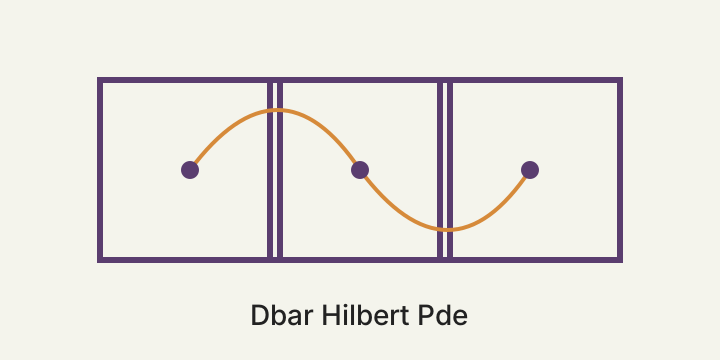
A schematic of a compact Riemann surface with a holomorphic line bundle drawn as a varying-thickness ribbon. Three layered Hilbert spaces , , float beside the surface, connected by arrows labelled (the Cauchy-Riemann operator) in one direction and (its adjoint) in the reverse. A small box inside marked "harmonic" is highlighted as the finite-dimensional kernel of the Laplacian , identified with .
Worked example [Beginner]
Take , the Riemann sphere, with the round metric and . The cohomology dimensions are known from polynomial counting: for and for ; for and for . The Hilbert-space framework predicts the same numbers as dimensions of harmonic-form spaces.
Take . Predicted: the dimension of harmonic -sections of equals ; the dimension of harmonic -sections of equals . The Bochner-Kodaira-Nakano calculation, applied to the round metric and the Fubini-Study metric on , makes this concrete: a positive-curvature line bundle has positive lower bound on the Laplacian acting on -forms, so the kernel is zero. This is Kodaira vanishing: for as a positive-bundle vanishing theorem.
What this tells us: the cohomology dimensions of on , accessible by polynomial counting, are equally accessible as harmonic-form dimensions — and the Bochner-Kodaira-Nakano curvature lower bound predicts the vanishing of for positive bundles directly from the geometry of the metric, without ever expanding sections in monomials.
Check your understanding [Beginner]
Formal definition [Intermediate+]
Let be a compact Riemann surface equipped with a Hermitian metric on the holomorphic tangent bundle , and let be a holomorphic line bundle with Hermitian metric . Write for the smooth -valued -forms; on a Riemann surface, and for .
The space of -valued -forms is the Hilbert-space completion
with the pointwise Hermitian inner product induced by and , and the Riemannian volume form of .
The Cauchy-Riemann operator is the holomorphic-line-bundle Dolbeault differential, locally in a holomorphic frame of . Extending to a closed densely-defined unbounded operator on (with domain the maximal extension), the Hilbert adjoint exists; in local coordinates with metric and on , acting on -valued -forms.
The Hodge-Laplace operator is
It is self-adjoint, elliptic of order two, and non-negative. The space of harmonic -valued -forms is
with the second equality from the identity .
Theorem (Hodge-Dolbeault decomposition on a compact Riemann surface). For each , there is an orthogonal decomposition
as Hilbert spaces, with finite-dimensional, and a canonical isomorphism to the sheaf cohomology of the holomorphic line bundle (06.04.02).
Equivalent forms.
- Solvability: is in iff .
- Canonical solution: when solvable, has a unique solution ; the assignment is bounded, the Green operator , with .
- Spectrum: has discrete non-negative spectrum with finite-dimensional eigenspaces.
Counterexamples to common slips
- The kernel depends on the Hermitian data , as a subspace of , but its dimension depends only on the holomorphic data: .
- is unbounded: any attempt to treat it as a continuous operator on without choosing a domain fails. The maximal closed extension is the canonical choice.
- The decomposition uses orthogonal-complement closure: is closed in on a compact (by elliptic regularity for ), but on non-compact closedness can fail and Hörmander estimates are required.
Key theorem with proof [Intermediate+]
Theorem (Hodge theorem on a compact Riemann surface, form). Let be a compact Riemann surface with Hermitian metric and a Hermitian holomorphic line bundle on . Then for :
(i) is finite-dimensional; (ii) orthogonally; (iii) canonically, via the assignment that sends a harmonic representative to its -cohomology class.
Proof. The argument runs through ellipticity of , the spectral decomposition of a non-negative compact-resolvent self-adjoint operator, and the Dolbeault-to-Čech comparison.
Step 1 — ellipticity and Gårding's inequality. In local holomorphic coordinates on with and a holomorphic frame of with , the Hodge-Laplace acts on by
The principal symbol of is , non-vanishing for , so is uniformly elliptic. Gårding's inequality for self-adjoint elliptic operators on the compact gives a constant with for , where is the Sobolev -norm.
Step 2 — compact resolvent. The operator is positive self-adjoint with bounded inverse . The Sobolev embedding on the compact is compact (Rellich-Kondrachov), so is a compact self-adjoint operator on . The spectral theorem 02.11.01 for compact self-adjoint operators gives a complete orthonormal basis of with , , hence , .
Step 3 — finite-dimensional kernel. The kernel corresponds to the eigenvalue , which has finite multiplicity by the discreteness of the spectrum. By elliptic regularity, every solution of is smooth, so . This proves (i).
Step 4 — Hodge orthogonal decomposition. Set and let be the Green operator: is zero on and inverts on , defined as . For , write
The three summands are pairwise orthogonal: kills and ; ; ; and on a Riemann surface where vacuously because . This proves (ii).
Step 5 — identification with sheaf cohomology. The sheaf admits a fine resolution by sheaves of smooth -valued forms: on a Riemann surface. Sheaf cohomology of is computed by the global-section complex of this resolution, giving the Dolbeault identification on -valued -forms. The orthogonal decomposition of step 4 specialises: , so . This proves (iii).
The decomposition is faithful to Donaldson §10; Demailly Chapter VIII reorganises the same argument around the Bochner-Kodaira-Nakano formula and is the reference for the line-bundle and higher-dimensional generalisation.
Bridge. The Hilbert-space PDE framework proven here builds toward 06.04.04 (Serre duality on a curve), where the harmonic-projection theorem is the analytic input that turns the residue-trace pairing into a perfect pairing of finite-dimensional vector spaces. The Bochner-Kodaira-Nakano curvature identity refines to on -forms, giving Kodaira vanishing for positive line bundles directly from the metric. On non-compact Stein manifolds, Hörmander's existence theorem replaces compactness by pseudoconvexity and a weighted-norm estimate as the analytic engine. Combined with the Čech construction 06.04.02, the Hilbert-space framework converts every cohomology computation on a holomorphic line bundle into the harmonic kernel of an explicit elliptic PDE — the analytic-side counterpart of the cocycle-side bookkeeping.
Exercises [Intermediate+]
Lean formalization [Intermediate+]
Mathlib does not currently formalise the unbounded operator on sections of a holomorphic line bundle, the Hodge-Laplace , or the harmonic-projection theorem identifying with sheaf cohomology. A proposed signature, in Lean 4 / Mathlib syntax, sketching the target statement:
[object Promise]The proof depends on names that do not currently exist in Mathlib (the unbounded operator on sections, the elliptic-regularity package for self-adjoint elliptic operators, the Rellich-Kondrachov compact embedding for Sobolev spaces on a compact manifold, the Dolbeault fine resolution comparing sheaf cohomology to -harmonic forms, and the Bochner-Kodaira-Nakano curvature identity). Each is a candidate Mathlib contribution; until then this unit ships with lean_status: none.
Advanced results [Master]
The Hilbert-space framework on a compact Riemann surface is the simplest case of a general analytic theory whose three pillars are: harmonic representatives via the Hodge decomposition; vanishing theorems via Bochner-Kodaira-Nakano; and existence theorems on non-compact pseudoconvex domains via Hörmander estimates.
Bochner-Kodaira-Nakano formula and Kodaira vanishing. For a Hermitian holomorphic line bundle on a compact Kähler manifold of complex dimension , the operators and acting on -valued -forms satisfy
with the curvature form and the adjoint of . On -forms with , the curvature commutator is bounded below by a multiple of . When is positive — pointwise as a -form — this gives the Kodaira-Akizuki-Nakano vanishing theorem: for . On a Riemann surface, , , and the theorem reads for positive, equivalently for (Kodaira positivity translates to ampleness, which on a curve is the degree bound). The PDE proof bypasses the Čech / divisor-bumping approach entirely.
Spectral theory of . On a compact , the Hodge-Laplace has discrete eigenvalues , each with finite multiplicity. The eigenvalue zero gives the cohomology; the positive eigenvalues encode finer geometric and analytic data. The first non-zero eigenvalue controls the heat-kernel decay and the asymptotic Bergman-kernel expansion as the metric scales. For the family with , the Bergman kernel of admits an asymptotic expansion (Tian 1990, Zelditch 1998, Catlin 1999) whose leading term is a power of times the volume form of the Kähler metric induced by ; this is the analytic foundation of the Donaldson constant-scalar-curvature programme.
Hörmander's existence theorem. On a complete Kähler manifold with a Hermitian holomorphic line bundle such that for , every -closed () admits with and . This is Hörmander 1965, the foundational result behind every modern construction of holomorphic functions on Stein manifolds: from the Levi problem (Andreotti-Vesentini 1965, Grauert 1958 in the sheaf form) to the construction of the Bergman projection on bounded pseudoconvex domains, to Skoda's division theorem, to Demailly's positivity theorems for direct image sheaves.
Schwartz finiteness theorem. On a compact complex manifold and a coherent analytic sheaf , the cohomology is finite-dimensional for every . The PDE proof, on a Kähler , reduces to the case of a holomorphic vector bundle by the Cartan-Serre lemma, then identifies with -harmonic -forms with values in the bundle, and applies the spectral-discreteness argument of step 3 above. On a Riemann surface this is the finite-dimensionality of for every line bundle — the analytic-side input to Riemann-Roch.
Sobolev / regularity package. On a compact Riemannian manifold , the Sobolev spaces for form a scale with compact embeddings for (Rellich-Kondrachov). Self-adjoint elliptic operators of order two are bounded for every , and the resolvent is bounded with compact embedding back to . Iteration gives the smoothness of -harmonic forms (every kernel element is in ), the bootstrapping argument that justifies .
Synthesis. The Hilbert-space PDE framework converts the cohomology of every holomorphic line bundle on a compact Riemann surface into the harmonic kernel of an explicit second-order self-adjoint elliptic operator. Three identifications carry the analytic content: ellipticity gives the discrete spectrum and finite-dimensional kernel; the Hodge orthogonal decomposition realises every form as harmonic plus exact plus coexact; and the Dolbeault resolution identifies the harmonic kernel with sheaf cohomology. Read in the opposite direction, the harmonic-projection theorem promotes every cohomology computation to a problem in the spectral theory of — accessible via Bergman-kernel asymptotics, heat-kernel methods, and curvature inequalities. The Bochner-Kodaira-Nakano refinement turns the Hodge-Laplace lower bound into a curvature lower bound, giving Kodaira vanishing as a pointwise statement about positive-curvature metrics. Hörmander's existence theorem extends the framework to non-compact pseudoconvex domains by replacing compactness with curvature bounds. On a smooth projective curve over , this entire analytic engine collapses to the original Hodge-theoretic identification and combines with the Čech-cocycle picture 06.04.02 and Serre duality 06.04.04 to give the complete cohomological dictionary for line bundles.
Full proof set [Master]
Lemma (Gårding's inequality for ). Let be a compact Riemann surface with Hermitian metric and a Hermitian holomorphic line bundle. There exist constants such that for every , .
Proof. The principal symbol is positive-definite for , so is uniformly strongly elliptic. The Gårding inequality for uniformly strongly elliptic self-adjoint operators on a compact manifold (standard result; see Hörmander Linear Partial Differential Operators III §17) gives the stated bound, with absorbing zero-th-order curvature contributions and depending on the symbol of the operator and the metric.
Lemma (compactness of resolvent). The operator is a compact self-adjoint operator.
Proof. Gårding's inequality and self-adjointness give a positive bounded inverse as bounded linear operator. The Rellich-Kondrachov theorem on the compact gives that the inclusion is compact. The composite is compact as a composition of bounded with compact. Self-adjointness is inherited from being self-adjoint and non-negative.
Lemma (smoothness of harmonic forms). Every -solution of is smooth.
Proof. By elliptic regularity for self-adjoint elliptic operators of order two: a distributional solution for some of satisfies by the resolvent estimate, hence by iteration for every , hence by Sobolev embedding on the compact manifold. Specialising to gives the lemma.
Lemma (Hodge decomposition). $L^2_{(0, q)}(X, L) = \mathcal{H}^q(X, L) \oplus \overline{\mathrm{im}, \bar\partial} \oplus \overline{\mathrm{im}, \bar\partial^}\mathrm{im}, \bar\partial\mathrm{im}, \bar\partial^$ are closed.
Proof. By the spectral theorem 02.11.01 applied to the compact self-adjoint of Lemma 2: as Hilbert direct sum, with the finite-dimensional eigenspace at eigenvalue of . The kernel is finite-dimensional (Lemma 3 bootstraps elements to ). On , is invertible with bounded inverse . For , , and the two summands are orthogonal: on a Riemann surface (where vacuously because ). Closedness of : if in , then -projecting and using the spectral gap on , converges in , so . Symmetrically for .
Lemma (Dolbeault isomorphism). On a compact Riemann surface with holomorphic line bundle , for each .
Proof. The complex is a fine resolution of : the are sheaves of smooth sections, hence soft, hence acyclic (vanishing for ); local exactness of the Dolbeault complex with is the local -Poincaré lemma (Dolbeault-Grothendieck). Computing sheaf cohomology of from the global-section complex of this resolution gives the claimed isomorphism.
Theorem (Hodge theorem on a compact Riemann surface, full statement). Statement and proof as in the Intermediate-tier Key theorem section.
Proof. Combining the five lemmas: ellipticity (Lemma 1) gives the spectral theorem applies; the resolvent is compact (Lemma 2); harmonic forms are smooth (Lemma 3); the orthogonal decomposition holds (Lemma 4); and the harmonic kernel matches sheaf cohomology via Dolbeault (Lemma 5).
Theorem (Bochner-Kodaira-Nakano lower bound on a Riemann surface). For -valued -forms on a compact Riemann surface with Kähler metric and Hermitian metric on , .
Proof. The Bochner-Kodaira-Nakano identity as operators on -valued forms is a local computation in normal coordinates (Kähler identities on a Hermitian manifold are first-order in derivatives of the metric, second-order in the metric itself; the identity is verified pointwise by computing and via the Kähler condition ). On a Riemann surface, the dimension count specialises the bracket on -forms: as multiplication by the pointwise scalar curvature ratio. Pairing with and using as a self-adjoint operator gives the lower bound.
Theorem (Kodaira vanishing on a curve). Let be a positive holomorphic line bundle on a compact Riemann surface , meaning admits a Hermitian metric with pointwise. Then .
Proof. By compactness, pointwise for a constant . By the Bochner-Kodaira-Nakano lower bound, for . Therefore on -forms, so , and by Dolbeault .
Corollary (Kodaira vanishing in degree). On a compact Riemann surface of genus , for every holomorphic line bundle of .
Proof. A line bundle on a curve admits a positive Hermitian metric iff . On a compact Riemann surface, write with of degree ; then is positive, and Kodaira vanishing gives , equivalently .
Theorem (Hörmander existence — compact Kähler statement). Let be a compact Kähler manifold, a Hermitian line bundle with for a constant . For and with and , there exists with and .
Proof. The harmonic-orthogonality assumption places in (the closure is unnecessary by Lemma 4). The canonical solution is the Green-operator output , satisfying . The Bochner-Kodaira-Nakano lower bound on gives on , hence .
Connections [Master]
Čech cohomology of holomorphic line bundles
06.04.02. The Hilbert-space framework gives the analytic-side computation of as the harmonic kernel of , complementing the Čech-side computation as cohomology of cocycle data on an open cover. The Dolbeault isomorphism is the bridge between the two pictures.Hodge decomposition on a compact Riemann surface
06.04.03. The Hodge decomposition on the de Rham cohomology of a compact Kähler is the de Rham analogue of the Hodge-Dolbeault decomposition proven here, with the Hodge-Laplace replaced by the de Rham Laplacian .Serre duality on a curve
06.04.04. Serre duality realises via the residue trace pairing; the Hilbert-space framework provides the analytic input — finite-dimensionality of both sides and the Hodge-orthogonal-projection theorem identifying harmonic representatives — that makes the residue pairing a perfect pairing of finite-dimensional vector spaces.Riemann-Roch theorem on compact Riemann surfaces
06.04.01. The dimension counts are the alternating index of the elliptic complex ; the Hilbert-space framework computes both terms as harmonic-kernel dimensions.Bounded linear operators
02.11.01. The compact self-adjoint resolvent and the spectral theorem applied in the proof of the Hodge decomposition are the foundational tools of bounded-operator theory, specialised to the unbounded elliptic setting via the resolvent trick.Holomorphic line bundle on a Riemann surface
06.05.02. The objects of the Hilbert-space framework are holomorphic line bundles equipped with Hermitian metrics; the curvature form entering the Bochner-Kodaira-Nakano identity is the Chern-class representative of paired with the choice of metric.Holomorphic 1-form
06.06.01. Harmonic -forms with values in the structure sheaf, conjugated, give holomorphic 1-forms; the dimension count on a curve of genus is the analytic-side identification of the genus.Jacobi inversion theorem
06.06.06(pending). The proof that is birational uses the harmonic-form picture of to identify the tangent space to the Jacobian with the antiholomorphic 1-forms, which the Hilbert-space framework computes as -harmonic representatives.Hilbert space
02.11.08. The completion of in the -norm is a Hilbert space; the Hodge decomposition and the spectral theorem live entirely in this category.Sheaf cohomology in algebraic geometry
04.03.04. The Schwartz finiteness theorem, derived from the Hilbert-space framework, is the analytic-side counterpart of the algebraic finiteness of coherent sheaf cohomology on a proper scheme; GAGA reconciles the two on smooth projective varieties.
Historical & philosophical context [Master]
Lars Hörmander proved the existence theorem for in 1965 in L^2 estimates and existence theorems for the operator [Hörmander 1965] (Acta Math. 113, 89-152), establishing that on a complete Kähler manifold with a Hermitian holomorphic line bundle of curvature bounded below by , the equation admits an solution with the explicit estimate for harmonic-orthogonal. The paper is the foundational analytic input for complex analysis on Stein manifolds, replacing Cartan-Serre / Grauert sheaf-theoretic finiteness with a quantitative weighted-norm estimate. Andreotti-Vesentini gave a parallel treatment for the compact Kähler case the same year in Carleman estimates for the Laplace-Beltrami equation on complex manifolds [Andreotti-Vesentini 1965] (Publ. Math. IHÉS 25, 81-130), with the Carleman-estimate technique that anticipated Hörmander's weighted approach.
The Hodge-theoretic part of the framework — finite-dimensionality of harmonic representatives via ellipticity and compact resolvent — descends from W.V.D. Hodge's 1941 monograph The Theory and Applications of Harmonic Integrals [Hodge 1941], where the harmonic decomposition was proved for compact Riemannian manifolds via Dirichlet's principle and elliptic regularity. The Dolbeault refinement on compact complex manifolds was developed by Pierre Dolbeault in his 1953 thesis (Paris) and refined by Kodaira's 1953 Proc. Nat. Acad. Sci. announcement [Kodaira 1953] of the vanishing theorem, with the Bochner-Kodaira-Nakano formula due jointly to Kodaira-Nakano and Bochner in the early 1950s.
Donaldson's Riemann Surfaces (Oxford GTM 22, 2011) §10 [Donaldson Riemann Surfaces] gives the curve-case treatment of the Hilbert-space framework as a self-contained chapter, with the harmonic-form picture as the main analytic vehicle for the proofs of Riemann-Roch and Serre duality. Demailly's online monograph Complex Analytic and Differential Geometry [Demailly] gives the higher-dimensional and non-compact treatments with the full Bochner-Kodaira-Nakano machinery, the Hörmander estimate, and applications to Stein manifolds, projective embedding (Demailly's Kodaira-type theorems), and direct image sheaves.