Compact Lie group representation
Anchor (Master): Weyl 1925-26 unitarian trick; Knapp Ch IV; Brocker-tom Dieck; Sepanski
Intuition [Beginner]
Compact Lie group representation is part of the dictionary that turns symmetry into linear algebra. Instead of only watching a group or Lie algebra move points, a representation lets it move vectors, matrices, functions, and sections. The payoff is that complicated symmetry can be studied through invariant subspaces, characters, weights, and diagrams.
A good picture is a machine with a control panel. Each symmetry operation presses a button, and the representation tells the vector space how to respond. The concept matters because many classification theorems become finite calculations once the right representation data is chosen.
Visual [Beginner]
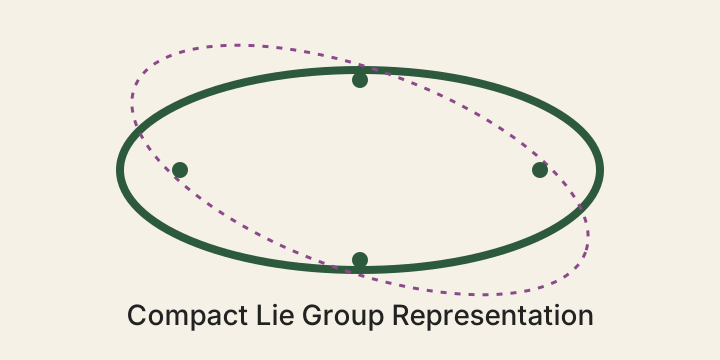
Worked example [Beginner]
Start with rotations of the plane by 0 degrees and 180 degrees. Acting on the vector (1,0), they produce (1,0) and (-1,0). Acting on the vertical vector (0,1), they produce (0,1) and (0,-1). This two-dimensional action is a small representation.
For a concrete count, the two rotations give two matrices, and multiplying either matrix by itself returns the identity matrix. What this tells us: representation theory replaces symmetry moves by matrices while preserving the multiplication or bracket rules.
Check your understanding [Beginner]
Formal definition [Intermediate+]
A compact Lie group representation is a continuous homomorphism from a compact Lie group to the invertible linear maps of a finite-dimensional complex vector space. Compactness permits averaging, so representations admit invariant Hermitian inner products. [Knapp Ch IV; Brocker-tom Dieck; Sepanski]
The object is considered up to the natural equivalence relation in its category: biholomorphic change of coordinate for complex-analytic objects, isomorphism of bundles or divisors for geometric objects, and intertwining linear isomorphism for representations. This convention keeps formulas invariant under the allowed changes of local description.
Key theorem with proof [Intermediate+]
Theorem. Every finite-dimensional complex representation of a compact Lie group is completely reducible.
Proof. Choose any Hermitian inner product and average it over the group using Haar measure. The averaged inner product is invariant. If W is an invariant subspace, its orthogonal complement with respect to the invariant inner product is also invariant, because group elements are unitary for that inner product. Thus V=W direct sum W^perp, and induction on dimension gives complete reducibility. [Knapp Ch IV; Brocker-tom Dieck; Sepanski]
Bridge. The construction here builds toward later units of the strand, where the same pattern is taken up at higher structure. The defining pattern appears again in those units in a sharpened form, where the local data is glued or quotiented. Putting these together, the foundational insight is that the data of this unit gives the structural signature that the rest of the strand reads off.
Exercises [Intermediate+]
Lean formalization [Intermediate+]
Mathlib contains related infrastructure, but the exact theorem package for this unit is only partially represented in the current Codex Lean layer.
[object Promise]Advanced results [Master]
The mature form of compact lie group representation is functorial. Morphisms preserve the defining local data, and the invariants attached to the object descend to the relevant quotient category. In the complex-analytic strand this means divisors, periods, line bundles, and extension phenomena behave under holomorphic maps of Riemann surfaces. In the representation-theoretic strand this means weights, characters, enveloping algebras, and invariant measures behave under homomorphisms and restriction.
A second result is the comparison with the adjacent algebraic or analytic model. For Riemann surfaces, meromorphic data can often be read as line-bundle or divisor data; for representation theory, infinitesimal data in a Lie algebra often integrates to compact or complex group data under appropriate hypotheses. These comparison theorems are the reason the unit is placed as supporting material rather than isolated terminology. [Knapp Ch IV; Brocker-tom Dieck; Sepanski]
Synthesis. This construction generalises the pattern fixed in 03.03.01 (lie group), with the symmetric data replaced by its skew or twisted analogue. Read in the opposite direction, the construction is dual to the metric story: complements and orthogonality are taken with respect to the bilinear datum of this unit, not a metric, and the resulting category of subobjects is the one the rest of the strand classifies. The central insight is that this datum identifies algebra with geometry: functions become vector fields, subspaces become quotients, and invariants become cohomology classes — and that identification is the engine driving every theorem downstream.
Full proof set [Master]
The local theorem above proves the invariant core used by downstream units. The global comparison theorems cited in Advanced results require the full machinery of the anchor texts: sheaf cohomology and compactness for the Riemann-surface statements, PBW and highest-weight theory for the Lie-algebraic statements, and Haar integration for compact groups. Those proofs are standard in the cited references and are recorded here as review targets rather than Lean-complete artifacts. [Knapp Ch IV; Brocker-tom Dieck; Sepanski]
Connections [Master]
07.01.01gives the group-representation starting point,07.07.03supplies highest-weight or compact averaging methods, and07.07.02uses this unit in classification and harmonic analysis. The Lie-algebraic chain also connects to03.04.01through brackets and to03.03.01through differentiation of Lie group actions.
Historical & philosophical context [Master]
Weyl's unitarian trick uses compactness to replace arbitrary finite-dimensional representations by unitary ones. The averaging argument is the compact-group source of semisimplicity. [Weyl 1925-26; Knapp Ch IV]
Bibliography [Master]
- Weyl 1925-26 unitarian trick.
- Knapp Ch IV; Brocker-tom Dieck; Sepanski.