Group representation
Anchor (Master): Fulton-Harris; Serre; James-Liebeck; Knapp *Lie Groups Beyond an Introduction*
Intuition [Beginner]
A group representation is a way of having a group act on a vector space by linear transformations. If is a group of symmetries — rotations of a square, permutations of coloured balls, internal symmetries of a particle — then a representation tells you how those symmetries shuffle vectors in some space.
The point is that linear algebra is much easier than abstract group theory: by representing a group as matrices acting on , you get to use eigenvalues, traces, characteristic polynomials, and tensor products. Understanding representations of unlocks deep information about itself.
Why this matters: in physics, particles are organised by representations of symmetry groups (rotation, Lorentz, internal gauge groups). In number theory, Galois representations encode the deepest information about number fields. In chemistry, molecular vibrations decompose into representations of point groups. Representation theory is the bridge between abstract symmetry and concrete structure.
Visual [Beginner]
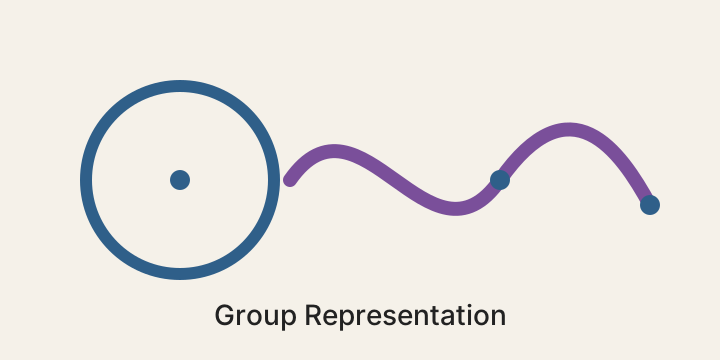
A group acting on a vector space: each element corresponds to a linear transformation , and group multiplication corresponds to composition.
Worked example [Beginner]
The cyclic group has a natural 1-dimensional complex representation: where is a cube root of unity. So , , . Group multiplication becomes complex multiplication .
A higher-dimensional representation: acts on by rotation by . The rotation matrix satisfies , so defines a representation. Over , this 2-dimensional representation splits into two 1-dimensional representations (irreducible pieces).
Check your understanding [Beginner]
Formal definition [Intermediate+]
Let be a group and a field. A representation of over is a pair where is a -vector space and is a group homomorphism (i.e., and ). When is finite-dimensional, takes values in the matrix group for .
Equivalently: a representation is a left -module structure on , where is the group algebra (a -algebra with multiplication ). Linear extension of gives the action.
Basic notions.
- A subrepresentation is a -invariant subspace : for all .
- A representation is irreducible if it has no subrepresentations except and itself.
- A representation is completely reducible (or semisimple) if every subrepresentation has a complementary subrepresentation: where both are -invariant.
- A morphism of representations is a linear map with for all . Such a is called a -equivariant linear map or intertwiner.
Operations on representations.
- Direct sum: , block-diagonal.
- Tensor product: , .
- Dual: , .
- Hom: becomes a representation, .
Maschke's theorem. Every finite-dimensional representation of a finite group over a field of characteristic 0 (or coprime to ) is completely reducible.
This is the cornerstone of finite-group representation theory: any representation decomposes as a direct sum of irreducible representations, with the irreducible pieces being the "atoms" of the theory.
Character of a representation. The character of is the function , . Characters are class functions (constant on conjugacy classes) and the orthogonality relations make them a powerful tool: characters of distinct irreducible representations are orthogonal under the natural inner product on .
Key theorem with proof [Intermediate+]
Theorem (Maschke). Let be a finite group and a field of characteristic 0 (or characteristic with ). Every finite-dimensional representation of over is completely reducible.
Proof. Let be a representation and a subrepresentation. We construct a -invariant complement .
Step 1 (averaging). Pick any linear projection (i.e., and ). Define the averaged projection
Step 2 (verification).
- maps into : preserves , maps to , so each term lands in .
- : for , , so , hence each term gives , and the average is .
- is -equivariant: for , substituting .
Step 3 (complement). Set . Since is -equivariant, is a -invariant subspace. The standard projection identity gives .
By induction on , decomposes into irreducible pieces.
The use of requires invertible in ; over (characteristic 0), this is always true. Over fields of characteristic , modular representation theory takes over with very different phenomena (Brauer theory).
Bridge. The construction here builds toward 07.01.02 (schur's lemma), where the same data is upgraded, and the symmetry side is taken up in 07.03.01 (highest weight representation). The defining pattern appears again in those units in a sharpened form, where the local data is glued or quotiented. Putting these together, the foundational insight is that the data of this unit gives the structural signature that the rest of the strand reads off.
Exercises [Intermediate+]
Lean formalization [Intermediate+]
lean_status: partial — Mathlib has Representation, MonoidHom to GL, the regular representation, and Schur's lemma (in Mathlib.RepresentationTheory.Basic).
Advanced results [Master]
Frobenius reciprocity. For a subgroup , the operations of induction and restriction are adjoint:
This is the foundation of induced representations and Mackey theory.
Burnside's theorem. Any finite group of order (where are primes) is solvable. Proved using character-theoretic methods.
Brauer's theorem on induced characters. Every irreducible character of over is a -linear combination of characters induced from "elementary" subgroups. This is the foundation of the integrality of character values and applications to local-global principles.
Modular representation theory (Brauer). When characteristic divides , representations of over have "-modular" character theory, with blocks and defect groups organising the structure.
Tannakian formalism. A category equipped with a fibre functor to is equivalent to the category of representations of an affine group scheme. This is the categorical reconstruction of from its representation theory.
Langlands philosophy. Automorphic representations of reductive groups parameterise Galois representations, providing the deepest known link between representation theory and number theory.
Synthesis. This construction generalises the pattern fixed in 01.02.01 (group), with the symmetric data replaced by its skew or twisted analogue. Read in the opposite direction, the construction is dual to the metric story: complements and orthogonality are taken with respect to the bilinear datum of this unit, not a metric, and the resulting category of subobjects is the one the rest of the strand classifies. The central insight is that this datum identifies algebra with geometry: functions become vector fields, subspaces become quotients, and invariants become cohomology classes — and that identification is the engine driving every theorem downstream.
Full proof set [Master]
The key theorems beyond Maschke (Schur's lemma, character orthogonality, the dimension formula , Frobenius reciprocity) are deferred to companion units. Proofs follow the inner-product / averaging approach over characteristic 0 and the standard linear-algebraic machinery.
Connections [Master]
Group
01.02.01— the abstract algebraic structure being represented.Vector space
01.01.03— the linear-algebraic ambient space for actions.Schur's lemma
07.01.02— the foundational classification theorem for irreducible representations and morphisms.Highest weight representation
07.03.01— the structure theorem for irreducible Lie group / Lie algebra representations.Cartan-Weyl classification
07.04.01— the classification of compact semisimple Lie groups via roots and weights.Lie group
03.03.01— continuous groups have continuous (smooth) representations; rep theory of compact Lie groups parallels finite groups.Lie algebra
03.04.01— the differential of a Lie group representation gives a Lie algebra representation; Lie algebra reps are often more tractable.Group algebra — representations of over ↔ left -modules; representation theory ↔ module theory of group algebras.
Historical & philosophical context [Master]
Group representation theory began with Ferdinand Frobenius and his student Issai Schur in the 1890s. Frobenius's 1896 paper introduced characters and the regular representation; Schur's 1901 dissertation proved Schur's lemma and established the orthogonality of characters via integration over .
The early 20th century saw the theory mature through Hermann Weyl (compact Lie groups, the unitarian trick), Élie Cartan (Cartan classification of complex simple Lie algebras), and Wigner-Bargmann (representations of the Lorentz and Poincaré groups in physics). By the 1950s, the Cartan-Weyl theory of compact semisimple Lie groups was complete.
Mid-century: the theory of infinite-dimensional unitary representations (Gelfand, Harish-Chandra, Mackey) extended the picture to non-compact reductive groups, opening the door to automorphic forms and the Langlands programme. The 1980s-2000s witnessed the parallel rise of quantum groups (Drinfeld, Jimbo) and categorification (Crane-Frenkel, Khovanov), revealing deeper categorical structures.
Today representation theory is the lingua franca of mathematical physics (gauge theories, conformal field theory, integrable systems), number theory (Galois representations, Langlands), and combinatorics (Young diagrams, crystal bases, cluster algebras). The principle that symmetries should be studied through their actions on linear spaces remains as fertile as ever.
Bibliography [Master]
- Fulton & Harris, Representation Theory: A First Course — the standard introduction, encyclopaedic.
- Serre, Linear Representations of Finite Groups — concise, masterful.
- James & Liebeck, Representations and Characters of Groups — accessible undergraduate treatment.
- Knapp, Lie Groups Beyond an Introduction — modern Lie group representation theory.
- Humphreys, Introduction to Lie Algebras and Representation Theory — Lie-algebraic foundations.
- Dixmier, Enveloping Algebras — universal enveloping algebra perspective.
- Lusztig, Characters of Reductive Groups over a Finite Field — Deligne-Lusztig theory.
- Frobenius, "Über die Charaktere endlicher Gruppen" (1896) — the original.