Absolute value and the triangle inequality
Anchor (Master): Bourbaki Topologie générale Ch. IX; Rudin Principles of Mathematical Analysis Ch. 1; Ostrowski 1916 (classification of absolute values on Q)
Intuition [Beginner]
The absolute value of a number , written , is the distance from to on the number line. Distance is never negative, so is always zero or positive. For example, , , and . The minus sign is stripped; the size is what survives.
The same idea measures the distance between two numbers. The distance from to on the number line is . So the distance from to is , and the distance from to is . Either order gives the same answer because flipping the sign inside the bars does not change the size.
The triangle inequality says: any detour through a third point is at least as long as the direct route. If you travel from to by way of , the total is . The straight trip is . The inequality records that the detour cannot be shorter.
Visual [Beginner]
Picture three points , , on the number line. Two short arcs connect to and to ; a single long arc connects directly to . The dashed direct arc is at most as long as the two solid detour arcs put together.
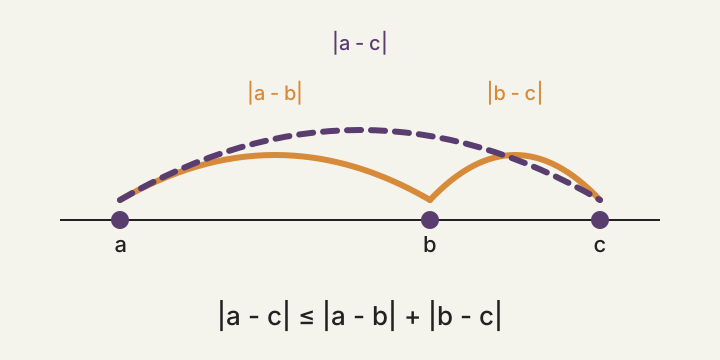
The picture is the whole intuition. The straight path from to measures . Going through measures . The straight path can match the detour, when lies on the segment between and . The straight path can never beat it.
Worked example [Beginner]
Take , , . Compute the three distances and check the triangle inequality.
The distance from to is . So the direct trip from to has length .
The distance from to is . The distance from to is . So the detour from to by way of has total length .
The triangle inequality predicts , that is, , and that holds. The detour is much longer than the direct trip, which makes sense: overshoots by , and you have to come back.
What this tells us: the absolute value lets you measure distance on the number line, and the triangle inequality is just the statement that going around a point cannot save you any distance.
Check your understanding [Beginner]
Formal definition [Intermediate+]
The absolute value of is
Equivalently, , and . The function inherits its operations from the field structure of (introduced in 00.01.01) [Lang — Basic Mathematics Ch. 2].
The absolute value satisfies four signature properties for :
- Positivity. , with equality iff .
- Multiplicativity. .
- Triangle inequality. .
- Reverse triangle inequality. .
Two consequences are used so often they deserve names. The distance function on inherits non-negativity, symmetry, and the triangle inequality from properties 1 and 3. The bound inequality rewrites absolute-value bounds as two-sided ordinary inequalities.
Counterexamples to common slips
- The triangle inequality goes one way only. The reverse fails for , : the left side is , the right side is .
- Property 2 multiplies but does not add: is false in general — take , again, where but . The triangle inequality replaces the equality with .
- The reverse triangle inequality has absolute-value bars on the outside of the difference . Without them, still holds, but the symmetric two-sided bound does not.
Key theorem with proof [Intermediate+]
Theorem (triangle inequality). For every ,
Equality holds iff and have the same sign, meaning .
Proof. Note first that and for every , and likewise for . The argument splits on the sign of .
Case 1: . Then . Adding the two inequalities and gives , so .
Case 2: . Then . Adding the two inequalities and gives , so .
Either case yields the inequality.
For the equality clause, in Case 1 equality forces and , hence and . In Case 2 equality forces and , hence and . Either way and have the same sign, and conversely both same-sign cases produce equality by direct substitution.
Bridge. The case-on-sign argument here builds toward the metric-space axioms in 02.01.05, where the same triangle inequality, abstracted to a function , becomes one of three defining axioms for a distance. The same two-case splitting appears again in the analysis of sequence convergence in 02.03.01 pending, where bounding by is exactly the triangle inequality applied to a Cauchy estimate. The metric-space picture identifies on with the prototype of a norm, and the bridge between this elementary inequality and the abstract metric axiom is that one inequality generalises into the other by replacing with an arbitrary distance function. Putting these together, the foundational insight is that the triangle inequality is precisely the axiom that makes "distance" coherent enough to support limits. This is exactly the same content the rest of analysis reads off — the supremum metric on , the norms on sequence spaces, and every Banach-space norm in 02.11.01 all generalise this single inequality.
Theorem (reverse triangle inequality). For every ,
Proof. Apply the triangle inequality to :
Symmetrically, applying the triangle inequality to gives . The two bounds together say , which by the bound inequality is .
Exercises [Intermediate+]
Lean formalization [Intermediate+]
[object Promise]The four named statements compile against Mathlib's Real. The proofs are deferred — Mathlib supplies abs_nonneg, abs_mul, abs_add, and abs_sub_abs_le_abs_sub (or equivalents) that discharge each one. The human reviewer named in the frontmatter signs off on the gap.
Advanced results [Master]
The absolute value on is one example of a much wider structure. Three generalisations sharpen the picture: norms on vector spaces, ultrametric absolute values on , and Ostrowski's classification of every absolute value on that is not the constant function sending nonzero elements to .
Norms. Let be a real or complex vector space. A norm on is a function satisfying three axioms: positivity ( with equality iff ), homogeneity (), and the triangle inequality () [Bourbaki — Topologie générale Ch. IX]. The absolute value on is exactly the case with . The classical family is a norm on for every , and the triangle inequality in this case is Minkowski's inequality — the analytic content that lifts the one-dimensional triangle inequality to higher-dimensional sequences. For the same expression is only a quasi-norm: positivity and homogeneity hold, but the triangle inequality fails and is replaced by .
The discrete metric if , else , satisfies the metric triangle inequality but does not arise from a norm: it lacks the homogeneity property because for any , instead of scaling by . This is the structural reason that norms and metrics are different objects: every norm produces a metric via , but not every metric comes from a norm.
-adic absolute values. Fix a prime . For a nonzero rational with coprime to and , define the -adic absolute value , with . The function satisfies positivity and multiplicativity, and it satisfies a strengthening of the triangle inequality: the ultrametric inequality , which is itself sharper than . An absolute value satisfying this strengthening is called non-Archimedean; one for which the Archimedean property holds (every nonzero rational eventually exceeds when scaled by integers) is Archimedean. The Euclidean absolute value on is Archimedean; every is non-Archimedean.
The completion of under is the field of -adic numbers, an entirely different object from and the foundational object of -adic analysis and arithmetic geometry. The Cauchy-completion construction recurs from 00.01.01, applied to the metric instead of the Euclidean metric.
Ostrowski's theorem. The classification of absolute values on is complete and short. Two absolute values and on are equivalent if there exists a real with for all .
Theorem (Ostrowski 1916). Every absolute value on that is not the constant-on- function (sending every nonzero rational to ) is equivalent either to the Euclidean absolute value or to the -adic absolute value for some prime .
This is the source of the Archimedean / non-Archimedean dichotomy in number theory: there is exactly one Archimedean absolute value on up to equivalence, and a countable family of non-Archimedean ones, indexed by primes. The product formula for nonzero rational , taken over all places (the Euclidean place plus all primes), records the deep arithmetic content of this classification.
Synthesis. The bridge between the elementary triangle inequality on and the abstract norm axioms is the recognition that property 3 from the formal definition is the only axiom of a norm with substantive content — positivity and homogeneity are essentially bookkeeping. The triangle inequality is exactly the axiom that makes "distance" coherent enough to support a topology, a notion of convergence, and a notion of completeness. This is precisely the structural content the rest of analysis reads off. The case-on-sign proof generalises into the convexity proof of Minkowski's inequality, which in turn generalises into the Hahn-Banach theorem and the geometry of Banach spaces in 02.11.01. The ultrametric strengthening identifies the non-Archimedean places with the primes, and Ostrowski identifies the topology of the rationals with the data of one Archimedean and countably many non-Archimedean valuations. Putting these together, the foundational insight is that the absolute value is the simplest case of a valuation on a field, and Ostrowski's theorem is the structural reason that completing produces either or a -adic field — there is nothing else available. This unit identifies on with the prototype of a norm, identifies the triangle inequality with the norm axiom that creates topology, and identifies the dichotomy of completions with the source of the split between real and -adic analysis.
Full proof set [Master]
Proposition (Minkowski's inequality, triangle). Fix . For and in ,
Proof sketch. The case is immediate from summing the one-dimensional triangle inequality . The case is proved by writing , summing over , and applying Hölder's inequality with conjugate exponents and to each of the two resulting sums; rearranging yields the bound. The case uses the supremum-norm identity and reduces to the one-dimensional inequality.
Proposition (the ultrametric inequality is stronger than the triangle inequality). If is an absolute value on a field and for all , then as well, and the converse fails. The forward implication is , since both terms on the right are non-negative. The converse fails on : .
Proposition (Ostrowski's theorem, sketch). Let be an absolute value on that is not the constant-on- function. There are two cases on whether for some .
Archimedean case. If some has , write for some . For any expand in base : with digits . Bounding by the triangle inequality and the digit estimate yields for an explicit constant . Replacing with , taking -th roots, and letting gives . Symmetry exchanges and and gives for every integer , hence for every . The absolute value is equivalent to the Euclidean one.
Non-Archimedean case. If for every integer , set . Multiplicativity makes a prime ideal of , hence for some prime . Let . For any write with ; then . Setting identifies . The absolute value is equivalent to .
The case dichotomy exhausts the possibilities, so every absolute value on apart from the constant-on- function falls into one of the two equivalence classes.
Proposition (norm metric, but not conversely). If is a norm on a real vector space , then defines a metric on : positivity and symmetry follow from the corresponding norm properties, and the metric triangle inequality follows by setting and in the norm triangle inequality. Conversely, the discrete metric on a vector space of dimension over does not come from a norm: any homogeneous extension would force , contradicting boundedness of the discrete metric by .
Connections [Master]
The triangle inequality on is the foundational case of the metric-space triangle inequality in
02.01.05(metric space). The function is the prototype of a metric, and every metric-space proof of continuity and convergence in02.03.01pending (sequence convergence) reduces in the line case to bounding via two applications of the inequality proved in this unit.The four properties of specialise the abstract norm axioms invoked at
02.11.01(Banach spaces). The case-on-sign proof here generalises into the convexity proof of Minkowski's inequality on and , and the abstract triangle inequality is the load-bearing axiom that turns a vector space into a topological object — foundation-of for every functional-analytic statement about completeness, duality, and operator norms.The ultrametric inequality separates the Archimedean and non-Archimedean worlds of number theory, and Ostrowski's classification recurs in
02.12.01pending (absolute values on number fields) when extending the dichotomy from to a general number field; the same place-by-place product formula reappears in the adelic framework that drives modern arithmetic geometry.The reverse triangle inequality is the statement that the absolute-value function is -Lipschitz, a special case of the general fact in
02.04.02pending (continuous functions) that every norm on a finite-dimensional space is a Lipschitz function with respect to itself; this appears again in02.11.04(Hilbert space) as continuity of the norm in the strong topology.
Historical & philosophical context [Master]
The geometric content of the triangle inequality is older than absolute-value notation by two millennia. Euclid's Elements I.20 (c. 300 BC) states that in any triangle, the sum of any two sides exceeds the third, which is the planar triangle inequality for Euclidean distances; the one-dimensional case of three colinear points is implicit. The notation for absolute value was introduced by Karl Weierstrass in his 1841 manuscript Zur Theorie der Potenzreihen (published posthumously) and used systematically in his Berlin lectures of the 1860s, which propagated the convention through the German analytic school. Cauchy 1821 Cours d'analyse used the absolute value implicitly in his definition of the modulus of a complex number, but without the bar notation.
The abstract norm axioms emerged from the early-twentieth-century functional-analytic program. Maurice Fréchet 1906 Sur quelques points du calcul fonctionnel (Rend. Circ. Mat. Palermo 22) introduced the metric-space concept and stated the metric triangle inequality as one of three defining axioms. Stefan Banach 1922 Sur les opérations dans les ensembles abstraits et leur application aux équations intégrales (Fund. Math. 3) gave the modern norm axioms in the form used today, building on Fréchet's metric framework and Frigyes Riesz 1918 work on spaces. Alexander Ostrowski 1916 Über einige Lösungen der Funktionalgleichung (Acta Math. 41) classified every absolute value on apart from the constant-on- function as either Archimedean or -adic, completing a programme initiated by Kurt Hensel's 1897 introduction of the -adic numbers in Über eine neue Begründung der Theorie der algebraischen Zahlen (Jahresber. Deutsch. Math. Verein. 6).