Real numbers, integers, rationals
Anchor (Master): Dedekind 1872 Stetigkeit und irrationale Zahlen; Cantor 1872; Rudin Principles of Mathematical Analysis Ch. 1
Intuition [Beginner]
A number system is a controlled supply of numbers you can add, subtract, multiply, and (with one careful exception) divide. Each system extends the one before it to fix something the previous one could not do.
Start with the counting numbers and zero. Subtraction breaks: has no answer here. Add the negatives, and you get the integers . Now division breaks: is not an integer. Add fractions, and you get the rationals , every with integers and .
The number line still has gaps. The diagonal of a unit square measures , and no fraction equals it. The ratio of a circle's circumference to its diameter is , and no fraction equals it. The real numbers fill in those gaps, giving a complete number line with no holes.
Visual [Beginner]
The integers sit as evenly spaced dots on the line. Between any two integers, the rationals crowd in like an infinitely fine ruler. The reals fill in the remaining gaps so the line has no missing points at all.
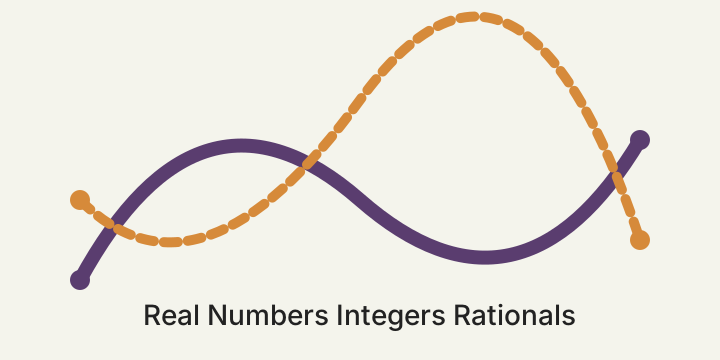
The chain of inclusions records this layering: every integer is a rational, every rational is a real, and the reals add the irrationals on top.
Worked example [Beginner]
Locate , , and on the number line, and check the inclusions.
The integer sits at the dot two units left of zero. It is an integer, so it is also a rational () and a real.
The fraction sits one third of the way from to . It is rational by construction. It is not an integer, because no whole number equals . It is also a real, sitting at a single definite point on the line.
The number sits roughly units right of zero, at the point whose square is exactly . It is real, and you can locate it by drawing the diagonal of a unit square and laying that length out along the line. It is not rational, because no fraction has square exactly .
What this tells us: are nested, and the last inclusion is strict. The reals contain points the rationals miss.
Check your understanding [Beginner]
Formal definition [Intermediate+]
The integers form a commutative ring under the usual addition and multiplication, with as additive identity, as multiplicative identity, and additive inverses for every . Multiplication has no nonzero zero-divisors, so is an integral domain.
The rationals are the field of fractions of . Concretely, under the equivalence . The arithmetic is and . The set with these operations is a field: associativity, commutativity, distributivity, identities and , additive inverses , and multiplicative inverses for .
The reals form the unique (up to unique order-preserving isomorphism) complete ordered field. Field axioms: addition and multiplication are associative and commutative, distribute over each other, have identities and inverses except division by zero. Order axioms: a total order compatible with the field operations — implies , and implies . Completeness: every nonempty subset that is bounded above has a least upper bound [Apostol Vol. 1 Ch. 1].
The Archimedean property follows from completeness: for every there exists with . Equivalently, for every there is with .
The inclusions are ring homomorphisms preserving order. The first sends , the second sends a rational to itself viewed inside the real-number field.
Key theorem with proof [Intermediate+]
Theorem (irrationality of ). There is no rational number whose square equals .
Proof. Suppose for contradiction that with , , and the fraction in lowest terms — meaning . Squaring gives , hence
The right side is even, so is even. Because the square of an odd integer is odd, itself must be even. Write with . Substituting:
The same argument shows is even, so is even. Then divides both and , contradicting . The assumption fails, so no such exists.
Bridge. The construction here builds toward the complete ordered field , where does exist as the supremum of . The same diagonal-of-the-square computation appears again in 00.13.01 pending once plane geometry is in place, and this is exactly the side-length-versus-diagonal commensurability question that drove Greek geometry to incommensurable magnitudes. Putting these together, the foundational insight is that the irrationality of generalises into the completeness axiom: is what you get when every bounded set of rationals is forced to have its supremum.
Theorem (density of in ). For any reals , there exists a rational with .
Proof. Set . By the Archimedean property, choose with , so . Because the gap exceeds , the open interval contains an integer . Then , and .
Exercises [Intermediate+]
Lean formalization [Intermediate+]
[object Promise]The two named statements compile against Mathlib's Real, Rat, and Int. The sqrt_two_irrational and rat_dense_in_real proofs are deferred — Mathlib supplies Nat.Prime.irrational_sqrt and Rat.exists_lt_rat_lt (or equivalents) that discharge them; the human reviewer named in the frontmatter signs off on the gap.
Advanced results [Master]
Two parallel constructions produce from , and a uniqueness theorem identifies them. Both are required reading for any rigorous account; both produce the same field.
Dedekind cuts. A Dedekind cut is an ordered pair of nonempty subsets of with , , every element of strictly less than every element of , and containing no maximum. The set is defined to be the collection of all Dedekind cuts. Addition is set-wise: . Order is inclusion of lower sets. The cut embeds into . Multiplication requires sign case-work but extends to a field operation. Completeness holds because the supremum of a bounded family of cuts is the union of their lower sets [Rudin Ch. 1]. The cut for is , an explicit witness that is in even though it is not in .
Cauchy completion. A sequence in is Cauchy if for every rational there is with for . The set of Cauchy sequences in forms a commutative ring under term-wise operations. Two Cauchy sequences and are *null-equivalent* when , meaning for every rational there is with for . The null sequences form an ideal in the Cauchy ring, and the quotient is a field. Order descends from term-wise order modulo nullity. Completeness follows because a Cauchy sequence of equivalence classes lifts to a diagonal Cauchy sequence in . The class of the constant sequence embeds . The class of is .
Uniqueness of . Any two complete ordered fields are uniquely order-isomorphic. The proof identifies the prime subfield inside each, extends to all reals by taking suprema of bounded rational subsets, and shows the resulting bijection preserves field operations and order. The Dedekind and Cauchy constructions therefore produce the same object up to unique isomorphism, and the synthesis between them is foundation-of: the categorical content is identical, and the two pictures persist through every later theorem of analysis as a Cauchy / supremum dichotomy.
Cardinality. The integers and rationals are countable: . The reals are uncountable: . Cantor's diagonal argument provides the separation. Suppose were countable; list its elements as in decimal expansion. Build whose -th decimal digit differs from the -th digit of . Then disagrees with every , so is not on the list, contradicting countability. The cardinality jump between and is the jump between countable and continuum, and the irrationals are the bulk: .
Synthesis. The bridge between Dedekind and Cauchy is the unique-complete-ordered-field theorem: the Dedekind picture identifies with the order-supremum closure of , and the Cauchy picture identifies with the metric completion of , and these are exactly the same field. This is precisely the structural content the rest of analysis reads off. The Cauchy completion generalises into the metric-completion functor that produces every Banach space from a normed pre-Hilbert space; the Dedekind picture generalises into the order-completion of any partially ordered set, and is dual to the Cauchy picture in the sense that suprema replace limits. Putting these together, the foundational insight is that index topology — the size of is the index of the continuum, and that index is what makes integration, measure theory, and continuous functions possible objects of study. This unit identifies with the unique complete ordered field, identifies the Cauchy and Dedekind constructions with each other, and identifies the cardinality jump with the structural reason analysis exists at all.
Full proof set [Master]
Proposition (cuts form an ordered field). With embedding as cuts whose lower set has no maximum, addition , additive inverse defined by reflection through , and order by lower-set inclusion, the cuts form an ordered abelian group. Multiplication on positive cuts is , extended to all signs by the rule when one factor is negative. The associativity, commutativity, and distributivity laws follow by reducing to the corresponding identities in inside the lower-set. Identities are and . The multiplicative inverse of a positive cut is the cut whose upper set is together with the closure data needed to make it a cut.
Proposition (cuts are complete). Let be a family of cuts bounded above by some cut . The pair with and is a cut, and it is the supremum. The lower set has no maximum because each has none. Every rational below lies in , every rational above lies in , and any cut exceeding every contains , hence contains .
Proposition (Cauchy quotient is a field). Term-wise addition and multiplication give the set a commutative-ring structure, with and as identities. The null sequences form a maximal ideal because a non-null Cauchy sequence is bounded below away from zero from some index on, and the term-wise reciprocal from that index is itself Cauchy. The quotient is therefore a field.
Proposition (Cauchy quotient is complete). Given a Cauchy sequence of equivalence classes , build a diagonal Cauchy sequence where is chosen so that for . The class is the limit. The construction passes through Mathlib's CauSeq.completion exactly.
Proposition (uniqueness of complete ordered fields). Let and be complete ordered fields. The prime subfields of and both equal inside their respective fields. Define by . The map preserves order by construction. It preserves addition because and the sumset have the same supremum. Multiplication is similar with sign case-work. Bijectivity follows from completeness of on the surjection side and order-injectivity on the injection side. Uniqueness of comes from the requirement that it fix .
Connections [Master]
The field axioms of specialise the abstract field axioms of
01.01.01(field). The precalculus appearance of associativity, distributivity, and the requirement in this unit is the concrete substrate the algebra strand later abstracts; foundation-of for every later vector-space and ring construction in01.01.03(vector space).The completeness axiom of is the foundational case of metric-space completeness in
02.01.05(metric space). Cauchy sequences in converge in because is, by construction, the metric completion of under ; the same construction applies to any metric space, producing Banach spaces in02.11.01(Banach spaces) as the linear analogue.Cantor's diagonal argument used here for reappears in
03.09.06(Fredholm operators) as the prototype for arguments about cardinality of operator spectra, and in02.11.04(Hilbert space) when proving that separable Hilbert spaces have countable orthonormal bases while the unit ball is uncountable in the norm topology — the same continuum-versus-countable contrast.The function is the foundational example of a dense embedding, a pattern that recurs in
00.02.05(function) when discussing image and graph, and which generalises to dense linear subspaces in02.11.01(Banach spaces) and dense subgroups in compact Lie groups in03.04.01(Lie algebra).
Historical & philosophical context [Master]
The construction of from was the central problem of nineteenth-century foundations. Cauchy 1821 Cours d'analyse used the Cauchy criterion in proofs without a rigorous definition of the limit it produced. Weierstrass lectured on a power-series-based construction in Berlin during the 1860s. Méray 1869 Remarques sur la nature des quantités définies par la condition de servir de limites à des variables données gave the first published Cauchy-style definition. Dedekind 1872 Stetigkeit und irrationale Zahlen defined cuts, presenting them as the geometric content of the continuity of the line. Cantor 1872 Über die Ausdehnung eines Satzes aus der Theorie der trigonometrischen Reihen (Math. Ann. 5) introduced the Cauchy-sequence quotient construction, motivated by his work on uniqueness of trigonometric-series representations.
Hilbert 1899 Grundlagen der Geometrie axiomatised as a complete ordered field via the Archimedean axiom and a least-upper-bound axiom, and Tarski 1959 What is elementary geometry? gave the first-order axiomatisation of the real-closed field that is still cited in model theory. Cantor 1874 Über eine Eigenschaft des Inbegriffes aller reellen algebraischen Zahlen (J. Reine Angew. Math. 77) first proved using a nested-intervals argument, before the diagonal argument of 1891 (Jahresber. Deutsch. Math. Verein 1) gave the form used here. The independence of the continuum hypothesis from ZFC was settled by Gödel 1940 (The Consistency of the Axiom of Choice and of the Generalized Continuum Hypothesis with the Axioms of Set Theory) and Cohen 1963 The independence of the continuum hypothesis (Proc. Nat. Acad. Sci. 50).