Bounded linear operators
Anchor (Master): Reed-Simon Vol. I §III–§VI; Conway §II–§VII; Pedersen *Analysis Now*
Intuition [Beginner]
A linear operator between two normed vector spaces is a rule that takes a vector and returns another vector, in a way that respects addition and scalar multiplication. Think of it as a linear transformation, but on possibly infinite-dimensional spaces.
A linear operator is bounded if it doesn't blow up: there's a constant such that for every input . Geometrically, stretches every vector by at most a factor of . The smallest such is called the operator norm of .
Why does boundedness matter? On finite-dimensional spaces, every linear operator is automatically bounded. On infinite-dimensional spaces (function spaces, sequence spaces), this fails: differentiation is unbounded on , for example. The bounded operators form the well-behaved class — they are continuous, they form a Banach space themselves, and they are the natural setting for spectral theory and Fredholm theory.
Visual [Beginner]
A unit ball in the source space mapped by to an ellipsoid (or its infinite-dimensional analogue) in the target space. Boundedness means the image is contained in a finite-radius ball; the operator norm is the radius of the smallest such enclosing ball.
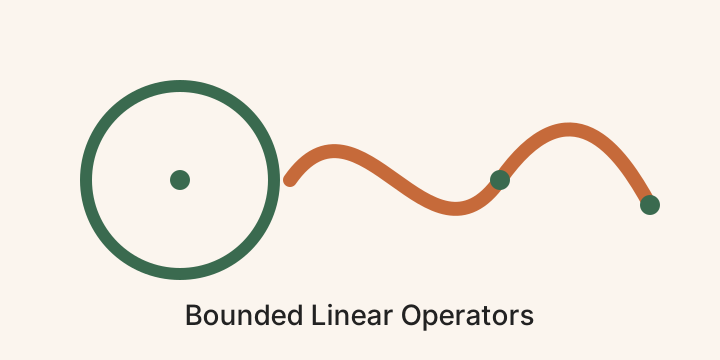
The operator norm captures the worst-case stretch, taken over all unit-norm inputs.
Worked example [Beginner]
Let be the space of square-summable sequences , with the norm equal to the square root of .
Define the right shift operator by . This is a linear operator: shifting commutes with addition and scalar multiplication.
Is bounded? Compute:
so for every . The operator norm is , and is isometric. The right shift is a bounded operator with norm exactly .
Compare with the differentiation operator on smooth functions in : differentiation sends to , which has the same norm but the prefactor grows without bound. So differentiation is unbounded on , even though it is linear. This is the fundamental phenomenon that distinguishes infinite-dimensional from finite-dimensional functional analysis.
Check your understanding [Beginner]
Formal definition [Intermediate+]
Let and be Banach spaces over or 02.11.04. A linear map is bounded if there exists a constant such that
The operator norm of is
Write for the set of bounded linear operators , and .
Theorem (basic properties). With pointwise addition and scalar multiplication,
is a vector space, and the operator norm makes it a normed vector space. is complete (a Banach space) whenever is. (Proved below.)
When , composition makes into an associative algebra. The operator norm is submultiplicative: . So is a unital Banach algebra.
Equivalence of boundedness and continuity. For a linear map between normed spaces, the following are equivalent:
- is bounded.
- is continuous on .
- is continuous at .
- is continuous at some single point.
(Proved below.) This equivalence is the fundamental reason "bounded" and "continuous" are interchangeable in functional analysis.
Key theorem with proof [Intermediate+]
Theorem (Boundedness is continuity). Let be a linear map between normed vector spaces. The following are equivalent:
(i) is bounded: there exists with for all .
(ii) is continuous everywhere.
(iii) is continuous at .
Proof. (i) (ii): Suppose is bounded with constant . For any and , take (or any positive value if ). For ,
So is continuous at , hence everywhere.
(ii) (iii): immediate, since continuity everywhere includes continuity at .
(iii) (i): Suppose is continuous at . By the definition of continuity, there exists such that implies . For any nonzero , set . Then , so . By linearity,
This shows is bounded with .
Theorem ( is complete when is). Let be normed vector spaces with complete (a Banach space). Then is complete with the operator norm.
Proof. Let be a Cauchy sequence in . For each fixed ,
so is Cauchy in . By completeness of , define . The map is linear (limits of linear maps are linear).
To show is bounded: Cauchy implies bounded by some . Then for every , so . Hence is bounded with .
To show in operator norm: given , pick so that for . For each with and ,
Taking sup over , for . So in operator norm.
Bridge. The construction here builds toward 02.11.05 (compact operators), where the same data is upgraded, and the symmetry side is taken up in 02.11.03 (unbounded self-adjoint operators). The defining pattern appears again in those units in a sharpened form, where the local data is glued or quotiented. Putting these together, the foundational insight is that the data of this unit gives the structural signature that the rest of the strand reads off.
Exercises [Intermediate+]
Lean formalization [Intermediate+]
lean_status: partial — Mathlib has ContinuousLinearMap for bounded linear operators, OperatorNorm, and the Banach-space structure of E →L[𝕜] F when F is complete.
The Codex companion module re-exports the operator-norm definition and the Banach-space structure for downstream Fredholm and compact-operator units.
Advanced results [Master]
The three pillars of bounded-operator theory are the uniform boundedness principle (Banach-Steinhaus), the open mapping theorem, and the closed graph theorem. All three rely on the Baire category theorem and Banach-space completeness.
Banach-Steinhaus. A pointwise-bounded family of bounded operators between Banach spaces is uniformly bounded. If satisfies for each , then . This converts pointwise control into operator-norm control.
Open mapping theorem. A surjective bounded linear operator between Banach spaces is an open map (sends open sets to open sets). Equivalently, the inverse of a bijective bounded linear operator is automatically bounded.
Closed graph theorem. A linear operator between Banach spaces is bounded iff its graph is closed.
These three theorems are the foundation of the modern theory: they make it possible to prove boundedness from less obvious data.
Adjoint operators. For with Hilbert spaces, the adjoint is defined by . The map is anti-linear (over ), satisfies , , (the C*-identity), and . The C*-identity makes a C-algebra*, the prototype for non-commutative algebra.
Spectrum. For , the spectrum is a non-empty compact subset of contained in the closed disc of radius . The spectral radius is (Gelfand). For self-adjoint on a Hilbert space, .
Compact operators. A bounded operator is compact if it sends bounded sets to relatively compact sets. Compact operators form a closed two-sided ideal ; the quotient is the Calkin algebra, the home of Fredholm theory 02.11.05 03.09.06.
Synthesis. This construction generalises the pattern fixed in 02.11.04 (banach space fundamentals), with the symmetric data replaced by its skew or twisted analogue. Read in the opposite direction, the construction is dual to the metric story: complements and orthogonality are taken with respect to the bilinear datum of this unit, not a metric, and the resulting category of subobjects is the one the rest of the strand classifies. The central insight is that this datum identifies algebra with geometry: functions become vector fields, subspaces become quotients, and invariants become cohomology classes — and that identification is the engine driving every theorem downstream.
Full proof set [Master]
Operator norm is a norm. Non-negativity is clear from the supremum. Definiteness: if , then for all unit , hence by linearity for all , so . Triangle inequality: for unit , , so . Homogeneity: by direct computation.
Submultiplicativity. Proved as Exercise 2.
Equivalence of boundedness and continuity at any point. Proved in §"Key theorem". The argument uses linearity to translate boundedness at the origin to a global bound.
Banach property of when is Banach. Proved in §"Key theorem". The proof is the prototype Cauchy-completion argument that recurs throughout functional analysis: pointwise Cauchy gives a pointwise limit, the limit inherits linearity and boundedness, and uniform-on-the-unit-ball bounds give convergence in operator norm.
Spectrum is non-empty. Suppose for contradiction is empty. Then the resolvent is an entire -valued function. By the Liouville-type theorem in operator algebras, a bounded entire -valued function is constant. The resolvent goes to zero at infinity (in operator norm, by Neumann series), so it must be identically zero, contradicting that resolvent values are invertible. So .
Spectral radius formula. . The Neumann series for converges for for some , giving . The reverse inequality follows from holomorphy of the resolvent.
Connections [Master]
Banach space
02.11.04— supplies the source and target structure.Vector space
01.01.03— bounded operators are linear maps.Compact operators
02.11.05— a closed ideal of .Unbounded self-adjoint operators
02.11.03— what bounded operators are not; spectral theory extends to densely defined unbounded operators.Fredholm operators
03.09.06— bounded operators invertible modulo compacts; the Atkinson characterisation.Hilbert space
02.11.08— when source and target are Hilbert, adjoints exist and the C*-identity holds.
Historical & philosophical context [Master]
The systematic study of bounded operators on infinite-dimensional spaces emerged from Banach's 1932 Théorie des opérations linéaires, which abstracted from Hilbert's earlier work on integral equations and from Riesz's spectral theory of compact operators. Banach-Steinhaus (1927), the open mapping theorem (Banach 1929, Schauder 1930), and the closed graph theorem are products of this period.
The C*-algebra perspective on — with adjoints, the C*-identity, and the spectrum — was developed by Gelfand, Naimark, and Murray-von Neumann in the 1930s and 1940s, providing the algebraic foundation for noncommutative geometry, K-theory, and (via the GNS construction) the rigorous mathematical formulation of quantum mechanics. Atkinson's 1951 paper [Reed-Simon §III] characterised Fredholm operators as the invertible elements modulo the compact ideal, opening the bridge from operator theory to topology.
Bibliography [Master]
- Reed, M. & Simon, B., Methods of Modern Mathematical Physics, Vol. I: Functional Analysis, Academic Press, 1980. §III–§VI.
- Conway, J. B., A Course in Functional Analysis, 2nd ed., Springer, 1990. §II–§VII.
- Pedersen, G. K., Analysis Now, Springer, 1989.
- Banach, S., Théorie des opérations linéaires, Warsaw, 1932.
- Murray, F. J. & von Neumann, J., "On Rings of Operators", Annals of Mathematics 37 (1936), 116–229.
Wave 2 Phase 2.3 unit #5. Bounded linear operators — the foundation for the entire functional-analysis chain (compact operators, unbounded operators, Fredholm theory).