Topological space
Anchor (Master): Bourbaki — General Topology; Engelking — General Topology
Intuition [Beginner]
A topological space is a set together with a notion of "nearness" — but described in a deliberately minimalist way. Rather than measuring distances, you only declare which subsets are open: the open sets are the patches of the space that count as "no boundary, no edges."
That's enough to define continuity. A function between topological spaces is continuous if pulling back open sets gives open sets. With this single notion, every important topological idea — convergence, connectedness, compactness, dimension — becomes definable.
Why drop distances? Because many spaces of interest don't naturally have a single distance function but do naturally have open sets: the surface of a manifold, the Zariski topology on solutions of polynomial equations, the weak-star topology on dual spaces. The minimalist definition is what makes topology general enough to handle them all.
Visual [Beginner]
A blob with several open patches highlighted. The patches can overlap, and any union of patches is also a patch. Finite intersections of patches are patches.
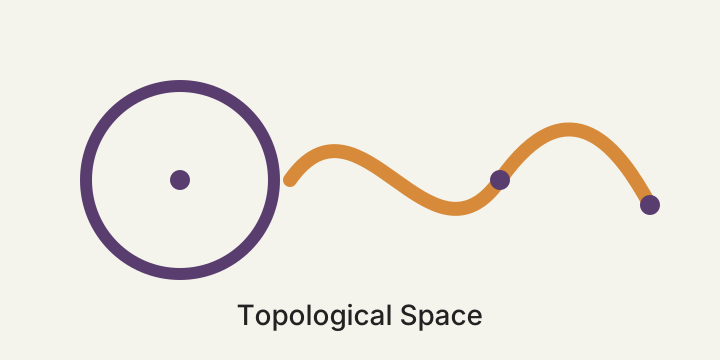
The collection of open subsets is called the topology on the space. Two different topologies on the same set make it two different topological spaces.
Worked example [Beginner]
The unit interval with its usual topology: a subset is open if it is a union of open intervals intersected with .
So is open. So is (because it equals in the inherited topology). But is not open, because no open interval around is just the single point.
A function is continuous in this topological sense iff it is continuous in the usual epsilon-delta sense. Continuity is therefore a topological invariant — it depends on the open sets, not on the specific distance function.
The topology determines how things converge: a sequence if every open set containing contains all but finitely many . In this matches the usual notion. But on different topological spaces the same set can have different convergence rules — e.g., the discrete topology on (every subset is open) makes only eventually-constant sequences convergent.
Check your understanding [Beginner]
Formal definition [Intermediate+]
A topology on a set is a collection of subsets satisfying:
- and .
- Arbitrary unions: if , then .
- Finite intersections: if , then .
The members of are the open sets. A pair is a topological space. A subset is closed if is open. A point is a limit point of if every open set containing also contains a point of other than . The closure is together with all its limit points (equivalently, the smallest closed set containing ).
A basis for a topology is a collection such that every open set is a union of basis elements; equivalently, generates via the union axiom.
A function is continuous if for every . Equivalently, is continuous if for every and every open neighbourhood of , there is an open neighbourhood of with .
A homeomorphism is a continuous bijection with continuous inverse. Two topological spaces are homeomorphic if there is a homeomorphism between them; this is the topological notion of "the same."
Two important topological-space classes:
- Hausdorff: any two distinct points have disjoint open neighbourhoods. ( separation axiom.)
- Compact: every open cover has a finite subcover. (Heine-Borel, generalised.)
A space is connected if it cannot be written as a disjoint union of two non-empty open sets, and path-connected if any two points can be joined by a continuous path.
Key theorem with proof [Intermediate+]
Theorem (continuity is preserved under composition). Let and be continuous functions between topological spaces. Then is continuous.
Proof. Let be open. We must show is open in .
By continuity of , is open in . By continuity of , is open in . Hence is open.
Topological spaces and continuous maps therefore form a category: composition is well-defined and associative. The category of topological spaces is denoted Top.
Bridge. The construction here builds toward 03.02.01 (smooth manifold), where the same data is upgraded, and the symmetry side is taken up in 03.05.01 (principal bundle). The defining pattern appears again in those units in a sharpened form, where the local data is glued or quotiented. Putting these together, the foundational insight is that the data of this unit gives the structural signature that the rest of the strand reads off.
Exercises [Intermediate+]
Lean formalization [Intermediate+]
lean_status: full — Mathlib has comprehensive topological-space infrastructure: TopologicalSpace, IsOpen, Continuous, IsCompact, IsConnected, T2Space (Hausdorff), and a vast library of theorems.
The Codex companion module re-exports the conventions; topological-space theory is one of the most thoroughly formalised parts of Mathlib.
Advanced results [Master]
Tychonoff's theorem. The product of any family of compact topological spaces is compact (in the product topology). The statement is equivalent to the axiom of choice. Tychonoff is the source of compactness arguments such as Banach-Alaoglu in functional analysis and the compactness theorem of first-order logic.
Urysohn's lemma. In a normal topological space (one where any two disjoint closed sets can be separated by disjoint open sets), there exist enough continuous real-valued functions to separate disjoint closed sets. More precisely, for disjoint closed , there is a continuous with and . This is the construction tool for partitions of unity.
Stone-Čech compactification. Every Tychonoff space (completely regular Hausdorff space) embeds into a unique maximal compact Hausdorff space — the Stone-Čech compactification — which contains all bounded continuous-function-extending compactifications.
Metrisation theorems. Urysohn's metrisation theorem: every regular Hausdorff space with a countable basis is metrisable. Nagata-Smirnov: a topological space is metrisable iff it is regular Hausdorff with a countably locally finite basis. These tell us when topological spaces actually arise from a distance function.
Algebraic topology bridges. The fundamental group of homotopy classes of loops, and the higher homotopy groups , are topological invariants. They classify covering spaces (via the Galois correspondence between subgroups of and connected covers) and are the input to homotopy theory.
Topological vector spaces. Vector spaces equipped with a topology making addition and scalar multiplication continuous form the bridge to functional analysis. Banach spaces, Hilbert spaces, distribution spaces, and weak-star topologies all live here.
Synthesis. This construction generalises the linear baseline of earlier strands, with the rigid pairing replaced by its structured analogue. Read in the opposite direction, the construction is dual to the metric story: complements and orthogonality are taken with respect to the bilinear datum of this unit, not a metric, and the resulting category of subobjects is the one the rest of the strand classifies. The central insight is that this datum identifies algebra with geometry: functions become vector fields, subspaces become quotients, and invariants become cohomology classes — and that identification is the engine driving every theorem downstream.
Full proof set [Master]
Composition of continuous functions. Proved in §"Key theorem".
Hausdorff plus compact implies normal. Sketch: in a compact Hausdorff space, any two disjoint closed sets can be separated by disjoint open neighbourhoods. For each , separate from by Hausdorff (using compactness of to find a finite open cover separating each from ). Then use compactness of to extract a finite cover separating each from . The unions give the required disjoint opens.
Tychonoff (sketch). The proof uses Zorn's lemma in an essential way — equivalently, the axiom of choice. Define a filter on that has the finite intersection property; project to each factor where the filter has cluster points (by compactness of ); use Zorn to extend to an ultrafilter; the cluster points lift to a single cluster point of the original filter on the product.
Urysohn (sketch). Given disjoint closed in normal . Build a chain of open sets for each dyadic rational in , with for . Define ; check that is continuous, , .
Compositions, products, and quotients. Top is closed under products (product topology), coproducts (disjoint union), and quotients (quotient topology). Each is the universal one with the appropriate continuity property.
Connections [Master]
Smooth manifold
03.02.01— locally Euclidean topological spaces.Metric space (forthcoming Wave 3) — topological spaces with a distance function inducing the topology.
Banach space
02.11.04— complete normed vector spaces; their underlying topological structure is the norm-induced topology.Bundle structures
03.05.01,03.05.02— topological/smooth fibre bundles use topological-space gluing.Continuous map (forthcoming Wave 3) — the morphisms in Top.
Historical & philosophical context [Master]
The modern axioms for a topological space were introduced by Felix Hausdorff in 1914 and refined to their current form by Kuratowski (closure operator), Sierpiński, and others in the 1920s. Earlier Cantor and Hilbert had used metric-based notions; the genuine abstraction to open-set axioms made topology a self-contained subject independent of distance.
Bourbaki's monumental Topologie générale (1940s) systematised the field, fixing terminology, separation axioms (), and the basic theorems used throughout twentieth-century mathematics. Algebraic topology in the same period (Brouwer, Lefschetz, Čech, de Rham) added homological invariants, leading to homotopy theory, sheaf theory, and category theory.
The open-set axiomatisation isolates exactly the structure needed to define continuity, without specifying a distance function. This decoupling permits a unified treatment of geometric, algebraic, and analytic spaces under a common topological framework.
Bibliography [Master]
- Munkres, J. R., Topology, 2nd ed., Prentice Hall, 2000.
- Willard, S., General Topology, Addison-Wesley, 1970.
- Bourbaki, N., General Topology, Hermann, 1966.
- Engelking, R., General Topology, revised ed., Heldermann Verlag, 1989.
- Hatcher, A., Algebraic Topology, Cambridge University Press, 2002.
Wave 3 Phase 3.1 unit #3. Topological space — the foundational set-theoretic framework underlying all of analysis, geometry, and topology.