Principal bundle
Anchor (Master): Kobayashi-Nomizu Vol. I §I.5; Steenrod §8; Husemoller §4
Intuition [Beginner]
A principal bundle is a systematic way to attach a copy of a symmetry group to every point of a space. Near any small patch, it looks like the patch times the group. Across larger regions, those copies may be glued together with twists.
The group does not act like extra coordinates chosen by hand. It records how frames, gauges, or internal labels can be changed without changing the base point. This is why principal bundles are the natural home for gauge theory and spin geometry.
Think of a principal bundle as a moving collection of identical dials, one above each point, where rotating a dial means applying the group.
Visual [Beginner]
The blue shape is the base space. Above each point is a copy of the same group-shaped fiber. Inside the purple window, the picture looks like a product.
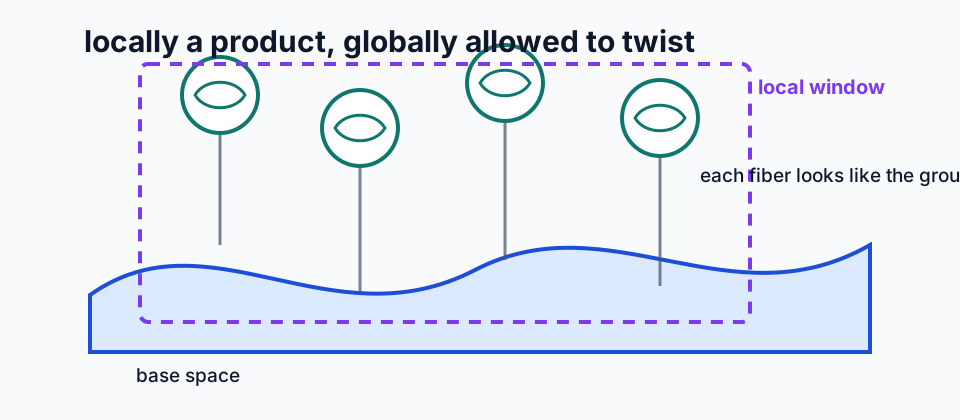
The local product view is reliable on small patches. The global bundle may still twist when patches are glued.
Worked example [Beginner]
On a circle, imagine attaching a tiny clock face above each point. Rotating the clock hand is the action of the circle group.
If all clock faces can be lined up around the full circle with no mismatch, the bundle is globally a product. If the local lineups require different phase choices on overlapping arcs, the same local picture can encode global twisting.
For a first concrete model, take every point of a base space and attach the same group with no twisting. The total space is just "base point plus group element."
What this tells us: a principal bundle is locally a product with a group, but its gluing data carries geometry.
Check your understanding [Beginner]
Formal definition [Intermediate+]
Let be a Lie group and let be a smooth manifold. A principal right -bundle over is a smooth surjective map
together with a smooth right action
such that:
- for all and .
- The action is free: implies .
- Every point of has an open neighborhood and a -equivariant diffeomorphism
over , where acts on by right multiplication in the second factor.
The group is the structure group. The fiber over is [Kobayashi-Nomizu §I.5].
The product example is with and right action . Principal bundles are classified locally by transition functions
that satisfy a cocycle condition on triple overlaps.
Key theorem with proof [Intermediate+]
Theorem (fibers are -torsors). If is a principal right -bundle, then each fiber is a free and transitive right -set.
Proof. Freeness is part of the definition: if for some , then .
For transitivity, choose . Take a principal-bundle chart over a neighborhood of ,
Write
with . Since is -equivariant,
Injectivity of gives . Thus the action is transitive on .
Bridge. The construction here builds toward 03.05.02 (vector bundle), where the same data is upgraded, and the symmetry side is taken up in 03.05.07 (principal bundle with connection). The defining pattern appears again in those units in a sharpened form, where the local data is glued or quotiented. Putting these together, the foundational insight is that the data of this unit gives the structural signature that the rest of the strand reads off.
Exercises [Intermediate+]
Lean formalization [Intermediate+]
lean_status: none — the principal-bundle structure used in differential geometry is not yet available as a mature Mathlib API.
A useful formalization would combine Lie groups, smooth fiber bundles, local trivializations, torsor fibers, transition cocycles, associated bundles, and gauge transformations.
Advanced results [Master]
Principal bundles can be described by transition functions. Given an open cover of , a principal -bundle determines maps
with , , and on triple overlaps. Conversely, such data glues the product bundles into a principal bundle [Steenrod §8].
If is a left action on a manifold or vector space , the associated bundle is
This construction turns principal-bundle data into vector bundles, frame bundles, tensor bundles, and spinor bundles.
A reduction of structure group from to a subgroup is a principal -subbundle whose extension recovers . Orientations, Riemannian metrics, and spin structures are naturally phrased as reductions or lifts of frame bundles.
Synthesis. This construction generalises the pattern fixed in 03.02.01 (smooth manifold), with the symmetric data replaced by its skew or twisted analogue. Read in the opposite direction, the construction is dual to the metric story: complements and orthogonality are taken with respect to the bilinear datum of this unit, not a metric, and the resulting category of subobjects is the one the rest of the strand classifies. The central insight is that this datum identifies algebra with geometry: functions become vector fields, subspaces become quotients, and invariants become cohomology classes — and that identification is the engine driving every theorem downstream.
Full proof set [Master]
Transition functions from local sections. Let be local sections. On , the torsor property gives a unique with
Smoothness follows from smooth local product charts. The identities and follow from uniqueness. The cocycle identity follows from
and uniqueness again.
Gluing from a cocycle. Start with the disjoint union of and impose
on overlaps. The cocycle identity is exactly the transitivity condition for this equivalence relation. The quotient maps to , has local charts induced by the pieces , and carries the right action .
Associated bundle local form. Over a local product chart , the associated bundle is identified with by . The quotient relation makes this independent of the representative. Thus associated bundles are locally product bundles with fiber .
Connections [Master]
Vector bundle
03.05.02— many vector bundles arise as associated bundles to principal frame bundles.Connection on a principal bundle
03.05.07— a connection is additional differential data on a principal bundle.Spin structure
03.09.04— a spin structure is a lift of an orthonormal frame principal bundle.Chern-Weil homomorphism
03.06.06— characteristic forms are built from connections on principal bundles.Yang-Mills action
03.07.05— gauge fields are connections on principal bundles, and gauge transformations are principal-bundle automorphisms.
Historical & philosophical context [Master]
The language of fiber bundles was shaped by Steenrod's 1951 monograph, where coordinate bundles and principal bundles organized transition functions and structure groups in topology [Steenrod §8]. Kobayashi and Nomizu made principal bundles central to differential geometry by treating connections, curvature, and reductions of structure group in a uniform framework [Kobayashi-Nomizu §I.5].
Gauge theory later adopted the same structure: the principal bundle records the internal symmetry, a connection records parallel comparison, and curvature records field strength. This geometric interpretation is the common source of Yang-Mills theory, Chern-Weil theory, and spin geometry.
Bibliography [Master]
- Kobayashi, S. & Nomizu, K., Foundations of Differential Geometry, Vol. I, Wiley, 1963. §I.5.
- Steenrod, N., The Topology of Fibre Bundles, Princeton University Press, 1951. §8.
- Husemoller, D., Fibre Bundles, Springer, 3rd ed., 1994. §4.
- Ehresmann, C., "Les connexions infinitésimales dans un espace fibré différentiable", Colloque de topologie, Bruxelles, 1950.
Wave 2 Phase 2.1 unit #2. Produced as the principal-bundle prerequisite for spin structures, Chern-Weil theory, and Yang-Mills theory.