Smooth manifold
Anchor (Master): Lee — Introduction to Smooth Manifolds; Warner — Foundations of Differentiable Manifolds and Lie Groups; Bourbaki — Variétés différentielles et analytiques
Intuition [Beginner]
A smooth manifold is a space that locally looks like ordinary -dimensional Euclidean space, but might fold or twist or close up in interesting ways globally.
The classic examples: a circle is a 1-manifold (locally a line), a sphere is a 2-manifold (locally a flat plane), a torus is also a 2-manifold (locally flat). Each looks like flat space near every point, but they have different global shapes.
The key idea is local linearity. You can do calculus in any tiny region of a manifold by using local coordinates that match Euclidean space. The challenge — and the genuine content of differential geometry — is that the local coordinates differ from region to region, and you need rules for translating between them. A smooth manifold is the data of "patch together Euclidean pieces" plus the rule "the patches agree smoothly where they overlap."
Why care? Because the universe of mathematical objects you'd want to do calculus on — surfaces in space, configuration spaces of mechanical systems, solution spaces of equations, abstract symmetry groups, spacetime in general relativity — almost all are smooth manifolds. Smooth manifolds are the setting in which calculus generalises to curved spaces.
Visual [Beginner]
A blob with several patches, each labelled with coordinate maps. Where two patches overlap, the transition rule is smooth.
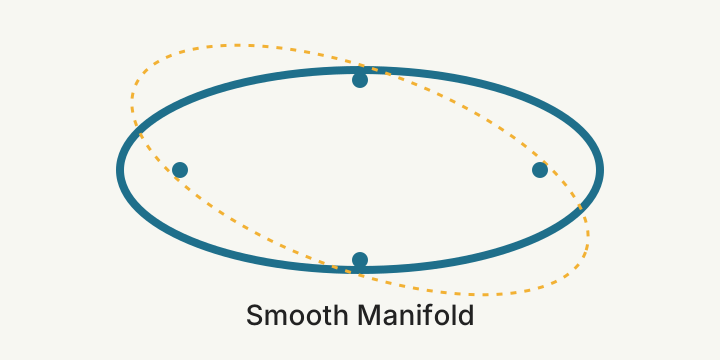
The picture is the manifold itself; the patches are the charts; the overlap rules are the transition functions. The whole structure is what we call the atlas.
Worked example [Beginner]
The unit sphere is a 2-dimensional smooth manifold. Here's why.
Cover the sphere with two patches: and . Use stereographic projection from the north pole to send onto (project each point through the north pole onto the plane ), and stereographic projection from the south pole to send onto .
Each projection gives a 2-dimensional coordinate system on its patch. The two patches together cover the whole sphere. On the overlap (the sphere minus both poles), the two coordinate systems are related by a smooth map — explicitly, in the standard normalisation. So the transition function is smooth, and is a smooth 2-manifold.
This is the prototype for every smooth manifold. We don't need an embedding into for the structure to make sense: the manifold is defined by its atlas, and an embedding (when one exists) is extra geometric data on top of that.
Check your understanding [Beginner]
Formal definition [Intermediate+]
A topological manifold of dimension is a topological space that is:
- Hausdorff (distinct points have disjoint neighbourhoods);
- Second countable (has a countable basis for the topology);
- Locally Euclidean of dimension : every point has an open neighbourhood together with a homeomorphism onto an open subset .
The pair is a chart at , and is the chart's coordinate map. A collection of charts whose domains cover is an atlas.
A topological manifold becomes a smooth manifold when its atlas has smooth transition functions: for any two charts and with , the transition function
is a smooth (i.e., ) map between open subsets of . An atlas with smooth transitions is a smooth atlas, and two smooth atlases are equivalent if their union is also a smooth atlas. A smooth structure on a topological manifold is an equivalence class of smooth atlases (equivalently, a maximal smooth atlas).
A smooth manifold is a topological manifold equipped with a smooth structure. We write .
A map between smooth manifolds is smooth if its expression in any pair of charts is smooth: for any chart of at and chart of at , the composition is smooth on its domain. A bijective smooth map with smooth inverse is a diffeomorphism.
Key theorem with proof [Intermediate+]
Theorem (smooth structure determined by maximal atlas). Two smooth atlases on a topological manifold define the same smooth structure if and only if their union is itself a smooth atlas. Equivalently, every smooth structure has a unique maximal smooth atlas (the union of all compatible smooth atlases).
Proof. Define an equivalence relation on smooth atlases: iff is itself a smooth atlas. Reflexivity is clear; symmetry is by definition. For transitivity, suppose and . We show is a smooth atlas.
Take charts and with non-empty overlap. Pick any chart at a point of . Since and are smooth atlases, the transitions and are smooth where defined. Compose:
a composition of smooth maps, hence smooth. So is smooth.
Now: every smooth atlas extends to a unique maximal smooth atlas, namely . By the equivalence-relation argument just shown, this is itself a smooth atlas, and it is maximal: any compatible chart already lies in it. Two atlases generate the same smooth structure iff they have the same maximal extension.
The theorem is structural plumbing: it says smooth structures are the natural equivalence classes of atlases, and every smooth manifold has a canonical "biggest" atlas containing all the charts you'd ever want. In practice we work with whatever atlas is convenient.
Bridge. The construction here builds toward 03.05.01 (principal bundle), where the same data is upgraded, and the symmetry side is taken up in 03.05.02 (vector bundle). The defining pattern appears again in those units in a sharpened form, where the local data is glued or quotiented. Putting these together, the foundational insight is that the data of this unit gives the structural signature that the rest of the strand reads off.
Exercises [Intermediate+]
Lean formalization [Intermediate+]
lean_status: partial — Mathlib has SmoothManifoldWithCorners and ChartedSpace with full support for smooth maps, tangent bundles, smooth fields. The Codex companion module wraps this for downstream uses.
Mathlib's ModelWithCorners allows manifolds with boundary or corners; the boundary-less case is the special instance with corners removed. The companion module re-exports the conventions.
Advanced results [Master]
Whitney embedding theorem. Every smooth -manifold embeds smoothly into (strong version) or (weak version). The proof uses transversality arguments and partitions of unity. Consequence: every abstract smooth manifold can in principle be realised as a smooth submanifold of Euclidean space, but the abstract definition is preferred for theoretical work.
Sard's theorem. For a smooth map between smooth manifolds, the set of critical values (images of points where is not surjective) has measure zero in . This is the key technical input for transversality theorems and Morse theory.
Partitions of unity. A smooth manifold admits partitions of unity subordinate to any open cover: smooth functions with pointwise, , locally finite. This is the foundational tool for gluing local constructions into global ones — it underlies the existence of Riemannian metrics, connections, integration, and almost every "construct a global object" theorem in differential geometry.
Tangent and cotangent bundles. has a canonical smooth manifold structure of dimension . Cotangent bundle similarly. These are the source spaces for differential forms () and vector fields ().
Exotic smooth structures. A topological manifold can carry multiple inequivalent smooth structures. In dimensions , smooth structures are unique (Moise). In dimension 4, admits an uncountable family of exotic smooth structures (Donaldson 1983, Freedman 1982). In dimensions , there are finitely many smooth structures on a fixed topological manifold (computable via surgery theory; Kirby-Siebenmann).
Manifolds with boundary and corners. The theory generalises to spaces locally modelled on (manifolds with boundary) or on quadrant-corners (manifolds with corners). Stokes's theorem and integration theory require this generalisation.
Synthesis. This construction generalises the pattern fixed in 01.01.03 (vector space), with the symmetric data replaced by its skew or twisted analogue. Read in the opposite direction, the construction is dual to the metric story: complements and orthogonality are taken with respect to the bilinear datum of this unit, not a metric, and the resulting category of subobjects is the one the rest of the strand classifies. The central insight is that this datum identifies algebra with geometry: functions become vector fields, subspaces become quotients, and invariants become cohomology classes — and that identification is the engine driving every theorem downstream.
Full proof set [Master]
Maximal-atlas theorem. Proved in §"Key theorem".
Existence of partitions of unity. Sketch: any smooth manifold is paracompact (locally compact Hausdorff plus second countable). For an open cover , pick a locally finite refinement with . Construct smooth bump functions supported in with on . Then is a partition of unity subordinate to , refinable to one subordinate to . The crucial existence ingredient is the smooth bump function on , for and zero otherwise — the prototype -but-not-analytic function.
Sard's theorem (sketch). Use induction on dimension. Reduce to the case smooth. Stratify the critical set by the rank of , and bound the measure of applied to each stratum using a Taylor-expansion + Vitali-covering argument. The full proof is technical (Lee Ch. 6); the key point is that smoothness gives just enough control to make the inductive argument close.
Tangent bundle smooth structure. is locally isomorphic to via the chart . Transition functions between two such charts on overlaps are , a smooth map (since is smooth and the Jacobian is too). So is smooth of dimension .
Whitney (sketch). First embed into a high-dimensional via a partition of unity (locally embed each chart, then glue). Then prove that the set of "bad" projections from to — those that fail to be embeddings — has lower dimension, hence misses some projections by Sard. Iterate to bring the codomain down to (weak) or (strong, requiring extra transversality).
Connections [Master]
Vector space
01.01.03— fibres of tangent bundles, models for local coordinate spaces.Principal bundle
03.05.01— fibre bundles whose total spaces and bases are smooth manifolds.Vector bundle
03.05.02— vector bundles over smooth manifolds.De Rham cohomology
03.04.06— built from differential forms on smooth manifolds.Integration on manifolds
03.04.03— integral of differential forms over orientable smooth manifolds.Differential operators
03.09.07,03.09.09— the analytic objects on smooth manifolds whose ellipticity and index theory underwrite Atiyah-Singer.Yang-Mills, Chern-Weil, spin structure — all live on smooth manifolds.
Historical & philosophical context [Master]
The notion of a smooth manifold crystallised through the work of Riemann (1854), who introduced the concept of a "Mannigfaltigkeit" (manifold) in his habilitation lecture, and Poincaré (1895), whose Analysis Situs gave the first systematic treatment of higher-dimensional manifolds. Veblen and Whitehead's 1932 monograph fixed the modern definition (Hausdorff, second countable, smooth atlas), and Whitney's embedding theorem (1936, 1944) established smooth manifolds as nothing more or less than smooth submanifolds of Euclidean space.
The 1950s–1970s programme of differential topology — Milnor's exotic 7-spheres (1956), Smale's -cobordism theorem (1962), Kirby-Siebenmann triangulation theory (1969) — established that the smooth, piecewise-linear, and topological categories of manifolds genuinely differ in dimensions . Donaldson's 1983 theorem and Freedman's 1982 classification then revealed dimension 4 as exceptionally rich, with uncountably many smooth s.
In physics, smooth manifolds are spacetime in general relativity, configuration space in classical mechanics, target spaces in field theory, and the underlying geometry of every gauge theory and string-theoretic construction. The smoothness assumption is what allows differential equations of motion to be written.
Bibliography [Master]
- Lee, J. M., Introduction to Smooth Manifolds, 2nd ed., Springer GTM 218, 2013.
- Spivak, M., A Comprehensive Introduction to Differential Geometry, Vol. I, Publish or Perish, 1979.
- Warner, F. W., Foundations of Differentiable Manifolds and Lie Groups, Springer GTM 94, 1983.
- Milnor, J., Topology from the Differentiable Viewpoint, Princeton University Press, 1965.
- Bourbaki, N., Variétés différentielles et analytiques, Hermann.
Wave 3 Phase 3.1 unit #1. Smooth manifold — the foundational geometric object underlying every unit in the modern-geometry section. Highest-leverage Wave 3 unit (10+ downstream Wave 1+2 units depend on it).