Fibration (Hurewicz and Serre)
Anchor (Master): Hurewicz 1955; Serre 1951 (originator papers); May Ch. 7--9; tom Dieck §5; Bott-Tu §17
Intuition [Beginner]
A fibration is a continuous map from a "total space" to a "base" that locally looks like a product — every point of has a neighbourhood whose preimage in splits as that neighbourhood times a fixed fibre . The Möbius band fibres over the circle (with fibre an interval); a torus fibres over the circle (with fibre another circle); a covering space is a fibration with discrete fibre.
The defining technical condition is the homotopy lifting property: if you have a homotopy in the base and a lift of its starting position to , you can lift the entire homotopy to continuously. Picturesquely: a path in the base, given a starting point in the fibre over its starting endpoint, lifts to a path in the total space ending in the fibre over the path's endpoint.
Fibrations are the engine of computational algebraic topology. The long exact sequence of a fibration
splits the homotopy groups of into pieces from the fibre and the base, letting you compute one when you know the other two. The Leray-Serre spectral sequence does the same job for cohomology and is the standard tool for computing cohomology of fibre bundles, classifying spaces, and Eilenberg-MacLane spaces.
Visual [Beginner]
A cylinder projecting to . Each vertical line in the cylinder is a fibre; the projection is the fibration map. A path on the circle lifts to a path on the cylinder once you pick a starting fibre point.
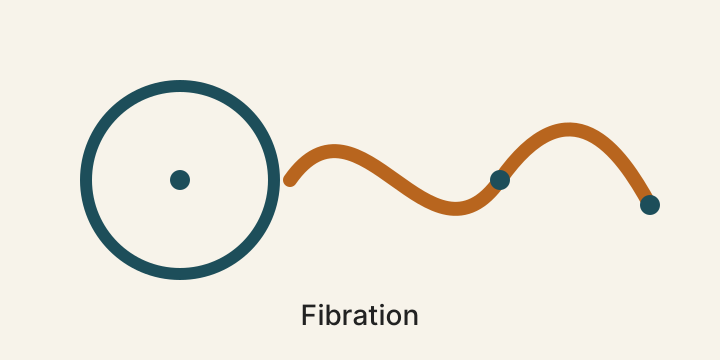
The Möbius band, viewed as a fibration over the circle, is the same picture but with the fibre flipped halfway around — a twist obstructing the global product structure.
Worked example [Beginner]
The map defined by viewing and quotienting by the diagonal action is the Hopf fibration. Each fibre is a circle (the orbit of one point under the action), so for every .
This is a fibration in the strongest sense — a fibre bundle, locally-product — but not globally a product. The long exact sequence gives
and reading off entries computes , generated by the Hopf map itself. The fact that is nonzero (loops on the 2-sphere can be linked nontrivially) was Hopf's discovery in 1931 and the first hint that higher homotopy groups are not what naïve intuition expects.
Check your understanding [Beginner]
Formal definition [Intermediate+]
Let be a continuous map of topological spaces.
Definition (homotopy lifting property, HLP). has the homotopy lifting property with respect to a space if for every continuous map and every homotopy with , there exists a homotopy with and .
Definition (Hurewicz fibration). is a Hurewicz fibration if it has the HLP with respect to every topological space .
Definition (Serre fibration). is a Serre fibration if it has the HLP with respect to every CW complex (equivalently, with respect to every disc ).
Every Hurewicz fibration is a Serre fibration; the converse fails in general.
Standard examples.
- Covering map. If is a covering map, is a Hurewicz fibration with discrete fibre. The HLP reduces to the unique path-lifting property.
- Fibre bundle. A locally-product fibre bundle over a paracompact base is a Hurewicz fibration (Hurewicz 1955).
- Path-space fibration. For any pointed space , the evaluation map , , where is the path space, is a Hurewicz fibration with fibre the loop space .
The fibre of over is . For a fibration over a path-connected base, all fibres are homotopy equivalent.
Key theorem with proof [Intermediate+]
Theorem (long exact sequence of a Serre fibration). Let be a Serre fibration with path-connected and a chosen base point , . Then there is a long exact sequence
ending at (the last few terms are sets / pointed sets, not groups).
Proof (sketch). The connecting map is constructed as follows. A class in is represented by a map sending the boundary to . View this as a homotopy from the constant map to itself (parameterised over via radial coordinates). The constant map lifts to the constant map . Apply the homotopy lifting property to lift the homotopy to . Restricting to gives a map (since is the constant map at ), and .
Independence of representative uses the HLP applied to homotopies between representatives. Exactness at each position is verified by a similar lifting argument.
Bridge. The long exact sequence builds toward 03.13.02 (Leray-Serre spectral sequence), which is the cohomological analogue applied to a more refined invariant: where the long exact sequence relates , , in a strict triangle, the spectral sequence relates to through a filtered family of differentials. The same machinery appears again in 03.12.02 (covering space), where covering maps are discrete-fibre fibrations and the HLP reduces to the elementary unique-path-lifting theorem. Putting these together, fibrations are exactly the maps for which "the fibre, the total space, and the base each see the others through a controlled algebraic device" — long exact sequences for homotopy, spectral sequences for cohomology, transfer maps for K-theory.
Exercises [Intermediate+]
Advanced results [Master]
The HLP-based definition of fibration is the modern descendant of Serre's 1951 reformulation of the fibre-bundle theory of Steenrod and Whitney. The key fact making the theory algebraically powerful is that fibrations behave like exact triangles in homotopy theory: the long exact sequence of homotopy groups, the Leray-Serre spectral sequence in cohomology, the Atiyah-Hirzebruch spectral sequence in K-theory, and the descent spectral sequences in motivic / equivariant settings are all instances of the same pattern.
Theorem (Hurewicz 1955). Every locally-product fibre bundle over a paracompact base is a Hurewicz fibration.
Theorem (Serre 1951, Leray-Serre spectral sequence). Let be a Serre fibration with path-connected and simply-connected, path-connected. There is a first-quadrant spectral sequence with -page
converging to $H^(E)$ as a filtered ring.*
The simple-connectedness of is required to make the local coefficient system a constant system; for general , the spectral sequence has with the local system determined by the -action on .
Theorem (fibration replacement). Every continuous map factors as where is a homotopy equivalence and is a Hurewicz fibration.
Construction. Let . The inclusion via is a homotopy equivalence, and , , is a Hurewicz fibration. The mapping cylinder is the dual replacement (cofibration replacement); the homotopy theory of is governed by the interplay of these two factorisations.
Synthesis. Fibrations generalise covering spaces in two ways at once: the discrete fibre is replaced by an arbitrary topological space, and the unique path-lifting is replaced by the homotopy lifting property. The central insight that makes the theory work is exactly the long exact sequence: every fibration gives a controlled algebraic device for relating , , , and that device is dual to the cofibre sequence of mapping cones in the Eckmann-Hilton sense — fibrations and cofibrations are the two halves of the model-category structure on . The Leray-Serre spectral sequence is the foundational reason Serre fibrations are computable: it identifies with up to a filtered extension, and putting this together with the Hopf-fibration computation of is the bridge between geometry and algebra that defines algebraic topology as a discipline.
Full proof set [Master]
Proposition. Every covering map is a Hurewicz fibration.
Proof. Given and with , define by unique path-lifting at each point of : for fixed , the path lifts uniquely to a path in starting at . Continuity of the assembled uses the local-product structure of together with continuity of .
Proposition (HLP for implies HLP for any CW pair). A map that has the HLP for for all has the HLP for every relative CW pair.
Proof. Induct on the cells of the relative CW structure. The base case is clear. For the inductive step, the attachment of an -cell along extends uniquely to by the HLP for . This is the formal content of the equivalence between "HLP for discs" and "Serre fibration."
Theorem (long exact sequence, key steps). The maps $i_p_*\partial\ker p_* = \mathrm{im}, i_*\pi_n(E)\ker \partial = \mathrm{im}, p_*\pi_n(B)\ker i_* = \mathrm{im}, \partial\pi_{n-1}(F)$.*
Proof (sketch of one identification). Exactness at , . Suppose has . Then the boundary lift is null-homotopic. Extend the null-homotopy using the HLP to a lift over ; the resulting represents an element of projecting to . The reverse inclusion is by direct check: since has constant boundary.
Connections [Master]
Covering space
03.12.02. Covering maps are exactly fibrations with discrete fibre. The unique path-lifting theorem is the special case of the HLP for a point and a path; the Galois correspondence becomes the special case of the long exact sequence terminating at .Leray-Serre spectral sequence
03.13.02. The cohomological analogue of the long exact sequence for fibrations. converges to .Quotient and identification topology
02.01.06. Fibrations interact with quotients via the mapping-cylinder and adjunction-space constructions: every map factors through a fibration via the path-space replacement, and dually through a cofibration via the mapping cylinder.Eilenberg-MacLane space
03.12.05. The Postnikov tower of any space is a sequence of fibrations — the basic computational scaffold for algebraic topology. The classifying-space construction is the base of the path-space fibration over .Classifying space
03.08.04. Principal -bundles correspond to homotopy classes , and the universal bundle is the prototypical fibration with discrete-quotient classifying space.
Historical & philosophical context [Master]
The theory of fibre bundles took shape in the 1930s-40s through the work of Whitney, Steenrod, Stiefel, and others — The Topology of Fibre Bundles (Steenrod, 1951) [Steenrod 1951] is the canonical source. Witold Hurewicz's 1955 paper On the concept of fibre space (Proc. Nat. Acad. Sci. 41) [Hurewicz 1955] introduced the homotopy lifting property as the right axiom for fibre-spaces in algebraic topology, decoupling the theory from the local-triviality machinery of Steenrod and making it possible to fibre-replace arbitrary maps.
Jean-Pierre Serre's 1951 thesis Homologie singulière des espaces fibrés (Ann. of Math. 54) [Serre 1951] introduced the relaxed condition (HLP for CW pairs only) that bears his name and proved the spectral sequence that revolutionised the calculation of homotopy and cohomology groups. Serre's calculations of homotopy groups of spheres via the Postnikov tower of -spaces was the first systematic computation in higher homotopy theory and earned him the Fields Medal in 1954.
The further programme — replacing fibre bundles by their homotopy-theoretic shadows, identifying them with classifying maps to , and extending the spectral sequence machinery to generalised cohomology theories — was developed by Atiyah-Hirzebruch, Adams, and others through the 1960s. The modern -categorical framing identifies (Kan-) fibrations of simplicial sets / spaces with fibrations in a model structure, and the long exact sequence is the homotopy-fibre-sequence statement in any pointed -category.