Quotient and identification topology
Anchor (Master): Brown §4; tom Dieck §1.5; Strickland *Topology and Groupoids* class notes
Intuition [Beginner]
A quotient topology is what you get when you collapse parts of a space according to an equivalence relation: glue points together, and ask which subsets count as open in the result. The rule is the natural one — a set in the quotient is open exactly when its preimage in the original space is open.
This single construction packages a huge family of basic operations:
- Cone — collapse one end of to a point. Every space embeds in its cone, and the cone is contractible.
- Suspension — collapse both ends. The suspension of is .
- Mapping cylinder of — glue one end of to via . deformation-retracts onto and replaces by a cofibration.
- Mapping cone — quotient by collapsing the other end. The reduced version is in homotopy theory.
- Adjunction space — glue to along a map from a subspace . CW skeleta are built by iterated adjunction.
Brown's textbook treats all of these uniformly through the universal property of the quotient: a continuous map out of a quotient space is the same data as a continuous map out of the original space that is constant on equivalence classes.
Visual [Beginner]
A square gets its top edge collapsed to a single point: the result is a triangle, and the topology on the triangle is the one in which open sets are exactly the images of open sets in the square that respect the collapse.
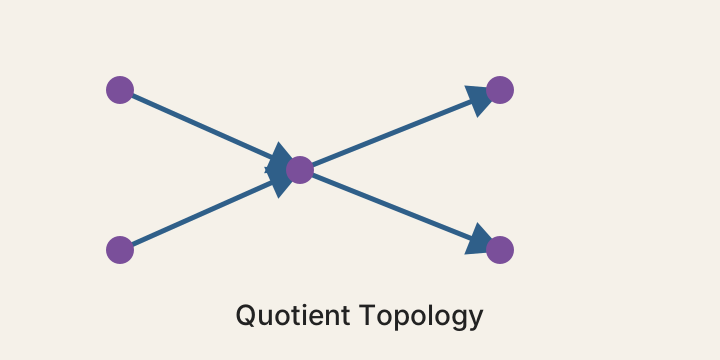
The same picture, with both top and bottom edges collapsed, is the suspension of the horizontal interval.
Worked example [Beginner]
Take the closed interval and identify . The quotient is the circle .
To see this is the correct topology on the circle, check the universal property: a continuous map is the same data as a continuous map with . Trace through this with and — the closed-curve condition is exactly the constraint that says you've drawn a loop, and the universal property turns it into a continuous map of the circle.
Check your understanding [Beginner]
Formal definition [Intermediate+]
Let be a topological space and an equivalence relation on . Let be the projection map. The quotient topology on is the collection of subsets such that is open in .
Equivalent reformulation in terms of an arbitrary surjection: given any surjection of sets with a topological space, the identification topology on is . The pair is called the identification space and is then automatically a quotient map.
Universal property. For any topological space and continuous map that is constant on equivalence classes (equivalently, factors set-theoretically through ), there is a unique continuous map with .
This is the defining property: quotient spaces are the spaces representing the functor .
A quotient map need not be open or closed in general; what's preserved is the universal property and continuity in the "minimal" direction.
Key theorem with proof [Intermediate+]
Theorem (universal property of the quotient topology). Let be a surjection equipped with the identification topology. For any topological space and any function , the composition is continuous if and only if is continuous.
Proof. (). Suppose is continuous and let be open. Then is open in . By definition of the identification topology, is open in . Hence is continuous.
(). If is continuous, is a composition of continuous maps and is continuous.
Corollary. Two surjections and inducing the same partition of give the same identification topology on .
Bridge. This universal-property packaging builds toward 03.12.01 (homotopy and homotopy group), where every standard construction — cone, suspension, mapping cone, mapping cylinder, smash product, adjunction — is exactly a quotient and the universal property is the foundational reason continuous-map computations in algebraic topology lift cleanly to homotopy classes. The same construction appears again in 03.12.02 (covering space), where the orbit space of a properly discontinuous action of a discrete group is the basic source of covering spaces. Putting these together, identification topology is the bridge between point-set topology and the world of CW complexes — every CW complex is built by iterated quotients of disjoint unions of discs, and the universal property generalises to the cellular pushout that defines a CW structure.
Exercises [Intermediate+]
Advanced results [Master]
The identification topology is the unique topology on making continuous and satisfying the universal property — and the universal property is what packages a long list of constructions in algebraic topology.
Cellular constructions. A CW complex is built by iterated adjunction: along the attaching maps . Each step is an adjunction space; each cell-attachment changes the homotopy type in a controlled way, and the universal property of the quotient gives a clean cellular pushout in :
The corresponding statement after passing to fundamental group / fundamental groupoid is exactly the cellular form of Seifert-van Kampen 03.12.09 — the pushout of groupoids matches the pushout of spaces.
Smash and wedge products. The wedge sum identifies basepoints. The smash product is
where embeds via the basepoints. Smash gives the symmetric monoidal structure on pointed spaces underlying spectra and stable homotopy [03.12.04, 03.12.06].
Mapping cone and cofibre sequence. The reduced mapping cone fits into the canonical cofibre sequence
This is the long exact sequence in (co)homology after applying any cohomology theory; it is the homotopy-theoretic analogue of an exact triangle.
Quotient by group action. Given a group acting continuously on , the orbit space carries the identification topology. The action is properly discontinuous if every has a neighbourhood with for all ; in that case is a covering map and the action is the most basic source of covering spaces 03.12.02.
Synthesis. Quotient topology generalises the elementary "glue some points together" intuition to a categorical statement: it is exactly the colimit of the equivalence relation in , and the universal property is the foundational reason it can be reasoned about without coordinates. Read in the opposite direction, the identification topology is dual to the subspace topology — where subspace is the limit () along an inclusion, quotient is the colimit () along a surjection. The central insight that organises the entire CW-complex programme is exactly this: building a complicated space by iterated quotient operations identifies algebra with geometry — generators correspond to cells, relations to attaching maps, and the cellular chain complex is exactly the algebraic shadow of the cellular pushout.
Full proof set [Master]
Proposition. The identification topology is the largest topology on for which is continuous.
Proof. Suppose is any topology on making continuous. For , is open in , so is open in the identification topology. Hence is contained in the identification topology.
Proposition. Let be a quotient map (surjection equipped with the identification topology). Composition with defines a bijection between continuous maps and continuous maps that are constant on -fibres.
Proof. The forward direction sends to , which is continuous (composition) and constant on -fibres ( is surjective, so -fibres are non-empty). The inverse sends to its set-theoretic factorisation through ; continuity of follows from the universal property. The two maps are inverse on the nose.
Proposition. A quotient of a Hausdorff space need not be Hausdorff.
Proof. Take with the relation iff or (identify only with ). Then is Hausdorff (the equivalence classes are closed). But take with the relation that identifies the two zero points and only those: the quotient is the "line with two origins", a non-Hausdorff manifold-like object. The two zero points cannot be separated.
Theorem (compactness preservation). If is compact and is a surjective quotient map, then is compact.
Proof. Let be an open cover of . By definition of the identification topology, is an open cover of . By compactness, finitely many cover . Then cover .
Connections [Master]
Topological space
02.01.01. The identification topology is the standard categorical mechanism for building new topological spaces by gluing — the colimit construction in .Continuous map
02.01.02. The universal property is the cleanest form of the statement that continuity passes through quotients: a function out of a quotient is continuous iff its lift to the source is.Homotopy and homotopy group
03.12.01. Every basic construction in algebraic topology — cone, suspension, mapping cone, mapping cylinder, wedge, smash — is a quotient or adjunction space. Homotopy invariance of these constructions follows from the universal property.Covering space
03.12.02. Orbit spaces of properly discontinuous group actions are quotient spaces; the quotient map is a covering map. This is the basic source of nontrivial covering spaces.Seifert-van Kampen theorem
03.12.09. The cellular pushout that defines a CW complex matches the groupoid pushout that computes its fundamental groupoid. Adjunction spaces and the groupoid Seifert-van Kampen are the same construction read at the level of spaces and at the level of groupoids.
Historical & philosophical context [Master]
The quotient topology has been part of the language of point-set topology since Hausdorff's 1914 Grundzüge der Mengenlehre [Hausdorff 1914]. Its central role in algebraic topology — through CW complexes, adjunction spaces, mapping cones, and smash products — was developed during the mid-20th-century algebraic-topology revolution, especially in work by J. H. C. Whitehead (Combinatorial homotopy, 1949) [Whitehead 1949]. The CW-complex framework Whitehead introduced makes the iterated-quotient construction the basic mechanism for building all spaces of homotopy-theoretic interest.
Ronald Brown's Topology and Groupoids (1968 / 2006) [Brown 2006] is one of the few textbooks to put the universal property of the identification topology first and treat all the standard constructions through it uniformly. Brown's framing is what makes the analogy between cellular pushouts of spaces and pushouts of fundamental groupoids transparent, and it sets up the higher-categorical generalisations of the same construction (filtered spaces, crossed complexes, ∞-groupoids).
In contemporary foundations, the universal property of the quotient topology is the prototype of a higher inductive type in homotopy type theory: the type-theoretic construction of the suspension as a higher inductive type with two point-constructors and a path-constructor for each is exactly the universal property of as a quotient of .