Classifying space
Anchor (Master): Husemoller §4; May §16; Milnor universal-bundle papers
Intuition [Beginner]
A classifying space is a library of all bundles of a chosen kind. Instead of building a bundle from scratch over a space , one draws a map from into the library. Pulling back the universal bundle along that map produces the bundle on .
Different maps can give the same bundle if they can be deformed into one another without tearing. The classifying space turns bundle problems into mapping problems.
For vector bundles, the classifying spaces behind and organize complex and real bundles. This is why classifying spaces enter K-theory and characteristic classes.
Visual [Beginner]
The universal bundle sits over the classifying space. A map from to the classifying space pulls that bundle back to .
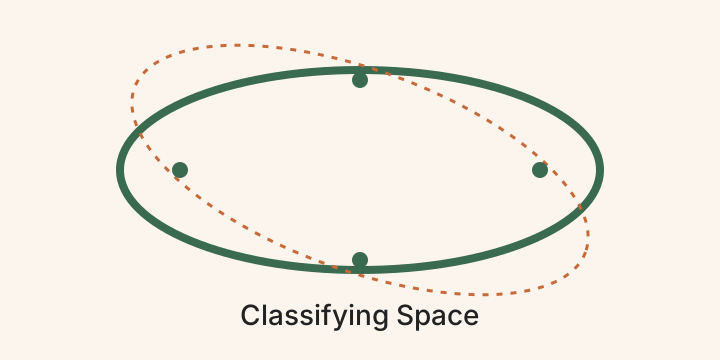
The map acts like a recipe: the same universal ingredient produces many local bundles.
Worked example [Beginner]
Think about line bundles over a circle. A simple line bundle is the cylinder, where every point carries a little copy of a line in the same orientation. A twisted line bundle is the Möbius band, where the line flips once around the circle.
A classifying space records these possibilities. A map from the circle into the classifying space selects which pattern occurs. If the map records no flip, the pullback is the cylinder. If it records one flip, the pullback is the Möbius band.
What this tells us: classifying spaces turn bundle construction into the study of maps.
Check your understanding [Beginner]
Formal definition [Intermediate+]
Let be a topological group. A classifying space is a base space equipped with a principal -bundle
such that principal -bundles over a suitable space are obtained, up to isomorphism, as pullbacks along maps , with isomorphism classes corresponding to homotopy classes of maps [fasttrack-texts §16].
For finite-rank vector bundles, the relevant examples are for complex rank- bundles and for real rank- bundles. Stabilizing in gives and , the classifying spaces used in topological K-theory 03.08.01.
Key theorem with proof [Intermediate+]
Theorem (Homotopic maps give isomorphic pullbacks). Let be a bundle and let be homotopic maps. If the homotopy classification hypotheses for the bundle category are satisfied, then and are isomorphic bundles over .
Proof. Let be a homotopy from to . Pull back along to obtain a bundle . Restricting this bundle to gives , and restricting it to gives .
Under the standard homotopy-invariance theorem for bundles over the cylinder, the restrictions of a bundle over to the two ends are isomorphic over [Husemoller §4]. Applying that theorem to gives .
Synthesis. The classifying space is exactly the homotopy-theoretic representing object for principal -bundles. This is precisely the foundational equivalence of categories: . The classifying space generalises the universal-bundle construction; it is the bridge between bundle theory and homotopy theory.
Bridge. The construction here builds toward 03.08.01 (topological k-theory), where the same data is upgraded, and the symmetry side is taken up in 03.08.07 (bott periodicity). The defining pattern appears again in those units in a sharpened form, where the local data is glued or quotiented. Putting these together, the foundational insight is that the data of this unit gives the structural signature that the rest of the strand reads off.
Exercises [Intermediate+]
Lean formalization [Intermediate+]
lean_status: none is recorded because the needed package would have to combine topological principal bundles, numerable bundles, universal bundles, homotopy classes, and concrete models for classical group classifying spaces.
Advanced results [Master]
For paracompact spaces and numerable principal -bundles, the classifying theorem gives a natural bijection
where the right side denotes isomorphism classes of principal -bundles over [Husemoller §4]. Milnor's construction supplies a universal -bundle with contractible for a broad class of topological groups [Milnor universal bundles].
For and , associated vector bundles convert the principal-bundle classification into the classification of rank- complex and real vector bundles. Stabilization under block sum produces and , the spaces representing reduced K-theory in the stable range.
, as infinite Grassmannians and the canonical bundle
For complex vector bundles of rank , the classifying space admits an explicit Grassmannian model:
where is the complex Grassmannian of -dimensional complex linear subspaces of . Equivalently, for real bundles. Over each finite Grassmannian sits the canonical (tautological) bundle
whose fibre over a point is the -dimensional subspace itself. (Notation: per Codex notation decision #19, the symbol denotes the tautological complex rank- bundle on , and denotes the universal rank- bundle on . The same notation is used in N13 for the Borel-presentation deepening.) The colimit is the universal complex rank- bundle in the Grassmannian model.
Theorem (Bott-Tu §23, Theorem 23.5). Let be a finite CW complex, or more generally a paracompact space of bounded cell-complexity. The pullback construction induces a natural bijection
sending a homotopy class to the pullback bundle . The analogous statement holds for and real rank- bundles.
The proof in the Grassmannian setting goes through finite-dimensional approximation. Given a rank- bundle , the section data over a finite cover trivialising embed each fibre into for large enough, giving a fibrewise-injective bundle map . The classifying map sends to the image of in , and by construction. Two such embeddings differ by a homotopy in the space of bundle injections, so the homotopy class of is intrinsic to . As , the maps assemble to a single homotopy class .
Universal-bundle pullback as a tool for naturality
The Grassmannian model makes naturality of characteristic classes a one-line consequence of the universal property. Suppose is any cohomology operation pulled back from . Given a bundle , the characteristic class is automatically natural under continuous maps:
This is the second canonical route to characteristic classes invoked in 03.06.06 — the universal-bundle-pullback companion to Chern-Weil. The Chern classes and Pontryagin classes are defined as the universal generators of the cohomology rings; pulling them back along the classifying map of any bundle gives the characteristic classes of that bundle, with naturality, the Whitney product formula (via on classifying spaces), and the rank bound all consequences of the classifying-space construction.
Cohomology ring of via the Borel construction
Theorem (LM B.1, as a graded ring). For a compact Lie group with maximal torus and Weyl group , the cohomology ring
is the ring of -invariant polynomials in generators of degree , one for each circle factor of . The Borel construction identifies $H^(BG;\mathbb{Q})GG/T\to BT\to BGG/TWH^(BG)=H^(BT)^W$. The classical examples follow:
| Generators | ||||
|---|---|---|---|---|
| Chern classes, | ||||
| Pontryagin classes, | ||||
| Pontryagin + Euler, | ||||
| symplectic Pontryagin, |
For -coefficients, the analogous mod-2 result identifies via Stiefel-Whitney classes 03.06.03, proved by the Leray-Hirsch theorem on the splitting principle. The Borel-construction perspective extends these statements to equivariant cohomology of -spaces and is the foundation on which characteristic-class theory rests: every invariant of principal -bundles is a polynomial in these universal classes pulled back along the classifying map.
Full proof set [Master]
The homotopy-invariance proof above supplies the map from homotopy classes to isomorphism classes. Surjectivity and injectivity of the full classification require the universal property of : every numerable principal bundle admits a classifying map, and two classifying maps for the same bundle are homotopic. Milnor proves these statements by constructing as a join-type contractible free -space and taking the orbit space as [Milnor universal bundles].
Naturality follows from pullback composition. If over and , then , so the classifying map for the pulled-back bundle is represented by .
Connections [Master]
Principal bundles
03.05.01— classifying spaces depend on principal bundles; classifies principal -bundles up to homotopy.Homotopy theory
03.12.01— the homotopy-classification statement is the foundational equivalence of categories.Topological K-theory
03.08.01— classifying spaces and organise stable vector bundles, supplying the spectrum-level structure on which K-theory is built.Bott periodicity
03.08.07— Bott periodicity is a periodicity statement about the homotopy type of the stable classical groups and their classifying spaces.Characteristic classes [03.06.04, 03.06.06] — a universal class on pulls back along a classifying map to the characteristic class of the bundle over , connecting this unit to Chern-Weil theory and Pontryagin/Chern classes.
Universal bundle and infinite Grassmannian
03.08.05— byconn:451.universal-bundle-grassmannian, Universal complex rank-k bundle γ_k = colim γ_k^n on infinite Grassmannian, equivalent to BU(k) (equivalence). carries the universal complex rank- bundle, equivalent up to homotopy to ; pullback implements .Leray-Hirsch and splitting principle
03.13.03— byconn:445.splitting-flag-borel, splitting principle equivalent to Borel presentation H(BG) = H*(BT)^W* (equivalence). The Borel-Hirzebruch presentation of as symmetric functions in Chern roots is exactly the universal splitting principle on classifying spaces.
Throughlines and forward promises. Classifying spaces are the foundational organising tool for principal-bundle theory. We will see the universal bundle on realise in 03.08.05; we will see Bott periodicity describe in 03.08.07; we will later see the Borel-Hirzebruch presentation structure characteristic-class theory. The foundational reason is exactly the universal-bundle pullback construction. Putting these together: every characteristic class is an instance of pullback from a universal class on ; the Borel presentation is the cohomology fact that makes this computable. This pattern recurs in K-theory ( is the classifying space for stable complex vector bundles), in cobordism (Thom spectra), and in equivariant cohomology (Borel construction). The bridge between specific bundles and universal cohomology is exactly the classifying map; this is the foundational insight that organises modern algebraic topology.
Historical & philosophical context [Master]
Milnor's 1956 papers gave a flexible construction of universal bundles and classifying spaces for topological groups [Milnor universal bundles]. The construction became part of the standard language of fibre bundle theory.
May's algebraic topology text presents classifying spaces as representing objects for principal bundles and as central examples in homotopy theory [fasttrack-texts §16]. Husemoller develops the bundle-theoretic classification in the setting used by vector bundles and characteristic classes [Husemoller §4].
Bibliography [Master]
- John Milnor, "Construction of universal bundles I," Annals of Mathematics 63 (1956). [Milnor universal bundles]
- Dale Husemoller, Fibre Bundles, §4. [Husemoller §4]
- J. Peter May, A Concise Course in Algebraic Topology, §16. [fasttrack-texts §16]