Multi-variable limit and continuity
Anchor (Master): Apostol *Calculus* Vol. 2 Ch. 8; Fréchet 1906 *Sur quelques points du calcul fonctionnel* (Rend. Circ. Mat. Palermo 22); Heine 1872 *Die Elemente der Functionenlehre* (J. reine angew. Math. 74); Bourbaki *Topologie Générale* Ch. I §7
Intuition [Beginner]
A function of several variables takes a tuple of numbers as input and produces another tuple as output. A function from the plane to the line accepts a point and returns a single number; a function from -space to the plane accepts and returns a pair . The picture for the simplest case, two inputs and one output, is a surface sitting above the floor of the input plane.
A limit describes what happens as the input slides toward a target point. The limit of at a point equals when, no matter how the input approaches , the output gets close to . Continuous at adds one more requirement: the value the function actually takes at matches that limit. Visually, a continuous function gives a surface with no holes, no jumps, no torn edges.
The catch in two dimensions or more is that a point can be approached from many directions. A safe limit must agree along every approach — straight lines from the left, from the right, from above, along curves, along spirals. If two different approaches give two different answers, no limit exists.
Visual [Beginner]
Two surfaces side by side. On the left, a smooth bowl shaped like , dipping down to a single low point at the origin where the function value is . On the right, a saddle-and-ridge shape for , with two arrows showing the line approaching the origin from a height of and the line approaching from a height of — two different heights at the same input point.
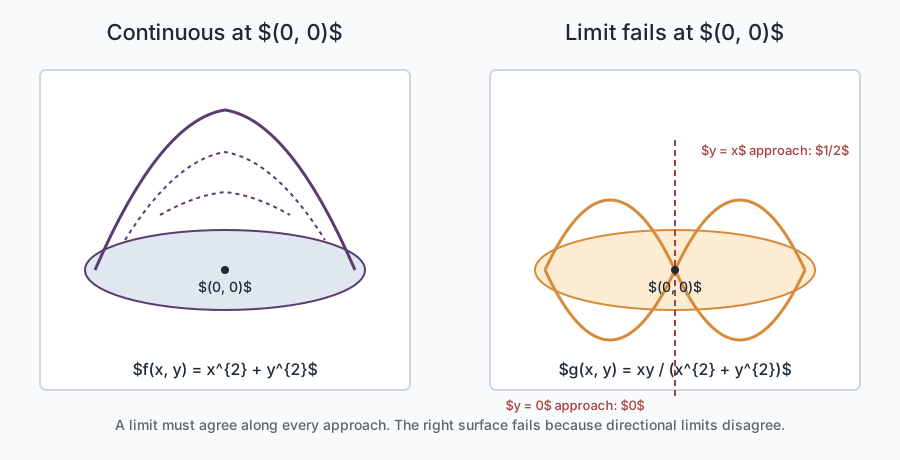
The left surface earns the label continuous. The right surface fails the limit test at the origin. The image is the visual signature of the central rule: a multi-variable limit must agree along every path of approach.
Worked example [Beginner]
Take the specific function and the target point . Plug in: . Approach along the -axis with : , which goes to as goes to . Approach along the -axis with : , which goes to . Approach along the diagonal : , which goes to . Every approach gives , and the actual function value is , so is continuous at the origin.
Now take at the same target point . The expression at the origin is , which is not a number. Approach along : , which goes to . Approach along with : , which stays at . Two paths, two answers — the limit does not exist, and no choice of value at fixes this. In two dimensions, "the function tends to a number" is a stronger requirement than in one, because every approach has to agree.
Check your understanding [Beginner]
Formal definition [Intermediate+]
The Euclidean norm on is for . The open ball of radius centred at is . A subset is **open** if for every some has . A point is a limit point of if every open ball around contains some point of different from .
Let , let be a limit point of , and let . The limit of at equals , written , when
The function is continuous at when is either an isolated point of or a limit point of with . Equivalently, for every some gives . The function is continuous on when it is continuous at every point of . Following Apostol [Apostol Ch. 8 §8.2–8.4].
A few standard reformulations are equivalent over with its Euclidean norm.
- Topological form. is continuous on iff is open relative to for every open [Munkres §18].
- Sequential form. is continuous at iff for every sequence in with , the image sequence [Rudin Ch. 4].
- Component form. Writing with , the function is continuous at iff every component is continuous at .
Counterexamples to common slips
- Equality on every line through does not imply the limit exists. For extended by , every straight line through the origin yields the limit , yet along the parabola the function equals . The limit at the origin therefore does not exist.
- Continuity in each variable separately does not imply joint continuity. The function extended by is continuous in for each fixed and continuous in for each fixed , yet it is not jointly continuous at the origin.
- A removable singularity is not always removable. If exists, redefining to that limit makes continuous at . If the limit does not exist, no redefinition produces continuity.
- The sequential criterion needs the Euclidean structure (or first-countability). In a general topological space, sequential continuity can be strictly weaker than topological continuity. Over they coincide because countable neighbourhood bases exist.
Key theorem with proof [Intermediate+]
Theorem (sequential characterisation of continuity). Let , let , and let . The function is continuous at if and only if for every sequence in with , the image sequence .
Proof. () Assume is continuous at , and let be a sequence in with . Fix . By continuity, choose so that implies for . Since , choose with for all . Then for all , so .
() Argue by contraposition. Assume is not continuous at . Then some has the property that for every , some satisfies and . Apply this with for each positive integer to extract with and .
The sequence converges to because the gap is bounded above by , and by the Archimedean property of proved in 02.02.01. The image sequence stays at distance at least from for every , so it does not converge to . The contrapositive is established, so the converse direction holds.
Bridge. The sequential criterion is the bridge between four neighbouring frames. First, it transports the - definition to the language of sequence convergence, the same translation that converts the completeness axiom (C) of 02.02.01 into the monotone convergence theorem. Second, it lifts to the general-topology characterisation in 02.01.02, where continuity is recast as "preimage of open is open"; over the three forms — -, sequential, topological — collapse into one because Euclidean space has countable neighbourhood bases. Third, it underpins the differential structure of 02.05.02 pending: the differential is defined as the linear map approximating at , and that approximation is meaningful only when is continuous at , since is exactly what makes the remainder control the function. Fourth, it furnishes the multivariable Heine-Cantor refinement: if is compact and is continuous, the same sequential mechanism produces uniform continuity, because no escape sequence can withhold a convergent subsequence. Read together, the four bridges identify continuity as the load-bearing notion that connects the order-completeness of the real line, the topological language of open sets, the linear-approximation framework of differentiation, and the compactness-driven uniformity that powers the existence theorems for integrals and ODEs.
Exercises [Intermediate+]
Lean formalization [Intermediate+]
lean_status: partial — Mathlib provides ContinuousAt, Continuous, the metric-space EuclideanSpace ℝ (Fin n), and the sequential characterisation through Metric.continuousAt_iff_seq_tendsto. The textbook-style packaging that puts the - form, the sequential form, and the multivariable Heine-Cantor theorem under one named result is the Codex-facing gap.
The companion module at Codex.Analysis.MultiVariable.LimitContinuity re-exports these statements and records the unification gap.
Advanced results [Master]
Multivariable Heine-Cantor. Let be compact and continuous. Then is uniformly continuous on . Stated and proved as Exercise 6 by sequential extraction; the original 1872 statement of Heine [Heine 1872] handled the single-variable case on a closed bounded interval, and Cantor in the same year gave the independent treatment. The multivariable extension uses the Bolzano-Weierstrass property of compact subsets of , which is the Euclidean specialisation of the Heine-Borel theorem.
Composition continuity. If is continuous and is continuous, then is continuous. Proved as Exercise 5 by the chained- argument; equivalently, by the topological criterion, is open whenever is open, since open sets pull back to open sets at each step.
Tietze extension theorem. Let be closed and let be continuous and bounded. Then extends to a continuous with the same bound. The result is a metric-space specialisation of Urysohn's normality machinery; proof via successive approximation by continuous functions whose maximum-norm errors are halved at each stage [Munkres §35]. The extension carries the same modulus of continuity in the compact case.
Banach fixed-point theorem. Let be a non-empty complete metric space and let be a contraction (Lipschitz constant ). Then has a unique fixed point, and the iteration converges to it from any starting point at geometric rate . Proved by showing is Cauchy via the geometric-series bound . The theorem is the workhorse behind the inverse and implicit function theorems of 02.05.04 and the Picard-Lindelöf existence theorem for ODEs.
Sequential vs topological continuity in general. Sequential continuity equals topological continuity exactly when the domain is first-countable: every point has a countable neighbourhood basis. Metric spaces are first-countable, so over the two criteria coincide. In a non-first-countable space (such as with the cocountable topology, or an uncountable product of copies of ), sequentially continuous functions need not be continuous. A net — a generalised sequence indexed by a directed set — restores the equivalence in full generality.
Synthesis. Four observations organise the unit. First, the - definition, the sequential criterion, the topological criterion, and the component-by-component criterion are four faces of the same notion on , identical because of the Euclidean metric structure inherited from the real-number axioms. Second, the requirement that limits agree along every approach is the load-bearing difference between single-variable and multi-variable analysis: a function of one variable approaches a target along two sides of a number line; a function of several variables approaches along a continuum of paths, including straight lines, parabolic arcs, and worse. Third, compactness upgrades pointwise continuity to uniform continuity, and that uniformity is the source of every existence theorem that follows: Riemann integrability of continuous functions on closed bounded boxes, Picard-Lindelöf for ODEs, Stone-Weierstrass approximation. Fourth, the metric-space framework introduced by Fréchet in 1906 [Fréchet 1906] generalises this entire picture to any space carrying a distance function, opening the door to function spaces, sequence spaces, and the Banach- and Hilbert-space technology of functional analysis. Taken together, these observations identify continuity as the single notion that bridges the order-completeness of 02.02.01, the topological language of [02.01.01–02], the linear approximation of 02.05.02 pending, and the contraction-based existence theorems that drive 02.05.04 and ordinary differential equations.
Full proof set [Master]
Sequential characterisation. Proved in §"Key theorem with proof" above.
Multivariable Heine-Cantor. Proved in Exercise 6 by a Bolzano-Weierstrass extraction.
Composition continuity. Proved in Exercise 5 by the chained- argument.
- equals topological. Proved in Exercise 7 by the basis of open balls.
Proposition (Bolzano-Weierstrass for ). Every bounded sequence in has a convergent subsequence. The single-variable case follows from the completeness axiom (C) of 02.02.01 via the monotone-subsequence lemma. The -dimensional case proceeds by induction on : extract a subsequence of the first coordinates that converges (single-variable case applied to the bounded sequence of first components), then a sub-subsequence on the second coordinates, and so on for steps. The final sub--subsequence converges in every coordinate, hence in by the component-form characterisation.
Proposition (Banach fixed-point theorem). Let be a non-empty complete metric space and with for some and all . Then has a unique fixed point $x^ \in Xx_{k+1} = T(x_k)x_0d(x_k, x^) \leq L^k d(x_0, x^) / (1 - L)$.*
Proof. By induction . For , the triangle inequality gives . Since by the Archimedean property of applied to , the sequence is Cauchy. By completeness of , it converges to some . By continuity of (Lipschitz functions are continuous) and the recurrence , the limit satisfies . Uniqueness: if is another fixed point, , so , forcing and .
Proposition (Tietze extension on , sketch). Let be closed and continuous. Build a sequence of continuous functions with and on . Each comes from Urysohn's lemma applied to the disjoint closed subsets where the running remainder is large positive and large negative. The series converges uniformly on to a continuous function with . Full proof in Munkres §35 [Munkres §35].
Connections [Master]
Topological space 02.01.01 — the - definition of multi-variable continuity is the metric-space specialisation of the topological "preimage of open is open" definition. The unit recovers the Euclidean instance from the topological framework, and the topological framework abstracts the unit's geometric content.
Continuous map 02.01.02 — the morphisms in the category . Multi-variable continuous functions are the morphisms restricted to objects of the form with the Euclidean topology. Sequential characterisation here equals the general categorical condition because is first-countable.
Real-number axioms 02.02.01 — the Euclidean norm depends on the order-and-completeness structure of in two essential ways: the square root used to define exists by the existence theorem for -th roots (Exercise 5 of 02.02.01), and the Archimedean property ensures that the witness sequences with converge to .
Partial derivative and the differential 02.05.02 pending (pending) — the differential at is the unique linear map approximating near to first order. Continuity at is necessary: if is not continuous at , no linear map can satisfy . The unit supplies the foundational notion that makes the differential well-defined.
Inverse and implicit function theorems 02.05.04 (pending) — the proofs of both theorems use the Banach fixed-point theorem on a complete metric space, which is in turn an application of the sequential criterion of this unit. The contraction estimate produces a Cauchy sequence whose limit, by completeness, lands in the metric space; continuity of the contraction map ensures that the limit is the fixed point.
Metric space 02.01.05 — the multi-variable framework is one instance of the metric-space framework. Cauchy completeness, uniform continuity, the Banach fixed-point theorem, and the Heine-Cantor theorem all live at the metric level and specialise to the Euclidean case treated here.
Banach space 02.11.04 — completeness of in the Euclidean norm makes it a finite-dimensional Banach space. The pattern "continuous linear map plus completeness implies existence by Banach fixed-point" recurs throughout functional analysis, and the Banach-Mazur game and open-mapping theorem at that level rest on the multi-variable continuity machinery of this unit.
Historical & philosophical context [Master]
Augustin-Louis Cauchy gave the first - formulation of limits and continuity in the 1821 Cours d'analyse [Cauchy 1821], confined to functions of a single real variable. The conceptual move that makes the multi-variable case interesting — the recognition that a point can be approached from many directions, and that a candidate limit must agree along all of them — became visible in the lecture practice of Riemann and Weierstrass in the 1850s and 1860s, though it was rarely written down explicitly. Eduard Heine in 1872 [Heine 1872] proved that continuity on a closed bounded interval is automatically uniform, the prototype of every later compactness-and-continuity theorem; Georg Cantor obtained the same result independently in the same year.
Maurice Fréchet's 1906 doctoral thesis [Fréchet 1906] introduced the abstract metric space and the abstract notion of a topological structure on a set, subsuming the Euclidean case treated in this unit. Felix Hausdorff's 1914 axiomatisation, the Kuratowski closure-operator presentation of 1922, and Bourbaki's mid-century treatise [Bourbaki Ch. I §7] consolidated continuity as the central morphism notion in topology, with the metric / Euclidean theory as one instance among many. The sequential criterion proved in this unit is the bridge between the Cauchy-Riemann-Heine prehistory and the Fréchet-Hausdorff topological present: it states the metric definition in terms that translate directly to the categorical one, and it identifies the specific structure (first-countability) that licenses the translation in general.