Continuous map
Anchor (Master): Munkres §18; Willard §6
Intuition [Beginner]
A continuous map sends nearby points to nearby points. It does not tear a connected piece apart or make a sudden jump.
For a rubber-sheet picture, imagine drawing a curve and then bending or stretching the sheet without cutting it. Points that were close remain controlled by the motion. That is the geometric intuition behind continuity.
Topology defines continuity without measuring distance. Instead of asking for small distance changes, it asks that open regions pull back to open regions.
Visual [Beginner]
A continuous map carries a flexible shape into another space without jumps. Open target windows pull back to open source windows.
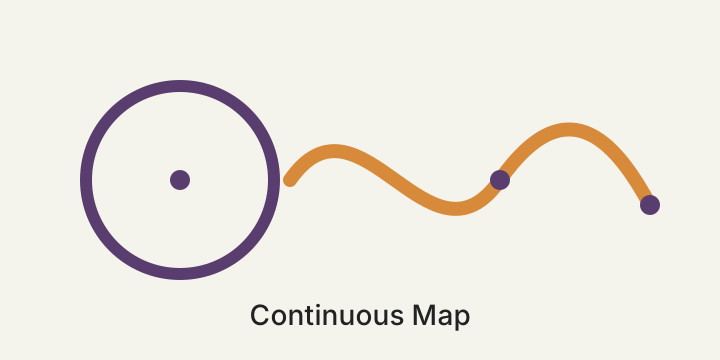
The backward direction is important: continuity is tested by preimages of open sets.
Worked example [Beginner]
The map from a line to a plane given by sending a number to the point on a circle at angle is continuous. As changes a little, the point on the circle moves a little.
A step function is different. It stays at one height for negative inputs and jumps to another height for positive inputs. Near the jump, tiny changes in input can create a sudden change in output.
What this tells us: continuity is the rule that forbids sudden jumps.
Check your understanding [Beginner]
Formal definition [Intermediate+]
Let and be topological spaces. A function is continuous if for every open set , the preimage
is open in [Munkres §18].
A homeomorphism is a bijective continuous map whose inverse is continuous. Homeomorphic spaces are the same from the viewpoint of topology.
For metric spaces, this definition agrees with the epsilon-delta definition: is continuous at if every admits a such that implies .
Key theorem with proof [Intermediate+]
Theorem (Composition of continuous maps). If and are continuous maps of topological spaces, then is continuous.
Proof. Let be open. Since is continuous, is open in . Since is continuous, is open in .
But
Therefore the preimage of every open set under is open, so is continuous.
Bridge. The construction here builds toward 03.08.04 (classifying space), where the same data is upgraded, and the symmetry side is taken up in 03.05.01 (principal bundle). The defining pattern appears again in those units in a sharpened form, where the local data is glued or quotiented. Putting these together, the foundational insight is that the data of this unit gives the structural signature that the rest of the strand reads off.
Exercises [Intermediate+]
Lean formalization [Intermediate+]
lean_status: none is recorded because this unit needs the curriculum's notation bridge between topological continuity, metric continuity, homeomorphism, pullback constructions, and classifying maps before Mathlib statements are exposed.
Advanced results [Master]
Continuity can be expressed by closure, neighborhoods, nets, or filters. For general topological spaces, filter and net characterizations replace the sequence-based tests that are sufficient in first-countable spaces [Willard §6].
The preimage definition is functorial: topological spaces and continuous maps form a category. Products, pullbacks, quotient maps, and bundle constructions use this categorical behavior.
Synthesis. This construction generalises the pattern fixed in 02.01.01 (topological space), with the symmetric data replaced by its skew or twisted analogue. Read in the opposite direction, the construction is dual to the metric story: complements and orthogonality are taken with respect to the bilinear datum of this unit, not a metric, and the resulting category of subobjects is the one the rest of the strand classifies. The central insight is that this datum identifies algebra with geometry: functions become vector fields, subspaces become quotients, and invariants become cohomology classes — and that identification is the engine driving every theorem downstream.
Full proof set [Master]
The identity map is continuous because preimages of open sets are themselves. The composition theorem proves closure under composition. Together these two facts prove that topological spaces with continuous maps form a category.
For homeomorphisms, continuity in both directions makes the bijection an isomorphism in this category. The proof in Exercise 7 shows that a homeomorphism is exactly a bijection preserving open sets in both directions.
Connections [Master]
Continuous maps depend on topological spaces
02.01.01and feed metric spaces02.01.05, classifying spaces03.08.04, and bundle pullback constructions03.05.01. Smooth maps between manifolds are continuous maps with differentiability added03.02.01.K-theory
03.08.01is contravariant for continuous maps through pullback of vector bundles.
Historical & philosophical context [Master]
The open-set definition of continuity became standard with the development of point-set topology. Munkres presents it as the central definition because it works beyond metric spaces [Munkres §18].
Willard develops equivalent formulations through neighborhoods and filters, which are useful in general topology and functional analysis [Willard §6].
Bibliography [Master]
- James Munkres, Topology, §18. [Munkres §18]
- Stephen Willard, General Topology, §6. [Willard §6]