Group action
Anchor (Master): Lang §I.5; Dummit-Foote §1.7; Artin Ch. 6
Intuition [Beginner]
A group action is a way for a group of reversible moves to move points of some space. The group contains the moves; the set contains the things being moved.
For a square, the rotation group acts on the four corners. A quarter-turn sends each corner to the next corner. A half-turn sends each corner to the opposite corner. The identity rotation leaves every corner fixed.
This separates symmetry from the object being transformed. The same rotation group can act on corners, edges, diagonals, or colorings.
Visual [Beginner]
The rotation group of a square moves the corners. One group element sends every corner to a new corner.
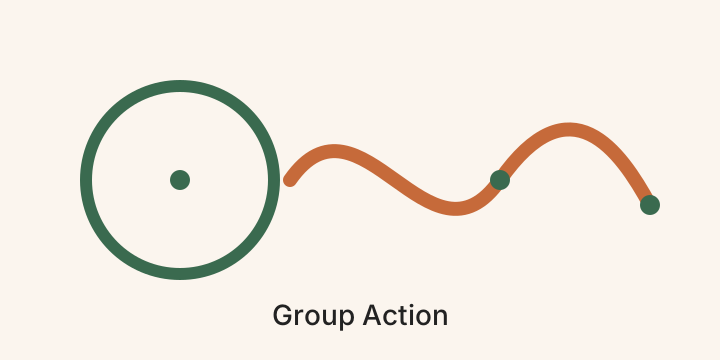
The action rule must respect combination: doing two group moves in sequence matches their product in the group.
Worked example [Beginner]
Let the four corners of a square be labeled . A quarter-turn rotation sends to , to , to , and to .
The half-turn is two quarter-turns. It sends to . Doing a quarter-turn twice also sends to .
What this tells us: an action converts group multiplication into actual motion of points.
Check your understanding [Beginner]
Formal definition [Intermediate+]
Let be a group and a set. A left action of on is a map
such that and for all and [Dummit-Foote §1.7].
The orbit of is . The stabilizer of is
An action is free if every stabilizer is the identity subgroup. It is transitive if there is one orbit. A set with a free and transitive -action is a -torsor.
Key theorem with proof [Intermediate+]
Theorem (Orbit-stabilizer). If a finite group acts on a set and , then
In particular, .
Proof. Define by . If , then , so , and hence . Thus is well-defined.
The map is surjective by the definition of orbit. It is injective because implies , so , hence . Therefore and have the same cardinality. For finite , .
Bridge. The construction here builds toward 03.05.01 (principal bundle), where the same data is upgraded, and the symmetry side is taken up in 03.08.04 (classifying space). The defining pattern appears again in those units in a sharpened form, where the local data is glued or quotiented. Putting these together, the foundational insight is that the data of this unit gives the structural signature that the rest of the strand reads off.
Exercises [Intermediate+]
Lean formalization [Intermediate+]
lean_status: none is recorded because this curriculum unit needs a local convention for left and right actions before tying Mathlib's action hierarchy to principal bundles and Lie-group actions.
Advanced results [Master]
Group actions may be encoded as homomorphisms , where is the permutation group of [Artin Ch. 6]. This turns action theory into ordinary group homomorphism theory.
For a transitive action, choosing identifies with the homogeneous space . For a free and transitive action, and is a torsor: it is isomorphic to after choosing a basepoint, but it has no distinguished identity element by itself.
Synthesis. This construction generalises the pattern fixed in 01.02.01 (group), with the symmetric data replaced by its skew or twisted analogue. Read in the opposite direction, the construction is dual to the metric story: complements and orthogonality are taken with respect to the bilinear datum of this unit, not a metric, and the resulting category of subobjects is the one the rest of the strand classifies. The central insight is that this datum identifies algebra with geometry: functions become vector fields, subspaces become quotients, and invariants become cohomology classes — and that identification is the engine driving every theorem downstream.
Full proof set [Master]
The homomorphism formulation is obtained by assigning to the bijection . The action axioms say exactly that the identity maps to the identity permutation and maps to the composite of the permutations for and .
For a transitive action, the proof of orbit-stabilizer gives a canonical -equivariant bijection by . Its well-definedness and bijectivity are the same computations as in the theorem.
Connections [Master]
Group actions build on groups
01.02.01and feed principal bundles03.05.01, where each fiber is a right torsor for the structure group. Lie groups03.03.01act smoothly on manifolds, producing homogeneous spaces and associated bundles. Orthogonal groups03.03.03act on frames, spheres, and quadratic-form level sets.Classifying spaces
03.08.04use principal bundles, so the free transitive action on fibers is part of their input.
Historical & philosophical context [Master]
Permutation representations made group actions central in the early development of group theory. The action viewpoint lets groups be studied through their effect on sets, roots, geometric figures, and later manifolds [Lang §I.5].
Artin emphasizes symmetry actions in geometry, while Dummit and Foote use orbit-stabilizer as the first major counting theorem for group actions [Artin Ch. 6; ref: TODO_REF Dummit-Foote §1.7].
Bibliography [Master]
- Serge Lang, Algebra, §I.5. [Lang §I.5]
- David Dummit and Richard Foote, Abstract Algebra, §1.7. [Dummit-Foote §1.7]
- Michael Artin, Algebra, Ch. 6. [Artin Ch. 6]