Singular cohomology and the de Rham theorem (with coefficients)
Anchor (Master): Bott-Tu §15; Hatcher §2.1, §3.1; Eilenberg-Steenrod 1952; de Rham 1931
Intuition [Beginner]
Singular cohomology counts holes by labelling triangles. Take a smooth manifold; a singular -simplex on it is a continuous map from the standard -dimensional triangle into the manifold. A singular -cochain is a rule that assigns a number to each such triangle. Closed cochains are those whose values are consistent across boundaries; exact cochains are those obtained from a -cochain by such a boundary rule. The cohomology is the closed modulo the exact.
The remarkable fact: on a smooth manifold, singular cohomology with real coefficients agrees with de Rham cohomology, the cohomology of differential forms. The two definitions look completely different — one combinatorial, the other analytic — but they compute the same numbers. This is the de Rham theorem.
The bridge between them is integration. Given a smooth differential form and a smooth singular simplex, you integrate the form over the simplex. Stokes' theorem makes the pairing descend to cohomology. The Poincaré lemma makes it locally an isomorphism. Mayer-Vietoris induction makes it globally an isomorphism.
Visual [Beginner]
A surface with overlapping triangulated patches; a closed differential form is integrated over the triangles to get the singular cohomology pairing.
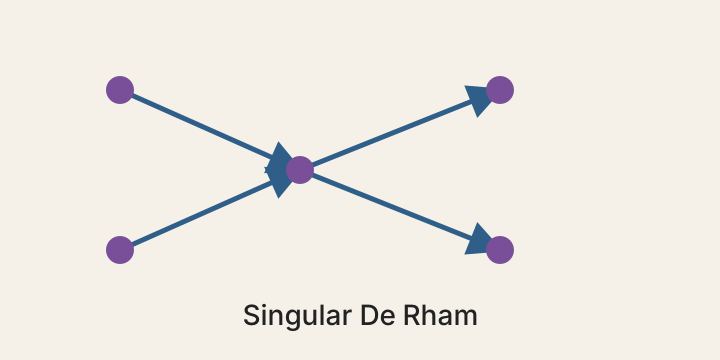
The picture is a guide: differential forms and triangulated cycles meet through integration, and the meeting point is the cohomology of the manifold.
Worked example [Beginner]
The circle . A singular 1-cocycle on assigns a real number to every continuous map of the standard interval into the circle, in a way consistent under boundary. The "winding number" cocycle assigns the net wind of the parametrising loop. Two parametrisations of the same loop give the same value, so the cocycle is closed. It is not exact: the constant zero cocycle is exact, but the winding-number cocycle is not zero.
So has at least dimension one. By integrating the angular form on over a parametrising loop, you compute the same number — the wind. The de Rham class pairs with the singular cocycle to give the wind. The two cohomologies agree.
What this tells us: a single number — the winding count — is captured by integration of forms over triangulated paths. Two languages, one phenomenon.
Check your understanding [Beginner]
Formal definition [Intermediate+]
Let be a topological space and an abelian group. The standard -simplex is the convex hull of the standard basis vectors. A singular -simplex in is a continuous map . The singular -chain group is the free abelian group on singular -simplices.
The boundary map sends to the alternating sum of its restrictions to the codimension-one faces:
One verifies . The singular cochain complex with coefficients in is with coboundary . The singular cohomology is
This is functorial: a continuous map induces via composition with .
Smooth vs continuous. On a smooth manifold , the smooth singular cochains are those defined on smooth singular simplices ( smooth). The smooth and continuous singular cohomologies coincide: every continuous simplex is homotopic to a smooth one, with chain-equivalent boundary [Bott-Tu §15]. Throughout, we work with smooth singular cochains.
Integration pairing. For a smooth manifold , a closed -form , and a smooth singular -simplex , define
Extending linearly gives a cochain map . By Stokes' theorem on (with boundary the alternating face sum), commutes with — in fact 03.04.05. So descends to a map of cohomologies .
Key theorem with proof [Intermediate+]
Theorem (de Rham). Let be a smooth manifold of finite type. The integration map $I_: H^k_{\mathrm{dR}}(M)\to H^k_{\mathrm{sing}}(M; \mathbb{R})k\geq 0$* [Bott-Tu §15].
Proof (Mayer-Vietoris induction). The argument follows the same template as the Künneth theorem 03.04.12: define both sides as functors of open subsets, exhibit a natural transformation, check the base case on a contractible piece, glue with the five lemma.
Setup. For an open , let and . The integration map gives a natural transformation .
Base case: contractible. On a contractible space, both sides reduce to in degree zero (Poincaré lemma for de Rham 03.04.06; cone construction for singular). The integration map sends the constant function to the cocycle "evaluate at the basepoint", which is also on every constant simplex. So is the identity on in degree zero, vanishing elsewhere — an isomorphism.
MV ladder. For open with , both functors have Mayer-Vietoris long exact sequences. The de Rham MV 03.04.07 is by partition of unity. The singular MV is by small chains (§"Singular MV via subdivision" below): every singular simplex is chain-homotopic to a sum of simplices each contained in or , and the resulting short exact sequence on chains gives the long exact sequence on cohomology.
The integration map intertwines the MV connecting maps, since both connecting maps are constructed via the Čech apparatus of restriction to opens, and integration commutes with restriction.
Inductive step. Assume is an isomorphism on . The five lemma applied to the MV ladder forces to be an isomorphism on .
Termination. Choose a finite good cover of 03.04.10. Each is contractible, so the base case applies. Each finite intersection is contractible. The induction proceeds: , then , then , terminating at after steps.
The proof depends on three pieces: the de Rham MV sequence (partition of unity), the singular MV sequence (small chains), and a finite good cover (good cover unit). Each piece is a separate theorem; the assembly is the de Rham theorem.
Singular MV via subdivision
The singular MV sequence requires that every singular chain on be replaceable by a chain-equivalent sum of chains supported in or in . The classical apparatus is the barycentric subdivision operator , satisfying and chain-homotopic to the identity. Iterating enough times reduces every simplex to a small one. By a Lebesgue-number argument on the open cover , after finitely many subdivisions every simplex lies in or in .
The resulting short exact sequence
with the small-chain complex chain-homotopic to , dualises to the singular MV cochain sequence.
Synthesis. The de Rham theorem is the foundational bridge between analytic and topological invariants of a smooth manifold. The integration pairing is exactly what identifies with . This is precisely the same pattern that recurs in every later comparison theorem (Hodge, GAGA, étale).
Bridge. The construction here builds toward later units of the strand, where the same pattern is taken up at higher structure. The defining pattern appears again in those units in a sharpened form, where the local data is glued or quotiented. Putting these together, the foundational insight is that the data of this unit gives the structural signature that the rest of the strand reads off.
Exercises [Intermediate+]
Lean formalization [Intermediate+]
lean_status: partial — Mathlib has AlgebraicTopology.SingularSet and AlgebraicTopology.SingularHomology; the de Rham — singular comparison map is not formalised. The companion file states the integration cochain map abstractly.
The missing project work: build the smooth-simplex layer over Mathlib's continuous-singular-set, formalise the integration pairing as a cochain-level map, and prove the de Rham comparison via the MV-induction template once the de Rham complex and good covers are present.
Advanced results [Master]
Three routes to the de Rham theorem
The de Rham theorem admits three structurally distinct proofs, each emphasising a different piece of the comparison apparatus.
Route 1 — Mayer-Vietoris induction. Treat both sides as functors of open subsets, exhibit the integration natural transformation, check the base case on contractible pieces, glue with the five lemma. This is the proof presented in the Intermediate tier above. Bott-Tu §15 attributes this format to its modern form.
Route 2 — Čech-de Rham double complex collapse. Form the double complex of forms on intersections of a good cover, observe that one filtration collapses to Čech-of- and the other to de Rham, and conclude that both equal the total cohomology of the double complex. This is exercise 6 above; the full development is in the Čech-de Rham unit 03.04.11. The advantage of this proof is that it is short once the double complex is in place, and it generalises immediately to twisted coefficient systems.
Route 3 — Sheaf-cohomology fine resolution. The constant sheaf admits a fine resolution by sheaves of differential forms:
exact at each stalk by the Poincaré lemma. The sheaves are fine (admit partitions of unity), hence acyclic for sheaf cohomology 04.03.01. So this resolution computes . On the other side, sheaf cohomology of on a paracompact Hausdorff space agrees with singular cohomology with coefficients (the sheaf-singular comparison theorem). Combining: .
This third route is the most concise and the most general. It does not require the manifold to have finite type, and it extends without modification to non-paracompact settings via Čech-derived sheaf cohomology.
This unit invokes conn:437.de-rham-three-routes from alg-top.singular-cohomology to topology.de-rham-cohomology (type: equivalence; anchor phrase: de Rham cohomology equivalent to singular cohomology with real coefficients (three routes) — MV induction, Čech-de Rham, sheaf-cohomology Leray).
Eilenberg-Steenrod axioms
Singular cohomology is uniquely characterised on the category of CW pairs by the seven Eilenberg-Steenrod axioms: homotopy invariance, exactness of the pair sequence, excision, dimension ( in degree zero, zero elsewhere), additivity, naturality, and the cohomological direction of arrows. The axioms reduce the computation of for any CW pair to the case of a single point.
The axioms isolate what makes singular cohomology the ordinary cohomology theory. Dropping the dimension axiom yields the family of generalised cohomology theories — K-theory, cobordism, -theory, and so on — each with nonzero coefficient groups on the point in higher degrees. The Brown representability theorem 1962 shows every reduced cohomology theory satisfying the Eilenberg-Steenrod axioms minus dimension is represented by an -spectrum.
Universal coefficient theorem
For any abelian group , the universal coefficient theorem in cohomology gives a natural short exact sequence
which splits non-naturally. When , over vanishes for any abelian group, so — singular cohomology with real coefficients is the dual vector space of singular homology with rational/real coefficients.
This is why de Rham cohomology — a real vector space — corresponds exactly to singular cohomology with real coefficients: both are the dual of integer homology tensored with .
Cup product
Singular cohomology has a natural ring structure via the cup product. For cocycles and with a pairing , define
on a -simplex . The cup product descends to cohomology, giving the structure of a graded-commutative ring.
The de Rham — singular ring isomorphism is that the integration map sends wedge product to cup product up to sign — this is the Eilenberg-Zilber theorem specialised to the de Rham setting. The sign is the natural one for graded-commutative algebras.
Full proof set [Master]
Singular MV via small chains — full statement
Let be a topological space and an open cover. Define to be the subcomplex of generated by simplices with for some . The small-chains theorem asserts the inclusion is a chain homotopy equivalence; the explicit chain homotopy is the iterated barycentric subdivision operator for large enough relative to a Lebesgue number of on the (compact) standard simplices.
The MV sequence for a two-element cover follows from the short exact sequence of small-chain complexes:
Dualising and using the chain-homotopy equivalence produces the singular MV cochain sequence.
Naturality of integration in MV
The de Rham MV connecting map is constructed via partition of unity: a closed form on extends to forms on via cutoffs, with a globally defined closed form on representing . The singular MV connecting map is constructed by lifting a small cocycle on to cocycles on and on separately and taking their difference as a cocycle on .
The integration map intertwines these: given a closed form on , integrating over a small simplex on gives a singular cocycle on ; the partition-of-unity extension on the form side and the small-chains lifting on the singular side both produce the same boundary data, since integration commutes with restriction to opens. Therefore .
Universal coefficient detail
Over , the chain complex is free, so the universal coefficient theorem reduces the computation of to and . For , since is divisible, for every . The exact sequence collapses to , and the right-hand side equals .
So is the real-dual of , which equals . The de Rham theorem identifies with , and the dual identification with is exactly the integration pairing .
Connections [Master]
This unit invokes the connections
conn:432.cech-de-rham-singularfrom N3 (route 2 of the de Rham theorem) — de Rham theorem built on Čech-de Rham double-complex collapse — andconn:429.mv-de-rham-singularfrom N1 (route 1) — de Rham theorem built on Mayer-Vietoris induction over a good cover.De Rham cohomology
03.04.06— singular cohomology with coefficients is de Rham cohomology on a smooth manifold, by the de Rham theorem proved here three ways. Connection type: equivalence (anchor: de Rham cohomology equivalent to singular cohomology with real coefficients (three routes)).Mayer-Vietoris
03.04.07— the singular MV sequence is the analogue of the de Rham MV; byconn:429.mv-de-rham-singular, de Rham theorem built on Mayer-Vietoris induction over a good cover. Route 1 compares them via integration.Čech-de Rham double complex
03.04.11— the double complex collapses to both Čech-of- and de Rham simultaneously, identifying the two; byconn:432.cech-de-rham-singular, de Rham theorem built on Čech-de Rham double-complex collapse — this is route 2.Sheaf cohomology
04.03.01— singular cohomology with coefficients is sheaf cohomology of the constant sheaf ; the fine resolution by gives route 3. Connection type: foundation-of.Künneth formula
03.04.12— singular Künneth (Eilenberg-Zilber) is the integer-coefficient version of the de Rham Künneth, with Tor corrections that disappear over . Connection type: bridging-theorem.Local systems and monodromy
04.03.02— twisted singular cohomology with local-system coefficients is the local-system generalisation of this unit's constant-coefficient case. Connection type: generalisation.Eilenberg-MacLane spaces (forthcoming) — by Brown representability, , identifying singular cohomology with the homotopy classes of maps to Eilenberg-MacLane spaces. Connection type: equivalence.
Leray-Serre spectral sequence (forthcoming) — singular cohomology is the input to the Leray-Serre spectral sequence of a fiber bundle. Connection type: foundation-of.
Throughlines and forward promises. The de Rham theorem is the foundational bridge between analysis and topology. We will see the three-routes equivalence recur whenever a comparison theorem appears (Hodge, GAGA, étale); we will see the universal coefficient theorem identify with the dual of singular homology in
03.04.06; we will later see local systems and twisted cohomology generalise the constant-coefficient case in04.03.02. The foundational reason de Rham equals singular over is exactly the integration pairing — this is precisely the same identification that recurs in every comparison theorem of the curriculum. Putting these together: the de Rham theorem is an instance of the broader "analytic invariants equal topological invariants paired by integration" pattern. This pattern recurs in Hodge theory, in -adic étale cohomology, and in -adic Hodge theory. The bridge between differential forms and singular cocycles is exactly the integration map; this is the foundational insight of de Rham 1931.
Historical & philosophical context [Master]
Eilenberg and Steenrod's 1952 Foundations of Algebraic Topology axiomatised singular cohomology and proved its uniqueness on the category of CW pairs. Their seven axioms — homotopy, exactness, excision, dimension, additivity, naturality, and cohomological-direction — extracted the structural skeleton of every classical cohomology theory and, by dropping the dimension axiom, made room for the generalised cohomology theories that occupied algebraic topology for the rest of the century.
Georges de Rham's 1931 Sur l'analysis situs des variétés à dimensions (Journal de Mathématiques Pures et Appliquées 10, 115–200) proved the equivalence between his analytic cohomology of differential forms and the topological cohomology of singular cycles, on a smooth manifold with real coefficients. De Rham worked combinatorially with simplicial chains, integrating forms over chains and using a Stokes-style pairing that descended to cohomology. The modern reformulation in Bott-Tu §15 replaces the simplicial argument with a Mayer-Vietoris induction over a good cover, yielding a cleaner functorial proof.
The de Rham theorem became the prototype of a comparison theorem in cohomology — analytic and topological invariants computing the same number, paired via integration. The pattern recurs in Hodge theory (the algebraic and analytic cohomologies coincide via GAGA), in étale cohomology (the étale and singular cohomologies coincide for complex varieties via Artin-Grothendieck), and in -adic Hodge theory (the de Rham and étale cohomologies are related via Fontaine's period rings). Each is a sophisticated descendant of the integration pairing de Rham wrote in his 1931 thesis.
Bibliography [Master]
- Eilenberg, S. & Steenrod, N., Foundations of Algebraic Topology, Princeton University Press, 1952.
- de Rham, G., "Sur l'analysis situs des variétés à dimensions", Journal de Mathématiques Pures et Appliquées 10 (1931), 115–200.
- Bott, R. & Tu, L. W., Differential Forms in Algebraic Topology, Springer, 1982. §13 (singular MV) and §15 (de Rham theorem).
- Hatcher, A., Algebraic Topology, Cambridge University Press, 2002. §2.1 (singular homology) and §3.1 (singular cohomology).
- Spanier, E. H., Algebraic Topology, Springer, 1966. Chapters 4–5.
- Brown, E. H., "Cohomology theories", Annals of Mathematics 75 (1962), 467–484. (Brown representability.)
- Madsen, I. & Tornehave, J., From Calculus to Cohomology, Cambridge University Press, 1997. (de Rham theorem at textbook level.)
Pass 4 Agent B unit N6. Singular cohomology + the de Rham theorem (three routes) — closes the singular-cohomology gap and anchors the cross-tier comparison theorem.