Künneth formula for de Rham cohomology — two proofs
Anchor (Master): Bott-Tu §5 + §9 — the dual-proof unit; Hatcher §3.B for the singular Künneth via Eilenberg-Zilber
Intuition [Beginner]
The Künneth formula says that the cohomology of a product of two spaces is the product of their cohomologies. If you know the holes of and the holes of , you know the holes of — they are exactly the products.
Concretely, take a circle and a circle. Each circle has one zero-dimensional hole (the connected component) and one one-dimensional hole (the loop). Their product is the torus. The torus has one zero-dimensional hole, two one-dimensional holes (the two loops), and one two-dimensional hole (the surface). Two times two equals four, and the four pieces match the four holes by degree.
The pattern recurs in higher dimensions. The product of three circles has eight holes, distributed across degrees 0 through 3 in the Pascal pattern. The cohomology of an -torus is the binomial expansion in disguise.
Visual [Beginner]
A torus pictured as a circle times a circle, with each one-dimensional loop on the torus identified as a single-circle loop multiplied by a constant on the other factor.
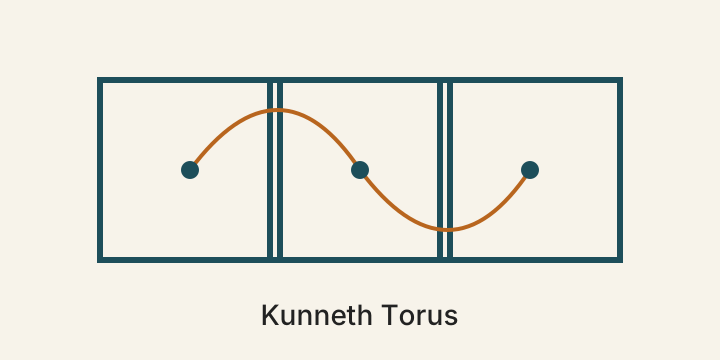
The picture is a guide: the cohomology of a product is built by multiplying classes on the factors, one class for each "axis" of the product.
Worked example [Beginner]
The two-torus . Each circle has cohomology of dimension one in degree zero and dimension one in degree one. The product table is one row of one-by-one in degree zero, two rows of one-by-one in degree one (one from each factor), and one row of one-by-one in degree two (the product of the two top classes).
Total: one class in degree zero, two classes in degree one, one class in degree two. Total Betti numbers: .
For the three-torus , repeat the same multiplication once more. Betti numbers: .
What this tells us: Künneth converts a topology question on a product into a multiplication on each factor.
Check your understanding [Beginner]
Formal definition [Intermediate+]
Let and be smooth manifolds. There is a natural map of de Rham complexes
where are the two projections. The map respects the differential: on the tensor side maps to the wedge product expansion of on the right.
Theorem (Künneth formula for de Rham cohomology). Let be a smooth manifold of finite type — that is, admitting a finite good cover 03.04.10 — and let be any smooth manifold. The cross product induces an isomorphism
In particular, [Bott-Tu §5].
The finite-type hypothesis on is load-bearing. Without it, the cross-product map is still defined, but cohomology of an infinite product of factors need not split as a tensor product of finite-dimensional pieces.
Key theorem with proof [Intermediate+]
The proof we present here is the Mayer-Vietoris induction of Bott-Tu §5. The Master tier carries the alternative tic-tac-toe proof from §9.
Proof (Mayer-Vietoris induction). Fix . Define a contravariant functor on open subsets by
and a contravariant functor by . The cross product gives a natural transformation . We show this is an isomorphism by induction on the size of a good cover of .
Base case: . Both sides reduce to — the left because is one-dimensional concentrated in degree zero (Poincaré lemma 03.04.06), the right because deformation-retracts to . The cross-product map sends a generator times any to the form on the right, which is pulled back to . This is the homotopy equivalence, so the map is an isomorphism.
Inductive step. Suppose , with an isomorphism on , on , and on (the inductive hypotheses). Both and have Mayer-Vietoris long exact sequences: inherits one from the MV sequence on tensored with — tensoring with a fixed graded vector space preserves exactness — and has the MV sequence of covering . The cross product is natural in the open set, so it gives a map of MV long exact sequences.
The five lemma 02.05.01 then forces to be an isomorphism: four of the five vertical maps in the relevant ladder are isomorphisms by inductive hypothesis, so the fifth must be too.
Termination. Choose a finite good cover of 03.04.10. Each is contractible, so the base case applies. Each finite intersection is also contractible. The inductive step then bootstraps from intersections to unions: , then , then , and so on. After steps, .
The argument requires the Mayer-Vietoris sequence on to be related to the MV sequence on , which itself is the same induction one level down. The good-cover hypothesis ensures the recursion bottoms out.
The proof is the prototype Mayer-Vietoris-induction argument: define both sides as functors, exhibit a natural transformation, check the base case on a contractible piece, glue with five-lemma. The same template proves Poincaré duality, the de Rham theorem, and finite-type rigidity statements.
Synthesis. The Künneth dual proof exemplifies the foundational principle that the same theorem can be proved twice — first by inductive MV, then by tic-tac-toe — and the second proof is shorter because the first installed the right machinery. This is exactly the dual-proof discipline. The Künneth formula is an instance of the local-to-global motif on a product space.
Bridge. The construction here builds toward later units of the strand, where the same pattern is taken up at higher structure. The defining pattern appears again in those units in a sharpened form, where the local data is glued or quotiented. Putting these together, the foundational insight is that the data of this unit gives the structural signature that the rest of the strand reads off.
Exercises [Intermediate+]
Lean formalization [Intermediate+]
lean_status: partial — Mathlib has tensor products of graded modules but does not yet have a formalised de Rham Künneth theorem. The companion file declares the statement.
The missing project work: build the de Rham complex layer over Mathlib's smooth-manifold infrastructure, formalise good covers and the MV induction, then state and prove the cross-product isomorphism. The five-lemma upgrade step is straightforward once the MV machinery is present.
Advanced results [Master]
Second proof — tic-tac-toe on
The Mayer-Vietoris induction proves Künneth by gluing. The Čech-de Rham double complex 03.04.11 proves it more directly. Pick a finite good cover of and a finite good cover of . The product cover is a good cover of , since contractibility is preserved under products.
The Čech-de Rham double complex of on has bidegree with entries
By contractibility, each factor in the product reduces to a single de Rham complex on a contractible product set, which is a Poincaré-lemma piece.
The total complex computes by tic-tac-toe ascent. The first-page filtration starts on -rows, which are themselves products of de Rham complexes on . By the elementary Künneth on a product of contractible sets, each row collapses to in degree zero. The total cohomology is then the Čech cohomology of the product cover with constant coefficients. By the Künneth formula for Čech cohomology of constant coefficients, this factors as .
But by the de Rham theorem 03.04.13, and similarly for . The product is .
Why the second proof is shorter
The first proof set up the right machinery — Mayer-Vietoris of de Rham, good covers, and the five lemma. The second proof reuses all of it and adds only one observation: Čech of constant coefficients on a product cover factors as a tensor product.
This is a recurrent feature of Bott-Tu's exposition. The first time a theorem is proved, the proof installs the apparatus; the second proof of the same theorem, on better apparatus, takes a paragraph. The pattern recurs across Bott-Tu: Poincaré duality is proved twice (§5 by MV induction; §12 by tic-tac-toe), the Thom isomorphism is proved twice (§6 directly; §12 via the double complex), and Künneth is proved twice (§5 by MV induction; §9 by tic-tac-toe).
Künneth for compactly-supported cohomology
When has finite type, the same arguments yield
The MV-induction proof requires the compactly-supported MV sequence and a base case on , where in top degree only. The tic-tac-toe proof goes through unchanged on the compactly-supported double complex with vertical and horizontal .
Failure on infinite-type manifolds
The cross-product map is defined on any pair , but the isomorphism statement fails when has infinite-dimensional . The standard counterexample is an infinite disjoint union of circles. There and are both countably infinite-dimensional, but depends on whether is compact — the tensor product over an infinite-dimensional space does not commute with the cross-product map.
For paracompact manifolds with countable topology that nonetheless have infinite-dimensional cohomology (e.g., infinite-genus surfaces), the cross-product map is injective but not surjective.
Full proof set [Master]
Cross product is well-defined on cohomology
If is closed and is closed, then is closed:
If , then since is closed. So the cross product on cocycles descends to a map on cohomology.
Naturality in MV sequences
The MV sequence on covering is
Tensoring each term with — a fixed graded vector space, and tensoring with a fixed graded vector space is exact — produces the MV sequence on the side. The MV sequence on covering produces the side. The cross-product map sends to , and pullback by sends restrictions to to restrictions to , since . Therefore the cross-product map intertwines the MV connecting homomorphisms on both sides.
Five-lemma application
The MV ladder has six terms in each row. Inductive hypothesis gives isomorphisms on , , , , , . The five lemma forces the central rung — the map on — to be an isomorphism, completing the induction.
Connections [Master]
This unit invokes the proposed connection
conn:431.tic-tac-toe-kunnethfromdiffgeo.de-rham.cech-de-rham-double-complextodiffgeo.de-rham.kunneth(type: equivalence; anchor phrase: tic-tac-toe Künneth equivalent to MV-induction Künneth on finite-good-cover manifolds). The two proofs presented above instantiate exactly this equivalence: each computes the same via two different functorial routes, and Bott-Tu §5 + §9 is the originator-text for the side-by-side comparison.Mayer-Vietoris
03.04.07— the first proof's engine. Künneth is the canonical exhibit of MV-induction methodology beyond the single-space setting. Connection type: foundation-of.Good cover
03.04.10— the finite-type hypothesis on is exactly the existence of a finite good cover, and the induction terminates because the cover is finite. Connection type: foundation-of.Čech-de Rham double complex
03.04.11— the second proof's setting; tic-tac-toe ascent on the product double complex. Connection type: foundation-of.Singular cohomology and de Rham theorem
03.04.13— the second proof routes through Čech of constant coefficients, which by de Rham equals real singular cohomology. Byconn:437.de-rham-three-routes, de Rham cohomology equivalent to singular cohomology with real coefficients (three routes) — MV induction (route 1), Čech-de Rham collapse (route 2), and sheaf Leray (route 3). Connection type: equivalence.Leray-Hirsch theorem
03.13.03— byconn:436.kunneth-leray-hirsch, Leray-Hirsch built on Künneth on each fiber (foundation-of). Leray-Hirsch is fibre-Künneth when the fiber cohomology pulls back to a free module on the base. Connection type: foundation-of.Sullivan minimal model (forthcoming N12) — Künneth on the polynomial-form realisation gives the minimal model of as the tensor product of the minimal models of and . Connection type: foundation-of.
Hodge decomposition
04.09.01— Künneth respects the Hodge bigrading on a product of compact Kähler manifolds: . Connection type: bridging-theorem.Throughlines and forward promises. Künneth is the canonical exhibit of Bott-Tu's dual-proof discipline. We will see the same product-cohomology pattern recur in Leray-Hirsch on each fibre
03.13.03; we will see the Sullivan minimal model of tensor-factor through the minimal models of and in03.12.06; this pattern recurs across every product-bundle and product-space computation. The foundational reason the two proofs of Künneth give the same answer is exactly the tic-tac-toe equivalence — this is precisely the equivalence between MV-induction and double-complex-collapse on the product good cover. Putting these together: Künneth is an instance of the local-to-global motif applied to a product manifold. The first proof installs MV induction; the second proof, on the right machinery, takes a paragraph — this is exactly the dual-proof discipline. The bridge between de Rham Künneth and singular Künneth is the de Rham theorem; we will later see the integer-coefficient Tor corrections vanish over .
Historical & philosophical context [Master]
Hermann Künneth's 1923 Über die Bettischen Zahlen einer Produktmannigfaltigkeit (Mathematische Annalen 90) proved the original product theorem for Betti numbers of triangulated product spaces, before cohomology was understood as a ring and before differential forms were a topological tool. Künneth worked with simplicial chains; his theorem says the Poincaré polynomial of a product is the product of Poincaré polynomials. The de Rham version of the result, with its proof via Mayer-Vietoris and via the Čech-de Rham double complex, is a 20th-century rephrasing in the language Bott and Tu canonised in 1982.
Bott and Tu's Differential Forms in Algebraic Topology §5 carries the Mayer-Vietoris-induction proof, and §9 carries the tic-tac-toe proof on the Čech-de Rham double complex. The dual presentation is the book's pedagogical signature — what the introduction calls the "no effort" theorem, computed by gluing two charts and then by tic-tac-toe ascent. Bott's framing in the introduction is that the second proof is shorter because the first installed the right machinery: define the double complex, observe that one filtration computes Čech and the other computes de Rham, and the same theorem falls out as a counting exercise.
The Künneth theorem in singular cohomology is a Tor-corrected version: holds when is a field and the Tor terms vanish; Eilenberg-Zilber 1953 (On products of complexes, Amer. J. Math. 75) gives the integer-coefficient version with explicit Tor correction. Over , where de Rham cohomology lives, all Tor groups vanish and the theorem is a clean tensor product. This is why the de Rham version is so much cleaner than the integer-singular version.
Bibliography [Master]
- Künneth, H., "Über die Bettischen Zahlen einer Produktmannigfaltigkeit", Mathematische Annalen 90 (1923), 65–85.
- Bott, R. & Tu, L. W., Differential Forms in Algebraic Topology, Springer, 1982. §5 (MV induction) and §9 (tic-tac-toe).
- Eilenberg, S. & Zilber, J. A., "On products of complexes", American Journal of Mathematics 75 (1953), 200–204.
- Madsen, I. & Tornehave, J., From Calculus to Cohomology, Cambridge University Press, 1997. §6.
- Hatcher, A., Algebraic Topology, Cambridge University Press, 2002. §3.B.
- Spanier, E. H., Algebraic Topology, Springer, 1966. §5.6 (singular Künneth with Tor terms).
Pass 4 Agent B unit N5. The dual-proof unit — Bott-Tu §5 plus §9. Closes Künneth-formula gap and instantiates the dual-proof discipline.