Local systems, monodromy, and twisted cohomology
Anchor (Master): Bott-Tu §13; Voisin *Hodge Theory and Complex Algebraic Geometry I* §3
Intuition [Beginner]
A local system on a space is a way of attaching a vector space to every point in a way that varies locally constantly: nearby points get the same vector space, and you can transport a vector along a path. The transport depends on the path's homotopy class, not the path itself. So loops in the space act as endomorphisms of the vector space — each loop rotates or shears it in some prescribed way. This action is called monodromy.
The simplest example: a circle with a vector space attached, and the rule that traversing the circle once flips the sign of every vector. Vectors come back negated. Two laps and they come back unchanged. This is the Möbius local system — a one-dimensional local system on the circle whose monodromy is multiplication by .
A second example: an orientable surface has a constant local system (no monodromy); a non-orientable surface like the Möbius strip has a nonzero orientation local system, where transporting a chosen orientation around a non-contractible loop reverses it.
Local systems generalise constant coefficients. When you compute cohomology with a local system, you measure not just the global topology but how the topology interacts with the prescribed monodromy.
Visual [Beginner]
A circle with a small line segment attached at each point; the segment rotates as you walk around the circle, returning to itself after one lap (the constant system) or to its reverse (the Möbius system).
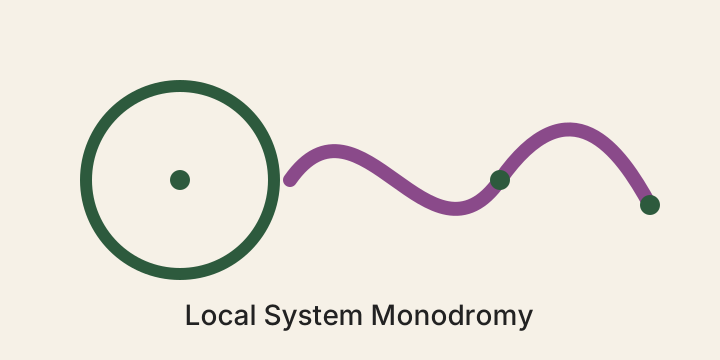
The picture is a guide: a local system is "constant data with a monodromy rule," and the rule is exactly the thing that fails to be determined by the space itself.
Worked example [Beginner]
The Möbius strip's central circle. Consider the rank-one local system whose monodromy around the central loop is multiplication by . Sections of this local system are functions that flip sign after one lap. The only such continuous function is the zero function — there are no global sections. So the zeroth cohomology of the Möbius local system on the circle is zero.
Compare with the constant local system on the same circle. Sections are continuous functions; the zeroth cohomology is the one-dimensional space of constant functions.
What this tells us: a local system can have less cohomology than the constant system, because the monodromy obstruction kills global sections. The orientation double cover of the Möbius strip — the cylinder — admits a real section (the constant function 1), but the section descends only as a sign-flipping section on the strip itself.
Check your understanding [Beginner]
Formal definition [Intermediate+]
Let be a topological space and a commutative ring (typically , , or ).
Local system. A local system of -modules on is a sheaf of -modules on such that every point has a neighborhood on which is isomorphic to a constant sheaf — that is, there exists an -module such that . The module is called the fiber of at any point of ; for a connected the fiber is independent of the chosen point up to isomorphism.
Bott-Tu §13 gives the equivalent locally constant presheaf definition: a presheaf on is locally constant if there is an open cover such that is a fixed module and the restriction maps are isomorphisms whenever . Sheafifying a locally constant presheaf gives a local system.
Monodromy representation. Fix a basepoint and let be the stalk at . For each loop based at , the locally-constant property allows the stalk to be transported along , returning to at the end. The transport depends only on the homotopy class of . The result is a homomorphism
the monodromy representation of [Bott-Tu §13].
Twisted cohomology. The cohomology with local-system coefficients is the sheaf cohomology
computed via injective resolutions of in the category of sheaves of -modules 04.03.01. For nice (paracompact, locally simply-connected) with universal cover and , twisted cohomology equals group cohomology:
when is a space.
Examples.
- The constant local system : monodromy is the identity. Twisted cohomology equals classical cohomology with constant coefficients.
- The orientation local system on a non-orientable manifold: monodromy is , with exactly when reverses orientation.
- The Möbius local system on : rank-one over , monodromy where is the generator.
Key theorem with proof [Intermediate+]
Theorem (monodromy theorem). Let be a connected, locally simply-connected, locally path-connected topological space with basepoint . The functor sending a local system to its monodromy representation,
is an equivalence of categories [Bott-Tu §13].
Proof. We construct quasi-inverses.
Forward functor. Given a local system with stalk , define for a loop at as follows. Since is locally simply-connected, the loop admits a finite cover by simply-connected opens with and . On each , is constant — pick an isomorphism . The composition
defines an automorphism of . Independence of the choice of cover and trivialisations follows from the simply-connected hypothesis on each . Independence of the homotopy class of follows from contracting a homotopy through nearby loops, applying the same argument finitely many times.
Backward functor. Given a representation , construct the associated local system as follows. Let be the universal cover, viewed as a principal -bundle. Form the associated sheaf
where acts diagonally — by deck transformations on and via on . This is a locally constant sheaf with fiber , and its monodromy representation recovers .
Equivalence. The two functors are quasi-inverse: starting from , building , and forming recovers up to natural isomorphism, and similarly the other direction. Naturality in and is immediate from the constructions.
The theorem is the structural foundation of Bott-Tu §13: local systems on connected are encoded by their monodromy, and computing cohomology with local-system coefficients reduces to a computation involving the -action.
Synthesis. A local system on a connected space is exactly a representation of . This is precisely the monodromy correspondence — the foundational bridge between fundamental-group representation theory and twisted cohomology. Local systems generalise the constant sheaf; the orientation local system is the canonical example used in twisted Poincaré duality.
Bridge. The construction here builds toward later units of the strand, where the same pattern is taken up at higher structure. The defining pattern appears again in those units in a sharpened form, where the local data is glued or quotiented. Putting these together, the foundational insight is that the data of this unit gives the structural signature that the rest of the strand reads off.
Exercises [Intermediate+]
Lean formalization [Intermediate+]
lean_status: none — Mathlib does not have a locally-constant-sheaf abstraction or the equivalence with -representations. The Riemann-Hilbert correspondence and twisted cohomology with local-system coefficients are also absent. See lean_mathlib_gap for the upstream contribution targets.
Pedagogically, the unit's content is statable in Lean once LocallyConstantSheaf, MonodromyRepresentation, and TwistedCohomology land. The two mainstream Lean-level statements are: (i) the monodromy equivalence as an equivalence of categories, and (ii) the identification of twisted cohomology on with group cohomology.
Advanced results [Master]
Twisted Poincaré duality
For an oriented manifold of dimension , ordinary Poincaré duality gives . On a non-orientable manifold, this fails — but a twisted version holds:
The orientation local system supplies exactly the "twist by orientation" needed to restore the duality. This is the Bott-Tu §7 reformulation: Poincaré duality always holds, but the right-hand side carries an orientation twist that is invisible when is orientable (the twist is then the constant system).
Local systems on spaces
When is a — Eilenberg-MacLane space with and all higher homotopy zero — the cohomology with local-system coefficients reduces to group cohomology:
This is the route by which classifying spaces compute group cohomology: , and group cohomology is sheaf cohomology on with the appropriate local system.
For , . The orientation local system on (with monodromy around the generator of ) computes where is the sign representation. The result for all matches the acyclicity of the Möbius local system on from Exercise 2.
Riemann-Hilbert correspondence
The Riemann-Hilbert correspondence on a complex manifold is the analytic equivalence
The forward functor sends to the sheaf of horizontal sections; the backward functor sends to with the canonical flat connection. The algebraic version, due to Deligne 1970, replaces "flat connection" with "regular singular flat connection" and operates on smooth quasi-projective varieties. The Kashiwara-Mebkhout extension to -modules carries the correspondence to the level of perverse sheaves, supplying the framework for the geometric Langlands programme.
Variations of Hodge structure
A variation of Hodge structure on a smooth quasi-projective complex variety is a local system with an extra structure: a Hodge filtration that varies holomorphically and satisfies the Griffiths transversality condition. Variations of Hodge structure are the natural target for the cohomology of a smooth proper family — by Deligne 1968, the higher direct images are local systems, and they carry a canonical Hodge structure extending the constant-system case.
This is the route by which Hodge theory globalises: pointwise Hodge structures on the cohomology of fibers vary in a controlled way along the base, encoded as a local system with a Hodge filtration.
Local systems on stratified spaces
On a stratified space (e.g., a complex algebraic variety with a Whitney stratification), constructible sheaves generalise local systems. A constructible sheaf is a sheaf that is locally constant on each stratum. The category of constructible sheaves is the natural setting for intersection cohomology and perverse sheaves — the framework in which the Kazhdan-Lusztig conjectures, the decomposition theorem, and the geometric Langlands correspondence live.
This unit invokes conn:438.local-system-pi1-rep from alg-geom.cohomology.local-system-monodromy to topology.homotopy (type: equivalence; anchor phrase: local system on connected X equivalent to π_1(X)-representation) and conn:439.local-system-twisted-de-rham from this unit to the Thom-cv-cohomology unit (type: foundation-of; anchor phrase: twisted de Rham complex built on orientation local system).
Full proof set [Master]
Pullback of a local system to a covering space
Let be a covering map with connected and locally simply-connected, and a local system on with monodromy . The pullback on has monodromy
When is the universal cover, is the inclusion of the one-element subgroup, and is the identity — pullback to the universal cover trivialises every local system. Exercise 4 is this statement specialised to the orientation double cover.
The Cartan-Eilenberg presheaf formulation
Cartan-Eilenberg 1956 §V.2 formulated local systems via presheaves with a -action: for each open a module , restriction maps for , and an action of on each for path-connected containing . Sheafifying gives a local system, and the presheaf-action data corresponds to the monodromy representation.
This formulation is what Bott-Tu §13 follows. It is computationally favourable because Čech cohomology is naturally a presheaf-based construction, and twisted Čech cohomology with local-system coefficients is the obvious presheaf-with-action generalisation.
Constructibility under operations
The pullback, pushforward, tensor product, and Hom of local systems are all local systems, with monodromy constructed from the constituent monodromies. For a continuous map :
- has monodromy .
- has monodromy .
- has monodromy (where is the contragredient).
Pushforward is generally not a local system — it is only constructible. This is the entry point to constructible-sheaf theory and the six-functor formalism.
Connections [Master]
Sheaf cohomology
04.03.01— the foundation: a local system is a special kind of sheaf, and twisted cohomology is sheaf cohomology of a locally constant sheaf. Connection type: foundation-of.Double cover
03.05.05— the orientation double cover trivialises the orientation local system; the simplest case of pullback-to-universal-cover. Connection type: instance.Covering space
03.12.02— local systems are in equivalence with -representations via the universal cover; covering-space theory is the geometric foundation. Connection type: foundation-of.Homotopy / fundamental group
03.12.01— the monodromy representation is a -representation; the equivalence is the monodromy theorem. Connection type: equivalence (anchor: local system on connected equivalent to -representation).De Rham cohomology
03.04.06— twisted de Rham cohomology with values in a flat bundle computes twisted cohomology with the corresponding local-system coefficients. Connection type: foundation-of (anchor: twisted de Rham complex built on orientation local system).Singular cohomology
03.04.13— twisted singular cohomology with local-system coefficients is the singular version of this unit's twisted cohomology. Connection type: generalisation.Eilenberg-MacLane space
03.12.05— for a , twisted cohomology equals group cohomology of with the corresponding -module. Connection type: bridging-theorem.Hodge decomposition
04.09.01— variations of Hodge structure are local systems with a Hodge filtration; the underlying local system carries the Gauss-Manin connection. Connection type: foundation-of.
Throughlines and forward promises. Local systems are the foundational tool for cohomology with twisted coefficients. We will see twisted Poincaré duality on non-orientable manifolds run through the orientation local system; we will see variations of Hodge structure refine local systems with extra holomorphic data. This pattern recurs throughout the Hodge-theoretic and Galois-theoretic generalisations of sheaf cohomology. The foundational reason local systems on connected are equivalent to -representations is exactly the monodromy correspondence. Putting these together: a local system is an instance of a constructible sheaf, the generalisation of constant cohomology, and the bridge between fundamental-group representation theory and twisted cohomology. This is precisely Poincaré 1883's monodromy insight made categorical. The bridge between -representations and locally constant sheaves is exactly the universal-cover trivialisation; this pattern recurs in étale cohomology, in -module theory, and in the Riemann-Hilbert correspondence.
Historical & philosophical context [Master]
Henri Poincaré's 1883 Sur les groupes des équations linéaires (Acta Mathematica 4, 201–311) introduced monodromy in the context of linear ordinary differential equations on the punctured complex plane. A linear ODE with regular singularities has a fundamental matrix of solutions; analytically continuing this matrix around a singularity produces a new fundamental matrix, related to the original by a constant invertible matrix — the monodromy matrix. The collection of monodromy matrices for all loops generates a representation of the fundamental group of the punctured domain, which Poincaré called the monodromy group.
Cartan and Eilenberg's 1956 Homological Algebra §V.2 formulated local systems abstractly as locally constant sheaves with -action, divorcing the concept from its analytic origin in differential equations. The presheaf formulation makes the same data computationally accessible via Čech cohomology, which is the route Bott-Tu §13 takes.
Deligne's 1970 Équations différentielles à points singuliers réguliers (Lecture Notes in Math. 163) extended the Riemann-Hilbert correspondence to the algebraic setting, identifying local systems on a smooth quasi-projective variety with regular-singular flat connections. The 1980s extension to -modules by Kashiwara, Mebkhout, and Beilinson-Bernstein-Deligne carried the correspondence to the level of perverse sheaves, supplying the framework in which intersection cohomology and the geometric Langlands programme are formulated.
The lineage: Poincaré 1883 (analytic monodromy of ODE) → Cartan-Eilenberg 1956 (presheaf formulation) → Bott-Tu 1982 §13 (the Čech-friendly textbook account) → Deligne 1970 (algebraic Riemann-Hilbert) → Kashiwara-Mebkhout 1980s (-modules and perverse sheaves). Each step extracted more of the structural content of "locally constant data with monodromy", culminating in the perverse-sheaf formalism that animates current work in geometric representation theory.
Bibliography [Master]
- Poincaré, H., "Sur les groupes des équations linéaires", Acta Mathematica 4 (1883), 201–311.
- Cartan, H. & Eilenberg, S., Homological Algebra, Princeton University Press, 1956.
- Bott, R. & Tu, L. W., Differential Forms in Algebraic Topology, Springer, 1982. §13.
- Voisin, C., Hodge Theory and Complex Algebraic Geometry I, Cambridge University Press, 2002. §3.
- Deligne, P., Équations différentielles à points singuliers réguliers, Lecture Notes in Mathematics 163, Springer, 1970.
- Kashiwara, M., "The Riemann-Hilbert problem for holonomic systems", Publications of the Research Institute for Mathematical Sciences 20 (1984), 319–365.
- Beilinson, A., Bernstein, J. & Deligne, P., "Faisceaux pervers", Astérisque 100 (1982), 5–171.
Pass 4 Agent B unit N11. Local systems, monodromy, twisted cohomology — closes Bott-Tu §13 gap and supplies the local-system foundation for the orientation-twisted Poincaré duality and the Riemann-Hilbert correspondence.