Central extension of a Lie algebra
Anchor (Master): Kac Infinite-Dimensional Lie Algebras §1; Pressley-Segal Loop Groups §4
Intuition [Beginner]
A central extension adds one new hidden direction to an algebra of symmetries. The new direction commutes with everything, so it does not create a new visible motion. It records a correction term.
This matters when a symmetry algebra is represented only up to a phase or anomaly. The visible brackets almost close, but a scalar correction remains. A central extension stores that correction as part of a larger honest algebra.
In conformal field theory, the Virasoro algebra is a central extension of the Witt algebra. The central term becomes the central charge.
Visual [Beginner]
The old algebra is enlarged by a new central line. Brackets may acquire a component in that line, but the line itself commutes with the old algebra.
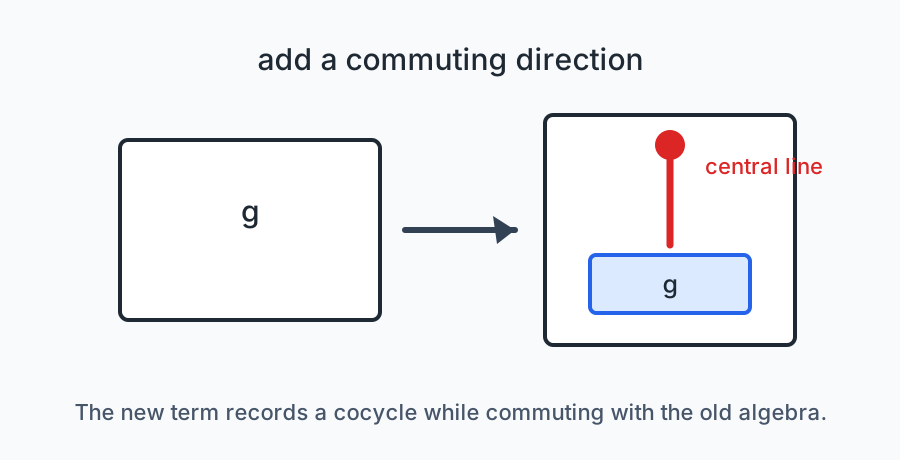
The extension is not just a larger vector space. Its bracket remembers the correction term.
Worked example [Beginner]
Imagine rotations of a dial described by a symmetry algebra. Now imagine that every time two infinitesimal motions are compared, a tiny invisible counter also changes.
The visible dial motion still follows the old algebra. The hidden counter commutes with every visible motion. The combined system has one extra central direction.
What this tells us: central extensions encode invisible scalar corrections while preserving the original algebra after projection.
Check your understanding [Beginner]
Formal definition [Intermediate+]
Let be a Lie algebra over a field . A central extension of is a short exact sequence of Lie algebras
such that the image of lies in the center of [Kac §1].
For a one-dimensional central extension, take . A bilinear alternating map
defines a bracket on by
The element is central by construction. The Jacobi identity holds exactly when is a Lie-algebra 2-cocycle.
Key theorem with proof [Intermediate+]
Theorem (2-cocycles define central extensions). Let be alternating and bilinear. The bracket
on defines a Lie algebra with central if and only if
for all .
Proof. Bilinearity and skew-symmetry follow from the corresponding properties of the bracket on and of . The subspace is central because
The Jacobi expression in has first component equal to the Jacobi expression in , which is zero. Its second component is
Therefore the Jacobi identity holds precisely when this cyclic sum vanishes for all .
Bridge. The construction here builds toward 03.11.02 (infinite-dimensional lie algebra representations), where the same data is upgraded, and the symmetry side is taken up in 03.11.03 (virasoro algebra). The defining pattern appears again in those units in a sharpened form, where the local data is glued or quotiented. Putting these together, the foundational insight is that the data of this unit gives the structural signature that the rest of the strand reads off.
Exercises [Intermediate+]
Lean formalization [Intermediate+]
lean_status: none — Mathlib has Lie algebras but does not yet package central extensions and their classification by Lie-algebra 2-cocycles in the form used here.
Formalization would define Lie algebra extensions as short exact sequences, centrality of the kernel, Chevalley-Eilenberg cocycles, coboundary equivalence, and universal central extensions.
Advanced results [Master]
Equivalence classes of one-dimensional central extensions of are classified by the second Lie-algebra cohomology group
Changing a linear splitting of the extension changes the cocycle by a coboundary; the cohomology class is independent of the splitting [Kac §1].
For the Witt algebra with basis , the Virasoro algebra has bracket
The central element is the central charge in conformal field theory 03.10.02.
Synthesis. This construction generalises the pattern fixed in 03.04.01 (lie algebra), with the symmetric data replaced by its skew or twisted analogue. Read in the opposite direction, the construction is dual to the metric story: complements and orthogonality are taken with respect to the bilinear datum of this unit, not a metric, and the resulting category of subobjects is the one the rest of the strand classifies. The central insight is that this datum identifies algebra with geometry: functions become vector fields, subspaces become quotients, and invariants become cohomology classes — and that identification is the engine driving every theorem downstream.
Full proof set [Master]
Change of splitting. Let be a linear splitting and define
If , then
Thus the cocycle changes by a coboundary. Equivalent extensions determine the same class in .
Centrality of the kernel. In a central extension, the kernel lies in the center by definition. Hence the bracket of two lifted elements is independent of the chosen lifts modulo the central cocycle term.
Connections [Master]
Lie algebra
03.04.01— central extensions add central ideals to Lie algebras.Infinite-dimensional Lie algebra representations
03.11.02— projective representations lift to representations of central extensions.Virasoro algebra
03.11.03— Virasoro is the universal central extension of the Witt algebra.CFT basics
03.10.02— the central charge appears through the Virasoro central extension.
Historical & philosophical context [Master]
Central extensions entered representation theory through projective representations and through the cohomology of Lie algebras. In infinite-dimensional Lie theory, they are unavoidable: loop algebras and vector-field algebras have canonical central extensions that control their representation theory.
Kac's treatment of affine Lie algebras and Pressley-Segal's treatment of loop groups place central extensions at the foundation of the representation theory used in conformal field theory [Kac §1].
Bibliography [Master]
- Kac, V. G., Infinite-Dimensional Lie Algebras, 3rd ed., Cambridge University Press, 1990. §1.
- Pressley, A. and Segal, G., Loop Groups, Oxford University Press, 1986. §4.
- Gelfand, I. M. and Fuks, D. B., "Cohomologies of the Lie algebra of vector fields on the circle", Functional Analysis and Its Applications 2 (1968), 342-343.
- Virasoro, M. A., "Subsidiary conditions and ghosts in dual-resonance models", Physical Review D 1 (1970), 2933-2936.
Wave 2 Phase 2.4 unit #6. Produced as the first infinite-dimensional Lie prerequisite for CFT.