CFT basics
Anchor (Master): Di Francesco-Mathieu-Sénéchal §5; Polchinski Vol. 1 §2; Tong — String Theory §4
Intuition [Beginner]
A conformal transformation preserves small angles while allowing local changes of scale. A tiny square may become a tiny rectangle-like patch, but the meeting angles of crossing curves stay the same.
A conformal field theory is a field theory whose local measurements respect this angle-preserving freedom. This is much stronger than ordinary rotation or translation symmetry. In two dimensions the symmetry becomes infinite-dimensional, which is why CFT is unusually computable.
The basic objects are local operators. An operator is placed at a point, and the theory assigns rules for how several such insertions interact as their points move.
Visual [Beginner]
The grid is stretched unevenly, but small crossing angles are preserved. The marked insertions represent local operators, and the rings suggest how nearby insertions affect one another.
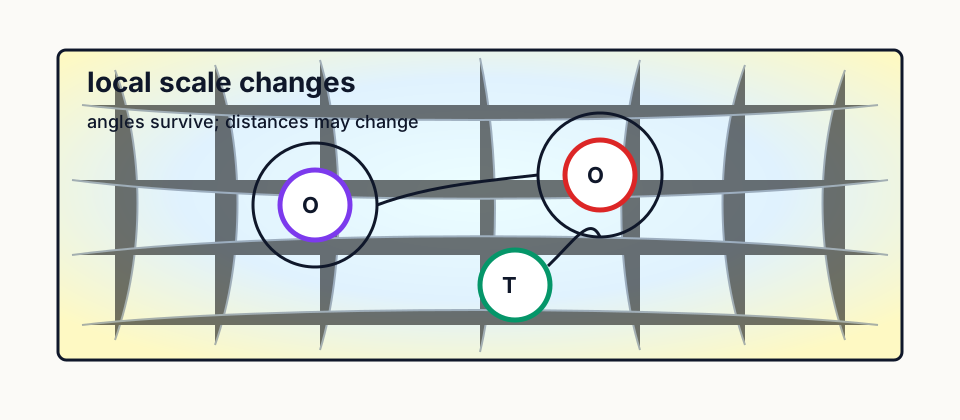
The important idea is local scale freedom. Distances may change from point to point, while angles remain meaningful.
Worked introduction [Beginner]
Place two identical operator insertions on a flat sheet. Translation symmetry says that only their separation matters. Rotation symmetry says that only the distance between them matters.
Conformal symmetry says more. If the sheet is locally stretched in an angle-preserving way, the answer must transform by a fixed scaling rule attached to the operator. That scaling rule is called its dimension.
For many two-dimensional theories, knowing the dimensions and a small amount of algebraic data determines large families of correlation functions.
Check your understanding [Beginner]
Formal definition [Intermediate+]
A two-dimensional Euclidean CFT assigns correlation functions
to local operators on a Riemann surface, with covariance under local holomorphic coordinate changes. A primary field of weights transforms under as
The scaling dimension is , and the spin is [tong §4].
The holomorphic stress tensor controls infinitesimal conformal transformations. Its Laurent modes are written
The quantum symmetry algebra is the Virasoro algebra
where is the central charge [Di Francesco-Mathieu-Sénéchal §5].
Key theorem with proof [Intermediate+]
Theorem (local conformal vector fields form the Witt algebra). On a complex coordinate patch, the holomorphic infinitesimal conformal transformations have basis
and satisfy
Proof. A holomorphic vector field has the form . For two such fields,
Set and . Then
Since , this gives
These vector fields are the classical holomorphic conformal symmetry modes. Quantization replaces their representation by the centrally extended Virasoro algebra.
Bridge. The Virasoro central extension and the operator-product algebra of stress-tensor modes build toward the modular-functor / TQFT formulation, where the partition function on a Riemann surface is exactly a section of a determinant line bundle — and the modular anomaly appears again in 03.09.10 (Atiyah-Singer) as the holomorphic anomaly of the Quillen metric on . Putting these together, the foundational reason a two-dimensional field theory carries a central charge is that conformal invariance is dual to a one-cocycle on the diffeomorphism algebra, and that cocycle's curvature is exactly on moduli space.
Exercises [Intermediate+]
Lean formalization [Intermediate+]
lean_status: none — Mathlib can state many Lie-algebraic notions, but not conformal field theory as a mathematical object.
Formalization would start with the Witt algebra as derivations of Laurent polynomials, then add its universal central extension. Local operators, OPEs, and Ward identities require new field-theoretic libraries.
Advanced results [Master]
The operator product expansion records the singular part of nearby operator insertions:
Associativity of the OPE imposes crossing constraints on four-point functions. In rational CFT these constraints reduce much of the theory to finite algebraic data: representations of the chiral algebra, fusion rules, modular transformation matrices, and compatible correlation functions [Di Francesco-Mathieu-Sénéchal §5].
Radial quantization identifies local operators at the origin with states on the circle. The Hamiltonian for radial time is up to the conventional central-charge shift on the cylinder. This is the state-operator correspondence used throughout string worldsheet theory [tong §4].
For the bosonic string, vanishing of the total conformal anomaly fixes the critical central charge. Polchinski's treatment uses this worldsheet CFT structure to organize quantization, vertex operators, ghosts, and scattering amplitudes [Polchinski Vol. 1 §2].
Synthesis. Two-dimensional conformal symmetry generalises the finite-dimensional Möbius algebra to the infinite-dimensional Witt-Virasoro algebra, with the bilinear datum being the OPE of the holomorphic stress tensor . The central insight is that the central charge is exactly the coefficient of the most singular OPE term and identifies the theory with a representation of : this is exactly the foundational reason rational CFTs are classified by representation-theoretic data (modular tensor categories) rather than by classical Lagrangians. Read in the opposite direction, conformal invariance is dual to scale invariance plus locality, and putting these together gives the bridge to algebraic geometry: Verlinde's formula identifies dimensions of conformal blocks with intersection numbers on moduli of bundles on a curve.
Full proof set [Master]
Two-dimensional conformal transformations. In real dimension two, an orientation-preserving local conformal map is holomorphic in a compatible complex coordinate. Its infinitesimal generators are holomorphic vector fields and antiholomorphic vector fields . The holomorphic and antiholomorphic sectors commute locally.
Witt bracket. The Intermediate proof gives the holomorphic bracket. The antiholomorphic modes
satisfy the same bracket, and
Thus the local classical conformal algebra is two commuting copies of the Witt algebra.
Virasoro extension. Projective quantum implementation of the Witt algebra admits a central extension. With generators and central element , the bracket is
In an irreducible representation, acts by the scalar central charge . This scalar appears in the operator product and in the conformal anomaly [Di Francesco-Mathieu-Sénéchal §5].
Connections [Master]
Spin structure
03.09.04— fermionic CFTs on Riemann surfaces depend on spin structures and Ramond/Neveu-Schwarz sectors.Yang-Mills action
03.07.05— gauge theory and CFT share stress-tensor methods, anomalies, and current algebras.Dirac operator
03.09.08— free fermion CFTs use chiral Dirac operators on Riemann surfaces.Atiyah-Singer index theorem
03.09.10— anomalies in two-dimensional field theories are organized by index-theoretic constructions.Bott periodicity
03.08.07— K-theoretic periodicity reappears in the classification of fermionic phases and anomaly data, outside the basic CFT unit.
Historical & philosophical context [Master]
Belavin, Polyakov, and Zamolodchikov made two-dimensional conformal symmetry into an exact computational method in 1984 by exploiting the Virasoro algebra and its representations. The textbook treatment of Di Francesco, Mathieu, and Sénéchal systematizes this representation-theoretic approach [Di Francesco-Mathieu-Sénéchal §5].
String theory made CFT a central geometric tool because a string worldsheet theory must retain conformal symmetry after gauge fixing the Polyakov action. Tong's notes introduce CFT in this worldsheet role, including OPEs, Ward identities, radial quantization, and the state-operator map [tong §4].
Bibliography [Master]
- Belavin, A. A., Polyakov, A. M. & Zamolodchikov, A. B., "Infinite conformal symmetry in two-dimensional quantum field theory", Nuclear Physics B 241 (1984), 333–380.
- Di Francesco, P., Mathieu, P. & Sénéchal, D., Conformal Field Theory, Springer, 1997. §5.
- Polchinski, J., String Theory, Vol. 1, Cambridge University Press, 1998. §2.
- Tong, D., Lectures on String Theory, §4.
Pilot unit #9. Produced in the continuation pass; complex-analysis and quantum-field-theory prerequisites remain pending.