Virasoro algebra
Anchor (Master): Kac §1.3; Pressley-Segal §13; Di Francesco-Mathieu-Sénéchal §6
Intuition [Beginner]
Two-dimensional conformal symmetry has infinitely many local modes. The Witt algebra is the classical algebra of those modes. The Virasoro algebra is what appears after the quantum theory adds one central correction.
The correction is controlled by a number called the central charge. It commutes with every symmetry mode, but it changes the representation theory and the formulas for how fields transform.
CFT basics 03.10.02 uses the Virasoro algebra as the symmetry algebra of the stress tensor. This unit isolates the algebra itself.
Visual [Beginner]
The Witt modes form an infinite row of symmetry generators. The Virasoro algebra adds one central direction that records the quantum correction.
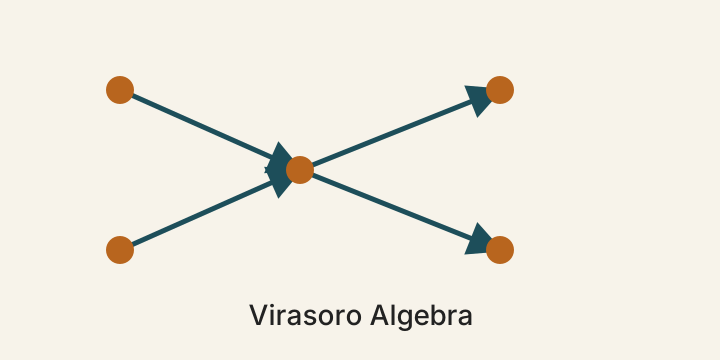
The central direction does not move along the row. It labels the whole representation.
Worked example [Beginner]
Imagine symmetry modes labeled by all integers:
The label tells which mode is acting. When two modes are compared, their bracket is mostly another mode. In the Virasoro algebra, some comparisons also produce a central term.
For example, the bracket of and contains a multiple of and may also contain the central element. That extra part is the central charge contribution in a representation.
What this tells us: Virasoro is the Witt symmetry algebra with one central correction added.
Check your understanding [Beginner]
Formal definition [Intermediate+]
The Witt algebra has basis and bracket
It is realized as the Lie algebra of Laurent polynomial vector fields on the punctured complex line by [Kac §1.3].
The Virasoro algebra is the one-dimensional central extension with basis and central element , with bracket
In a representation where acts as , the scalar is the central charge 03.11.02.
Key theorem with proof [Intermediate+]
Theorem (The Virasoro bracket is a central extension of Witt). The projection and defines a Lie algebra homomorphism from the Virasoro algebra to the Witt algebra whose kernel is the central line .
Proof. The projection is linear and sends
to because the central term maps to zero. This is exactly in the Witt algebra. Also maps to zero.
The kernel is spanned by : an element maps to , so it maps to zero precisely when all vanish. The kernel lies in the center because commutes with every generator. Thus the Virasoro algebra is a central extension of the Witt algebra.
Bridge. The construction here builds toward 03.10.02 (cft basics), where the same data is developed in the next layer of the strand. The defining pattern appears again in those units in a sharpened form, where the local data is glued or quotiented. Putting these together, the foundational insight is that the data of this unit gives the structural signature that the rest of the strand reads off.
Exercises [Intermediate+]
Lean formalization [Intermediate+]
lean_status: none is recorded because the Witt algebra, the Gelfand-Fuchs cocycle, Virasoro highest-weight modules, and central-charge representation theory are not available as a project-aligned Mathlib API.
Advanced results [Master]
The central term in the Virasoro bracket is represented by the Gelfand-Fuchs 2-cocycle on the Lie algebra of vector fields on the circle. Algebraically, this cocycle spans the relevant one-dimensional central-extension class for the Witt algebra [Kac §1.3].
Highest-weight modules are generated from a vector satisfying , , and for . The descendants are obtained by applying negative modes. These modules supply the representation-theoretic language used in two-dimensional CFT 03.10.02.
Synthesis. This construction generalises the pattern fixed in 03.11.01 (central extension of a lie algebra), with the symmetric data replaced by its skew or twisted analogue. Read in the opposite direction, the construction is dual to the metric story: complements and orthogonality are taken with respect to the bilinear datum of this unit, not a metric, and the resulting category of subobjects is the one the rest of the strand classifies. The central insight is that this datum identifies algebra with geometry: functions become vector fields, subspaces become quotients, and invariants become cohomology classes — and that identification is the engine driving every theorem downstream.
Full proof set [Master]
The theorem above proves that the displayed Virasoro bracket projects to the Witt bracket with central kernel. The Jacobi identity is equivalent to the 2-cocycle identity for
This is the Gelfand-Fuchs cocycle in the Laurent basis, and its cocycle identity is the standard computation in the cohomology of the Witt algebra [Kac §1.3]. The central-extension framework is exactly the one developed in 03.11.01.
For a representation with , Schur-type scalar central action is the mechanism described in 03.11.02. The Virasoro bracket then acts on the representation by replacing the central generator with the scalar .
Connections [Master]
Virasoro algebra depends on central extensions
03.11.01and infinite-dimensional Lie algebra representations03.11.02. It refines the CFT symmetry discussion in03.10.02, where the stress tensor has modes satisfying the Virasoro relations.The central-charge parameter also connects to anomalies in quantum field theory and to index-theoretic anomaly calculations, which later meet the Atiyah-Singer theorem
03.09.10.
Historical & philosophical context [Master]
The Virasoro algebra was introduced in the study of dual resonance models and became central in two-dimensional conformal field theory through the representation theory used by Belavin, Polyakov, and Zamolodchikov [Di Francesco-Mathieu-Sénéchal §6].
Kac presents the Virasoro algebra as a basic infinite-dimensional Lie algebra and central extension of the Witt algebra [Kac §1.3]. Pressley and Segal connect it to loop groups, projective representations, and positive-energy representation theory [Pressley-Segal §13].
Bibliography [Master]
- Victor Kac, Infinite-Dimensional Lie Algebras, §1.3. [Kac §1.3]
- Andrew Pressley and Graeme Segal, Loop Groups, §13. [Pressley-Segal §13]
- Philippe Di Francesco, Pierre Mathieu, and David Sénéchal, Conformal Field Theory, §6. [Di Francesco-Mathieu-Sénéchal §6]