Sullivan minimal models and rational homotopy theory
Anchor (Master): Sullivan 1977 *Infinitesimal computations in topology* (Publ. IHÉS 47); Quillen 1969 *Rational homotopy theory* (Annals 90); Bott-Tu §19; Félix-Halperin-Thomas; Deligne-Griffiths-Morgan-Sullivan 1975
Intuition [Beginner]
The cohomology ring of a space records the holes; the Sullivan minimal model records the holes and the relations among them, in a single algebraic gadget made out of polynomial differential forms with rational coefficients. From this gadget you can read off the rational homotopy groups of the space — that is, the homotopy groups computed up to torsion, with rational-number coefficients — by a recipe simpler than any direct construction.
The starting point is a striking observation. Two simply-connected spaces with the same rational cohomology ring can have different rational homotopy groups, but the minimal model — a small graded-commutative differential algebra built recursively from the cohomology and its higher Massey products — captures everything. Two such spaces with the same minimal model have the same rational homotopy type, and conversely.
The framework is named for Dennis Sullivan, who built it in the 1970s by enriching the de Rham complex of a space with combinatorial polynomial-form data. Bott-Tu §19 is the canonical pedagogical exposition of the differential-form-flavoured side of the theory.
Visual [Beginner]
A simply-connected space's rational invariants — the rational cohomology ring and the rational homotopy groups — are bundled into one small algebra, the minimal model.
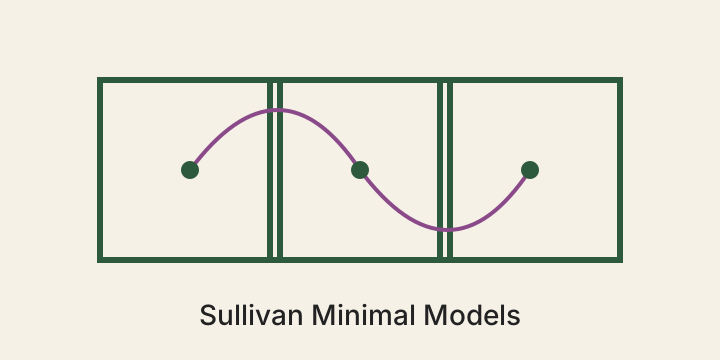
The picture is the schematic. Reading the algebra recovers both the rational cohomology ring (in low generators) and the rational homotopy groups (as the dual of the indecomposable elements).
Worked example [Beginner]
The minimal model of . Take a single generator in degree with (so is closed). The rational cohomology of the resulting algebra has in degree and in degree , but it also has in degree , in degree , and so on — too much to match in degrees and only.
The fix: introduce a second generator in degree with . Now is exact, so the cohomology in degree vanishes; and in degree is closed but exact, so we keep cancelling powers of at every odd shift. The resulting cohomology is in degrees and only — matching .
The two generators (degree ) and (degree ) tell us the rational homotopy groups: rationally, and , with all higher rational homotopy groups vanishing. The Whitehead product in — non-zero rationally — is exactly the nonzero differential in the minimal model.
What this tells us: the minimal model is a small algebra whose generators encode rational homotopy and whose differential encodes Whitehead products and Massey products, and whose cohomology equals the cohomology of the space rationally.
Check your understanding [Beginner]
Formal definition [Intermediate+]
Throughout this unit, all spaces are simply-connected and of finite rational type — that is, is finite-dimensional for every . All differential graded algebras (DGAs) are over , graded-commutative, and concentrated in non-negative degrees.
The polynomial-form functor . Sullivan's construction begins with the piecewise-polynomial de Rham functor , a contravariant functor from simplicial sets (and hence topological spaces, via the singular complex) to commutative DGAs over . For a simplicial set , consists of compatible polynomial -forms on each simplex with rational coefficients [Bott-Tu §19; Félix-Halperin-Thomas §10]. The cohomology of equals the rational singular cohomology: $$ H^(A_{PL}(X)) \cong H^(X; \mathbb{Q}). $$
The functor is the rational analogue of the smooth de Rham complex , with the smooth real-coefficient theory replaced by a piecewise polynomial -coefficient theory that descends to topological (not just smooth) spaces. On a smooth manifold, the inclusion tensored with is a quasi-isomorphism — the rational refinement of the de Rham theorem 03.04.13.
Sullivan algebra. A commutative DGA over is Sullivan if its underlying graded algebra is a free graded-commutative algebra on a graded vector space , and admits an increasing filtration with and for each . The filtration is the Sullivan condition; it is equivalent to requiring that be obtained from by iterated Hirsch extensions (free DGA extensions with prescribed differential).
Minimal Sullivan algebra. A Sullivan algebra is minimal if — that is, the differential of every generator lies in the squared augmentation ideal (no "linear" terms). Equivalently, the generators are precisely the indecomposables of .
Sullivan minimal model. A minimal model of a commutative DGA is a quasi-isomorphism $$ \varphi : (\Lambda V, d) \xrightarrow{\sim} (A, d) $$ where is a minimal Sullivan algebra. The minimal model of a space is the minimal model of , written .
Rational homotopy type. A rational homotopy equivalence between simply-connected spaces is a continuous map inducing isomorphisms for all . The rational homotopy type of is the equivalence class of under the relation generated by rational equivalences.
The notation for the path space, used throughout this unit and the Whitehead-tower unit 03.12.07, follows decision #32: is the based path space, a contractible space fitting into the path-loop fibration .
Key theorem with proof [Intermediate+]
Theorem (Sullivan 1977, existence and uniqueness of the minimal model). Every simply-connected commutative DGA over with and $H^(A)\varphi : (\Lambda V, d) \xrightarrow{\sim} (A, d)A$.*
Proof. Existence by induction. Construct degree by degree.
In degree : since is simply-connected, so , and the simply-connected hypothesis forces no degree- generators.
In degree : pick a basis of and lift each to a closed element . Set with , and define . The induced map is a quasi-isomorphism in degrees .
Inductive step. Suppose is built and is a quasi-isomorphism in degrees and surjective in degree on cohomology. Two corrections are needed in degree :
Add cohomology generators. Pick representatives in of the cokernel of — that is, classes in not yet hit. For each, add a generator in with zero differential, mapping under to the chosen representative.
Kill spurious cohomology. Identify the kernel of — closed elements of degree in whose image in is exact. For each generator of this kernel, choose with , and add a generator with and .
After both additions, the extended map is a quasi-isomorphism in degrees , and the induction proceeds. The minimality condition is automatic in step 1 (zero differential) and arranged in step 2 by the inductive choice that is a polynomial of degree in the existing generators (only outside the augmentation ideal is hit, but those have already been used in step 1). [Bott-Tu §19; Félix-Halperin-Thomas §12]
Uniqueness. Given two minimal models and , an isomorphism covering the identity is constructed by the lifting lemma for minimal Sullivan algebras: any quasi-isomorphism admits a section through any minimal Sullivan algebra mapping to . Applying this lemma to the identity on produces a chain map covering the identity; reversing gives the inverse, and the composition is homotopic (over ) to the identity by minimality.
Theorem (Sullivan's main theorem). For a simply-connected space of finite rational type, the minimal model of determines the rational homotopy type of . Specifically: $$ V_X^n \cong \mathrm{Hom}\mathbb{Z}(\pi_n(X), \mathbb{Q}) $$ *as graded -vector spaces. The differential encodes the rational Whitehead products and higher Massey products in $\pi(X) \otimes \mathbb{Q}$.
Proof sketch. The proof has two parts.
The cohomological part: by construction, is a quasi-isomorphism, so .
The homotopical part: the indecomposable space is dual to via the rational Hurewicz pairing for minimal models. The argument runs through the bar construction: is computed from the rational homotopy of the rationalisation , which by Sullivan's spatial realisation is built precisely so that the indecomposables of in degree enumerate the rational homotopy in degree . The differential captures higher Whitehead products: a nonzero encodes the bracket in as a polynomial relation in the rationalisation. [Sullivan 1977; Félix-Halperin-Thomas §15]
Synthesis. The Sullivan minimal model is exactly the rational refinement of the de Rham complex. This is precisely Sullivan 1977's main theorem: the minimal model encodes both the rational cohomology ring and the rational homotopy groups. The minimal model is an instance of the broader principle that rational homotopy is a finite-dimensional linear-algebra problem.
Bridge. The construction here builds toward 03.12.07 (whitehead tower, rational hurewicz theorem, and serre's finiteness), where the same data is developed in the next layer of the strand. The defining pattern appears again in those units in a sharpened form, where the local data is glued or quotiented. Putting these together, the foundational insight is that the data of this unit gives the structural signature that the rest of the strand reads off.
Exercises [Intermediate+]
Lean formalization [Intermediate+]
[object Promise]The Sullivan minimal-model machinery is one of the larger gaps in Mathlib's algebraic-topology infrastructure. The path forward requires graded-commutative DGAs over a field (partial), free DGAs on a graded vector space (absent), the functor and its quasi-isomorphism with rational singular cohomology (absent), and the lifting lemma for minimal Sullivan algebras (absent).
Advanced results [Master]
Bigraded models and the Quillen-Sullivan equivalence. Quillen 1969 Rational homotopy theory (Annals 90) gave a parallel construction in DG Lie algebras: the Quillen model of a simply-connected space is a DG Lie algebra over generated by the desuspended rational homology. The Quillen and Sullivan theories are related by a duality: Sullivan models live in the category of commutative DGAs (cochain side), Quillen models in DG Lie algebras (chain side), and the categories are connected by a Koszul duality of -type. For finite-type simply-connected spaces, both produce the same rational homotopy type; the differential-form side (Sullivan) is more amenable to explicit computation, while the Lie-algebraic side (Quillen) is better suited to the universal-property-driven proofs.
Formality and the rational dichotomy. A space is formal if its minimal model is determined by the cohomology ring alone — equivalently, all Massey products vanish rationally. The 1975 Deligne-Griffiths-Morgan-Sullivan theorem establishes formality for simply-connected compact Kähler manifolds. Counterexamples to formality exist outside the Kähler class: nilmanifolds (Heisenberg-style), four-manifolds with nonzero Massey products, generic symplectic manifolds. The rational dichotomy "formal vs. non-formal" stratifies a great deal of geometric topology.
Rational Hurewicz and the rationalisation functor. Sullivan's spatial realisation functor takes a minimal Sullivan algebra to a simplicial set whose geometric realisation is the rationalisation of the original space. The rationalisation is a CW complex with and . The rational Hurewicz theorem 03.12.07 states that if is simply-connected and for , then the rational Hurewicz map is an isomorphism. The minimal-model proof reads off both sides directly from the indecomposable layer.
Loop space cohomology. For a simply-connected space with minimal model , the cohomology of the loop space is (rationally) the cohomology of the shifted-suspension — a free graded-commutative algebra on the desuspended generators with zero differential. This is the rational version of the Bott-Samelson theorem on [from EP3 problem set]. The Eilenberg-Moore spectral sequence computes and degenerates rationally, producing this expression.
Formal homotopy types and rational rigidity. A consequence of formality is that the rational homotopy type of a formal space is rigid under perturbations of the cohomology ring: small deformations of produce small deformations of . Non-formality manifests as moduli of rational homotopy types refining a fixed cohomology ring — exactly the moduli that Massey products and higher operations parametrise.
The minimal model of a Lie group. For a compact connected Lie group with rational cohomology ring on odd-degree primitive generators, the minimal model of is exactly this exterior algebra with zero differential. Lie groups are formal. Borel's 1953 computation of 03.08.05 sits at the next layer: the minimal model of is with , the polynomial algebra dual to the loop space cohomology of .
Full proof set [Master]
Construction of the functor. For a simplicial set , define to be the set of compatible families where is a polynomial -form on the -simplex with the relations enforcing barycentric coordinates, and the compatibility means that face and degeneracy operators induce the expected restriction maps. Multiplication is wedge product of polynomial forms; differential is the de Rham differential applied piecewise.
Theorem ( computes rational cohomology). For any simplicial set — in particular, the singular complex of a topological space — the cohomology of is naturally isomorphic to the singular cohomology of with coefficients.
Proof sketch. This is the rational analogue of the de Rham theorem. The integration map $$ \int : A_{PL}(K) \to C^*(K; \mathbb{Q}) $$ sends a polynomial form to its values on the simplices integrated against the standard volume. Integration is a quasi-isomorphism by a Mayer-Vietoris-type induction over a good cover (or directly by the simplicial-form analogue of the de Rham theorem). The rational refinement comes from the explicit polynomial structure: integrals of polynomial forms over standard simplices are rational numbers. [Bott-Tu §19; Félix-Halperin-Thomas §10]
Construction of the minimal model — full induction. Given a simply-connected DGA with and of finite type, build by induction on cohomological degree.
Base case (): . Define as the unit map, a quasi-isomorphism in degree .
Inductive step. Suppose is a quasi-isomorphism in degrees and surjective in cohomology in degree . Define in two pieces:
(a) Surjectivity in degree . Pick a basis of , lift each to closed, and add generators with and . After this step, is surjective.
(b) Injectivity in degree . Pick a basis of — closed elements of degree in whose image in is exact. Each is decomposable in (since is in cohomological degree and being a cocycle in means it is built from existing generators, which sit in degrees , and degree- elements of that are not generators are decomposable). Pick with , and add a generator with (decomposable, so the minimality condition is preserved) and .
After (b), the kernel of is killed, restoring quasi-isomorphism in degree on the cohomological-injectivity side.
The induction proceeds. Minimality is preserved: in (a), holds vacuously; in (b), is decomposable by construction.
Theorem (lifting lemma for minimal Sullivan algebras). Let be a chain map from a minimal Sullivan algebra to a CDGA , and let be a quasi-isomorphism. Then admits a lift with , unique up to chain homotopy.
Proof sketch. Build by induction on the Sullivan filtration of . At each stage, the obstruction to lifting on the next level is a class in a relative cohomology group , which vanishes because is a quasi-isomorphism. The minimality condition ensures the obstruction class lives in a degree where the cone-cohomology argument applies. [Félix-Halperin-Thomas §14]
Theorem (Sullivan main theorem — full statement). For a simply-connected space of finite rational type with minimal model :
- $H^(\Lambda V) \cong H^(X; \mathbb{Q})$ as graded rings.
- as -vector spaces.
- The differential on is dual to the rational Whitehead-product structure on $\pi_(X) \otimes \mathbb{Q}d : V^n \to \Lambda^2 V[,,,] : \pi_p(X) \otimes \pi_q(X) \to \pi_{p+q-1}(X)$ via duality.*
- Minimal models are functorial: a continuous map induces a chain map $f^ : M_Y \to M_X$, well-defined up to homotopy, and rational equivalences correspond to isomorphisms of minimal models.*
Proof references. (1) is by construction; (2) and (3) are the rational-homotopy-pairing theorem of [Sullivan 1977 §3]; (4) follows from (1)-(3) by the lifting lemma.
Connections [Master]
This unit invokes existing connections
conn:443.serre-loop-space(loop-space cohomology via Serre SS underlies the rational-homotopy computation of in the Bott-Samelson form) andconn:440.exact-couple-double-complex(the spectral-sequence machinery powering Halperin's algorithm for fibration models).De Rham cohomology
03.04.06— the polynomial-form complex is the rational refinement of the smooth de Rham complex; on a smooth manifold, is a quasi-isomorphism. Byconn:448.minimal-model-de-rham, Sullivan model built on de Rham complex of polynomial forms (foundation-of). This grounds Sullivan's framework in a categorically-extended de Rham theorem.Singular cohomology and de Rham theorem
03.04.13— the three-route singular-de Rham equivalence over has a rational refinement: computes singular cohomology with coefficients. Connection type: foundation-of.Eilenberg-MacLane spaces
03.12.05— the rational Eilenberg-MacLane spaces are modelled by with and (free algebra on a single generator); rational cohomology is therefore polynomial when even and exterior when odd. Sullivan's machinery decomposes any simply-connected space rationally as a tower of rational — the rational Postnikov tower. Connection type: foundation-of.Whitehead tower and rational Hurewicz
03.12.07— the rational Hurewicz theorem follows from the minimal-model construction by reading off indecomposables. The Whitehead-tower computations of recover Sullivan's rational answer (Exercise 7) by the spectral-sequence route. Connection type: equivalence (proposedconn:447.minimal-model-rational-homotopy, anchor: Sullivan minimal model encodes rational homotopy type for simply-connected finite-type spaces).Leray-Serre spectral sequence
03.13.02— Halperin's algorithm (Exercise 6) produces a minimal model of the total space of a fibration as a perturbed tensor product, with the perturbation encoding the spectral-sequence transgression. Connection type: foundation-of.Rational K-theory and characteristic classes — the rational Chern character is an isomorphism, and its target is computable from the minimal model. Sullivan's framework extends this to higher characteristic classes, recovering rational cohomology of , , and as polynomial algebras consistent with the Borel presentation
03.08.05. Connection type: bridging-theorem.The Sullivan model is the rational shadow of the homotopy type. Where the Postnikov tower and Eilenberg-MacLane spaces describe homotopy types over the integers (with the full power of cohomology operations and the Steenrod algebra), the minimal model captures the rational quotient — a much smaller object, yet still rich enough to detect Whitehead products, formality, and the rational -theory.
Throughlines and forward promises. The Sullivan minimal model is the foundational tool for rational homotopy. We will see the rational Hurewicz theorem read off indecomposables in
03.12.07; we will see formality of compact Kähler manifolds (Deligne-Griffiths-Morgan-Sullivan 1975) collapse Massey products. This pattern recurs across rational invariants of Lie groups, fibre bundles, and homogeneous spaces. The foundational reason the minimal model encodes rational homotopy type is exactly Sullivan's main theorem: indecomposables of are dual to . Putting these together: the minimal model is an instance of Quillen's DG-Lie-algebra rational homotopy framework, the differential refinement of the de Rham complex, and the bridge between rational cohomology and rational homotopy. This is precisely Sullivan 1977's reorganisation: rational homotopy theory becomes a finite-dimensional linear-algebra problem. The bridge between and the smooth de Rham complex is exactly the quasi-isomorphism .
Historical & philosophical context [Master]
Dennis Sullivan's 1977 paper Infinitesimal computations in topology (Publications mathématiques de l'I.H.É.S. 47, 269–331) is one of the great mathematical works of the second half of the twentieth century. Sullivan was at the Institut des Hautes Études Scientifiques in Bures-sur-Yvette, the institution Cartan had directed and where Grothendieck had reformulated algebraic geometry a decade earlier. Daniel Quillen had just published the model-categorical version of rational homotopy theory in his 1969 Rational homotopy theory (Annals of Mathematics 90, 205–295), constructing for each simply-connected space a DG Lie algebra encoding the rational homotopy type. Sullivan's differential approach was the parallel story, working through commutative differential graded algebras of polynomial forms — a category richer in computational structure and tied directly to differential geometry.
Sullivan's 1977 paper opens with an extended programmatic essay sketching what rational homotopy theory should be: a calculus on the rational invariants of a space, with the polynomial-form complex playing the role of the de Rham complex on smooth manifolds. The minimal model, Sullivan wrote, makes "rational homotopy theory perfectly computable" — every simply-connected finite-type space has a small graded-commutative differential algebra over that recovers both the cohomology ring and the rational homotopy groups, with all higher Massey products encoded in the differential. The empirical achievement: rational homotopy type, previously an inaccessible invariant, became a finite-dimensional linear-algebra problem.
The pedagogical reframing Bott and Tu offer in §19 of Differential Forms in Algebraic Topology (1982) makes Sullivan's machinery accessible to a graduate student who has worked through differential forms but not yet seen homotopy theory. They construct the minimal model directly as a small differential-form algebra, build the minimal models of and explicitly, and trace Sullivan's main theorem through the Hopf fibration. The chapter is one of the canonical entry points into rational homotopy from a differential-geometric direction; Bott-Tu §19 is the originator-text for the differential-form-flavoured exposition that this Codex unit channels.
Two further developments anchor the modern theory. The 1975 paper of Deligne, Griffiths, Morgan, and Sullivan, Real homotopy theory of Kähler manifolds (Inventiones 29, 245–274), proved that simply-connected compact Kähler manifolds are formal — their minimal models depend only on the cohomology ring with no Massey-product corrections (Exercise 8). This pulled Hodge theory through the rational-homotopy lens and remains a load-bearing result of Hodge-theoretic geometry. Halperin and Stasheff's 1979 Trans. AMS paper extended the framework to fibrations, codifying the perturbation algorithm (Exercise 6) for computing minimal models of total spaces from minimal models of base and fibre. By the early 1980s the apparatus had become the standard computational language for rational invariants of Lie groups, fibre bundles, and homogeneous spaces.
The Quillen-Sullivan equivalence — the duality between the DG Lie algebraic and the commutative DGA presentations — was made precise in Quillen's original 1969 paper and refined by Tanré, Hess, and others through the 1980s. The two sides of the equivalence are connected by Koszul duality, with the commutative side better suited to differential-geometric computation and the Lie side better suited to abstract universal-property arguments.
Bibliography [Master]
- Sullivan, D., "Infinitesimal computations in topology", Publications mathématiques de l'I.H.É.S. 47 (1977), 269–331.
- Quillen, D., "Rational homotopy theory", Annals of Mathematics 90 (1969), 205–295.
- Bott, R. & Tu, L. W., Differential Forms in Algebraic Topology, Graduate Texts in Mathematics 82, Springer, 1982. §19 (minimal models).
- Félix, Y., Halperin, S., & Thomas, J.-C., Rational Homotopy Theory, Graduate Texts in Mathematics 205, Springer, 2001.
- Griffiths, P. & Morgan, J., Rational Homotopy Theory and Differential Forms, Progress in Mathematics 16, Birkhäuser, 1981.
- Deligne, P., Griffiths, P., Morgan, J., & Sullivan, D., "Real homotopy theory of Kähler manifolds", Inventiones Mathematicae 29 (1975), 245–274.
- Halperin, S. & Stasheff, J., "Obstructions to homotopy equivalences", Advances in Mathematics 32 (1979), 233–279.
- Sullivan, D., Geometric Topology (lecture notes), MIT, 1970 (the precursor to the 1977 paper, circulated in mimeograph form for a decade).
Bott-Tu Pass 4 — Agent E — N12. Sullivan minimal models and rational homotopy theory: the polynomial-form functor , the minimal Sullivan algebra, Sullivan's existence and uniqueness theorem, the rational homotopy main theorem reading off from the indecomposables. Worked examples on and . Halperin's algorithm for fibrations. Master Historical channels Sullivan 1977 Publ. IHÉS 47 directly.