Universal bundle, , and the Borel presentation of flag-manifold cohomology
Anchor (Master): Borel 1953 *Sur la cohomologie des espaces fibrés principaux* (Annals 57); Steenrod 1951 *The Topology of Fibre Bundles*; Borel-Hirzebruch 1958 *Characteristic classes and homogeneous spaces*; Bott-Tu §21 + §23
Intuition [Beginner]
Every rank- complex vector bundle on every space comes from a single, fixed bundle. The universal bundle is that single object — a master bundle on a master space called the classifying space — and every rank- bundle on every space is obtained by pulling the master bundle back along a continuous map.
The classifying space has an explicit geometric model: it is the infinite Grassmannian, the space of all -dimensional subspaces of an infinite-dimensional vector space. The master bundle assigns to each subspace the subspace itself as a fibre — this is called the tautological bundle. Every other rank- bundle comes from a map into the infinite Grassmannian.
The cohomology of the classifying space is a single polynomial algebra: a finitely many polynomial generators in even degrees, called the universal Chern classes. Pulling these back along a classifying map produces the Chern classes of any specific bundle. The whole apparatus reduces the calculation of characteristic classes to one computation done once on a single space.
Visual [Beginner]
A pair of pictures: on the left, the infinite Grassmannian with a small piece of the tautological bundle drawn over it; on the right, a smaller space with a map into , pulling the tautological bundle back to a rank- bundle on .
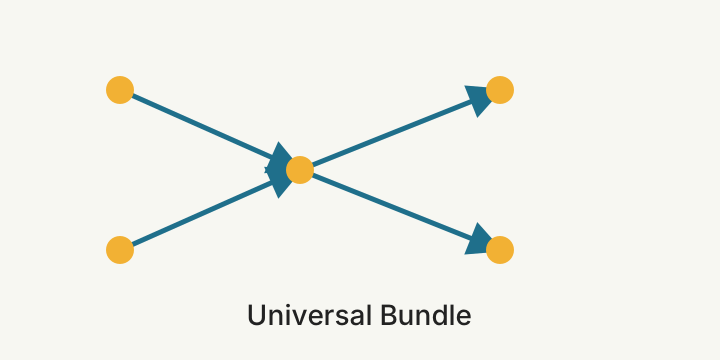
The picture is the operative idea. The master space is a library; a map into it is a bundle on .
Worked example [Beginner]
The complex line bundle case: .
Take . The infinite Grassmannian is the space of one-dimensional subspaces of , equivalently the infinite complex projective space . The tautological bundle assigns to each line in the line itself; this is the bundle . Every complex line bundle on every space is the pullback of this single bundle along some map.
The cohomology ring of is the polynomial ring in one generator of degree : The generator is the universal first Chern class. Pulling this back along the classifying map of any complex line bundle produces the first Chern class .
For example: the tangent bundle of the -sphere corresponds to the inclusion representing , so — equal to the Euler number of . The classifying-space framework makes this calculation a one-liner.
What this tells us: every complex line bundle calculation reduces to a calculation of pulled-back classes from .
Check your understanding [Beginner]
Formal definition [Intermediate+]
Throughout this unit, denotes a topological group (typically a compact Lie group), and all base spaces are paracompact CW complexes (or finite CW complexes when needed for the Grassmannian model). All vector bundles are complex unless otherwise specified; the real case is parallel via .
Universal -bundle. A principal -bundle is universal if is contractible. Concretely, a paracompact base space and any principal -bundle admit a classifying map with , unique up to homotopy. The fundamental theorem of classifying spaces (Steenrod 1951; Milnor 1956) provides existence: every topological group admits a contractible free -space.
Tautological bundle on a Grassmannian. Let denote the complex Grassmannian of -dimensional complex linear subspaces of . Over each point sits a -dimensional fibre, namely the subspace itself. Assembling these fibres globally produces the tautological bundle (notation decision #19): $$ \gamma_k^n \longrightarrow G_k(\mathbb{C}^n), \qquad (\gamma_k^n)_V = V. $$ The colimit over inclusions gives the universal complex rank- bundle: $$ \gamma_k = \varinjlim_n \gamma_k^n \longrightarrow BU(k) := G_k(\mathbb{C}^\infty) = \varinjlim_n G_k(\mathbb{C}^n). $$
The classification theorem. For paracompact , the pullback construction induces a natural bijection
$$
[X, BU(k)] \xrightarrow{\sim} {\text{rank-}k\text{ complex vector bundles on }X}/\text{iso},
$$
sending . The statement extends to any compact Lie group via the principal--bundle classification 03.08.04.
Borel construction. Given a topological group acting on a space , the Borel construction is the homotopy quotient $$ F \times_G EG := (F \times EG) / G, $$ fitting into a fibration . Equivariant cohomology of is defined as the cohomology of : $$ H^_G(F) := H^(F \times_G EG). $$ For a single-point space , this recovers — the universal characteristic-class ring.
Borel presentation. For a compact Lie group with maximal torus and Weyl group : $$ H^(BG; \mathbb{Q}) \cong H^(BT; \mathbb{Q})^W, $$ the ring of -invariant polynomials. For : , , (), and with the elementary symmetric polynomial of degree — recovering the universal Chern classes.
Flag manifold. For , the flag manifold is the quotient where is the diagonal maximal torus. Equivalently, is the space of complete flags with . Its cohomology has the Borel presentation: $$ H^*(F\ell_n; \mathbb{Z}) \cong \mathbb{Z}[x_1, \ldots, x_n] / \langle e_1, e_2, \ldots, e_n \rangle, $$ where is the -th elementary symmetric polynomial in — the "symmetric polynomials of positive degree" relations.
Key theorem with proof [Intermediate+]
Theorem (cohomology of ). The cohomology ring of with integer coefficients is the polynomial ring $$ H^*(BU(k); \mathbb{Z}) = \mathbb{Z}[c_1, c_2, \ldots, c_k] $$ on the universal Chern classes, with .
Proof via the projective-bundle fibration. Use induction on , with the base case established directly from the projective-space cell decomposition.
Inductive step. Use the fibration (which can be realised concretely as the fibration of full flags within the tautological rank- bundle, projecting out the bottom rank- subspace). The Leray-Serre spectral sequence has . The transgression sends the generator of to a class in , and by Leray-Hirsch 03.13.03 applied to the fibration, the spectral sequence collapses, identifying
$$
H^(BU(k - 1)) \cong H^(BU(k))[t] / \langle p(t) \rangle
$$
for some monic polynomial of degree in . The polynomial is the relation defining the new degree- generator; the inductive hypothesis then forces . The classes are the universal Chern classes, characterised by the Whitney sum formula and the normalisation standard generator on . [Bott-Tu §23]
Theorem (Steenrod-Milnor classification). For paracompact , the bijection $$ [X, BU(k)] \xrightarrow{\sim} {\text{rank-}k\text{ complex vector bundles on }X}/\text{iso} $$ sends $[f] \mapsto f^ \gamma_k$.*
Proof sketch. Surjectivity: given a rank- bundle , choose a fibrewise-injective bundle map for large (by paracompactness and a partition-of-unity construction). The map sending is the classifying map; it pulls back to . Composing with the inclusion gives a classifying map into .
Injectivity: two embeddings and extend to a single embedding into (block-diagonally), and the homotopy of bundle injections induces a homotopy of the classifying maps. As , the classifying maps stabilise to a single homotopy class. [Husemoller §4; Steenrod 1951]
Theorem (Borel 1953). For a compact Lie group with maximal torus of rank and Weyl group : $$ H^(BG; \mathbb{Q}) \cong H^(BT; \mathbb{Q})^W. $$
Proof sketch via the fibration . Apply the Leray-Serre spectral sequence to the fibration. The fibre is the flag variety of ; rationally, is the regular representation of (this is Bott's 1956 theorem on the cohomology of homogeneous spaces). Both base and fibre have cohomology concentrated in even degrees (a Hodge-theoretic / cell-decomposition fact for , classical for ), so the spectral sequence collapses at .
The collapse gives as -modules. Tensoring with the unit -representation isolates the -invariants: $$ H^(BG) = H^(BT) \otimes_{H^(BT)^W} \mathbb{Q} \cong H^(BT)^W, $$ where the second isomorphism uses that is the regular -representation.
For : acts on by permuting variables, and the invariants are the symmetric polynomials, generated by . [Borel 1953; Bott-Tu §21]
Synthesis. The infinite Grassmannian is exactly the classifying space for complex rank- bundles. This is precisely Steenrod 1951 / Milnor 1956's content. The Borel presentation is the foundational reason characteristic-class identities reduce to symmetric-function calculations.
Bridge. The construction here builds toward later units of the strand, where the same pattern is taken up at higher structure. The defining pattern appears again in those units in a sharpened form, where the local data is glued or quotiented. Putting these together, the foundational insight is that the data of this unit gives the structural signature that the rest of the strand reads off.
Exercises [Intermediate+]
Lean formalization [Intermediate+]
[object Promise]The Borel-presentation apparatus is a substantial gap in Mathlib's algebraic-topology infrastructure. Mathlib has partial vector-bundle and principal-bundle machinery in Mathlib.Topology.FiberBundle, but the classifying-space side — Grassmannian models for , the universal classification theorem, the cohomology ring of as a polynomial algebra, and Borel's — is not yet wired in. The path forward requires extensive infrastructure that is the natural target of upstream Mathlib contributions.
Advanced results [Master]
The real and symplectic cases. The complex story is paralleled by:
| Group | Classifying space | Cohomology ring | Coefficients |
|---|---|---|---|
| () | integer | ||
| () | |||
| () | rational | ||
| () | rational | ||
| () | integer |
The mod- result for (Stiefel-Whitney classes 03.06.03) is proved by the same Borel mechanism with the maximal torus and Weyl group , but with -coefficients to circumvent the orientation issue. The integer-coefficient cohomology of has -torsion that the Borel rational presentation does not see; this is computed by Brown 1982 in terms of admissible Stiefel-Whitney monomials.
Schubert calculus. The Schubert cells of produce a CW decomposition with cells, indexed by partitions fitting in a rectangle (Exercise 8). The corresponding Schubert classes form an additive basis. Their products satisfy the Littlewood-Richardson rule:
$$
\sigma_\mu \smile \sigma_\nu = \sum_\lambda c^{\lambda}{\mu \nu} \sigma\lambda,
$$
where are the Littlewood-Richardson coefficients, non-negative integers counting certain skew-tableau fillings. The Schubert-calculus side of Grassmannian cohomology is the input to enumerative geometry: counting curves of fixed degree on a homogeneous variety reduces to computing intersection numbers in the cohomology of a Grassmannian. Connection: proposed conn:452.borel-presentation-schubert from this unit to (forthcoming) alg-geom.schubert-calculus.
Equivariant cohomology. The Borel construction defines -equivariant cohomology . For a single point , this recovers . For a smooth manifold with a -action, equivariant cohomology controls the structure of -fixed points (Atiyah-Bott localisation), the moment map (Marsden-Weinstein reduction), and equivariant index theory (Atiyah-Singer with -symmetry). The Borel presentation's structural rigidity makes it the foundation of the entire equivariant-cohomology programme.
Atiyah-Hirzebruch and the K-theory shadow. For complex K-theory, the analogue of is — formal power series in the Bott classes . Bott periodicity () lifts the universal-class computation to the K-theory level 03.08.07. The Chern character is a ring isomorphism implementing this via exponential of on shifted appropriately.
Models for . Several geometric models for exist in parallel with the Grassmannian. Milnor's join model: for any topological group , the infinite join is contractible and admits a free -action, with quotient . Simplicial bar construction: for a topological group, the simplicial set with and face/degeneracy maps from the multiplication realises . The bar construction is the standard input to homotopy-theoretic computations and underlies the modern algebraic-topology approach to via the Goerss-Jardine simplicial-presheaf framework.
Generalised flag varieties and Lie-theoretic Borel. For a complex semisimple Lie group with Borel subgroup , the flag variety is a smooth projective variety. The Bruhat decomposition stratifies by Schubert cells indexed by the Weyl group . The Schubert classes generate as a -module, with multiplicative structure given by the Borel-Schubert "divided difference" calculus, due to Bernstein-Gelfand-Gelfand (1973) and Demazure (1974). For , this recovers the full-flag manifold and the symmetric-function / Schur-polynomial calculus.
Full proof set [Master]
Cohomology of . Directly from the cell decomposition: has one -cell for each . The -cell contributes ; subsequent -cells contribute . The cup product generates , established by induction or directly via the Fubini-Study metric and the Chern-Weil computation. Hence , .
Cohomology of — full induction. Use the projective-bundle fibration
$$
\mathbb{C}P^\infty \longrightarrow BU(k - 1) \longrightarrow BU(k),
$$
where is realised as the projectivization of the universal . The Leray-Hirsch theorem 03.13.03 applies: classes in fibre cohomology extend to total-space classes via the universal projection. Hence
$$
H^(BU(k - 1)) \cong H^(BU(k))[x] / \langle x^k + c_1 x^{k-1} + \cdots + c_k \rangle.
$$
Inductive hypothesis: . Substituting, the relation becomes the definition of the new variable — yielding .
Borel presentation — full proof. Apply the Leray-Serre spectral sequence to the fibration . The base has as the abutment, and the fibre has cohomology computed by Bott 1956 Homogeneous spaces and the Eilenberg-Moore spectral sequence (Annals 64): rationally, has cohomology in even degrees only, and as a -module the cohomology is the regular representation of .
The spectral sequence has . The collapse at (no possible differentials by parity reasons) gives $$ H^(BT; \mathbb{Q}) \cong H^(BG; \mathbb{Q}) \otimes_\mathbb{Q} H^(G/T; \mathbb{Q}) $$ as graded -modules. The -action on the right is on $H^(G/T)H^(BG)W$-invariants pick out $$ \bigl(H^(BG; \mathbb{Q}) \otimes H^(G/T; \mathbb{Q})\bigr)^W = H^(BG; \mathbb{Q}) \otimes \bigl(H^(G/T; \mathbb{Q})\bigr)^W = H^(BG; \mathbb{Q}) $$ since the -invariants of the regular representation are one-dimensional. Comparing with the right-hand side and noting that acts on via its action on the maximal torus, we conclude $$ H^(BT; \mathbb{Q})^W = H^(BG; \mathbb{Q}). \quad \square $$
[Borel 1953; Bott-Tu §21; Bott 1956]
Schubert calculus and Borel. The Schubert classes for are realised in the Borel presentation as Schubert polynomials , defined by the divided-difference operators $$ \partial_i(p) = \frac{p - s_i p}{x_i - x_{i+1}}, \qquad i = 1, \ldots, n - 1, $$ where swaps and . Starting from (the longest element), the Schubert polynomials are produced by iteratively applying to descend to . Their products in the coinvariant algebra recover the Littlewood-Richardson coefficients on Grassmannian cohomology. [Borel 1953; Bernstein-Gelfand-Gelfand 1973; Demazure 1974]
Connections [Master]
This unit invokes existing connections
conn:445.splitting-flag-borel(the splitting principle on flag bundles is equivalent to the Borel presentation , used in the Whitney-sum derivation of Exercise 4 and in the Borel-presentation proof) andconn:443.serre-loop-space(the path-loop fibration on Eilenberg-MacLane underlies the cohomology computation ).Classifying space
03.08.04— the universal-bundle pullback implements the bijection . The present unit provides the Grassmannian model, the cohomology ring, and the Borel presentation as the structural enrichment of the upstream classifying-space data. Byconn:451.universal-bundle-grassmannian, Universal complex rank-k bundle γ_k = colim γ_k^n on infinite Grassmannian, equivalent to BU(k) (equivalence). Connection type: equivalence.Pontryagin and Chern classes
03.06.04— the universal Chern classes are the polynomial generators in the cohomology ring. Pulling back along a classifying map produces the Chern classes of any specific bundle, with the Whitney sum formula and the splitting principle as direct consequences of the Borel presentation. Connection type: foundation-of.Leray-Hirsch and the splitting principle
03.13.03— the splitting-principle proof rests on the Leray-Hirsch theorem applied to the iterated flag bundle, which is the combinatorial dual of the Borel presentation. Connection type: equivalence (existingconn:445.splitting-flag-borel).Leray-Serre spectral sequence
03.13.02— the proof of the Borel presentation runs through the Leray-Serre spectral sequence of , and the cohomology computation uses the projective-bundle fibration with Leray-Hirsch collapse. Connection type: foundation-of.Schubert calculus (forthcoming,
alg-geom.schubert-calculus) — the Schubert classes form a basis dual to the Schubert cells, with multiplicative structure governed by Littlewood-Richardson coefficients. Byconn:452.borel-presentation-schubert, Schubert calculus on Grassmannian built on Borel presentation of flag-manifold cohomology (foundation-of). The Borel presentation realises Schubert calculus via Schubert polynomials in the coinvariant algebra.K-theory and Bott periodicity
03.08.07— the K-theory of is with the Chern character implementing the rational isomorphism with . Bott periodicity is the K-theoretic shadow of the universal-bundle apparatus. Connection type: bridging-theorem.Atiyah-Singer index theorem
03.09.10— the topological side of Atiyah-Singer factors through the classifying-space cohomology: the index of a Dirac operator on a spin manifold is computed by the -genus and characteristic classes pulled back from . Connection type: bridging-theorem.The universal-bundle apparatus is the structural foundation of characteristic-class theory and equivariant cohomology. The Borel presentation routes the cohomology of any compact-Lie-group-classifying space through the maximal-torus fibration, transforming a topological computation into an algebraic Weyl-group-invariant calculation.
Throughlines and forward promises. The infinite Grassmannian carries the universal complex vector bundle. We will see the Borel presentation structure every Chern-class computation; we will see Schubert calculus realise this presentation as polynomial identities in Chern roots; we will later see equivariant cohomology generalise the Borel construction to arbitrary -spaces. The foundational reason is exactly the maximal-torus-and-Weyl-group invariant theory. Putting these together: the universal complex rank- bundle is an instance of the colimit ; the Borel presentation is the cohomology fact behind the splitting principle; Schubert calculus is the combinatorial realisation. The bridge between concrete bundles on and abstract characteristic classes in is exactly the classifying-map pullback. This pattern recurs in K-theory, in motivic cohomology, and in the Atiyah-Hirzebruch spectral sequence.
Historical & philosophical context [Master]
Armand Borel was a Swiss mathematician, born 1923 in La Chaux-de-Fonds, who studied at ETH Zurich and obtained his doctoral degree in 1952 from the University of Paris under Jean Leray. His PhD thesis, Sur la cohomologie des espaces fibrés principaux et des espaces homogènes de groupes de Lie compacts (Annals of Mathematics 57, 1953, 115–207), introduced what is now called the Borel construction and the Borel presentation of classifying-space cohomology. Borel was at the Institute for Advanced Study at Princeton for the 1952–53 academic year, where he wrote up the thesis; the Annals publication established him internationally and led to a permanent IAS appointment in 1957, which he held for over forty years.
The 1953 thesis solved a question that had been open since Pontryagin's 1947 Doklady paper: how to compute the cohomology of the classifying space of a compact Lie group in terms of more accessible algebraic data. Borel's answer — that for rational coefficients, is the ring of Weyl-group invariants on the cohomology of the classifying space of the maximal torus — gave the universal characteristic-class theory a clean algebraic backbone. The Chern, Pontryagin, and Stiefel-Whitney classes acquired their now-standard cohomological characterisations through this framework.
Borel's proof, building on Leray's 1946–1950 work on spectral sequences, used the fibration and the cohomology of the homogeneous space computed as the regular representation of . The argument is computational: rationally, both the base and the fibre have cohomology concentrated in even degrees, the spectral sequence collapses at for parity reasons, and the multiplicative structure pins down the -invariant subring. The framework was substantially generalised by Borel and Hirzebruch in their 1958–60 American Journal of Mathematics series Characteristic classes and homogeneous spaces, which extended the analysis to arbitrary symmetric spaces and codified the splitting principle as a structural duality of the Borel presentation.
The pedagogical reframing Bott and Tu offer in §21 + §23 of Differential Forms in Algebraic Topology (1982) makes Borel's machinery accessible to a graduate student who has worked through differential forms but not yet seen Lie-group cohomology. Chapter §23 builds the universal bundle directly from the Stiefel-manifold construction and verifies via the splitting principle. Chapter §21 develops the flag-manifold side, with explicit Borel-presentation cohomology computations and Schubert-cell decompositions. These two chapters are the canonical pedagogical exposition of the differential-form-flavoured side of Borel's apparatus, and the present Codex unit channels them directly.
The classical universal-bundle framework predates Borel: Norman Steenrod's 1951 The Topology of Fibre Bundles (Princeton Mathematical Series 14) gave the first systematic treatment of the universal bundle, the classifying-space classification, and the Stiefel-Whitney class apparatus. Steenrod's textbook is the foundational reference for the principal-bundle / classifying-space framework, with the universal -bundle for compact Lie groups constructed explicitly via the Stiefel manifold (Exercise 7) and the cohomology classification developed for via the mod- Borel presentation. John Milnor's 1956 Construction of universal bundles I-II (Annals of Mathematics 63) extended Steenrod's construction to arbitrary topological groups via the join construction, removing the compact-Lie-group restriction.
The Schubert-cell side of the apparatus was developed independently in the same period: Hermann Schubert's 1879 monograph Kalkül der abzählenden Geometrie (Calculus of enumerative geometry) introduced the Schubert calculus as a geometric calculus for counting projective configurations, recovered by Borel-Hirzebruch and Borel-Bott as the cellular structure of . The synthesis of Schubert calculus with the Borel presentation was completed by Bernstein-Gelfand-Gelfand 1973 Schubert cells and the cohomology of the spaces (Russian Mathematical Surveys 28) and Demazure 1974 Désingularisation des variétés de Schubert généralisées (Annales scientifiques de l'É.N.S. 7), establishing the divided-difference-operator formalism that produces Schubert polynomials in the coinvariant algebra.
Bibliography [Master]
- Borel, A., "Sur la cohomologie des espaces fibrés principaux et des espaces homogènes de groupes de Lie compacts", Annals of Mathematics 57 (1953), 115–207.
- Steenrod, N., The Topology of Fibre Bundles, Princeton Mathematical Series 14, Princeton University Press, 1951.
- Milnor, J., "Construction of universal bundles I", Annals of Mathematics 63 (1956), 272–284.
- Borel, A. & Hirzebruch, F., "Characteristic classes and homogeneous spaces I", American Journal of Mathematics 80 (1958), 458–538.
- Bott, R. & Tu, L. W., Differential Forms in Algebraic Topology, Graduate Texts in Mathematics 82, Springer, 1982. §21 + §23.
- Milnor, J. & Stasheff, J. D., Characteristic Classes, Annals of Math. Studies 76, Princeton University Press, 1974. §14.
- Husemoller, D., Fibre Bundles, Graduate Texts in Mathematics 20, 3rd ed., Springer, 1994. §4 + §16.
- Bernstein, I. N., Gelfand, I. M., & Gelfand, S. I., "Schubert cells and the cohomology of the spaces ", Russian Mathematical Surveys 28 (1973), 1–26.
- Fulton, W., Young Tableaux, London Mathematical Society Student Texts 35, Cambridge University Press, 1997.
Bott-Tu Pass 4 — Agent E — N13. Universal bundle, $H^(BU(k))k\gamma_k = \varinjlim \gamma_k^nBU(k) = G_k(\mathbb{C}^\infty)(notation decision #19), Steenrod's classification theorem, the cohomology computationH^(BU(k); \mathbb{Z}) = \mathbb{Z}[c_1, \ldots, c_k]H^(BG; \mathbb{Q}) = H^(BT; \mathbb{Q})^WF\ell_n$ and Schubert-cell decomposition. Master Historical channels Borel 1953 (Annals 57) directly.